Share It On:
 Unlock high-tier innovation and streamline your growth with AIaaS—the scalable, cost-effective solution for modern entrepreneurs and tech-forward global companies.
Between the eye-watering costs of specialized hardware and the "good luck finding them" hunt for data scientists, it’s a steep hill to climb. This is where AIaaS, or Artificial Intelligence as a Service, enters the chat.
Essentially, artificial intelligence as a service is a cloud-based delivery model that lets companies plug into powerful AI capabilities without having to build the engine themselves. Think of it like a streaming service for tech—you pay a subscription or a "pay-as-you-go" fee to access cutting-edge tools via the cloud. It’s all about democratizing artificial intelligence services, making it possible for a scrappy startup to play in the same league as the tech giants.
What is AIaaS?
Building a custom AI from scratch is a massive flex, but it’s also a total headache for most businesses. Between the eye-watering costs of specialized hardware and the "good luck finding them" hunt for data scientists, it’s a steep hill to climb. This is where AIaaS, or Artificial Intelligence as a Service, enters the chat.
Essentially, artificial intelligence as a service is a cloud-based delivery model that lets companies plug into powerful AI capabilities without having to build the engine themselves. Think of it like a streaming service for tech—you pay a subscription or a "pay-as-you-go" fee to access cutting-edge tools via the cloud. It’s all about democratizing artificial intelligence services, making it possible for a scrappy startup to play in the same league as the tech giants.
How AIaaS Works?
The magic behind AI as a service happens behind the scenes in massive data centers. Providers host the infrastructure, manage the complex algorithms, and handle the heavy lifting of processing data.
For the users, the process is pretty straightforward. Users typically connect your existing software to the artificial intelligence services and solutions via APIs (Application Programming Interfaces).
The next step is to send data through the API, the service processes it using pre-trained models, and it shoots the results back to you in seconds. It’s a seamless integration that bypasses the "build vs. buy" dilemma by offering a ready-to-use AI service that scales with escalating needs.
Different Types of AIaaS
When we talk about the types of AI available in the cloud, it isn't a "one-size-fits-all" situation. Depending on your tech stack, you might need a simple API or a full-blown development environment.
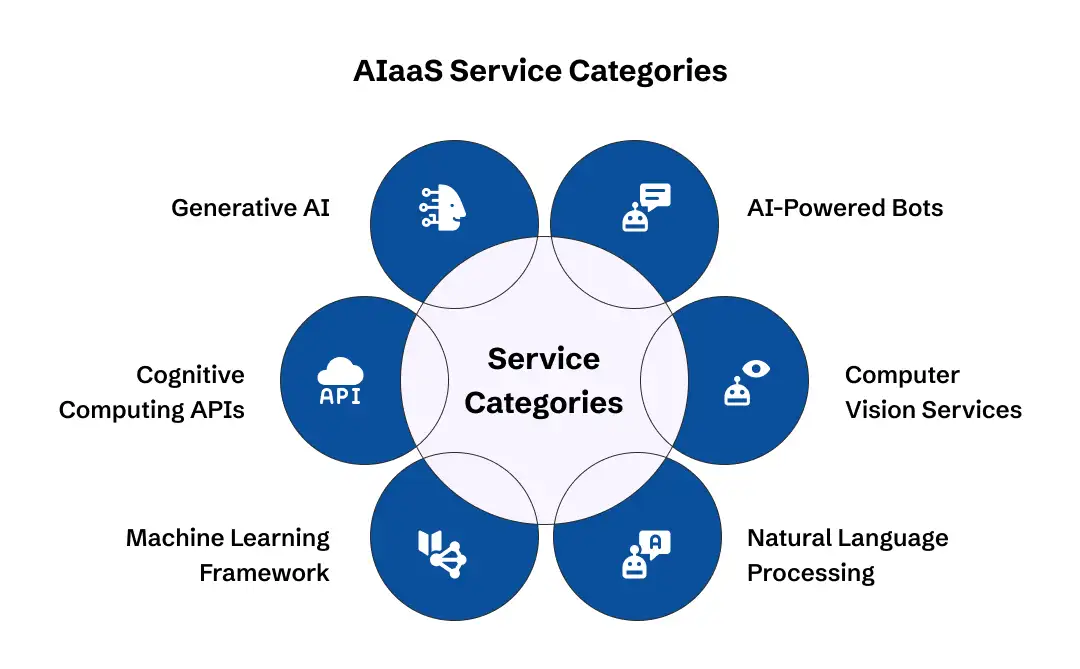
1. Machine Learning Frameworks (MLaaS)
Machine learning is the undisputed heavyweight of the market, holding a dominant 40.7% revenue share in 2024 according to Grand View Research. This model provides the "raw materials"—the algorithms and processing power—needed to build and train custom models. It’s perfect for companies that have some data science talent but don't want to spend millions on local servers to run complex computations.
2. Natural Language Processing (NLP)
NLP is what makes computers "get" us. These artificial intelligence services power everything from sentiment analysis to real-time translation. With the market for AI assistants projected to hit $73.80 billion by 2033, the demand for NLP is skyrocketing. Businesses use it to scan through thousands of customer emails or reviews to find out if people are actually feeling the vibe or if there's a PR crisis brewing.
3. Computer Vision Services
This tech allows machines to "see" and interpret visual data from the world. It’s a game-changer for security and quality control. In 2024, computer vision became a cornerstone for AI as a service companies offering automated image diagnosis and factory floor monitoring. It helps brands identify defects on a production line or recognize loyal customers in a retail store, all without a human having to blink once.
4. AI-Powered Bots and Virtual Assistants
If you’ve chatted with a support bot recently, you’ve used this. Modern bots are moving beyond basic "if/then" logic into full conversational AI. Fortune Business Insights notes that these assistants have boosted customer support efficiency by roughly 30% for major financial institutions. They are the frontline of artificial intelligence in IT services, handling millions of queries 24/7 without needing a coffee break or a vacation.
5. Generative AI as a Service (Gen-AIaaS)
Gen-AI is the new kid on the block that’s already running the show. Over 70% of enterprises have already deployed generative AI in at least one function by 2025. This type of AI as service allows you to generate text, code, or images on the fly. It’s lowkey revolutionizing how marketing and dev teams work, letting them create content or debug code in seconds rather than hours.
6. Cognitive Computing APIs
Think of these as "Lego bricks" for your software. Instead of building a brain, you just plug in an API for a specific task, like speech-to-text or face recognition. These are the most accessible artificial intelligence services and solutions because they require almost zero machine learning knowledge. You just call the API, and the service does the rest, making it a staple for rapid AI in app development.
Key Benefits of AIaaS
The reason artificial intelligence as a service is blowing up is that it solves the "it’s too expensive" problem overnight. Here is why businesses are obsessed with it right now.
1. Massive Productivity Gains
64% of businesses firmly believe that AI will enhance their overall productivity, according to ResearchAndMarkets. By offloading routine tasks like data entry or basic customer queries to an AI service, your human team can focus on the creative, high-level strategy that actually moves the needle. It’s about working smarter, not harder, and letting the machines handle the "boring" stuff.
2. Drastic Cost Reduction
Building an in-house AI team is a budget killer. Between hiring six-figure engineers and buying expensive GPUs, the costs are insane. AIaaS flips the script by offering a pay-as-you-go model. You only pay for the "compute" you actually use. This "democratization" means that even a small startup can access the same artificial intelligence services that used to be reserved for the Fortune 500.
3. Rapid Scalability and Flexibility
In the business world, things change fast. If your app suddenly goes viral, you need your AI to keep up. Because these are cloud-based artificial intelligence services and solutions, they can scale from ten users to ten million in the blink of an eye. You aren't locked into a physical server that might crash under pressure; the cloud expands and contracts based on your real-time traffic.
4. Faster Speed to Market
In the tech race, being first matters. Using pre-built artificial intelligence development services means you don't have to spend two years in R&D. You can integrate a feature—like a recommendation engine or a voice search—into your app in a matter of days. This agility is a total lifesaver for companies trying to keep their SDLC tight and their product releases frequent.
5. Enhanced Data-Driven Decision Making
Predictive analytics is one of the most powerful AI use cases. AIaaS allows you to crunch "Big Data" that would overwhelm any human. By leveraging artificial intelligence in it services, you can spot trends, forecast sales, and identify market shifts before your competitors even know they’re happening. It turns your "gut feeling" into a data-backed strategy that actually delivers ROI.
6. Accessibility to Top-Tier Innovation
The Future of AI is moving so fast that keeping up is a full-time job. When you use an artificial intelligence platform as a service, the provider handles the upgrades. You automatically get access to the latest, most advanced models without having to re-code your entire system. It’s like having a "forever-upgraded" brain for your business that keeps getting smarter while you sleep.

Challenges when implementing AIaaS
It’s not all sunshine and rainbows. There are some hurdles you need to watch out for if you don't want your implementation to go south.
1. Data Privacy and Security Risks
This is the big one. Roughly 40% of business leaders cite privacy and confidentiality as their top concern when adopting AI, according to IBM. When you use AI as a service, you’re essentially sending your "crown jewels"—your data—to a third party. If you’re in a regulated field like healthcare, one data breach could be "game over," so you have to be incredibly picky about security protocols.
2. High Integration Complexity
Just because it's a "service" doesn't mean it’s "plug-and-play" in five minutes. Integrating AI into your existing SDLC and legacy systems can be a massive headache. You might find that your old databases don't "speak the same language" as the new artificial intelligence platform as a service. If the integration is clunky, it can slow down your entire workflow rather than speeding it up.
3. Data Quality and Bias
AI is a "garbage in, garbage out" system. IBM reports that 45% of organizations worry about data accuracy and bias. If your historical data is messy or biased, the AI will make bad decisions. For example, a biased hiring AI could accidentally filter out great candidates. Ensuring your data is "clean" and representative is a full-time job in itself before you even turn the AI on.
4. Hidden Costs and Budget Creep
The "pay-as-you-go" model is great until it isn't. If you don't monitor your usage, those API calls can add up fast. Some businesses have been hit with "sticker shock" after their AI usage spiked unexpectedly. Managing the cost of artificial intelligence development services requires a dedicated eye on the dashboard to ensure you aren't burning cash on unnecessary computations.
5. Talent and Skill Gaps
Even though you aren't building the AI, you still need people who know how to use it. About 42% of companies say they lack the internal expertise to truly leverage generative AI. You need a team that understands how to prompt the models, interpret the results, and maintain the connection. Without this "human-in-the-loop," your AI service is just a fancy, expensive toy.
6. Vendor Lock-In
When you build your entire workflow around one specific provider's types of AI, it’s lowkey hard to leave. If that provider raises prices or changes their terms, you might find yourself stuck. Porting your data and models to another platform is a massive technical lift. Savvy entrepreneurs always have a "Plan B" to ensure they aren't totally at the mercy of one tech giant.
How AIaaS is Being Deployed Across Different Industries
The Future of AI isn’t some far-off dream—it’s literally happening in your pocket and on your screen right now.
1. BFSI (Banking, Finance, and Insurance)
The BFSI sector is the MVP here, leading the market with a 20.4% share as of 2024. Banks are using artificial intelligence services and solutions for everything from fraud detection to credit scoring. By analyzing transaction patterns in real-time, AI can flag a suspicious purchase in London while you’re asleep in New York, saving billions in potential losses every year.
2. Healthcare and Life Sciences
Healthcare is currently the fastest-growing vertical for AIaaS, with a projected CAGR of 34.3% through 2033 (SNS Insider). From drug discovery to AI-driven diagnostics, the impact is life-saving. Doctors are using computer vision to spot tumors on scans that are too small for the human eye, making "personalized medicine" a reality rather than a buzzword.
3. Retail and E-commerce
Retailers are using AI services to kill the "abandoned cart" problem. By using recommendation engines, they can show you exactly what you want before you even know you want it. AIaaS also helps with inventory management—predicting that you'll need more parkas in October so the shelves aren't empty when the first snow hits. It’s all about creating that "seamless" shopping vibe.
4. Manufacturing and Industry 4.0
In the factory world, downtime is the enemy. By deploying AI as a service, manufacturers use predictive maintenance to fix machines before they break. Fortune Business Insights mentions that AIaaS-enabled platforms have reduced downtime by 15-20% for major industrial clients. It’s like having a mechanic that can "hear" a bolt loosening from three miles away through data sensors.
5. IT and Telecommunications
The IT sector uses artificial intelligence in IT services to keep the internet running smoothly. Telecom companies use AI to predict network congestion and reroute traffic automatically. It’s also a huge help for "service-desk management," where AI agents handle the routine "I forgot my password" tickets, leaving the human IT pros to deal with the actual server fires.
6. Marketing and Content Creation
Marketing has been flipped on its head by Gen-AI. Agencies are using artificial intelligence development services to create thousands of personalized ad variations in minutes. Instead of one generic billboard, brands can now serve a specific ad to a specific person based on their browsing history. It’s high-precision marketing that delivers a way better ROI than the old "spray and pray" method.
Best Practices for Adopting AIaaS
If you want to avoid being part of the "we tried AI, and it failed" statistics, you need a solid game plan. Here’s how to do it right.
1. Define Clear ROI-Driven Goals
Don't just use AI because it’s "trendy." Identify a specific pain point—like long wait times in customer service—and set a measurable KPI. Whether it's reducing costs by 10% or increasing lead conversion by 5%, having a clear target ensures you aren't just throwing money into the "AI void." Focus on the AI use cases that actually impact your bottom line.
2. Prioritize Data Governance
Your AI is only as smart as the data you give it. Before signing up for artificial intelligence services, do a deep dive into your own data health. Is it clean? Is it organized? Is it compliant? As the experts at Matillion say, "you can't automate insight from chaos." Fix your data pipeline first, or you'll just be automating your mistakes.
3. Start with a Focused Pilot
Don't try to "boil the ocean" on day one. Pick a small, high-impact project to test the waters. A pilot program allows you to see how the AI service integrates with your team without risking the whole business. If the pilot fails, you've learned a cheap lesson. If it wins, you have the "social proof" needed to get the rest of the company on board.
4. Build a Hybrid Talent Strategy
You don't need a team of 50 AI scientists, but you do need "AI-literate" employees. Invest in upskilling your current team so they know how to work alongside these new tools. A mix of in-house knowledge and external AI development companies is usually the sweet spot. It ensures you have the vision internally while the experts handle the technical heavy lifting.
5. Ensure Ethical and Transparent Use
With the EU AI Act and other regulations hitting the scene, "Black Box" AI is a liability. Make sure your artificial intelligence platform as a service offers "Explainable AI." You need to know why the AI made a certain decision, especially in finance or HR. Transparency builds trust with your customers and keeps the regulators off your back.
6. Monitor Performance and Costs Regularly
AI isn't a "set it and forget it" tool. You need to watch for "model drift," where the AI starts getting less accurate over time as the world changes. Also, keep a hawk-eye on your billing dashboard. Set up alerts so you don't get a surprise $50,000 bill because a developer left an experimental script running over the weekend.
Step‑by‑Step Guide to Implementing AIaaS
Ready to level up? Here is a roadmap to get your artificial intelligence as a service journey started without the drama.
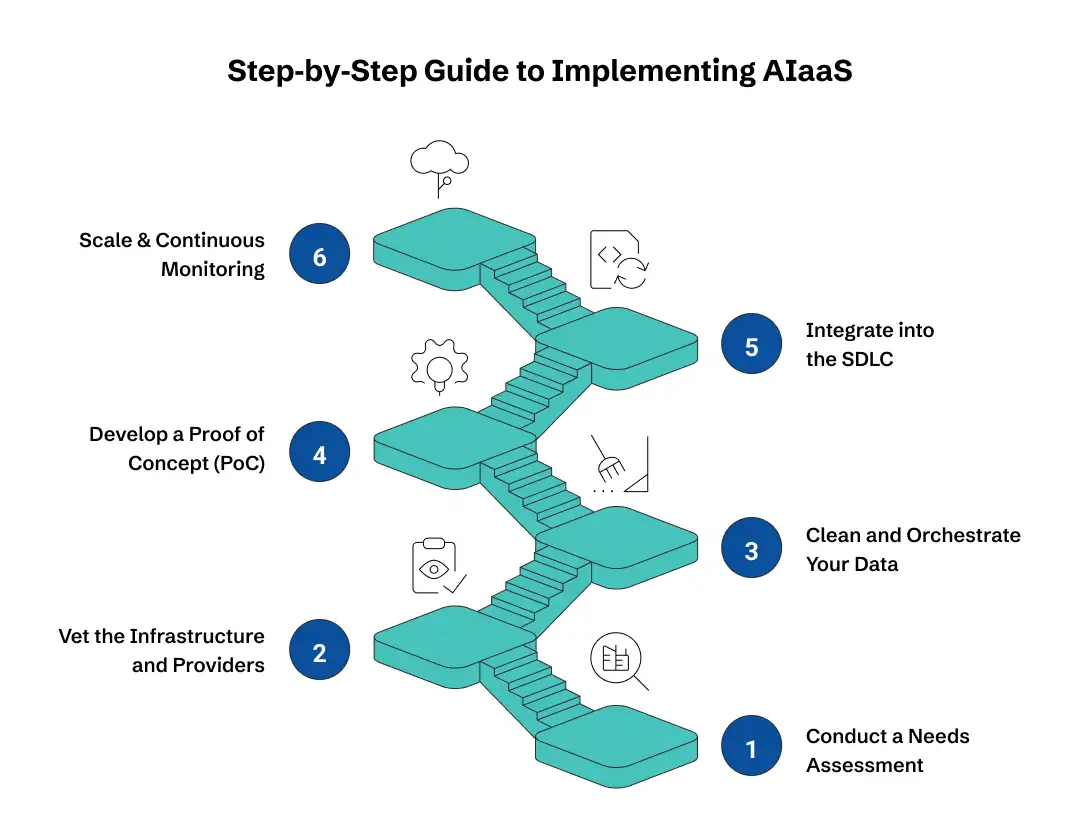
Step 1: Conduct a Needs Assessment
Start by auditing your current business processes. Where is the friction? Is your support team overwhelmed? Are your sales forecasts always wrong? Identify the "high-impact" problems where an AI service could provide the quickest win. Don't look for the "coolest" tech; look for the most useful one for your specific niche.
Step 2: Vet the Infrastructure and Providers
Not all AI as a service companies are created equal. Compare their security certifications, their uptime records, and how easily they integrate with your current software. Look for a provider that matches your scale—if you're a startup, you don't need an enterprise-only contract. Check if they support the specific types of AI you actually need for your project.
Step 3: Clean and Orchestrate Your Data
This is the "unsexy" but essential part. You need to unify your data from different sources (like your CRM and your website) and put it into a format the AI can digest. Use data integration tools to build a reliable pipeline. Remember, a well-structured dataset is the foundation of any successful artificial intelligence development services implementation.
Step 4: Develop a Proof of Concept (PoC)
Run your AI in a "sandbox" environment first. Feed it real data and see if the outputs are actually accurate. This is where you'll find the bugs and the biases. Use this stage to refine your prompts and adjust your settings. A successful PoC gives you the confidence—and the data—to justify a full-scale rollout to your stakeholders.
Step 5: Integrate into the SDLC
Now it’s time to get the devs involved. Connect the AI APIs to your application and ensure the data flows smoothly. This stage of AI in app development requires rigorous testing to make sure the AI doesn't slow down your user experience. Ensure you have "fallback logic" in case the service goes down, so your app doesn't just break.
Step 6: Scale and Continuous Monitoring
Once the AI is live, the work isn't over. Set up a dashboard to track its performance against your original KPIs. Train your staff on how to use the new features and gather feedback. As you see success, you can start scaling the AI to other departments. The Future of AI in your company should be an iterative process, not a one-time event.
Cost of Implementing AIaaS
The cost of artificial intelligence as a service varies wildly based on complexity, but for 2026, we can break it down into three main tiers.
Initial Implementation Estimates (The "Build" Phase)
Even though you're using a service, you still have to pay for the integration, data cleaning, and setup.
| Complexity Level | Average Cost (USD) | Timeline | Best For... |
|---|---|---|---|
| Basic (MVP) | $40,000 – $75,000 | 2–4 Months | Simple chatbots, basic data filters. |
| Mid-Level | $80,000 – $200,000 | 4–8 Months | Predictive analytics, recommendation engines. |
| Enterprise | $250,000 – $500,000+ | 8–12+ Months | Multimodal AI, global-scale automation. |
The "Token Tax": Monthly Recurring Costs
Once you're live, your costs switch to a subscription or usage-based model. These are the "OpEx" numbers you'll see on your monthly bill.
- API Usage: Usually priced per "1,000 tokens" (roughly 750 words). Top-tier models cost between $0.01 and $0.15 per 1,000 tokens.
- Monthly Subscriptions: Basic enterprise tiers often start at $3,000 – $5,000/month for a set amount of usage.
- Maintenance: Expect to spend 15% – 20% of your initial build cost annually on "keeping it smart" (updates and retraining).
The Hidden Budget Killers
Don't let these "quiet" expenses catch you off guard:
| Expense Category | Estimated Impact / Cost | Description |
|---|---|---|
| Data Preparation | 25% – 40% of total budget | Cleaning and labeling "messy" data is lowkey the most expensive part—often costing more than the AI itself. |
| System Integration | $10,000 – $50,000 | Getting the AI to vibe with your legacy CRM or ERP systems takes serious dev hours and architectural heavy lifting. |
| Talent Upskilling | +10% of implementation budget | You can't just "set it and forget it." Your team needs training to effectively use ai as service tools without breaking things. |
Frequently Asked Questions
What is the primary advantage of choosing alaas over in-house development?
The biggest perk of AIaaS is the massive reduction in upfront capital expenditure. You skip the million-dollar hardware costs and the "talent war" for AI researchers. Instead, you get to experiment with artificial intelligence services for a fraction of the cost, making innovation "pay-as-you-go."
How can a business ensure data security when using ai as a service?
To keep your data on "lockdown," you must vet AI as a service companies for strict encryption and compliance standards like SOC2 or GDPR. Always use "data masking" where possible and ensure your service level agreement (SLA) clearly defines who owns the data.
Is AI in app development only for tech-heavy companies?
Not at all. With low-code and no-code artificial intelligence platform as a service options, even non-tech founders can integrate AI. It’s becoming a standard part of the SDLC, allowing any business to add features like smart search or automated support without writing a single line of neural-network code.
How do artificial intelligence development services handle industry-specific needs?
Modern AI as service providers are moving toward "domain-specific" models. Whether you're in healthcare or finance, you can find types of AI pre-trained on industry data. This ensures the AI understands your specific "jargon" and regulatory requirements right out of the box.
Why is data quality so critical for an effective ai service?
Because AI is essentially a "pattern recognition" engine. If you feed it "messy" or inaccurate data, the artificial intelligence services and solutions will produce flawed results. High-quality, clean data is the "fuel" that makes the AI run smoothly and provides the ROI you’re looking for.

Uncover executable insights, extensive research, and expert opinions in one place.
Related Content