Share It On:
 What if flawless code could be easily achieved by just writing the right prompt, without the endless debugging? That’s the future of AI in software development!
With startups launching MVPs at lightning speed and enterprise giants optimizing million-dollar codebases with machine precision, AI is rewriting the rules of the software development game. As a result, AI development tool software has gained a lot of traction, and its market is projected to reach $9.76 billion in 2026, according to a report shared by Statista.
For instance, tools like GitHub Copilot are generating billions of lines of code monthly, and AI-powered frameworks like SonarQube are catching critical vulnerabilities before they reach production—the transition is astounding.
In April 2026, Microsoft’s CTO, Kevin Scott, shared his prediction about the future of coding, confirming that 95% of code will be generated by AI in the coming five years.
Given these seismic changes, it’s time to ask: how will AI in software development redefine the way future developers build, teams collaborate, and leaders drive innovation?
Ariel Katz, the CEO of Sisense, weighed in on this during his interview with Forbes. He said, “It's not just about automating tasks; it's about enabling developers to think and work at a much higher level and focus on the strategic aspects of their projects.”
As we stand at this technological inflection point, understanding AI's role in software development isn't about following trends; it's about positioning yourself for the future of coding itself.
Let’s explore what lies ahead for your business as we decode the role of AI in the software development workflow.
The Evolution of AI in Software Development
Over a period of time, artificial intelligence has transformed in many unimaginable ways. Initially, the technology was treated only as a tool for basic automation, but now, it is more than that.
AI has now become an integral part of the development process, helping developers write code faster, detect bugs, and more. Research has also revealed that AI coding assistants boost the developers’ productivity by 26%.
That being said, AI’s collaborative role with developers will shape a new era of software creation. The recent trends emphasize AI as a technology that augments human capabilities by letting them focus on creative problem-solving and strategic thinking.
Seeing the increasing demand for such advanced technology, many AI development companies have started to create specialized solutions to meet the expectations.
Benefits of AI in Software Development
What if you could speed up your software development process, cut costs, or innovate faster, and all of this while boosting your team’s efficiency & productivity?
This is not just a hypothesis anymore, but a strategic reality that most of the CEOs and CTOs are embracing. The power of AI in software development lies in the ability to embed intelligence throughout the development lifecycle.
Let’s explore how artificial intelligence in software development can be the catalyst for efficiency, cost reduction, and future-proofing your overall process.
| Benefits | Impact |
|---|---|
| Faster Development Cycles | Faster development lifecycle by automating coding, testing, and deployment |
| Improved Code Quality | Identifying bugs, code errors, and vulnerabilities before the final output |
| Reduced Manual Work | Automates repetitive tasks like code generation, documentation, and testing |
| Predictive Project Management | Forecasts delays, estimates resources, and manages risks using past data |
| Continuous Learning & Adaptation | Models learn from usage patterns and evolve to make smarter suggestions over time |
| Enhanced Collaboration | Teams stay aligned by summarizing code changes, comments, and updates |
| Lower Development Costs | Reduced time and effort lead to significant cost savings in long-term projects |
| Improved Developer Productivity | Automates repetitive tasks, allowing developers to focus on core tasks |
Top AI Use Cases in Software Development
Industry leaders are actively integrating artificial intelligence into their workflows to make things easier and faster. Let’s have a look at some of the interesting AI use cases in software development:
1. Code Generation and Autocompletion
Top giants like Microsoft have begun to leverage tools like GitHub Copilot and Amazon CodeWhisperer to get accurate predictions & suggestions. As per the research conducted by GitHub, AI programmer helps developers code up to 55% faster, and 85% of developers feel more confident in their code quality.
The study shows that by automating repetitive tasks, AI results in faster development cycles, causes fewer manual errors, and boosts the team’s productivity substantially.
2. Bug Detection and Fixing
AI in software engineering has revolutionized bug detection and resolution, making it faster and more efficient than ever.
Top AI tools, like DeepCode or PolyCoder, automatically scan codebases to detect potential bugs, logic errors, and security vulnerabilities. These tools use machine learning to recognize coding patterns and provide smarter feedback.
3. Automated Testing
AI in software development generates test cases, runs regression tests, and prioritizes which tests to execute based on code changes. It makes sure that the new code doesn’t break existing functionality without requiring manual effort every time.
Well, there are chances that the team might miss a few things in a hurry, but AI can’t. It will not only automate your repetitive tasks but also complete the work faster without compromising quality.
4. Intelligent Code Reviews
AI can act as the first line of defense in a code review, checking for adherence to style guides, identifying complex logic that needs a human eye, and freeing up senior developers to focus on architectural issues.
Why do you think it is important?
This entire process speeds up the review process, reduces human errors, and, most importantly, ensures high code quality.
5. Automated Documentation
AI tools can automate the documentation process by analyzing code and generating clear explanations. From documenting classes, methods, and APIs to workflows, artificial intelligence will ensure consistency and maintain accuracy across the board.
Automated documentation improves the overall onboarding experience and reduces the dependency on developers, supporting better collaboration across teams.

Artificial Intelligence in Software Development Lifecycle
The traditional approach of AI in the Software Development Lifecycle (SDLC) is still in the game and winning, followed by Plan, Design, Code, Test, Deploy, and Maintenance.
Let’s have a closer look at each phase.
The process is solid and reliable, and the integration of artificial intelligence in software development boosts every single phase.
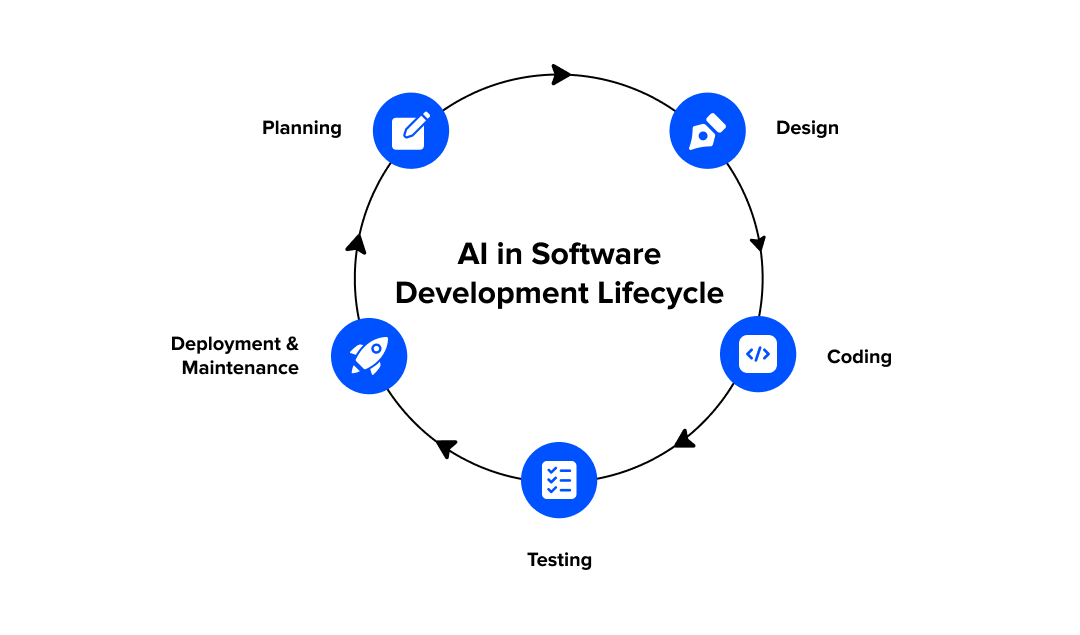
1. Planning
With the help of AI tools, your software teams can analyze the insights of historical data that will help you predict accurate timelines. You can now make smarter and data-driven decisions like never before, as AI for software development empowers you with automated code analysis.
2. Design
Leverage generative AI software development for your next design project! Instead of spending days (sometimes weeks!) creating mockups or wireframes from scratch, designers can simply use text-to-design tools.
Providing a precise prompt of any feature or desired user experience can help you generate multiple designs. This ability helps in increasing the likelihood of discovering more innovative & effective solutions.
3. Coding
One of the major benefits of AI in software development that your team can experience is getting the coding process done quickly & efficiently. Imagine they have an AI code assistant who will suggest snippets, translate prompts into functional code, and whatnot.
Don’t you think it will make their work easier and 10x faster?
4. Testing
Your team doesn’t have to waste their time anymore on writing test cases manually!
With the help of cutting-edge technology, your team can automatically create, manage, and run comprehensive tests that human eyes might miss. This will result in a faster development process, improve the quality, and let developers focus on other core tasks.
5. Deployment & Maintenance
After completing the testing, AI will automate and optimize the deployment, ensuring a smoother, faster, and more reliable release. Later, the team will keep an eye on monitoring software to predict potential failures and add features based on users’ feedback.
Challenges of AI in Software Development Every Entrepreneur Must Know
AI and software development are a great combination when it comes to boosting productivity and driving innovation. But with any transformative technology, there are innate challenges that businesses must pay attention to to unlock their full potential.
Here are the key challenges that every entrepreneur or tech-savvy should be aware of for the successful integration of AI in software development.
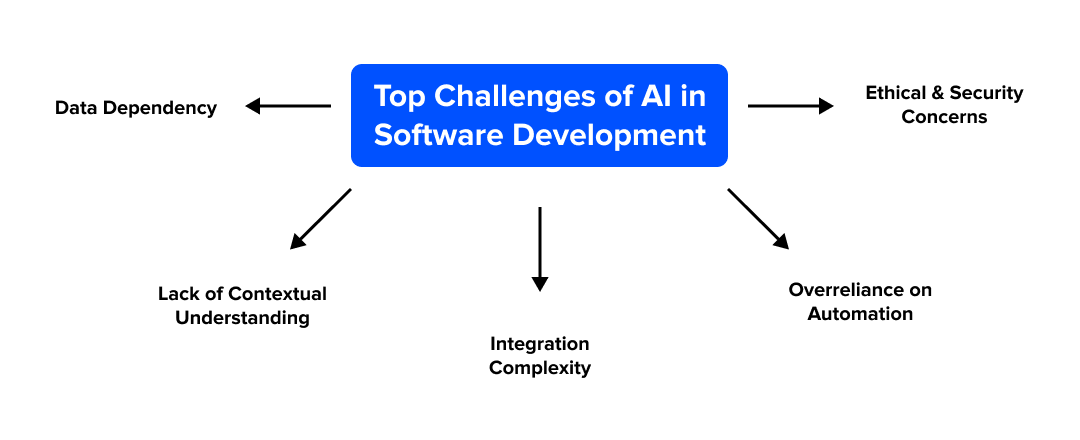
1. Data Dependency
AI system heavily needs large amounts of data so that they can make predictions and decisions. But do you know what happens in most cases? The data is outdated, incomplete, or sometimes biased. As a result, it affects the overall performance of AI, ending up questioning its credibility.
That is why it is crucial to invest in robust data governance practices to make sure that your data is clean and accurate to maximize the effectiveness of artificial intelligence.
2. Lack of Contextual Understanding
You have given the prompt, and it might also give you the answer. But do you think it will provide you with the desired response you actually want?
Well, no! Sometimes, it fails to understand the business’s actual logic or goals. As a result, it cannot make accurate decisions or adapt to complex real-world human scenarios without human input.
To overcome such a challenge, businesses must balance AI with human expertise to ensure that the information provided by AI is strategically aligned with strategic goals.
3. Integration Complexity
AI integration process with existing development workflows, Continuous Integration/Continuous Delivery [CI/CD] pipelines, or legacy systems is technically challenging. The entire integration process comes with compatibility issues, security concerns, and learning curves.
By prioritizing careful strategic planning, businesses with AI-driven solutions can easily turn potential risks into a seamless transition. This approach ensures that your business can unleash the full power of AI and gain a competitive advantage.
4. Overreliance on Automation
If you are relying too much on AI-generated code, you are doing it wrong.
AI might increase your productivity by quickly reviewing the code or even automating bug-fixing. But it leaves room for loopholes. The chances of errors going unnoticed, the occurrence of security flaws, or poor performance increase.
As a business owner, you must ensure a balance between automation and manual reviews in order to maintain high-quality standards in the software development process.
5. Ethical and Security Concerns
Apart from technical complexity, AI has a fair share of ethical and security challenges as well. If not managed proactively, it can pose a significant risk to your brand’s reputation and compliance standing. Moreover, many tools are trained on vast public codebases, and the concerns of intellectual property and license violations increase.
To mitigate such risks, complying with data privacy laws like GDPR can safeguard the personal data while helping businesses meet strict privacy regulations. By aligning with such security standards, you can build a trustworthy AI practice.

What is the Future of AI in Software Development?
The future of AI in software development seems bright, transformative, and promising!
Artificial intelligence is not here to replace humans but to make their work efficient; it will become the power of a co-pilot.
Here’s what the future of AI in software development looks like:
- Autonomous Agent-Based Engineering: Forget AI co-pilots; think autonomous AI agents. The future developer will not write code line-by-line but will act as a manager, assigning a high-level business objective, like "develop an inventory management module that integrates with our existing logistics API," to an AI agent.
- Self-Healing and Self-Evolving Software: The next generation of applications will be dynamic, living entities. We will see software that can autonomously detect bugs or security vulnerabilities in its code, then write, test, and deploy the patches itself in real-time.
- AI-Generated Requirements and System Design: The process will begin long before the first line of code is written. Future AI systems will analyze market trends, competitor products, and even real-time user sentiment to generate ideal software requirements and architectural blueprints.
- The End of Static User Interfaces: The concept of a single, fixed user interface will become obsolete. AI will generate a unique, personalized UI for each user, rendered in real time and based on their context, skill level, and immediate goals.
- The Rise of the "AI Shepherd" and Ethicist: As AI takes over the mechanics of creation, the senior developer role will transform into that of an "AI Shepherd" or "System Ethicist." Their primary job will not be coding, but training, curating, and ethically aligning fleets of autonomous software agents.
These forward-looking concepts are not just theoretical; they are grounded in the real-world needs that industry leaders are already focused on. For instance, in a recent interview, the joint managing directors of Future Platforms highlighted that “AI is going to be the next epoch of technology!”
The Bottom Line: Will AI Replace Software Developers?
No, AI will not replace software developers, but it will certainly advance the way they work. Artificial intelligence is here to ease the work, and if leveraged properly, it will transform developers into problem-solvers.
AI can be a master of “how”, like how to write code faster or bug testing, but the curiosity that drives innovation and creativity? That will always remain human.
So, the future isn’t about replacing developers or, for that matter, any professional; it’s just about upgrading the way everyone works. The right way to use AI is a smart usage so that developers (or anyone else) can think about the bigger picture.
No one is losing their job; we’re simply moving towards a future where technology enhances our capabilities.
Frequently Asked Questions
What is AI in software development in simple terms?
AI in software development means leveraging smart tools that have the ability to learn from past data. It helps developers to write, text, and resolve the issue instantly. You no longer need to handle everything manually; you can just take the help of AI to find the errors, write code, and speed up the development process.
What is the single biggest benefit of using AI in coding?
Speed. It’s just raw speed. All that boilerplate code developers have to write for every new project? Not anymore. From automating tasks to detecting bugs in real time, AI will make your workflow smarter and faster than ever. AI is just like your helping friend that will help you work more efficiently.
Is AI-generated code secure and reliable?
To some extent, AI-generated code can be secure and reliable, but you can’t trust it blindly. AI tools are trained well on vast amounts of data, and that is why they give solutions quickly. As a result, it opens the door to security vulnerabilities, generates unnecessary code patterns, and doesn’t match the business logic.
How can a beginner developer start using AI?
Don't overthink it. Just install an extension like Copilot and start typing. Seriously. You’ll see it suggesting stuff. Sometimes, it'll be a godsend; other times, you just need to give a better prompt to get your desired result. Just use it. Play with it. See where it fits. You learn by doing, not by reading a manual.
What are the main challenges of implementing AI in development?
The key challenge in implementing AI in software development includes:
- Lack of context understanding
- Data quality and availability
- Integration with existing systems
- Security and ethical concerns
- Developer trust and adoption
Can AI help with old or poorly documented code?
Of course, yes! AI does help with poorly documented code and even with legacy code. Here’s how:
- Code explanation
- Code summarization
- Refactoring suggestions
- Test case generation
- Bridging the knowledge gap
What is Generative AI in the context of software development?
Generative AI is a type of advanced and smart tool that can create new content. Whereas Generative AI software development means it can generate code, documentation, tests, UI designs, and entire application components based on the prompts given.
Does using AI reduce the cost of software development?
Definitely, yes! AI does reduce the cost of software development – all thanks to the automation it does. Here’s how AI helps in reducing the overall pricing:
- Reduce human errors
- Improves resource efficiency
- Cut testing costs
- Speeds up development time
- Accelerates onboarding
What is the most important skill for a developer in the age of AI?
The most important skill for a developer in the age of AI is adaptability — the ability to learn, evolve, and work effectively with AI tools. Do you know why adaptability matters?
Here’s why:
- Review and refine AI-generated suggestions
- Integrate intelligent tools into their workflows
- Understand when to trust AI and when to rely on its logic
What is the future of AI in software development?
The future of AI in software development seems promising because it will change the way teams design, develop, document, deliver, and debug software. In short, AI can speed up the feature additions, fix bugs, and support requests.

Uncover executable insights, extensive research, and expert opinions in one place.
Related Content