Share It On:
 Deciding between in-house vs outsourced healthcare software development? Discover the ultimate hybrid strategy to build scalable, secure, and compliant applications.
The hospitality game is moving fast, and honestly, if you aren't looking at hotel booking app development trends 2026, you're playing catch-up. Travelers today don't just want a place to crash; they want a high-tech, seamless vibe that starts the second they open their phone. If your app feels like a relic from 2019, that’s a major "yikes" for your brand.
For entrepreneurs ready to hire a mobile app development team, the goal is to build an ecosystem, not just a tool. Whether you are navigating the SDLC for the first time or deep into a custom mobile app development, these 15 trends are your North Star for the coming year.
Top 15 Hotel Booking App Development Trends In 2026
To make this easy to digest, we’ve broken down the top trends into three major shifts: Intelligence, Infrastructure, and Immersion.
The AI and Data Revolution
1. AI-Driven Hyper-Personalization
We’ve moved past "Hello [Name]" emails. In 2026, AI in app development means your app knows a user wants a high-floor room with an extra pillow before they even ask. By analyzing past behaviors and real-time data, apps now offer bespoke packages that actually convert. According to Hotelbeds, the personalization market in travel is growing at a 17% CAGR, proving that generic interfaces are officially "mid."
2. Predictive Analytics for Dynamic Pricing
Price drops shouldn't be a guessing game. Modern hotel booking applications use predictive algorithms to adjust rates based on demand, local events, and even weather patterns. This isn't just for the big players anymore; it's a standard feature of hotel app development. Research and Markets notes that AI in hospitality is expected to reach $2.28 billion by 2030, with revenue management being a primary driver for this explosive growth.
3. Generative AI Concierge
Forget those clunky chatbots that never understand you. The 2026 vibe is all about Generative AI assistants that handle complex requests—like "Find me a vegan-friendly spot nearby with a view." It’s a complete game-changer for hospitality technology trends 2026. Research from Insightace Analytic shows the AI in the tourism market hit $3.7 billion in 2025, with virtual assistants becoming the "new normal" for guest support.
4. Sustainability and Carbon Tracking
Eco-conscious travel isn't a niche; it’s the standard. Apps now integrate carbon footprint calculators for every stay. It’s a brilliant way to build trust with Gen Z. According to Grand View Research, the demand for sustainability-focused smart building solutions is rising, and travelers are now actively choosing hotel booking apps that highlight "Green-certified" properties to align with their personal ESG values and lifestyle.
5. Super App Ecosystems
Why have five apps when one can do it all? The future of hospitality mobile apps lies in "Super Apps" that handle flights, room service, and local tour bookings in one window. It’s all about the "one-click" economy. Mobile booking revenue is officially overtaking desktop in 2026, making these all-in-one platforms the ultimate "power move" for brands wanting to own the entire guest journey.

Frictionless Hardware & Infrastructure
6. IoT-Powered Smart Rooms
Imagine walking into a room that already knows your preferred temperature. By 2026, hotel mobile app development must include IoT controls for lighting, AC, and even smart mirrors. This isn't sci-fi anymore—it’s expected. MarketsandMarkets projects the smart hospitality market to reach $49.9 billion by 2027, showing that "dumb" rooms are a total dealbreaker for modern travelers who value total control.
7. Contactless Check-In & Digital Keys
The front desk line is officially "cringe." In 2026, guests expect to skip the lobby and head straight to their room using a digital key stored in their app. It’s a massive part of hospitality app development trends. A report by 360iResearch values the global contactless check-in market at $1.77 billion in 2026, proving that friction-free entry is the new gold standard for the industry.
8. Biometric Authentication for Security
Passwords are so last decade. In 2026, hotel booking app development services are prioritizing Face ID and fingerprint scanning for everything from logins to room access. It’s fast, secure, and feels incredibly high-end. Industry data highlights that a significant number of guests prefer hotels with self-service biometric options, as it provides a sense of security and speed that legacy systems simply can't touch.
9. Blockchain for Secure Transactions
Security is a "bet," and blockchain is the winner. By using decentralized ledgers, hotel booking applications ensure that payments and guest data are tamper-proof. It’s the ultimate way to eliminate "double bookings" and fraud. While it sounds techy, it’s a core trend for hospitality app development companies. Experts at IndustryARC suggest that blockchain integration is key to solving the data safety and security issues currently plaguing the digital travel sector.
10. Voice-Activated Booking Flows
"Hey Siri, book a suite for my anniversary." Voice search is no longer a gimmick; it’s a primary way people interact with hotel booking apps. Integrating voice commands is a "no-brainer" for accessibility and convenience. Research and Markets identifies voice-enabled room controls and booking as one of the major trends defining the hospitality technology trends 2026 landscape, as hands-free tech becomes a lifestyle staple.
Immersive Experiences & New Frontiers
11. AR-Powered Virtual Tours
Flat photos are boring. Augmented Reality (AR) allows users to "walk" through a room before they book it, ensuring the "vibe check" is passed. This is a massive feature of hotel app development in 2026. According to Precedence Research, the AR/VR market is set to hit $118.79 billion in 2026, with the software segment alone seeing massive growth as travel brands invest in immersive previews.
12. Metaverse Previews and Bookings
The Metaverse is finally getting practical. High-end brands are creating 3D digital twins of their resorts where users can explore amenities in a virtual world before committing. This is the future of hospitality mobile apps. Analysts at SkyQuest predict that XR (Extended Reality) will see an 87% rebound in 2026, making "Meta-hospitality" a legit revenue stream for those who hire mobile application developers early.
13. Gamified Loyalty Programs
Now, apps use streaks, badges, and "level-up" mechanics to keep users engaged. It’s about making the booking experience fun, not just functional. This trend is a key part of custom mobile app development guide strategies. A major chunk of businesses say that these deep engagement tactics are essential for retaining customers in an increasingly crowded mobile market.
14. Hyper-Local Experience Curation
Apps are evolving into personal travel guides. By using real-time location data, they offer "off-the-beaten-path" suggestions tailored to the user’s specific profile. It’s a "chef's kiss" for engagement. Research shows that location-based filtering and personalized outreach can increase revenue by 10-15%, making it one of the most profitable hospitality app development trends to watch this year.
15. In-App Social Networking for Guests
Solo travel is peaking, and apps are helping people connect. Some hotel booking applications now feature opt-in social "lounges" where guests can find workout partners or dinner buddies. It’s a fresh take on hotel booking app development. While niche, this focus on "community" is a rising trend. Travelers in 2026 are prioritizing experiences that cater to both their work needs and their social leisure activities.
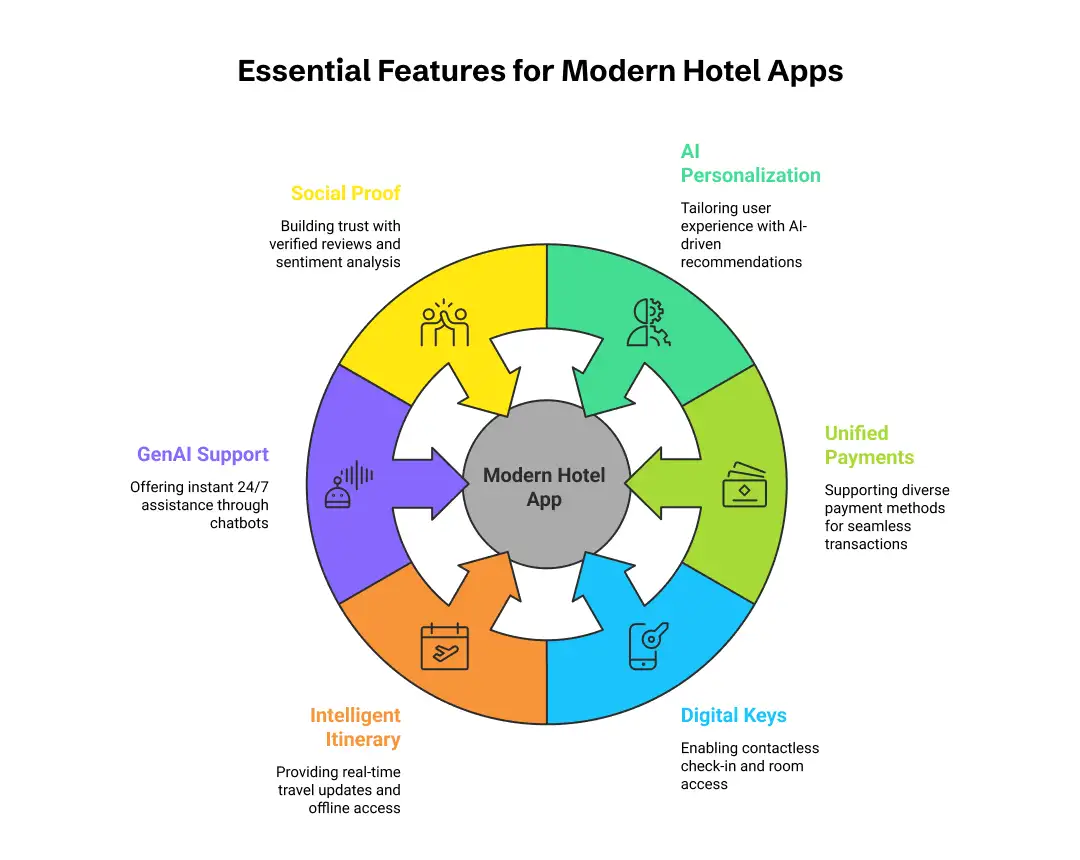
Essential Features Every Modern Hotel App Needs
If you want your app to be "the one" users keep on their home screen, you need to nail the basics while adding that 2026 flair. Here are the non-negotiables:
1. AI-Powered Personalization & Smart Search
Generic listings are officially "mid." Every modern app needs an AI in app development engine that filters results based on a user's unique vibe—like "high-floor with a gym nearby." By 2026, predictive search is the gold standard, ensuring users find exactly what they need without scrolling through endless junk.
2. Unified Multi-Method Payment Gateway
In 2026, if you only accept Visa/Mastercard, you're losing money. A high-converting feature of hotel app development is a gateway that supports everything from Apple Pay and Google Pay to BNPL (Buy Now Pay Later) and even crypto. Mobile payment market is exploding, so your hotel booking app development must prioritize a frictionless, "one-tap" checkout to lower cart abandonment.
3. Seamless Digital Key & Contactless Check-In
Waiting at the front desk is a total dealbreaker. A top hospitality app development trend is integrating digital keys that allow guests to head straight to their room using their phone. This feature requires deep hotel mobile app development expertise to sync with property hardware.
4. Intelligent Itinerary & Real-Time Sync
Modern travelers are busy, and they need their info "clutch." An essential feature is a dynamic itinerary that syncs flight status, gate changes, and local weather. When you hire mobile application developers, ask for a "My Trips" dashboard that works offline. Real-time context and offline access are critical for user retention, especially in areas with spotty airport Wi-Fi.
5. In-App Chat & GenAI Support
Human support is great, but 24/7 instant answers are better. Integrating a GenAI chatbot is a core hospitality technology trend 2026. These bots can handle room service orders, spa bookings, or local recommendations in seconds. Research shows that hotels using AI chatbots see a 20-35% boost in direct booking conversions by answering guest queries at 2 AM without human lag.
6. Verified Social Proof & Sentiment Analysis
Nobody trusts corporate photos anymore. Your app needs a verified review ecosystem with video testimonials and AI-powered sentiment highlights. This allows users to quickly see the "vibe check" of a property—like "great for remote work" or "loud lobby." It’s a key part of any custom mobile app development guide because social proof is the ultimate driver for trust and final conversion in 2026.
The Tech Stack for a Scalable Hotel App in 2026
Scaling a hotel booking app requires a foundation that won't crumble during peak holiday surges. If you're looking to hire mobile application developers, make sure they are fluent in this 2026-ready stack:
- Frontend: Flutter or React Native are the goats for cross-platform efficiency. For that premium feel, Swift (iOS) and Kotlin (Android) remain the kings of high-performance native UIs.
- Backend: Node.js or Python (Django/FastAPI) are ideal for handling complex Ai in app development integrations and real-time data processing.
- Database: Use PostgreSQL for structured booking data and MongoDB or Elasticsearch for lightning-fast property searches and personalization.
- Cloud & Infrastructure: AWS or Google Cloud with auto-scaling is a must. You need a "headless" architecture to ensure your PMS (Property Management System) and CRM can talk to each other without lag.
Monetization Strategies: How to Drive ROI
Building an app is one thing; making it a "cash cow" is another. Here’s how you drive real ROI in 2026:
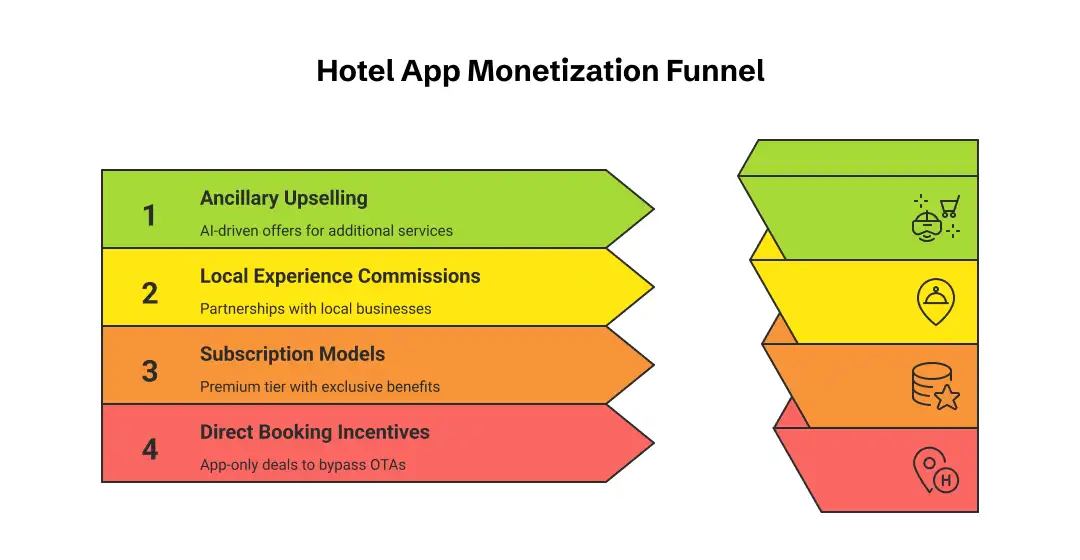
- Ancillary Upselling: This is where the real money is. Use AI to trigger offers for spa treatments, room upgrades, or late check-outs at the exact moment a guest is most likely to buy.
- Commission on Local Experiences: Partner with local tour operators and restaurants. Taking a 10-15% cut on every dinner reservation made through your app is a massive revenue stream.
- Subscription (Travel Club) Models: Offer a "Pro" tier for a monthly fee that gives users "insider" rates, free upgrades, and waived resort fees.
- Direct Booking Incentives: Move users away from OTAs (Online Travel Agencies) by offering exclusive app-only deals. Every direct booking saves you that 15-30% commission fee.
Conclusion
The 2026 hospitality space is basically "innovate or evaporate." These hotel booking app development trends 2026 aren't just flashy add-ons; they are what guests now expect as a bare minimum. From AI in app development to seamless IoT integrations, the bar has been raised.
If you’re an entrepreneur, the winning move is a hybrid approach—leverage high-tech automation for efficiency, but keep the human "soul" of hospitality alive in your UX. Don't wait until your competitors have already cornered the market. Now is the time to hire a mobile app development team and start building the future.
Frequently Asked Questions
Which are the best hotel booking app development trends in 2026?
The largest hotel booking app development trends in 2026 are AI hyper-personalization, room preview with the help of AR, and contactless check-in, which has become the priority of the modern traveler. The app is a virtual concierge that takes care of room temperature, tours around the neighborhood, and much more.
How much is the average hotel booking app development cost?
The cost of developing a hotel booking application can vary according to the quality of the application used in the modern market with the price of the basic application accessing up to $50,000 and the high-quality options reaching up to 250,000 and above. Pricing is significantly based on such features as AI in the creation of apps, a multi-language approach, and extensive integrations with the IoT.
How to choose a mobile app development company?
When deciding on the mobile app development company to pick, it is always better to focus on those who have a history of showing their track record in the trends of hospitality technology 2026. A partner that pays attention to a strict SDLC and provides solid post-launch hotel booking app development services should be sought.
How is AI important to the hotel industry in terms of app development?
The use of AI in creating an app enables hotels to provide predictive service and personal marketing that enhances loyalty. Dynamic pricing and instant guest support are the foundations of AI in 2026, which is why it is an essential feature of hotel app development.
What is the ideal budget framework of the hotel booking app?
A comprehensive budget framework of the hotel booking app should include discovery, design, development, and a 20% buffer for maintenance. Investing in custom mobile app development guide strategies early ensures you don't overspend while still delivering a top-tier guest experience.

Uncover executable insights, extensive research, and expert opinions in one place.
Related Content