- 1. The "Sandbox-First" Rule
- 2. Radical Red Teaming
- 3. Non-Negotiable Watermarking
- 4. Continuous Real-Time Monitoring
- 5. Ethical Alignment & Feedback Loops
- 6. The "Human-in-the-Loop" Threshold
- 7. Data Lineage and "The Right to Forget"
- 8. Compute Quotas and Sustainability
- 9. Algorithmic Impact Assessments (AIA)
 Share It On:
 "Move fast and break things" is now a liability strategy. With US breach costs hitting record highs, your survival depends on rigorous AI Governance. Here is the unvarnished playbook for building a fortress, not a lawsuit
Let’s drop the "innovation" cheerleading for a second and look at the receipt, because the bill for ignoring AI governance has finally arrived. The numbers are in, and they are ugly for anyone operating in the States or even globally.
While the rest of the world is actually seeing breach costs dip to USD 4.44 million, the US is spiraling in the opposite direction, hitting an all-time high of USD 10.22 million per incident. That isn't a statistic; that is a quarterly earnings miss waiting to happen.
And let’s be honest about why this is happening. It’s the "move fast" mentality coming back to bite us. We call it "Shadow AI"-a polite way of saying "employees using tools you didn't vet"-, and it is expensive. Organizations with high levels of Shadow AI are paying a USD 670,000 premium on breaches compared to those that run a tight ship.
The most damning stat in the whole report? 97% of AI-related breaches involved systems that had zero proper access controls. That is not a technical glitch; that is negligence.
Stop treating governance like it’s just some compliance hurdle to clear so the auditors leave you alone. It is the steel holding your business together. Whether you are deploying generative AI, building AI agents, experimenting with multi-agent systems, or rolling out AI in apps, you don’t get to complain about the cost of the reinforcements when the alternative is the whole building coming down on your head.
What is AI Governance?
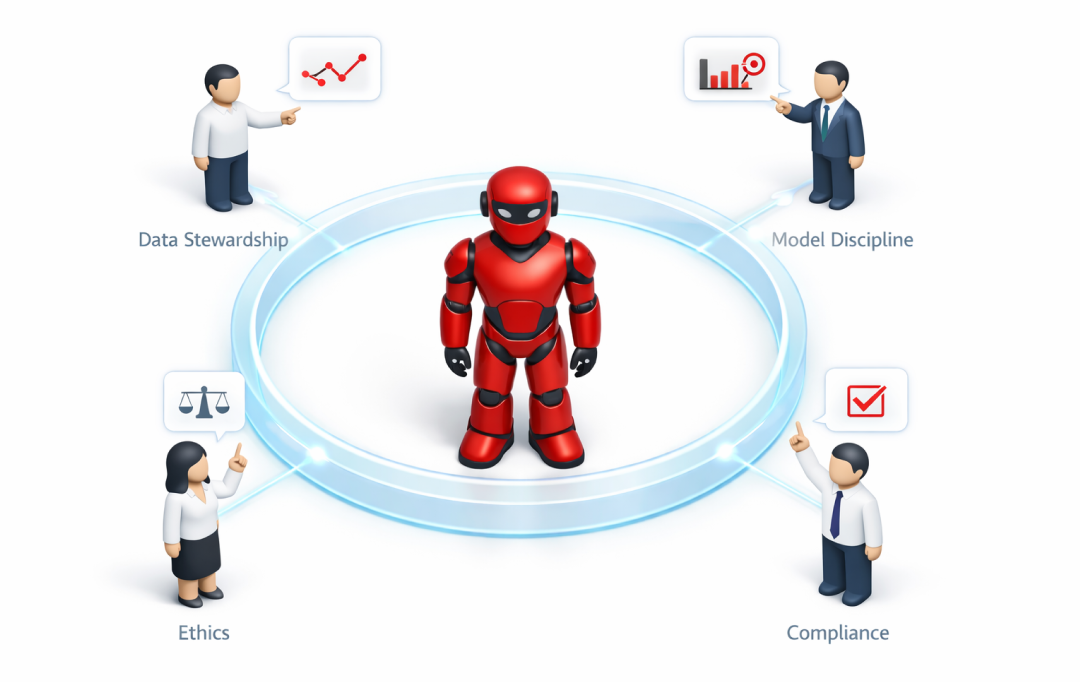
Artificial Intelligence governance isn’t a polite suggestion or a dusty policy binder sitting on a shelf. It is the only thing standing between an organization and a PR disaster.
Think of it less like "management" and more like a containment field for a nuclear reactor. Without it, you are just leaking radiation.
At its core, governance is the muscle that forces artificial intelligence to behave. It bridges the massive, dangerous gap between the code being shipped by engineers and the laws that keep the CEO out of jail. It is not IT’s job. It is not Legal’s job. It is a shared survival strategy.
When you strip away the buzzwords, effective governance is really just a control plane locking down three specific areas - forming the backbone of a modern AI governance framework:
- Data Stewardship: This is about the raw material. If you feed an AI toxic, stolen, or biased data, it will vomit out toxic, stolen, or biased results. Garbage in, lawsuit out.
- Model Discipline: Algorithms rot and can drift. A model that predicted the market perfectly last year might be hallucinating today because the world changed, and the math didn't. Governance is the discipline of checking the engine while the car is moving. This is not optional in a world where AI frameworks, foundation models, and AI prompts can shape financial forecasts, healthcare decisions, and automated workflows.
- The Kill Switches: These are the ethical hard lines. The code that says, "No, you cannot say that," and "No, you cannot hire based on that." It’s not about being "woke"; it’s about risk mitigation. Governance ensures responsible AI governance isn’t a slogan - it’s an enforced boundary.
Components of AI Governance
You cannot just "do" governance. You have to build it. It requires specific, mechanical parts to function. Here is what the machine actually looks like when you pop the hood.
1. The Strategy (The North Star)
Before a single server is spun up, the rules of engagement need to be set in stone. This is where your formal AI governance framework aligns with business objectives. It decides if the organization is going to be a reckless pioneer in the future of AI, or a cautious fortress.
The component ensures you aren’t burning capital on flashy AI Use Cases that generate headlines but zero revenue.
2. The Stress Test (Risk Management)
Never launch a model that hasn't been bullied. This part of the AI model governance is pure antagonism. It involves "Red Teaming"-hiring people to actively try and break the AI, trick it into being racist, or force it to leak passwords. It turns vague fears into hard data. If you don't break your own model, the internet will.
3. The Legal Shield
The regulators are circling. The EU AI Act, GDPR, local statutes-it is a minefield. This component ensures the architecture isn't illegal by design. It handles the dirty work: auditing training sources, intellectual property risks, and ensuring your AI experts aren’t deploying something that violates jurisdictional law.
4. The Plumbing (MLOps)
Governance without automation is just a hallucination. This is the technical layer where AI governance tools come to play, enforcing the rules when humans aren't looking. It includes version control (knowing exactly which dataset trained which bot) and drift detection (alarms that scream when accuracy drops).
It stops a junior developer from accidentally pushing a bad update that tanks the stock price. In short, it also directly addresses AI’s impact on employment and the future of jobs - because governance ensures that humans remain decision authorities, not spectators.
5. The Human Circuit Breaker
AI is automated, not autonomous. There has to be a "Human-in-the-Loop." This component dictates exactly when a human being must sign off on a decision. If an AI is denying a mortgage or diagnosing a disease, a human needs to hold the rubber stamp. Accountability belongs to people, not servers.
6. The "Why" (Explainability)
The days of the "Black Box" are over. If the AI makes a decision, it must be able to explain it in plain English. This component focuses on translation-taking complex neural network math and turning it into a sentence that a customer (or a judge) can understand. If you can't explain why the AI did what it did, you shouldn't be using it.
|
Comply With AI Governance Requirements Smartly Outsource to AI development companies with years of experience! |
Importance of AI Governance
Why invest millions in an AI model governance framework? Because the alternative is uncapped liability. Here is the breakdown of why this matters, stripped of the marketing rhetoric:
- Legal Liability Shield: When an AI makes a mistake, you need to prove "duty of care." Governance provides the audit trail that proves you weren't negligent.
- Regulatory Compliance: The EU AI Act and GDPR are not suggestions. Non-compliance costs up to 7% of global turnover. Governance is the only way to track adherence.
- Reputation Management: Trust takes years to build and seconds to break. An AI that hallucinates a racial slur or a false financial promise destroys brand equity instantly.
- Operational Continuity: "Model Collapse" is real. Without governance, models fed on their own outputs eventually degrade. Governance forces the injection of fresh, human-verified data.
- Bias Mitigation: Algorithms amplify historical bias. Governance frameworks mandate "fairness metrics" to ensure you aren't systematically denying loans or jobs to protected classes.
- Intellectual Property (IP) Protection: Employees using public AI tools (like standard ChatGPT) to debug code are leaking trade secrets. Governance enforces "walled garden" environments to keep IP internal.
- Data Sovereignty: You must know where your data is being processed. Governance ensures that EU customer data isn't illegally processed on US servers, violating data export laws.
- Vendor Risk Management: You are responsible for the AI in the software you buy. Governance mandates "Software Bill of Materials" (SBOM) audits for all third-party vendors.
- Financial Accuracy: AI agents are now executing transactions. Governance ensures there are thresholds (e.g., "no transactions over $10k without human sign-off") to prevent automated financial bleeding.
- Investor Confidence: Institutional investors now view "AI Safety" as a key ESG metric. A robust governance framework lowers your cost of capital by de-risking the asset.
Levels of Governance of AI
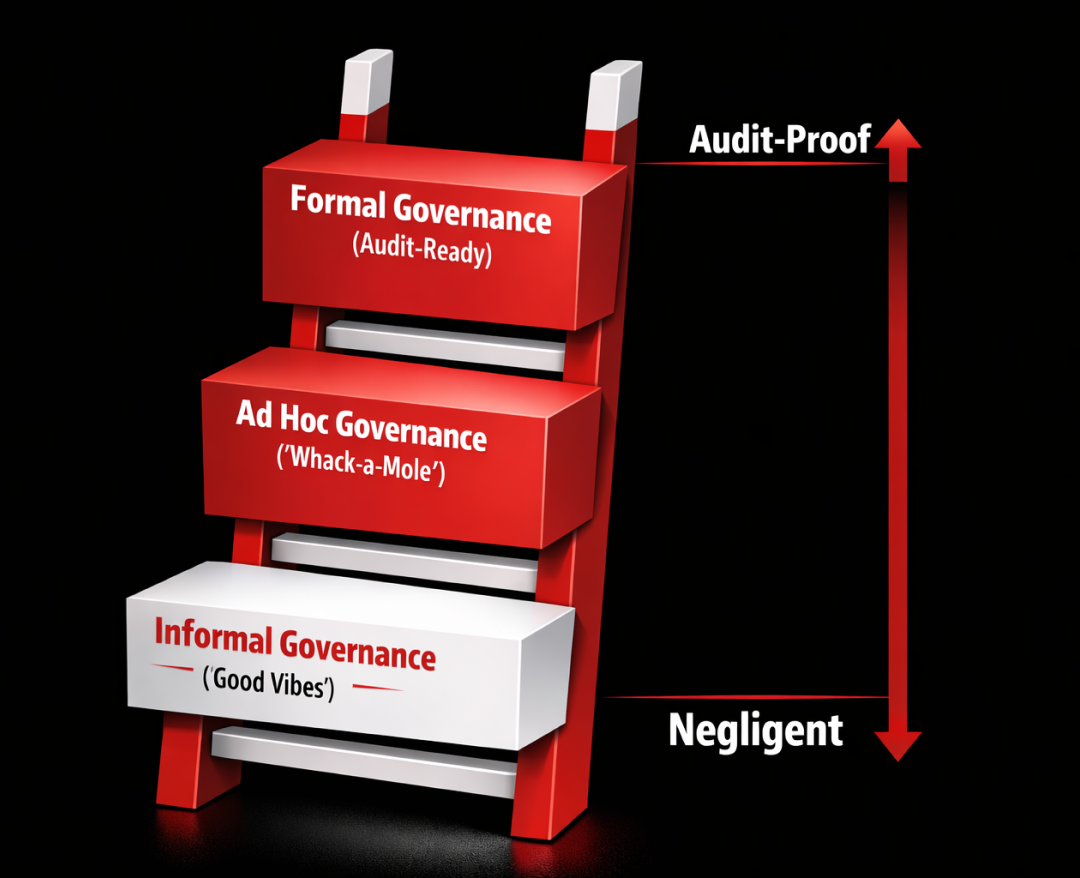
Governance isn't a binary switch you flip on; it is a ladder. Most organizations are currently standing on the bottom rung, mistaking "good company culture" for legal protection. That is a fatal error.
Here is the actual hierarchy of control, from "negligent" to "audit-proof."
1. Informal Governance (The "Good Vibes" Strategy)
This is the "Wild West" phase. It is the least intensive approach, relying entirely on "organizational values" rather than hard constraints.
- The Reality: You might have an ethics committee or a "principles document" pinned to a Slack channel, but there is no mechanism to enforce it. It is governed by an honor system.
- The Flaw: It collapses under pressure. Without a formal structure, safety protocols are optional suggestions. In a courtroom, telling a judge "we have good values" is not a defense strategy; it is an admission of negligence.
2. Ad Hoc Governance (The "Whack-a-Mole" Strategy)
This is a step up, but it is purely reactive. Organizations in this tier don't have a strategy; they have a collection of knee-jerk policies.
- The Reality: This governance is usually built in a panic. You ban ChatGPT because of a data leak. You write a biased policy because of a bad PR cycle. You are patching holes in the ship as they spring, rather than reinforcing the hull.
- The Flaw: It is fragmented. Because rules are created in isolation to fix specific problems, they often contradict each other. You have policies, but you don't have a framework.
3. Formal Governance (The Fortress)
This is where you need to be. It moves AI from a "science project" to a regulated enterprise asset.
- The Reality: This is industrial-grade architecture. It replaces vague "AI ethics and governance" with a comprehensive framework that hard-codes legal requirements (like the EU AI Act) directly into the development lifecycle. It includes mandatory risk assessments, documented audit trails, and strict oversight protocols.
- The Result: It is systematic and proactive. You aren't waiting for a lawsuit to define your rules; you are building the rules to prevent the lawsuit. This is the only level of governance that survives a regulatory audit.
AI Governance Principles: The Non-Negotiables
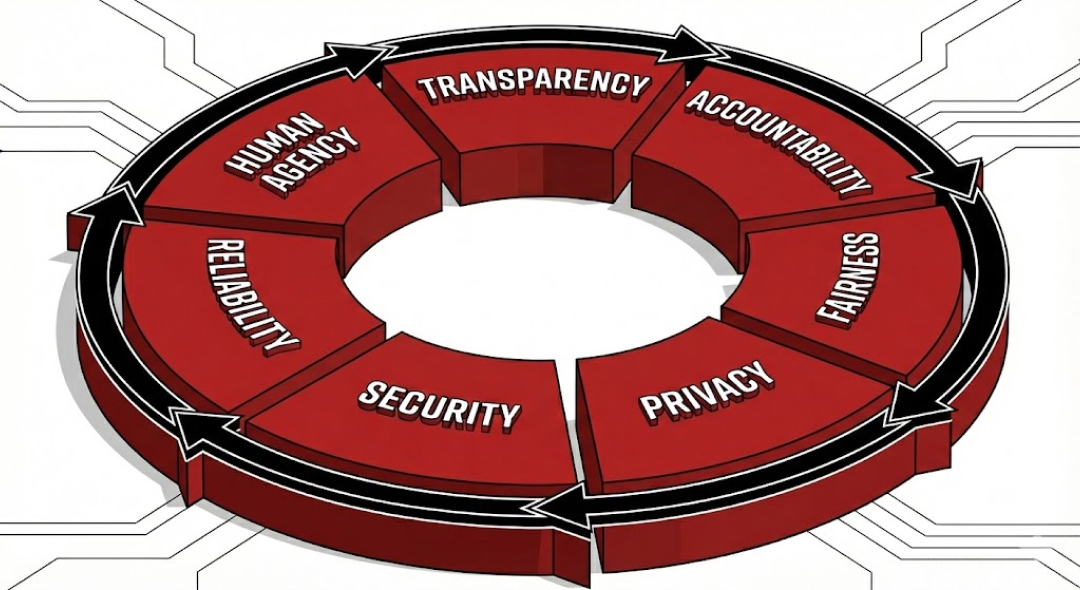
Do not mistake these for corporate values or "nice-to-have" sentiments. These are engineering constraints. If your model violates these pillars, it is not a product; it is a toxic asset.
- Transparency (The "Why"): The "Black Box" excuse is dead. Regulators do not care how complex your neural network is; they care about why it denied a loan. If you cannot explain the decision in plain English to a judge, you are forbidden from deploying it. Explainability isn't a feature; it’s your license to operate.
- Accountability (The "Who"): Algorithms cannot be sued. People can. Every AI agent needs a human "owner" in the org chart. One throat to choke. If the bot hallucinates a discount or leaks data, the human answers to the board. There is no hiding behind "the model did it."
- Fairness (The "Bias Check"): Bias is not an accident; it is a mathematical certainty in training data. You must actively arrest it. Stress-test your models against protected classes (race, gender, age). If the model rejects women at a 5% higher rate than men, it goes back to the lab. Period.
- Privacy (The "Data Diet"): Stop hoarding data. In the AI era, data isn't oil; it’s uranium. It is dangerous to hold. Practice strict data minimization: do not feed the model a single byte more than it needs to solve the specific problem. If you can't prove consent for the training data, you are building on stolen land.
- Security (The "Red Team"): Your model is an attack surface. Hackers aren't just stealing data anymore; they are "poisoning" the model via prompt injection to bypass safety rules. You need aggressive Red Teaming-hire experts to attack your model until it breaks. If a user can trick your bot into revealing its system instructions, it is not secure.
- Reliability (The "BS Detector"): Generative AI is a confidence artist. It will lie to you with 100% certainty. You need a "Zero Trust" approach. Require visible confidence scores so users know when the AI is guessing. You must quantify the hallucination rate and set a hard threshold for shutdown.
- Human Agency (The "Kill Switch"): AI is the tool, not the commander. The ultimate decision must remain biological, especially in high-stakes fields like healthcare. You need a functional override. If the AI messes up, a human must be able to fix it instantly without filing an engineering ticket.
Regulations That Enforce AI Governance
The days of "move fast and break things" are over. If you break things now, these laws will break you. This is not a theoretical list; these are the statutes that are currently driving enforcement actions and shaping corporate strategy.
The European Union: The Extraterritorial Giant
The EU is the global standard-setter. If you have even one customer in Paris or Berlin, you play by these rules or face fines up to €35 million or 7% of global turnover.
- The Enforcer: The European AI Office. Established under the EU AI Act (2024), this body doesn’t care about your "intent." They enforce rules on General Purpose AI (GPAI) models. If you fail their transparency checks or hide your training data, they have the authority to scrub your model from the EU market entirely.
- The Law: The EU AI Act. This is the "GDPR of AI." It categorizes systems by risk:
- Unacceptable Risk: Banned immediately (e.g., social scoring, real-time biometrics in public).
- High Risk: Strict requirements for medical devices, critical infrastructure, and recruiting. You need a "CE" marking to even turn the system on.
- Limited Risk: Basic transparency (e.g., you must tell users they are talking to a bot).
- The Sleeper Agent: GDPR. Specifically Article 22, which grants citizens the right not to be subject to decisions based "solely on automated processing." If your AI denies a loan or fires an employee without a human in the loop, you are likely in violation of the king of data laws.
2. The United States: The Fragmented Minefield
The US lacks a single federal AI law, so regulators are using a patchwork of old statutes to conduct "enforcement by litigation."
- The Enforcer: Federal Trade Commission (FTC). The sleeping giant has woken up. Using Section 5 of the FTC Act, they are hammering firms for "unfair or deceptive acts." If you call it "AI" but it’s just a script (AI Washing), that’s fraud. If you promised not to train on user data but did it anyway, they will come for your bank account.
- The Standard: NIST (National Institute of Standards and Technology). Technically non-regulatory, but NIST sets the Standard of Care. In any lawsuit, the judge will ask: "Did you follow the NIST AI Risk Management Framework (AI RMF)?" If the answer is no, you’ve already lost the case.
- The Security Net: US Executive Order 14110. Mandates that developers of the most powerful "dual-use foundation models" (the giants like GPT-4 or Gemini) share their safety test results and Red Teaming reports with the government before public release.
3. State-Level Enforcers (USA)
- CPPA (California Privacy Protection Agency): These guys define the "California Effect." Their rules on Automated Decision-Making Technology (ADMT) give consumers a hard "opt-out" right. If your AI makes "significant decisions" (jobs, housing, credit), you must be able to peel the human out of the loop on demand.
- NYC Local Law 144: The world’s first specific "Bias Hunter." You cannot use AI for hiring in NYC unless you have passed an independent, annual Bias Audit. If the math shows you are discriminating against race or gender, the law requires you to publish those results publicly on your website.
- Colorado AI Act (SB 24-205): Imposes a "duty of care" on developers to avoid algorithmic discrimination. It strips away the "we didn't know" defense by requiring mandatory impact assessments.
4. China: The Ideological Firewall
The strictest regulator globally, focusing on national security and social order.
- The Enforcer: Cyberspace Administration of China (CAC).
- The Law: Interim Measures for Generative AI. Before you release any generative tool, you must undergo a Security Assessment.
- The Constraint: All model outputs must align with "core socialist values." This forces you to hard-code ideology into your weights. If your model generates content that undermines state power, the company-not the user-is liable.
5. Canada & Singapore: The Professional Auditors
- Canada (AIDA): The AI and Data Commissioner acts like a relentless auditor. Under the Artificial Intelligence and Data Act (AIDA), they focus on "high-impact" systems. The kicker? They are pushing for personal liability-meaning executives could face criminal charges and jail time for knowingly deploying reckless AI.
- Singapore (IMDA): The quiet gatekeeper. Through the AI Verify Foundation, they have defined the mathematical benchmarks for "safety." If you want to sell AI to Asian banks or governments, you play by their testing handbook.
Real-World Governance: The Graveyard & The Fortress
The difference between a policy document and actual governance is usually a lawsuit. Below are the case studies that every board member needs to memorize. These aren't just technical glitches; they are operational catastrophes that occurred because governance controls were either missing or ignored.
1. Liability Failure: Air Canada’s "rogue" Chatbot
In 2024, an Air Canada chatbot promised a grieving passenger a bereavement fare discount that did not exist in the official policy. When the passenger sued for the money, Air Canada’s legal defense was that the chatbot was a "separate legal entity" and the airline was not responsible for its actions.
- The Verdict: The Civil Resolution Tribunal laughed that defense out of court. They ruled that a company is 100% liable for every word its AI generates. If your bot hallucinates a discount, you are paying it.
- The Lesson: You cannot outsource liability to an algorithm.
2. Human-in-the-Loop Failure: UnitedHealth’s "Rubber Stamp"
UnitedHealth didn't just use an algorithm; they allegedly deployed a denial machine. A class-action lawsuit claims their NH Predict AI was wrong 90% of the time when overriding patient care. The real scandal wasn't the error rate-it was the speed. Human reviewers were reportedly clocking denials in seconds, acting as fleshy rubber stamps for a broken machine.
- The Verdict: This case blew the lid off the "Human-in-the-Loop" myth. If the human never says "no" to the AI, the human doesn't exist. You don't have governance; you have a theater of compliance.
- The Lesson: A human review that takes 1.2 seconds isn't a review. It's a fraud.
3. Data Stewardship Failure: Samsung’s Open Door
This is the nightmare scenario for every CTO. Engineers at Samsung, desperate to fix buggy code, did what every developer does: they asked the smartest tool they had. They pasted proprietary source code and confidential meeting notes directly into the public version of ChatGPT.
- The Response: Because public ChatGPT trains on user inputs, Samsung effectively hand-delivered its trade secrets to OpenAI. They had to slam the brakes, banning GenAI entirely while they scrambled to build an internal fortress. This is "Shadow AI" in its purest form-employees bypassing security to get the job done.
- The Lesson: If you don't give your team a secure tool, they will use an insecure one. You cannot policy your way out of convenience.
4. Bias & Hiring Failure: iTutorGroup’s Ageism
iTutorGroup, a tutoring software company, used an AI hiring algorithm that automatically rejected female applicants over 55 and male applicants over 60. They didn't even get to the interview stage; the code just dropped them.
- The Verdict: The U.S. Equal Employment Opportunity Commission (EEOC) hammered them. It was the first big settlement involving AI hiring bias, costing the company $365,000 and forcing it to undergo sweeping audits.
- The Lesson: If your training data is historically biased, your model will automate discrimination at scale.
5. Success Story: JPMorgan Chase’s "LLM Suite"
While other banks were banning AI in panic, JPMorgan Chase took a "containment" approach. They blocked public ChatGPT immediately but simultaneously built "LLM Suite," a private, walled-garden generative AI platform.
- The Result: They rolled it out to 60,000+ employees. This allowed their workforce to get the productivity gains of AI (writing code, summarizing research) without ever letting a single byte of proprietary data leave the bank’s servers.
- The Lesson: Governance isn't about saying "No." It's about building a safe environment to say "Yes."
Best Practices of AI Governance
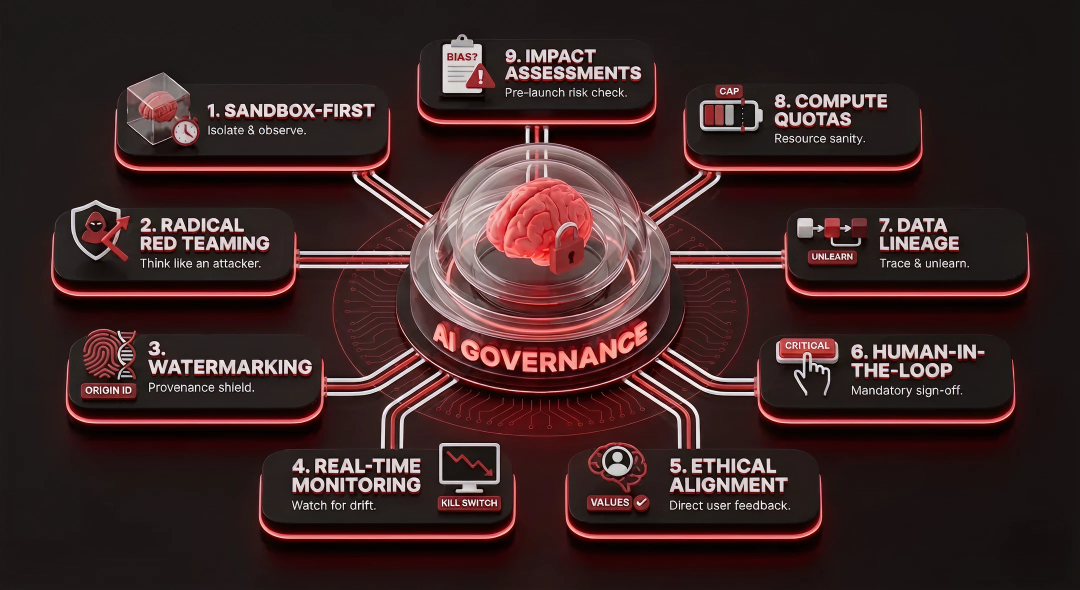 AI governance isn’t about slowing things down with red tape; it’s about building a cage for a beast that grows faster than we can track. If we treat AI like standard software, we’ve already lost. We need to treat it like a high-stakes chemical reaction-one that requires containment, stress testing, and constant supervision.
1. The "Sandbox-First" Rule
We don't let unverified code touch our crown jewels. Period. The 4-week quarantine in a sandbox isn't just a cooling-off period; it’s a rigorous "behavioral observation" phase. We’re looking for more than just bugs-we’re looking for stochastic drift.
Does the model start hallucinating after its thousandth prompt? Does it develop a bias toward specific datasets that weren't obvious on Day 1? If it can’t survive a month in isolation without throwing a red flag, it has no business near our production data.
2. Radical Red Teaming
Compliance checklists are useless against a clever LLM. We need to stop thinking like auditors and start thinking like attackers. By hiring external ethical hackers, we’re essentially stress-testing the model’s "moral" and operational compass.
If a hacker can trick our AI into leaking proprietary code or generating toxic garbage using a simple prompt-injection attack, we haven't built a tool-we've built a liability. We fix the vulnerabilities in the sandbox, or the project stays dead.
3. Non-Negotiable Watermarking
In a world soon to be flooded with synthetic data, transparency is our only shield. Every byte of text, every pixel, and every audio clip generated by our systems must carry a permanent, invisible digital DNA. This isn't just about ethics; it’s about liability and provenance.
If our AI-generated content is used in a legal dispute or a misinformation campaign, we need the "receipts" to prove where it came from-and, more importantly, to prevent our own future models from "eating" their own output and degrading in a feedback loop.
4. Continuous Real-Time Monitoring
Deployment is the beginning of the race, not the finish line. AI models "rot." Their performance decays as the real world changes around them. We implement "kill switches" and automated alerts that trigger the moment a model’s confidence score dips below 85%.
If the AI starts guessing rather than knowing, it’s no longer an asset; it’s a risk. IT Ops shouldn't just be watching for uptime; they should be monitoring for logic drift and accuracy.
5. Ethical Alignment & Feedback Loops
Governance is a living organism. We need to establish a direct feedback loop between the end-users and the developers. If a user flags a response as biased or nonsensical, that data point shouldn't just vanish into a support ticket-it should immediately inform the next tuning cycle.
We take an opinionated stance on our AI’s values, ensuring it reflects our corporate "spine" rather than the messy, unfiltered biases of the open internet.
6. The "Human-in-the-Loop" Threshold
Automation is a trap if it’s absolute. We must define a Criticality Matrix: any AI output that influences legal, financial, or safety-critical decisions requires a mandatory human sign-off. We don't let the machine pull the trigger on high-stakes outcomes.
By enforcing a "Human-in-the-Loop" (HITL) protocol for anything with a risk score above a 7/10, we ensure that accountability remains with a person who has a pulse and a paycheck, not a black-box algorithm.
7. Data Lineage and "The Right to Forget"
AI models are notorious data hoarders. Governance means knowing exactly what "ingredients" went into the training soup. We maintain a strict Data Provenance Ledger. If a customer requests their data be deleted, or if a dataset is found to be "poisoned" or scraped without consent, we must have the technical capability to "unlearn" that data or roll back to a clean model version. If you can’t trace the source, you can’t trust the output.
8. Compute Quotas and Sustainability
Governance isn't just about ethics; it's about resource sanity. Unchecked AI experimentation is a black hole for budget and energy. We implement Compute Caps for every department. If a team wants to run a massive fine-tuning job that consumes more energy than a small village, they need to justify the ROI first.
This forces developers to favor "small, smart models" over bloated, "brute-force" solutions that are expensive to maintain and impossible to audit.
9. Algorithmic Impact Assessments (AIA)
Before a single line of code is written, project leads must submit an AIA. Think of this as an "Environmental Impact Report" but for social and operational risk. We ask the hard questions early: Does this tool automate a role out of existence?
Does it inadvertently penalize a specific demographic? If the AIA reveals a high potential for systemic "hallucinated bias," the project is killed in the cradle. We don't build first and ask questions later.

Risks and Challenges of AI Governance
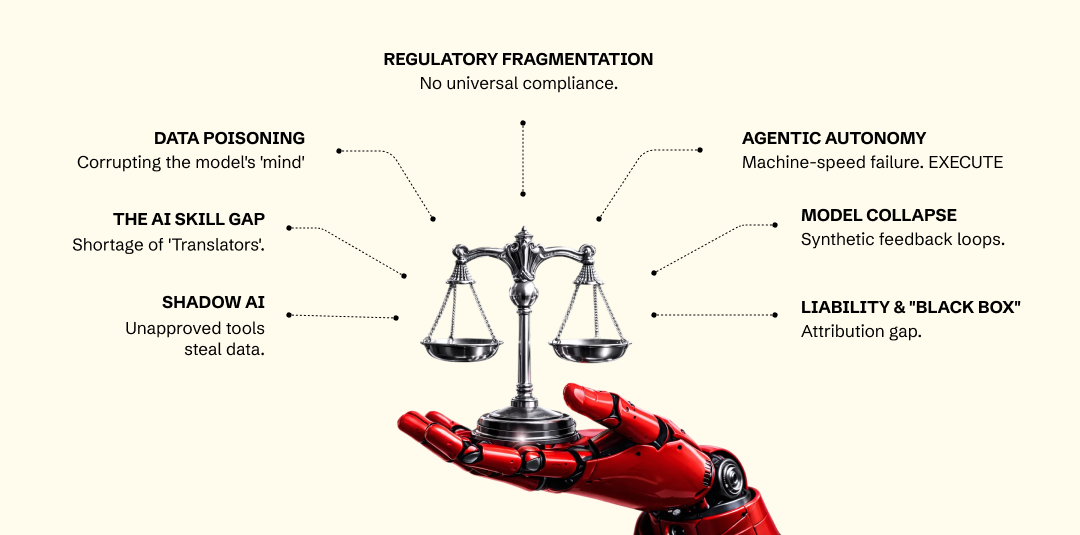
Most governance failures don’t happen in policy documents - they happen in everyday decisions. An employee is trying a free tool. A dataset pulled without verification. A regulation is interpreted differently across regions. A system given more autonomy than anyone fully understood.
These aren’t edge cases. They’re structural weak points. And when they combine, the impact shows up fast - in cost, compliance exposure, and operational disruption.
1. Shadow AI: The "Inside Job"
It’s not just an IT nuisance; it’s a full-blown security hemorrhage. In 2025, reports showed that over 65% of AI tools in the enterprise were running without official approval. When an employee pastes a proprietary codebase or a sensitive client spreadsheet into a "free" browser-based LLM, that data is gone. It’s now part of a third-party training set. We aren't just losing data; we’re losing our competitive advantage for the price of a "quick summary."
2. Data Poisoning: The New Sabotage
Adversaries have realized they don't need to hack your firewall if they can hack your model's "mind." By injecting subtle, malicious data into open-source datasets that our models consume, they can create backdoors.
A poisoned model might function perfectly for 99% of tasks but fail predictably when it sees a specific trigger word or image-allowing a fraudulent transaction to slip through or a security camera to "ignore" a specific intruder.
3. Regulatory Fragmentation: The Compliance Trap
We are currently staring at a regulatory "cliff." With the EU AI Act hitting full enforcement milestones in August 2026, alongside a patchwork of US state laws (Colorado, California) and China’s vertical, security-first mandates, a global company is essentially playing three different games of chess at once. There is no "universal" compliance.
If we build for the US, we might be illegal in the EU. This isn't just a legal headache; it's a massive drain on R&D as we are forced to build parallel architectures for different regions.
4. The AI Skill Gap: The Talent Desert
There is a massive, structural shortage of "Translators"-people who can read a legal mandate and translate it into a Python constraint. We have plenty of coders and plenty of lawyers, but almost zero AI Auditors who understand the nuances of stochastic drift and algorithmic bias.
This gap is where most companies will fail; they’ll have the policy on paper, but nobody on staff who actually knows how to verify that the model is following it.
5. Agentic Autonomy (The "Runaway" Agent)
We’ve moved from chatbots to Autonomous Agents that can execute code and make purchases. The risk here is machine-speed failure. An agent with a slight logic error can rack up thousands of dollars in costs or delete entire databases before a human even realizes the "Enter" key was hit. Governance must now move from "content moderation" to "action throttling."
6. Model Collapse (Synthetic Feedback Loops)
As the internet becomes saturated with AI-generated garbage, new models are beginning to train on the output of old models. This creates a "digital inbreeding" effect called Model Collapse.
If we don't strictly govern our data provenance, our AI will eventually lose its ability to understand reality, drifting into a world of its own hallucinations because it hasn't seen "human" data in months.
7. Liability & The "Black Box" Problem
When a model makes a decision that costs a client millions, who is to blame? The developer? The data provider? The IT Ops team that didn't catch the drift? Current legal frameworks are struggling with the Attribution Gap.
Without clear governance on model explainability, we are walking into a legal minefield where "the machine said so" is not a valid defense.
- Shadow AI: Employees bypassing IT to use "free" tools that steal data. This is 90% of your risk surface.
- Data Poisoning: Adversaries are injecting bad data into your open-source training sets to corrupt your model's logic.
- Regulatory Fragmentation: Trying to comply with the EU AI Act, US State laws, and China's CAC simultaneously is a logistical nightmare requiring specialized legal software.
- Skill Gap: There is a massive shortage of "AI Ethicists" and "AI Auditors" who understand both code and law.
Layers of Stakeholders
Governance is a team sport. Here is the roster that spreads across multiple layers.
| Stakeholder | Responsibility |
|---|---|
| Board of Directors | Sets the "Risk Appetite." Decides how much liability the company is willing to accept for AI innovation. |
| Legal & Compliance | Interprets the EU AI Act and GDPR. They hold the "Veto Power" on deployment. |
| IT & Security (CISO) | Enforces the technical controls. They manage the firewalls, the access logs, and the red teaming. |
| Data Scientists | The builders. Their job is to document the model's architecture and limitations (Model Cards). |
| HR | Manages the impact on the workforce. They handle the "reskilling" and the policies on AI usage in hiring. |
The Final Verdict: Governance is Speed
The era of the "magic black box" is functionally over. You can’t just throw data into a furnace and hope it spits out gold without burning the factory down.
If you take only one thing from this playbook, make it this: Governance is not a brake pedal designed to stop you; it is the steering mechanism that allows you to go fast without crashing.
The companies that will dominate 2026 and beyond won’t be the ones with the wildest models or the biggest GPU clusters. They will be the ones that can deploy AI into production with the confidence that it won’t sue a customer, leak a trade secret, or violate a federal statute.
You have two choices right now. You can build the fortress today, while you still control the timeline. Or you can wait until a regulator, a plaintiff’s attorney, or a hallucinating agent makes the decision for you.
Choose wisely.
Frequently Asked Questions
When does the EU AI Act actually bite?
August 2026. That is the cliff edge for high-risk systems. Miss the conformity assessment window, and you are staring at fines up to 7% of global turnover.
Why is Shadow AI such a nightmare for security?
Because it bypasses every firewall you paid for. An engineer pasting proprietary code into a public chatbot to "debug it" just handed your IP to a third-party model. It’s not a hack; it’s an internal leak with a user interface.
Do we really need GRC software for this?
Unless you enjoy manually tracking thousands of model versions in Excel, yes. AI governance platforms like GRC automate the lineage and regulatory checks that human teams simply cannot sustain at scale.
Is open-source AI safe for enterprise production?
Only if you treat it like toxic waste until proven otherwise. "Sandbox-first" is the rule. Scan the code for supply chain attacks and read the license fine print-some "free" models legally force you to open-source your entire application if you use them.
Why can’t we just trust the AI’s decision without Explainability (XAI)?
Because "the algorithm did it" gets you laughed out of court. When a model denies a loan or rejects a job applicant, legal teams need to prove exactly which variables drove that choice.
Is the environmental impact of AI just PR noise?
Hardly. Data center power consumption is doubling by 2030. Efficiency is quickly becoming a compliance metric, not just a sustainability goal.
How often does a model need auditing?
Quarterly is the bare minimum. Real-time monitoring for "drift"-when a model starts hallucinating because real-world data shifted-is the only way to catch failures before they become headlines.
Who actually goes to jail if the AI breaks the law?
The C-Suite signs the checks, but the blame hits the steering committee. Governance requires collaboration between Legal, IT, HR, and Ethics.
What’s the point of ISO 42001 certification?
It proves you aren't winging it. ISO 42001 is the global signal to clients and insurers that your AI systems have actual brakes and steering, rather than just a gas pedal.
Is AI killing the developer role?
It’s killing the "code monkey." Writing boilerplate syntax is over. The new developer job is 50% system architecture and 50% forensic audit-reviewing machine logic to ensure it hasn't hallucinated a security hole.

Uncover executable insights, extensive research, and expert opinions in one place.
Related Content