- 1. A New Dialogue: From Tools to Teammates
- 2. Agentic AI and Autonomous Decision-Making
- 3. Emotional Intelligence Comes to Machines
- 4. Multimodal Interfaces Redefine Accessibility
- 5. Memory and Continuity: Toward Persistent AI
- 6. The Industrial Turn: When Algorithms Meet the Assembly Line
- 7. Healthcare: From Reactive to Predictive
- 8. Finance: Automating Trust
- 9. Manufacturing and Logistics: The Automation Flywheel
- 10. Retail and Media: Hyper-Personal Everything
- 11. Education: The Age of Adaptive Tutors
- 12. Energy and Climate: Intelligence for the Planet
- 13. Transportation: From Autonomy to Coordination
- 14. The New Morality of Machines
- 15. Regulation and Global Governance
- 16. The Accountability Question
- 17. Privacy, Synthetic Data, and Federated Learning
- 18. AI Safety and Existential Risk
- 19. The Information Integrity Battle
- 20. Toward Ethical Infrastructure
- 21. The Technology Curve Steepens
- 22. Generative AI: From Novelty to Necessity
- 23. AutoML and the Democratization of Model Building
- 24. The Edge AI Revolution
- 25. Neuromorphic and Quantum Computing
- 25. Robotics and Embodied Intelligence
- 26. The Human Equation: Work, Skills, and Reinvention
- 27. Augmentation, Not Replacement
- 28. Reskilling at Scale
- 29. The Rise of the Virtual Workforce
- 30. Economic Ripples: From Micro-Tasks to Mega-Markets
- 31. The Cultural Shift: Coexistence, Not Control
 Share It On:
 The Future of AI isn’t arriving — it’s already rewriting the rules of how we think, work, and build. What began as a prediction is fast becoming participation: algorithms that plan, feel, and remember.
The AI trends defining 2026 mark a turning point where intelligence stops being a tool and starts acting like a teammate. From agentic reasoning that lets software act with intent, to emotion-aware systems reshaping customer experience, to multimodal models blurring the boundaries between voice, vision, and logic — every signal points toward one reality: AI is no longer an experiment, it’s the new infrastructure of human progress.
The question now isn’t what AI can do, but how responsibly we will direct it.
Latest Trends Influencing the Future of AI in 2026
Now, let’s dive deeper into numbers influencing the overall scenario of AI across the planet.
1. A New Dialogue: From Tools to Teammates
The earliest chatbots mimicked conversation; today’s models comprehend it.
At Microsoft Ignite 2024, Satya Nadella described this transition as “the rise of a universal interface—voice, vision, text, and reasoning fused into one continuum.” What once required coding or clicks is becoming a conversation.
Behind this shift sits a class of systems known as agentic reasoning—algorithms that can plan tasks, delegate subtasks, and decide when to act. The idea sounds futuristic, but it’s already appearing in enterprise pilots.
In PwC’s AI Agent Survey 2026, 88 percent of executives said they will increase budgets for autonomous and semi-autonomous AI this year. McKinsey predicts that by 2030, about 15 percent of operational decisions in large organizations could be handled by machines acting within predefined ethical limits.
Sam Altman summarized it neatly at the World Economic Forum 2024. He said,
"I think everyone's job will look a little bit more like that. We will all operate at a little bit higher of a level of abstraction. We will all have access to a lot more capability. We'll still make decisions. They may trend more towards curation over time, but we'll make decisions about what should happen in the world."
That nuance—intent and context together—marks AI’s next great usability leap.
2. Agentic AI and Autonomous Decision-Making
Agentic AI represents a departure from predictive analytics toward autonomous reasoning. Gartner forecasts that 40 percent of enterprise workflows will include some form of agentic automation within three years. Early adopters report time-to-completion reductions approaching 35 percent on repetitive tasks such as scheduling, reporting, and procurement.
What makes this possible is a maturing ecosystem of orchestration frameworks—LangChain, Semantic Kernel, and emerging open agents from Meta and Google—that allow developers to connect models directly to data and APIs.
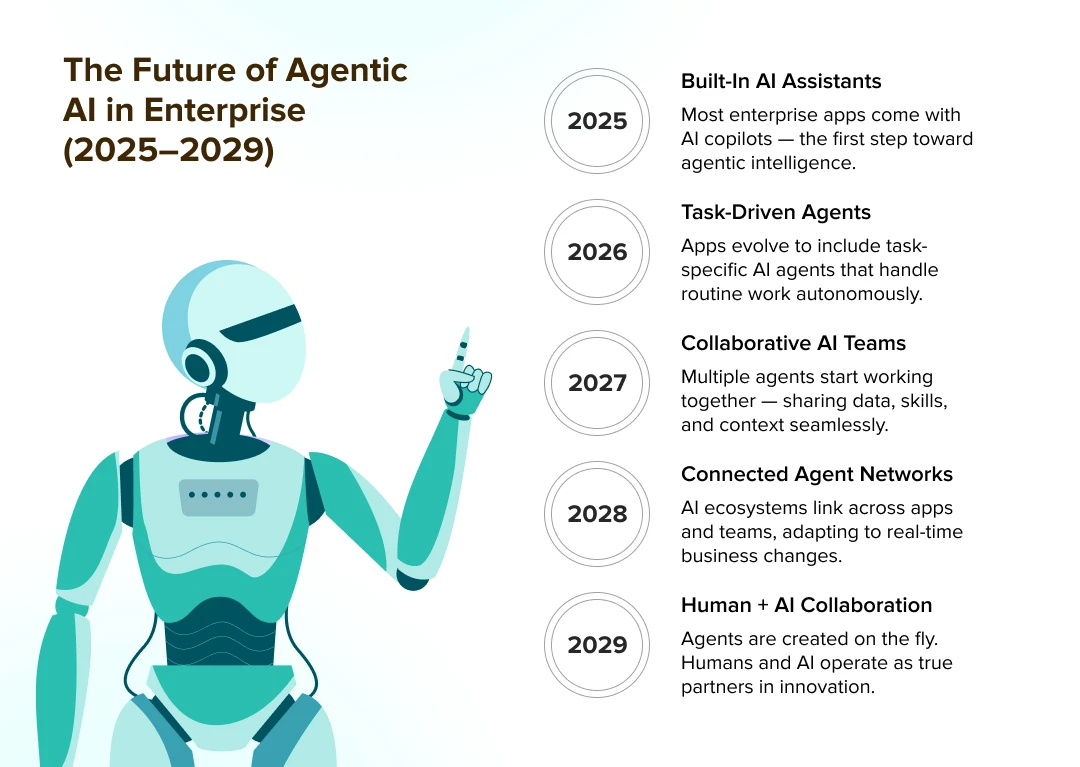
However, Gartner also warns that more than 40 percent of agentic projects may be abandoned by 2027 because many teams chase novelty rather than measurable outcomes.
For companies building AI in mobile apps or deploying AI agents for customer service, success will depend on human-centered design: deciding where autonomy ends and accountability begins.
In call-center trials, first-contact resolution rates have climbed to 89 percent when human agents supervise AI copilots instead of being replaced by them. The data suggest that augmentation, not substitution, delivers the real value.

3. Emotional Intelligence Comes to Machines
As algorithms grow capable of reading context, the next ambition is empathy. Affective computing—software that interprets emotion through language, tone, or expression—is moving into mainstream interfaces.
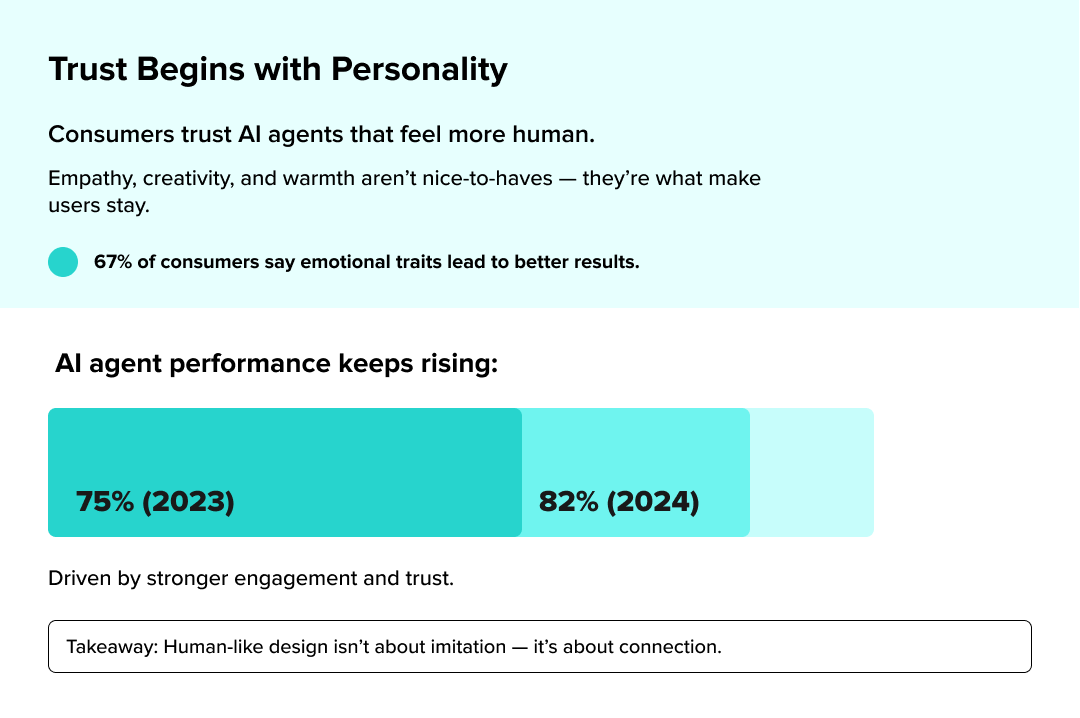
Research summarized by Zendesk shows that 67 percent of consumers are comfortable interacting with emotionally responsive AI with traits such as empathy, creativity, and friendliness.
Grand View Research estimated the global Emotion Detection & Recognition market at $47.28 billion in 2023 and projects it to reach $136.46 billion by 2030, growing at a CAGR of 16.0%.
The motivation is clear. Remote work, telemedicine, and digital learning have exposed how emotion influences engagement. Healthcare chatbots that detect vocal stress now escalate high-risk calls automatically.
In classrooms, adaptive tutors adjust lesson difficulty when they sense frustration. When done responsibly, emotional intelligence increases user trust and retention; when done poorly, it veers into manipulation.
Fei-Fei Li, director of Stanford’s Human-Centered AI Institute, warned during a TED Talk in 2024. She said,
“To realize this future won’t be easy. It requires all of us to take thoughtful steps and develop technologies that always put humans in the center.”
Her comment underscores why AI governance tools and ethics review boards must evolve alongside technology. As emotional AI enters marketing, therapy, and education, independent oversight will determine whether empathy becomes service or strategy.
4. Multimodal Interfaces Redefine Accessibility
Humans rarely rely on one sense at a time; our machines are learning to do the same. Multimodal AI —systems that integrate text, image, and sound—has moved from research labs to consumer devices. Gartner estimates that 40 percent of generative-AI solutions will be multimodal by 2027, a jump from just 1 percent in 2023.
OpenAI’s GPT-4o, Google’s Gemini 1.5, and Anthropic’s Claude 3 are examples of this convergence. Each can describe visuals, parse speech, and produce coherent cross-media responses.
According to McKinsey’s 2024 Digital Report, companies embedding multimodal models in devops workflows saw 25 percent productivity gains, especially in complex development-related tasks.
For developers working on AI in mobile apps, this means interfaces will soon rely on gesture, gaze, and image input as much as text. It’s a shift that broadens accessibility for people with disabilities and transforms content discovery.
Instead of typing, users might show an image and ask, “Find products like this.” The broader consequence is philosophical: technology that once required literacy will soon adapt to human instinct.
5. Memory and Continuity: Toward Persistent AI
Today’s assistants forget most of what you tell them. That limitation is vanishing fast. Persistent-memory models—capable of storing context across sessions—are being built into productivity and analytics suites. According to IBM’s Institute for Business Value, 60% of executives say employees will be interacting with AI assistants by the end of the year.
These systems use federated storage, so personal data remains local while summary insights sync securely to the cloud. The approach protects privacy while enabling continuity. Imagine an AI project manager that remembers deadlines, knows who approved last quarter’s design, and drafts next week’s report without re-training. That scenario is arriving faster in AI’s future than most expect.
Persistent assistants will also influence the growth of AI in customer retention by personalizing interactions across months instead of minutes. When paired with generative models, memory transforms AI from transactional to relational—a companion that evolves with its user.
As Arvind Krishna observed in this SXSW interview tagged above, “If you can do 30% more code with the same number of people, are you going to get more code written or less?”
The ability to remember context is how those people—and their digital counterparts—stay ahead.
6. The Industrial Turn: When Algorithms Meet the Assembly Line
Artificial intelligence is no longer a back-office experiment; it’s an operational layer spanning every sector. Recent analysis by the McKinsey Global Institute—as cited in The Simple Macroeconomics of AI (Acemoglu, 2024)—projects that AI and automation could raise average annual GDP growth in advanced economies by 1.5 to 3.4 percentage points over the coming decade.
In practical terms, that means productivity could accelerate most in data-rich industries such as healthcare, manufacturing, finance, and professional services, where automation can scale quickly.
Here’s a deeper analysis!
7. Healthcare: From Reactive to Predictive
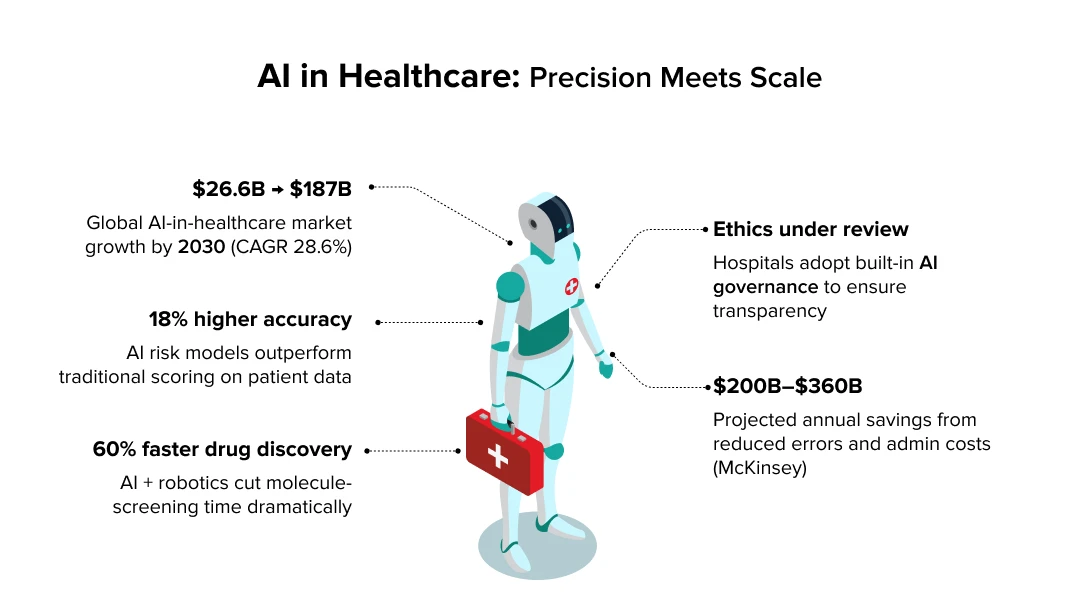
Few areas reveal AI’s potential more clearly than medicine. The global AI-in-healthcare market, as a Grand View Research report claims, is worth $26.57 billion in 2024 and projected to exceed $187 billion by 2030, at a CAGR of 28,62% between 2026 and 2030.
McKinsey projects that current AI, machine-learning, and deep-learning technologies could deliver $200 billion to $360 billion in annual savings across health-care systems through reductions in administrative overhead, misdiagnosis, and inefficient care.
Hospitals now use AI-enabled robotics and decision-support engines that match or surpass radiologist accuracy in early-stage cancer detection. Studies of AI-driven drug-discovery platforms report up to a 60% reduction in early-stage molecule-screening time when robotics, simulation, and machine-learning models are combined.
For example, one review published in a journal by Innovare Academics noted that AI integrated with organ-on-chip systems trimmed screening time by 60% and boosted prediction accuracy by 40%.
What triggers adoption is the convergence of digitized records and federated data access. A cardiovascular-risk model trained on millions of anonymized EHRs recently outperformed standard scoring by 18 percent. In practice, that means thousands of lives.
Yet IBM’s 2026 insights exploring AI’s future caution that explainability remains critical: a misdiagnosis by a medical AI is still a human liability. Ethical review boards now require algorithmic audit trails, pushing vendors to build AI governance tools directly into clinical platforms.
8. Finance: Automating Trust
The financial sector approaches AI with both enthusiasm and paranoia—an understandable pairing. Deloitte’s 2024 report on AI in banking is resulting in rising opportunities as well as risks. The report includes a forecast that U.S. fraud losses driven by generative AI could reach USD 40 billion by 2027.
Machine-learning engines now evaluate billions of transactions each second, cutting false positives by nearly half. AI also personalizes risk scoring: credit models using unstructured behavioral data improve loan-approval accuracy by 10 percent while reducing bias.
At the same time, regulators are tightening scrutiny. The U.S. OCC and the EU’s EBA both issued 2026 guidelines requiring algorithmic explainability in consumer-credit decisions.
This makes transparency a market differentiator. As IBM CEO Arvind Krishna said during IBM Think 2024, “Only 1% of enterprise data has found its way into any form of AI model so far.”
For developers integrating AI in banking or in other such sensitive use cases, compliance-ready architecture will soon be as important as accuracy itself.
9. Manufacturing and Logistics: The Automation Flywheel
Factories are evolving into self-regulating ecosystems. The C-suite consensus is overwhelming; executive surveys, including recent analysis from Deloitte, confirm that the vast majority of manufacturing leaders now view AI as a critical driver for competitiveness.
The primary target isn't just automation, it's foresight—the Grand View Research market report identifies machine learning for predictive maintenance as the dominant application, a trend that is fundamentally shifting factories from reactive repair to proactive optimization. The financial footprint of this shift is staggering.
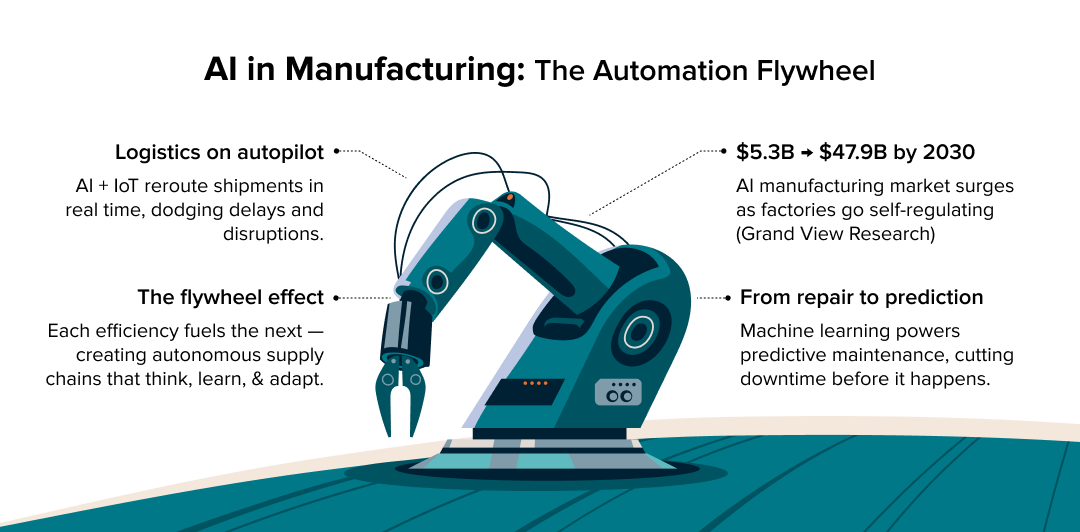
Projections from the same report value the AI-in-manufacturing sector at $5.32 billion in 2024, with a projected climb to $47.88 billion by 2030. Sensors stream machine data into cloud dashboards where AI use cases in process automation forecast part failures days in advance. Logistics giants combine computer vision with IoT telemetry to reroute shipments in real time, avoiding weather or labor disruptions.
The near AI’s future points toward autonomous supply chains that can self-correct inventory imbalances—an “automation flywheel” where each efficiency funds the next round of AI upgrades. But adoption brings concentration risk.
Market analysis highlights dominance among a handful of industrial-AI vendors, raising antitrust questions. For enterprises choosing between providers, the deciding factor will be interoperability: the ability to link automation, analytics, and cloud-based AI governance frameworks without lock-in.
10. Retail and Media: Hyper-Personal Everything
Retailers once chased demographics; now they pursue moments. The gold rush is on, though not without caution. Gartner's 2026 CMO Spend survey reveals a complex picture: while overall marketing budgets have tightened, 39% of CMOs—feeling constrained by resources and seeking to reduce labor spending—view generative AI as the critical tool to grow their impact far beyond their budgetary limits.
The market reflects this pivot, with Grand View Research projecting that the AI in the Media and Entertainment sector will swell from $25.98 billion in 2024 to $99.48 billion by 2030. Recommendation engines, as reports highlighting the situation of AI in the future suggest, are also now the standard.
Streaming platforms combine AI in gamification with sentiment analytics to keep viewers engaged longer. E-commerce brands embed AI in customer retention pipelines that tailor offers based on emotional cues picked up from language and browsing patterns.
The trigger is economic: as ad costs rise, personalization reduces waste. Yet privacy concerns remain palpable—Cisco’s 2026 Data Privacy Benchmark Study found that while 91% of organizations trust global providers for data protection, 90% also see local storage as inherently safer, creating a significant "trust vs. location" paradox for global brands.
11. Education: The Age of Adaptive Tutors
AI is also reshaping how people learn. Market forecasts from Precedence Research value the AI-in-education market at $7.05 billion in 2026, projecting it will surpass $112.30 billion by 2034.
The promise of efficiency is finally materializing; a 2026 survey from Gallup and the Walton Family Foundation found that teachers who use AI save an average of nearly six weeks per year on administrative work, time they can reinvest in student interaction.
Modern platforms now provide personalized lesson paths, voice-based question answering, and automatic evaluation using AI tools for educators.
However, equity remains the central challenge. The U.S. Department of Education's 2024 report warns not of a digital divide, but a "digital use divide," where affluent students leverage AI for creation and critical inquiry while lower-income students are siloed into drill-and-practice remediation, potentially widening existing learning gaps.
As Dr. Fei-Fei Li, a leading voice from Stanford, said it perfectly,
“I often tell my students not to be misled by the name ‘artificial intelligence’ – there is nothing artificial about it. AI is made by humans, intended to behave by humans, and, ultimately, to impact humans’ lives and human society.”
12. Energy and Climate: Intelligence for the Planet
Sustainability has become AI’s unexpected proving ground. The potential impact of this new AI trend is profound; multiple analyses continue to cite a landmark PwC report, which found that data-driven AI efficiencies could slash global CO₂ emissions by up to 4 percent by 2030—the equivalent of 2.4 gigatons.
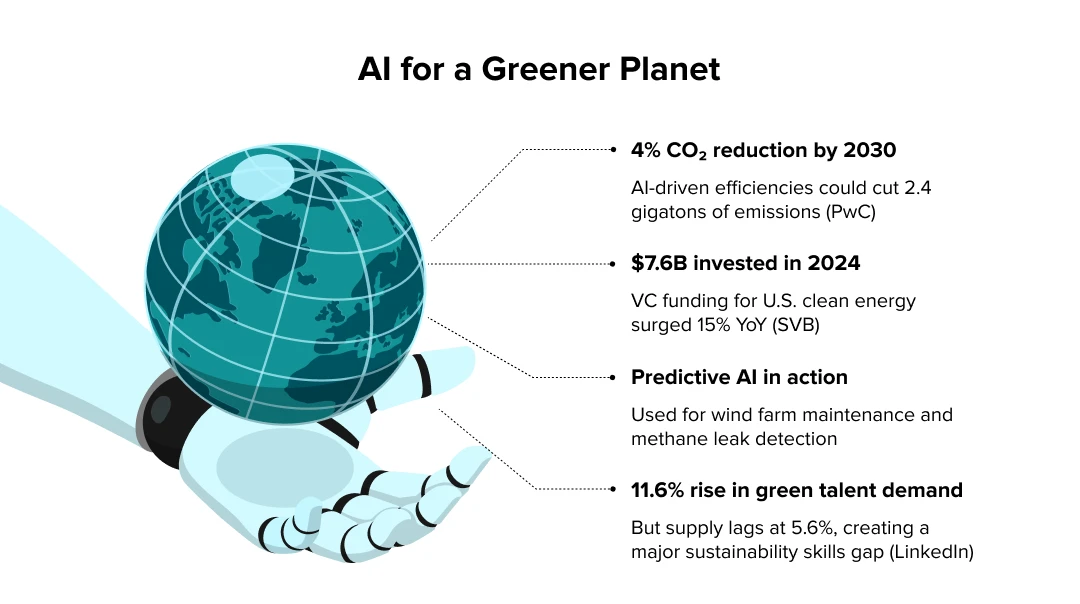
The investment spigot is wide open, with Silicon Valley Bank's 2026 "Future of Climate Tech" report tracking $7.6 billion in VC funding for US clean energy and power companies in 2024 alone. That marks a 15% YoY growth.
Utilities now deploy predictive maintenance on wind farms, while oil majors use machine vision to detect methane leaks. This fusion of AI and sustainability is giving rise to “green intelligence”—systems that optimize resource use automatically.
It’s also an emerging talent vortex. LinkedIn's 2024 Global Green Skills Report found that demand for green talent grew 11.6% in the past year, while the supply of qualified workers only increased by 5.6%, creating a critical skills gap.

13. Transportation: From Autonomy to Coordination
Autonomous vehicles have captured headlines, but the quieter revolution is traffic intelligence. The global AI-in-transportation market—valued by Research and Markets at $4.27 billion in 2026—is expected to grow to $9.02 billion by 2029. Cities are adopting AI-powered traffic monitoring systems that adjust signal timing dynamically.
Fleet operators use AI productivity tools to optimize fuel consumption. Still, regulation remains uneven. The OECD’s 2026 report on "AI, Machine Learning and Regulation" highlights the immense challenge of validating these systems, pushing regulators to develop entirely new frameworks for autonomous vehicles.
This shift in focus was summarized by Granicus’s AI leadership:
“Right now it is still a very niche market. I mean only in developed countries in that to you know very expensive cars are providing that functionality. You'll see that becomes more and more common even in places like India. I think already some of the top SUV manufacturers are having those sorts of self-driving options available, however, not completely. I mean you cannot have a car that drives on its own completely just yet in India but at least some functionality.”
-Ratnakar Pandey, AI & Data Science Consultant
14. The New Morality of Machines
Every technology revolution forces a moral reckoning. With AI, that reckoning is arriving sooner than expected. Governments are scrambling to keep pace while businesses weigh AI ethics against competitiveness.
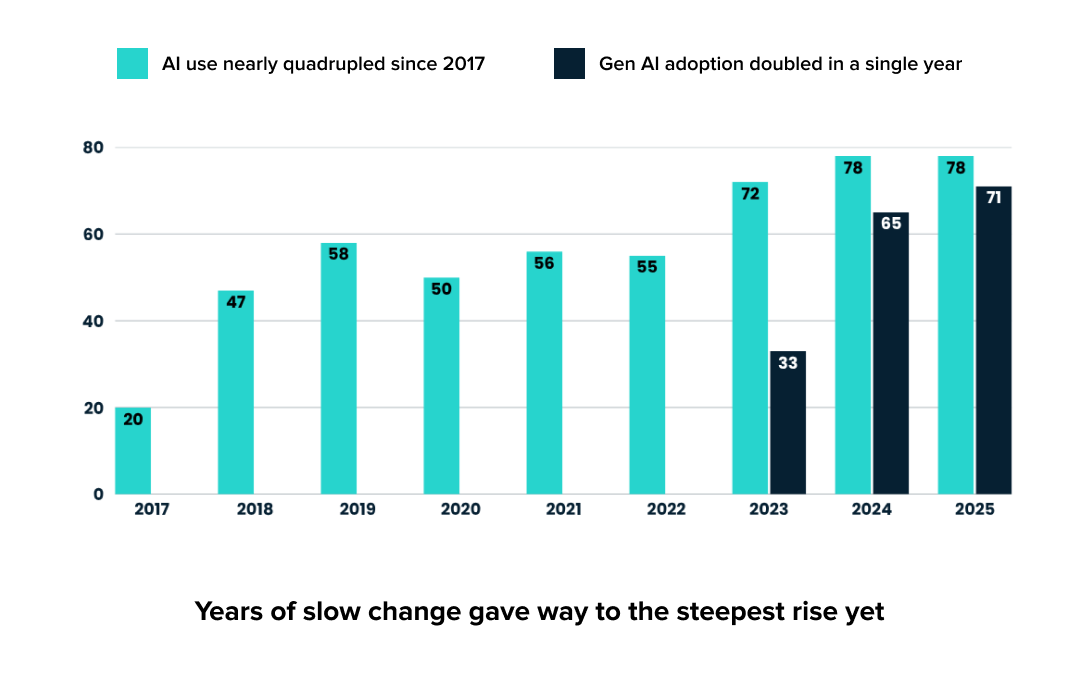
According to McKinsey’s 2026 "State of AI" report, adoption has soared: 78 percent of organizations now use generative AI in at least one function, up from 72 percent in 2024.
Yet according to Deloitte’s 2024 report on Ethics and Trust in Technology, the gap between policy and practice remains a chasm: respondents confirmed their organization either has no specific ethical principles for AI at all (37%) or they are simply unsure if any exist (9%). This is the gap where the next great risks—and opportunities—will emerge.
15. Regulation and Global Governance
The European Union’s AI Act, finalized in 2024, remains the world’s most comprehensive framework. It categorizes AI by risk level—from minimal to unacceptable—and mandates transparency reports for high-risk systems influencing new AI trends. The U.S., Japan, and India are following suit with sector-based standards rather than blanket laws.
Gartner’s AI Governance Forecast 2026 predicts that by 2027, half of global enterprises will adopt internal AI-compliance tools. In response, vendors are developing AI governance tools and platforms that track algorithmic lineage, versioning, and audit results automatically.
Ethical oversight is also going multinational. The United Nations’ Global Digital Compact (finalized in 2024) pushes for distributed governance and cross-border cooperation on data and AI.
Yet experts warn that enforcement remains fragmented. Bottom-up regulation, driven by corporate transparency and consumer pressure, may ultimately shape more behavior than top-down decrees.
This sentiment—that ethics must be part of the core architecture—now guides many public-sector RFPs that require explainability-by-design from all artificial intelligence development companies bidding on contracts.
16. The Accountability Question
As AI gains autonomy, accountability becomes harder to pinpoint. If a generative model plagiarizes content or a medical algorithm misdiagnoses a patient, who bears responsibility—the developer, the user, or the AI itself?
Legal systems worldwide are struggling to answer.
In 2026, the EU moved forward with its updated Product Liability Directive, which explicitly includes software and AI systems, making it easier for consumers to seek recourse for harm. The framework draws from product safety protocols and could become a global precedent.
Meanwhile, Canada and Singapore have piloted governance frameworks like the Artificial Intelligence and Data Act (AIDA) and the AI Verify Foundation, which require continuous performance audits and risk assessments.
Deloitte’s 2024 "State of Ethics and Trust in Technology" report found that 54 percent of executives consider cognitive technologies (like AI) to pose the most severe ethical risks of any emerging tech. The business impact is tangible: companies that publicly disclose AI policies report higher consumer trust.
Ethical accountability isn’t just a compliance checkbox—it’s now a brand asset.
17. Privacy, Synthetic Data, and Federated Learning
Synthetic data remains the raw material of intelligence, yet privacy laws are rewriting how that material can be used. The global synthetic data market, valued by Fortune Business Insights at $288.5 million in 2024, is expected to reach $2.34 billion by 2030. Synthetic records allow organizations to train models without exposing personal information.
Parallel to that, federated-learning architectures enable decentralized training: devices process data locally and share only model gradients with central servers. IBM’s "Trustworthy AI" framework identifies this as a cornerstone of “privacy-preserving intelligence.”
For industries like finance, healthcare, and education, synthetic data and federated AI combine compliance with performance. However, even these innovations face scrutiny. The European Data Protection Board is evaluating whether generated datasets truly anonymize individuals, and experts caution that poorly designed synthetic datasets can still leak identity through correlation attacks.
18. AI Safety and Existential Risk
AI safety has shifted from a philosophical debate to an industry category.
The "AI Vulnerability Scanning Market" is valued at $2.61 billion in 2024 and is forecast to exceed $5.7 billion by 2029, according to The Business Research Company. Governments are founding dedicated AI Safety Institutes—the U.K. in 2023, followed by Japan and the U.S. in 2024—to evaluate frontier models for bias, misuse, and unintended capabilities.
Corporate adoption mirrors this urgency. Many large enterprises now run internal “red-teaming” units to stress-test models for security vulnerabilities and prompt injections. The discipline borrows from cybersecurity, blending risk assessment and continuous validation.
Elon Musk, during a 2021 interview on the Lex Fridman Podcast, remarked:
“People in the A.I. community refer to the advent of digital superintelligence as the singularity. That is not to say that it is good or bad, but that it is very difficult to predict what will happen after that point. And that there’s some probability it will be bad, some probability it will be good. We obviously want to affect that probability and have it be more good than bad.”
The real challenge is scale. Gartner analysis warns that by 2026, “death by AI” legal claims will exceed 2,000 due to insufficient AI risk guardrails. As AI spreads in customer service, marketing, and industrial automation, maintaining human oversight across billions of inferences will become one of the decade’s defining technical feats.
19. The Information Integrity Battle
Generative AI’s power to create realistic text, video, and speech has a darker side. The Sumsub Identity Fraud Report 2024 noted a 4x increase in the number of deepfakes detected worldwide from 2023 to 2024. The report also highlighted that deepfakes have become "deeply entrenched" fraud tools, accounting for 7% of all fraud in 2024.
To combat this, governments and tech consortia are developing digital watermarking standards like C2PA and content credentials integrated into image metadata.
Platforms such as Adobe Firefly and OpenAI’s DALL·E now embed invisible tags identifying AI generation. Still, the arms race continues.
McKinsey’s 2026 risk brief argues that misinformation mitigation will soon require hybrid detection—AI systems trained to identify other AIs. This creates a feedback loop where defense evolves at the pace of deception.
The business takeaway is straightforward: enterprises deploying AI in social media or marketing must invest as heavily in authenticity verification as they do in creative automation. Transparency isn’t just ethical—it’s survival.
20. Toward Ethical Infrastructure
The final piece of the puzzle is cultural. Technology cannot self-regulate; people do. The organizations that thrive in the AI era will treat ethics as infrastructure, embedding fairness and accountability into product lifecycles rather than bolting them on afterward.
Microsoft CEO Satya Nadella articulated this sense of responsibility at the World Economic Forum in 2024:
“I don't think the world will put up anymore with any of us (in the tech industry) coming up with something that has not thought through safety, trust, equity... These are big issues.”
That statement captures a fundamental truth: the future of artificial intelligence will be won not by those who move fastest, but by those who move responsibly.
21. The Technology Curve Steepens
AI’s rapid climb owes as much to hardware as to algorithms. Every leap in computing power shortens the distance between research and real-world impact. In 2026, the frontier looks less like science fiction and more like infrastructure — dense networks of models, chips, and frameworks quietly automating billions of small decisions each day.
The convergence of generative models, edge computing, and quantum acceleration is rewriting performance benchmarks across industries. As McKinsey notes in its Tech Trends Outlook 2026, the companies capturing disproportionate AI value are those that treat innovation as a system, not a project.
This has resulted in over $124.3 billion in equity investments for AI firms in 2024 and a rise of 35% AI-based job postings between 2023 and 2024.
22. Generative AI: From Novelty to Necessity
Generative AI has evolved from curiosity to corporate muscle. According to Statista (2024), the global AI market is valued at $184 billion in 2024, on pace to exceed $826.7 billion by 2030. McKinsey (2023) estimates its economic contribution could reach $4.4 trillion annually, matching the GDP of Japan.
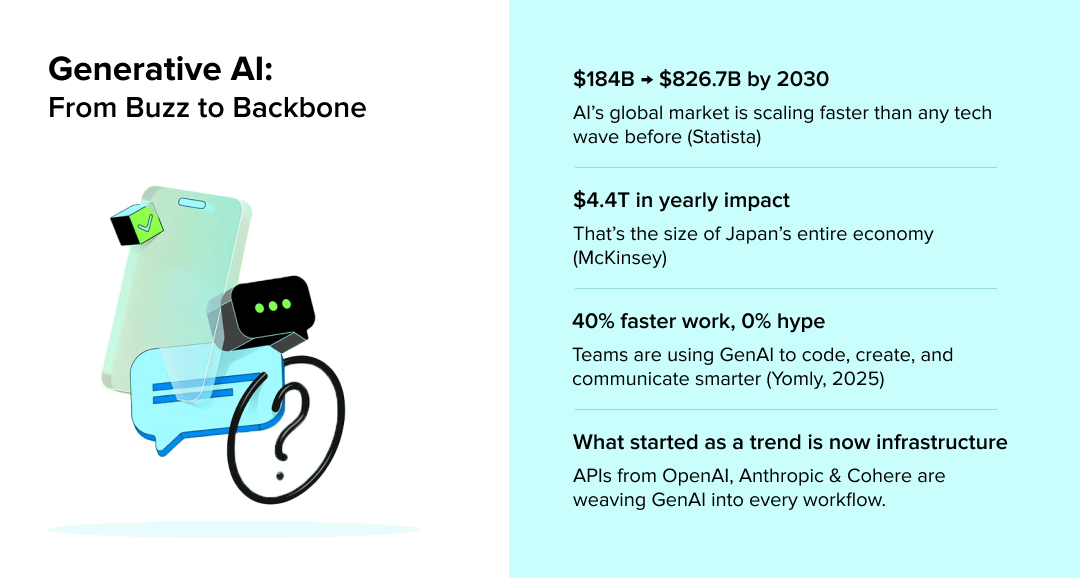
That momentum stems from practical value, not hype. A 2026 analysis from Yomly (confirming earlier 2023 studies) found that GenAI can make workers 40% faster on complex tasks. Developers use it to accelerate software testing; marketers use it for real-time content generation.
And unlike the early wave of consumer experimentation, enterprise adoption now drives growth. What’s next is integration, as APIs from OpenAI, Anthropic, and Cohere merge into business workflows, treating content generation as a service layer rather than a creative department.
As Sam Altman said in an interview with Salesforce,
“We’re going to get better art than we’ve ever had before, but still, AI will be a tool that amplifies humans, not replaces them.”
23. AutoML and the Democratization of Model Building
AI development once required PhDs; now it’s entering the low-code era. According to Coherent Market Insights (2026), the AutoML market will rise from $4.65 billion in 2026 to $73.66 billion by 2032, growing at a 48.4% CAGR. AutoML (Automated Machine Learning) enables “citizen developers” to train models using drag-and-drop interfaces, drastically reducing dependency on data-science teams.
While this expands access, it also magnifies governance challenges. Unvetted models trained on biased or incomplete data can reinforce systemic errors.
McKinsey’s 2026 analysis warns of "agent sprawl—the uncontrolled proliferation of redundant, fragmented, and ungoverned agents," which can "quickly become operational chaos." Successful organizations are therefore building "structured governance, design standards, and life cycle management" and deploying "agent-specific governance mechanisms."
24. The Edge AI Revolution
The next wave of intelligence is moving closer to where data is generated. Market.us (2026) values the edge AI market at $28.8 billion in 2026, projected to surpass $196.6 billion by 2034. Edge computing allows models to process information locally, reducing latency and improving privacy.
AI predictions for the future state, in sectors such as manufacturing, healthcare, and finance, this model is becoming the default. Diagnostic devices now analyze scans directly on embedded chips, while retail sensors detect shelf stock-outs without cloud calls.
Federated architectures combine these nodes into collective learning systems. By 2026, Gartner (2026) expects 40% of enterprise applications will be integrated with task-specific AI agents, many of them operating at the edge—a quiet but profound decentralization of intelligence.
25. Neuromorphic and Quantum Computing
Hardware is undergoing its own renaissance. Neuromorphic chips—designed to mimic the human brain—promise orders-of-magnitude efficiency improvements. Science.org research on its NorthPole chip highlights prototypes achieving 25x energy savings compared to traditional GPUs in tasks like vision recognition.
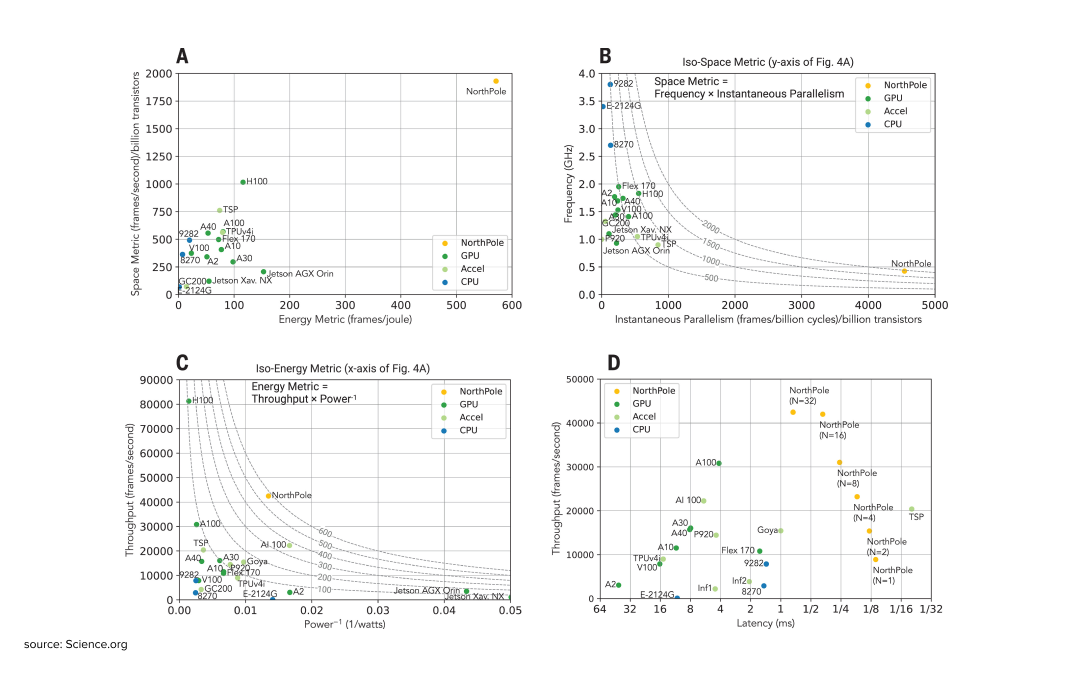
Parallel to that, quantum computing is transitioning from theory to early commercialization. McKinsey’s 2026 "Quantum Technology Monitor" projects that by 2035, hybrid quantum-AI architectures could deliver up to $2.0 trillion in value, addressing problems “intractable for classical supercomputers,” such as molecular modeling or climate forecasting.
Nvidia CEO Jensen Huang framed this principle perfectly at the GTC 2024 keynote. When unveiling the new Blackwell chip.
“General-purpose computing has run out of steam. We need another way of doing computing, so that we can continue to scale, so that we can continue to drive down the cost of computing, so that we can continue to consume more and more computing while being sustainable.”
25. Robotics and Embodied Intelligence
AI’s embodiment in physical machines marks another threshold. The global robotics market—valued by Statista at $50.38 billion in 2026—is projected to exceed $60.02 billion by 2030.
Modern robots combine vision models, proprioceptive feedback, and real-time planning, influencing the future of artificial intelligence significantly. Factories deploy collaborative “cobots” that safely share space with humans; hospitals use delivery bots guided by AI use cases in robotics.
Boston Dynamics’ latest generation integrates reinforcement learning to adapt gait patterns instantly.
Demis Hassabis of DeepMind, speaking at the All In Summit 2026, reflected,
“For an AI to be truly general—to build AGI—we feel that the system needs to understand the world around us and the physical world around us, not just the abstract world of languages or mathematics.”
That statement captures why embodied AI will define the next design frontier: merging physical and digital fluency.
26. The Human Equation: Work, Skills, and Reinvention
Technology changes faster than people do, but every major leap eventually redefines what “work” means. Artificial intelligence is doing it again — quietly rewriting the rules of employment, productivity, and creativity.
According to McKinsey’s 2024 analysis, up to 30 percent of hours worked in the United States could be automated by 2030, while 44 percent of workers’ core skills are expected to be disrupted in the next five years, as reported by the World Economic Forum (2023). Yet, the story isn’t about disappearance — it’s about redesign.
McKinsey’s 2024 report estimates that while automation may lead to almost 12 million occupational transitions in the U.S. by 2030, new models project significant augmentation and new role creation. IBM’s 2023 workforce brief found that 87 percent of executives expect AI to augment roles rather than replace them.
27. Augmentation, Not Replacement
The near future of work will hinge on augmentation — humans and machines enhancing each other’s strengths. AI copilots embedded into office suites now summarize meetings, generate code, and craft reports in seconds.
Microsoft’s 2026 Work Trend Index showed that 82 percent of leaders now expect to use artificial intelligence agents at work, with 47% percent prioritizing training the existing workforce in AI-based skills.
In call centers, AI copilots manage data retrieval while humans focus on empathy and negotiation. In journalism and marketing, generative models handle first drafts while editors refine tone and accuracy. This shift reframes the labor economy around orchestration — people guiding fleets of intelligent agents rather than performing every task themselves.
The companies investing early in AI productivity tools and training programs are building an advantage that transcends cost savings — they’re future-proofing their people.
28. Reskilling at Scale
As with every industrial shift, reskilling determines who benefits and who’s left behind.
IBM’s Skills Transformation Report highlights that 40 percent of global workers will need retraining within three years to adapt to AI integration. Encouragingly, 87 percent of surveyed executives plan to increase learning budgets for technical upskilling.
McKinsey’s 2024 "Technology Trends Outlook" confirms that firms that actively reskill employees see higher returns from AI investments, noting a "wide skills gap" for high-demand tech skills. The reason is simple: cultural fluency with AI amplifies its impact.
To meet this demand, universities and training startups are turning to evolving future AI tools for educators and adaptive-learning systems. LinkedIn's 2024 reports highlight that AI skills are becoming a critical hiring differentiator.
29. The Rise of the Virtual Workforce
The next stage of automation isn’t physical — it’s cognitive.
Virtual AI employees, built from generative and agentic architectures, can already perform defined workflows: drafting marketing copy, analyzing contracts, or answering Tier-1 support queries.
According to Gartner’s AI future predictions, by 2028, organizations that automate 80 percent of customer-facing processes with multi-agent AI will "dominate" their peers.
These systems complement human teams rather than replace them outright. For example, an HR department might deploy an AI agent to handle onboarding paperwork, freeing managers to focus on retention and morale. In marketing, autonomous campaign optimizers adjust ad spend hourly across channels, using AI in marketing for precise, goal-driven alignment.
This hybrid model — humans for empathy and complexity, AI for scale and precision — defines the modern “virtual workforce.” As adoption deepens, governance will remain vital: companies must apply AI regulation frameworks and external audits to prevent bias or privacy violations.
30. Economic Ripples: From Micro-Tasks to Mega-Markets
The economic impact of AI extends far beyond efficiency metrics. A 2023 report from Bloomberg Intelligence projects the generative AI market could explode to $1.3 trillion by 2032.
In developing economies, AI could close infrastructure gaps. The World Bank’s 2026 policy brief identifies AI-enabled agriculture and logistics as key accelerators for emerging markets, potentially lifting GDP growth by up to 1.2 percentage points annually in Southeast Asia and Sub-Saharan Africa.
However, economic concentration remains a concern. Gartner’s analysis of AI industry trends warns that data ownership is consolidating rapidly among a handful of cloud providers, echoing the early internet era. Policymakers influencing the future of artificial intelligence are exploring open-source AI agents and interoperability standards to ensure the market remains competitive.
31. The Cultural Shift: Coexistence, Not Control
The future of AI is neither utopia nor apocalypse — it’s coexistence.
In daily life, AI will quietly mediate decisions, enhance creativity, and simplify the complex. In business, it will demand humility from leaders: the courage to experiment and the restraint to pause when ethical lines blur.
As researcher Ben Shneiderman articulated, the core task is "Bridging the gap between ethics and practice: guidelines for reliable, safe, and trustworthy human-centered AI systems".
That insight sums up the cultural challenge ahead. Organizations that view AI as a collaborative partner — not a cost-cutting weapon — will build more sustainable, trusted brands in the years to come.
The Road Ahead
The trajectory defining the future of AI technology can be summarized in three words: integration, governance, and partnership. Integration, because AI is no longer a separate technology but a foundation that underlies all digital activity. Among the most impactful future technology trends, AI is rapidly becoming the backbone of digital transformation across industries.
And partnership, because the collaboration between human intuition and machine precision will be the hallmark of competitive advantage. By 2030, nearly every app, workflow, and service will include an intelligent layer.
AI in healthcare will predict illness before symptoms appear; AI in social media will curate healthier digital spaces; AI in mobile apps will personalize interfaces so fluidly that interaction will feel organic. The difference between success and obsolescence won’t be who uses AI — it will be who uses it wisely.
Frequently Asked Questions
What is the future of AI?
AI is set to become an invisible infrastructure powering every industry. Verified 2025 data from Statista and McKinsey show rapid adoption across healthcare, finance, and education — with the global market projected to exceed $740 billion by 2030.
How will AI affect jobs?
McKinsey predicts automation could impact 30 percent of tasks worldwide, but new opportunities in AI operations, governance, and ethics will more than offset losses.
Why is AI important to the future?
Because it amplifies human potential — turning insight into action faster than any previous tool, from diagnosing diseases to building smarter cities.
What will AI look like in the future?
Smaller, specialized, and seamlessly embedded. AI will move from large centralized models to federated, context-aware systems running locally on devices and networks.
How will AI change the world?
Through scale. From AI in customer retention to AI in robotics, every application compounds efficiency and learning — reshaping how societies allocate time, talent, and trust.
Can AI predict the future?
Not really — at least not in the way people imagine. What these systems actually do is recognize patterns and make informed guesses based on what’s happened before. A bank might use it to flag potential market changes; a hospital could use it to spot warning signs in patient data.
Those small, evidence-based forecasts are where the future uses of AI feel most real — not as fortune-telling, but as a smarter way to read what’s already unfolding. The results can be powerful, though they’re never certain, and that uncertainty is what keeps humans in the loop.
How will AI affect the future?
Probably in ways we’ll only notice after they’ve already happened. The current trends in artificial intelligence show it weaving quietly into daily routines — recommending what to watch, helping doctors plan treatments, even improving how teachers track progress.
Over time, the future uses of AI will shift from doing tasks for us to working alongside us, shaping decisions and creative work without taking them over. The real transformation won’t come from the tech itself, but from how thoughtfully people choose to apply it.
Is AI the future?
In many ways, yes — though not in the sci-fi sense most people imagine, the latest AI trends show that artificial intelligence is no longer a separate innovation but part of the fabric of everyday technology.
It powers the tools we use at work, the services we rely on for health and learning, and even the apps that shape how we communicate. What makes it “the future” isn’t the code itself, but the shift in mindset it inspires — a move toward systems that learn, adapt, and improve with us. AI isn’t replacing human progress; it’s becoming one of the ways we drive it.

Uncover executable insights, extensive research, and expert opinions in one place.
Related Content