- Step 1: Segment and Define Your Audience
- Step 2: Establish SMART Objectives in line with Business Objectives
- Step 3: Develop a Coherent Core Brand Message
- Step 4: Develop Your Multimedia Strategy
- Step 5: Build a Multi-Channel Content Strategy
- Step 6: Construct the Operating Infrastructure
- Step 7: Implement Your Integrated Marketing Campaign Plan
- Step 8: Continuous Optimization and Performance Measurement
 Share It On:
 Scattered campaigns cost you growth. Discover how an integrated marketing plan can align your strategy, messaging, and execution before inefficiencies start draining your ROI.
A scattered marketing strategy can no longer work in a world where the average consumer is exposed to thousands of brand messages every day. The brands that are winning are the ones with a distinct, coherent voice - speaking with one voice on all platforms their audience occupies. And that is what a well developed marketing plan based on the principles of the integrated marketing communications (IMC) helps you achieve.
Laying down a baseline integrated marketing strategy is one of the most highly-leveraged investments you can make, whether you are a startup working out your first go-to-market strategy or an established organization reworking its outreach. The guide takes you through the entire process, including audience research and goal-setting, channel selection, campaign implementation, and optimization, to create an IMC plan that really converts.
What Is an Integrated Marketing Plan?
An integrated marketing plan is a coordinated approach where all your marketing channels, messages, and teams are coordinated to one brand voice and share the same set of objectives. Instead of considering social media, email, content, paid ads, and PR as silos, integrated marketing planning links them together as one cohesive structure.
The term originates from Integrated Marketing Communications (IMC), a discipline pioneered by Northwestern University's Medill School, which views every customer touchpoint as part of a continuous brand conversation. It is not merely that a great IMC marketing plan coordinates the channels but it makes certain that all the content, all the advertisements and all customer touchpoints are reinforcing the same core message.
So, what is an integrated marketing plan exactly? Consider it as the grand plan your whole marketing organization operates off of - the one that defines audience segments to channels, channels to content, and content to quantifiable business results.
Why an Integrated Marketing Plan is a Must in 2026
Marketers have never had more at stake. Consumers are split between dozens of platforms, ad fatigue is a reality, and audiences have never been able to block out irrelevant messaging more than now. Here’s why creating an integrated marketing plan needs to be on the agenda of all marketing leaders:
1. Consistency is Key to Trust and Revenue
A consistent messaging across channels has been proven to drive much better differentiation, stronger brand recognition and increased conversion rates. Seeing the same value proposition on Instagram, in their inbox and on your website, you gain credibility, and credibility sells.
2. Efficiency Multiplies Impact
A coordinated communications strategy enables units to recycle content smartly across channels, saving on production and maximizing reach. One thought-leadership article can be the source of a LinkedIn post, an email newsletter, a short-video script, and a podcast episode, all supporting the same campaign story. For brands looking to streamline video production, platforms like Higgsfield offer an AI Video Generator as part of a broader creative workflow.
3. Data Becomes Actionable
Attribution is less messy when all the channels are running out of the same integrated marketing campaign plan. With the first social touchpoint to the last email click, you can get a 360-degree perspective of what is working and where your marketing dollars should flow next.
4. Teams Work Smarter
One of the characteristics of a good IMC plan is cross functional alignment. Once the content, paid media, PR, and sales are all playing off the same playbook, redundant effort is eliminated, and campaign momentum grows.
Developing a Step-by-Step Integrated Marketing Plan
The framework below is based on the best practices applied by the most successful IMC practitioners and can be traced to the evidence-based approach promoted by such programs as the Medill IMC Professional curriculum. This is what it takes to develop a performing integrated marketing plan.
Step 1: Segment and Define Your Audience
Any successful marketing strategy begins with an in-depth knowledge of the individuals you are targeting. Before you write a line of copy or settle on a channel, you must know:
- Who are the customers you wish to reach? Psychographic, geographic location, demographics, income, lifestyle.
- What are their issues? The pain points that put them in the search of solutions in the first place.
- What is the way they consume content? What platforms they are on, when they are most active, and what formats are their favorites.
- Why do they make such purchases? Reviews, prices, brand values, expert suggestions?
Begin with an analysis of current customer statistics: CRM records, web analysis, social listening tools, and previous campaign performance. Where you have gaps in an integrated marketing plan (new product or market), qualitative research (interviews, focus groups) and competitive analysis might be used to complete the picture.
Based on this study, create buyer personas - fictional, detailed portraits of your dream clients. Each persona must have behavioral motives, content desires, channel choice, and typical objections. These personas will serve as your guiding light in the whole integrated marketing planning process.
You can divide your audience into two or four groups at the most. Messaging gets diluted as a result of over-segmentation. Mobilize your efforts towards the areas that have the greatest potential to generate revenue and that are most strategic.
Step 2: Establish SMART Objectives in line with Business Objectives
The results of your IMC plan must produce business results that are important to the business such as revenue, market share, customer acquisition or brand awareness.
Organize your goals with the help of the SMART framework:
| SMART Component | Definition | Example |
|---|---|---|
| Specific | Clearly defined, not vague | "Increase qualified leads from mid-market SaaS buyers" |
| Measurable | Quantifiable target | "By 25%" |
| Achievable | Realistic given resources | Within current team capacity and budget |
| Relevant | Tied to a business priority | Supports Q3 pipeline growth target |
| Timely | Deadline-bound | "By September 30, 2026" |
An entire SMART objective of an IMC marketing plan would be: To achieve 25% more sales-qualified leads with mid-market buyers of the SaaS solution by the end of Q3 2026, as measured by CRM attribution.
Establish two levels of goals: campaign-level goals (what every individual integrated marketing campaign plan is meant to accomplish) and program-level goals (the broad results your entire integrated marketing communications plan is striving to accomplish). This two-tier system allows teams to stay performance-oriented in the short term and stay within view of the long term.
Step 3: Develop a Coherent Core Brand Message
This is the key to your combined communication plan. All channels in your integrated media strategy: social, email, content, paid search, PR must all have a single voice.
Your core brand message should include the following:
- Your Value Proposition: The main advantage that you present to customers, but not in your own words. Present it in a way that highlights what benefits them, and why they should choose you.
- Your Brand Personality: The emotional register, tone, and style of your messages (bold, empathetic, authoritative, playful, etc.).
- Your Evidence: The information, case study, testimonials and statistics that supports your value proposition.
- Your Differentiator: What makes you the correct option among all the available options.
When you have these four elements, boil it down to a messaging hierarchy, a master document that will guide all of your campaigns by your whole team, the creative brief. It is this hierarchical of messaging that makes the execution of integrated marketing communication plan consistent but not robotic.
A critical difference: An online LinkedIn post and a 30-second video advertisement will have a different look and feel, yet should both elicit the same brand perception, the same value proposition, and address the same need among the audience.
Step 4: Develop Your Multimedia Strategy
The choice of channels used is one of the most often-dining decisions to make when creating an integrated marketing plan. The misplaced channel mix indicates that your best content goes to the wrong individuals - or even no one.
Never rely on an integrated media plan based on an assumption. Analyze:
- Where your target audience is located in the online space (platform analytics, survey data).
- Where your competition is gaining ground in n competitive places (competitive intelligence for digital marketing)
- What channels have worked best in the past with your category?
- What are the new avenues your audience is moving towards?
An average integrated marketing strategy in 2026 may comprise a mix of:
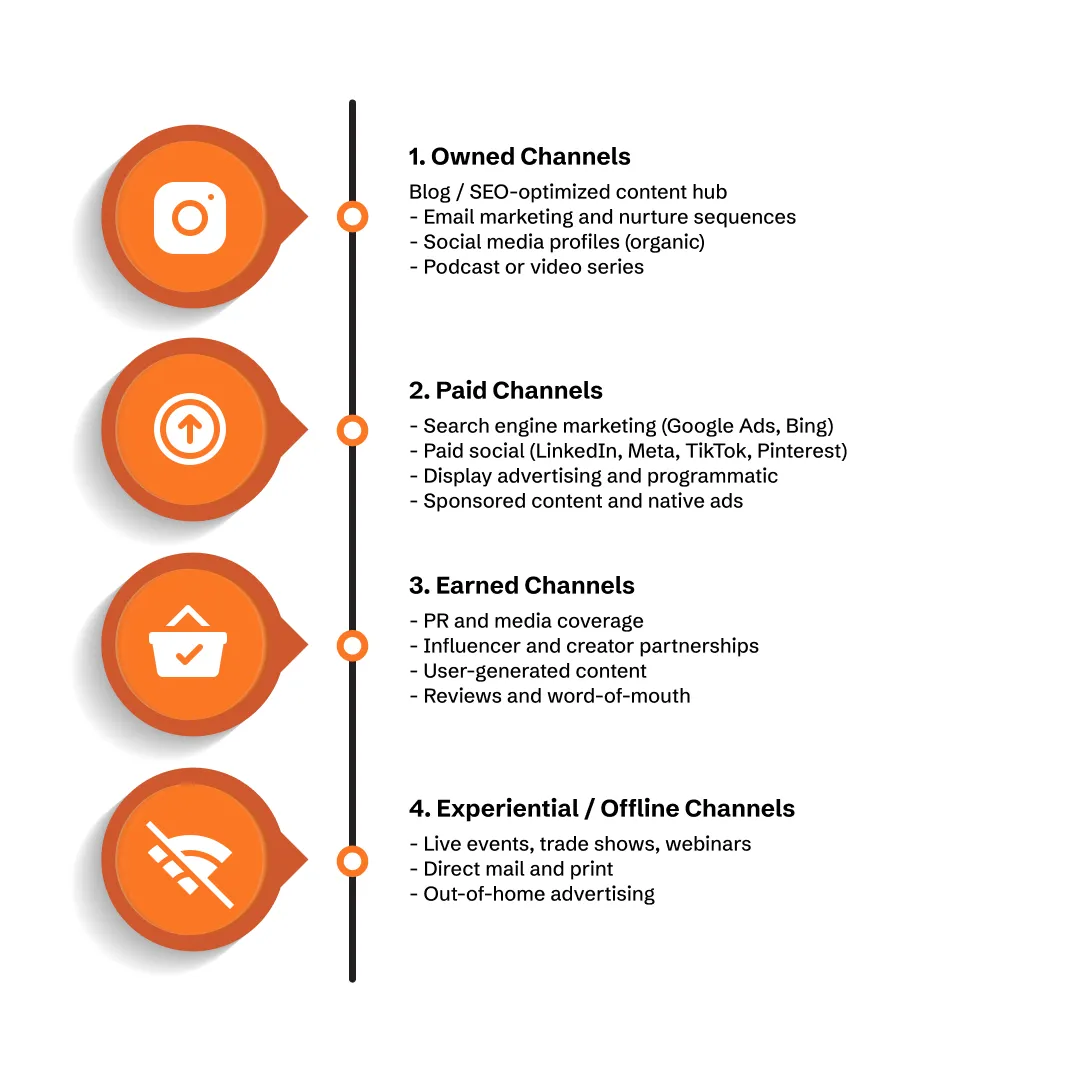
The revival of traditional media is one of the trends that will influence the choice of integrated media plans in 2026. With consumers reacting against screen overload, print, radio, live events, and direct mail are reemerging. The most advanced integrated marketing strategies incorporate the digital accuracy with the heart and soul of physical and experiential touch points.
The communications strategy of your integrated communications must be designed around the point where your audience actually exists, not where it will be most convenient to implement.
| You Might Also Like: Key Marketing Strategies to Grow Your Business
Step 5: Build a Multi-Channel Content Strategy
After choosing your channels, it is time to start mapping content to each step of the buyer journey across all channels.
Let’a take a look at the buyer journey framework:
| Stage | Goal | Content Types |
|---|---|---|
| Awareness | Introduce your brand to new audiences | Blog posts, social content, PR, SEO articles, video ads |
| Consideration | Educate and build preference | Case studies, webinars, comparison guides, email nurtures |
| Decision | Convert interest into action | Demo offers, testimonials, ROI calculators, free trials |
| Retention | Deepen loyalty and drive repeat purchases | Onboarding content, newsletters, loyalty programs, community |
For each stage and channel, define the following:
- Form of content (video, long-form, infographic, carousel, podcast, etc.)
- Messaging angle (awareness content focuses on the problem; decision content focuses on the solution)
- Call to action (what do we want the audience to do next)
- Publication rate (frequency, and when)
Repurposing serves as your efficiency generator in an integrated, multi-channel marketing campaign strategy. One pillar content, such as a general 3,000-word guide on your big subject, can be broken down into an article on LinkedIn, a three-part email sequence, five pieces on social media, an infographic, a short YouTube video, and a webinar. All versions are inherent to their channels and support the same theme of the campaign.
More importantly, add personalization at every layer, as far as your tech stack supports. Segment your message to your audience. A small business owner and an enterprise procurement manager both have an interest in your software product, albeit to very different extents. The integrated marketing communication plan must also address the unique motivations of the segments, directly.
Step 6: Construct the Operating Infrastructure
An integrated marketing plan will work well only if you build a system that fully supports it.Prior to initiating your initial campaign, make sure you have the proper infrastructure at hand:
1. Technology Stack
- CRM Platform (e.g., Salesforce, HubSpot): collects customer data in one place and allows personalizing it on the scale.
- Marketing Automation (e.g., Marketo, Klaviyo, HubSpot): Automatic email series, lead ratings, and cross-channel events.
- Analytics Suite (e.g., Google Analytics 4, Mixpanel): Monitors the performance on all channels.
- Content Management System: Stores and organizes your own content.
- Project Management Tool (e.g., Asana, Monday.com): Helps you stay on track of your timelines, deliverables, and dependencies.
2. Governance and Workflow
- Create a content calendar, which will map all of the campaign touchpoints in all of the channels and provide the entire team with the idea of what is publishing, when, and where.
- Establish approval processes so that all the content is subjected to the brand and compliance review and subsequently becomes live.
- Build a common asset bank: logos, fonts, photography, copy advice, accepted boilerplate - so that all staff in the team can work on-brand, without having to feel bottlenecked.
The lack of this operational backbone will bring even the most brilliant IMC plan to the ground with the chaos of execution.
Step 7: Implement Your Integrated Marketing Campaign Plan
With strategy, content, and infrastructure in place, it's time to launch. Effective execution of an integrated marketing campaign plan requires:
Pre-Launch Checklist:
- Any material checked, authorized, and scheduled on channels.
- UTM parameters, conversion events, and tracking pixels set.
- Team briefing on campaign objectives and messages as well as their respective tasks.
- Defined escalation paths of real-time problems.
Rather than dropping everything simultaneously, consider sequenced launches that build momentum. For instance, start with a teaser email to your current list, do a gated content release to lead capture, and then kick it off with paid social targeting lookalike audiences, and then end with PR push to earned media contacts.
This sequenced strategy builds a story line that transforms a single integrated marketing campaign strategy into a lasting experience with the audience, instead of a noise burst.

Step 8: Continuous Optimization and Performance Measurement
Data-driven optimization is what separates a good marketing plan from a great one. After launch, your integrated marketing communications plan should include a regular cadence of performance review and iteration.
Target conversion oriented KPIs instead of vanity metrics. Major steps towards any imc plan would be:
- Conversion Rate: The proportion of your audience that engages in doing what you want them to do (purchase, sign-up, demo request).
- Click-Through Rate (CTR): The proportion of users using your CTAs - the initial measure of message-channel fit.
- Cost Per Acquisition (CPA): The overall amount spent per overall conversions. The final efficiency standard.
- Customer Lifetime Value (CLV): Particularly relevant to retention-based campaigns.
- Marketing Qualified Leads (MQLs) and Sales Qualified Leads (SQLs): In B2B-based integrated marketing plans.
- Channel Attribution: Which are the channels creating first touch, assist and final touch conversions.
Optimization Tactics:
- A/B Testing: Conduct controlled experiments on the subject lines, headlines, CTAs, visuals, and landing page text. Appear to decision by data rather than opinion.
- Channel Rebalancing: Move budget and effort to those channels that are the most profitable. An integrated media plan must be a living document and not a fixed allocation.
- Message Refinement: In case one of your value propositions is resonating more than others, increase it throughout your integrated communication plan.
- Expansion of audience: Once a segment is working, create lookalike audiences to grow.
Apart from this, conduct weekly campaign and monthly program reviews of performance. After every quarter, re-examine your overall strategy in integrated marketing planning on how it can be adjusted to meet the changing business priorities.
Common Mistakes in Integrated Marketing Planning (And How to Avoid Them)
Even veteran groups make errors in the creation of an integrated marketing plan. The following are common pitfalls to avoid:
1. Confusing Multi-Channel with Integrated: It is not just the presence across several channels that can be called integrated marketing planning. Integration implies that your channels collaborate with each other - exchange of information, support of messages, and seamless customer experience. Individually effective channel teams do not create an integrated marketing communications plan.
2. Not Conducting Audience Research: It is easy to be tempted to go to the tactics immediately and not go through the process of conducting research on the audience. However, an IMC plan based on guesses, as opposed to actual data, will virtually never do well. Invest time up front - your whole integrated marketing campaign plan relies on it.
3. Inconsistent Brand Voice Inconsistency: When your voice in Twitter is informal and intimate and your email marketing is business-like and formal, customers can sense it. Your unified communication strategy should also have voice and tone rules which are adhered to by all channel teams.
4. Measuring the Wrong Things: If your marketing strategy is designed to impress the audience and increase the number of followers instead of the number of conversions and revenue generated, it will appear good on paper and perform poorly in reality. Connect all measures to a business outcome.
5. Making the Plan Static: Your integrated marketing plans should be reviewed and updated on a regular basis. Markets evolve, algorithms evolve, consumer behavior evolves. The ideal integrated marketing plan is the one established upon constant improvement.
Key Takeaways: Why an Integrated Marketing Plan Works
Having paced all the steps of how to create an integrated marketing plan, some themes come out as paramount distinguishing factors between successful and unsuccessful plans:
- Begin with the audience: Each choice, at the level of messaging, selection of channel, content format, cadence is informed by a profound knowledge of targeting marketing.
- Unify your message: An excellent integrated communications plan has a single voice throughout all touchpoints, which results in the type of brand coherence that fosters trust and causes conversion.
- Let data lead: Gut feel alone will never be the basis of a good integrated marketing planning. Evidence-based: Develop your plan, test and test, measure and test.
- Invest in infrastructure: It is the right technology and workflow systems that enable an integrated marketing communication plan to expand and not fall.
- Play the long game: IMC is not a single campaign approach. The winning brands are those that build an integrated marketing plan as a continuing organizational capability - not a project.
Final Thoughts: Your Integrated Marketing Plan Starts Now
The difference between a brand that gets growing steadily and a brand that is difficult to get going virtually always boils down to planning. What makes the difference between reactive marketing and deliberate growth is a data-driven integrated marketing plan that is coherent and logical.
The framework provided in this guide offers you a proven roadmap, whether this is the first imc plan marketing you are developing, a disjointed channel strategy you are reorganizing, or a successful campaign that you are transforming into a new full-fledged integrated marketing campaign plan.
Begin with your readers. Align your message. Centre your integrated media strategy on the location where your customers are. To perform consistently, rigorously, and optimize ruthlessly.
That is integrated marketing planning at its best - and that is what makes the difference between the brands that are noticed and the ones that are selected.
Frequently Asked Questions
What is integrated marketing plan?
An integrated marketing plan refers to a coordinated approach that entails the synchronizing of messages, channels and objectives throughout the overall marketing activities. Rather than isolated campaigns, it provides uniformity across touchpoints, which can assist brands in providing a seamless customer experience and enhancing performance by coordinating activities and making decisions based on data.
What is the practicality of designing integrated marketing plan?
Development of an integrated marketing plan begins with research of the audience, SMART goals, core message, choosing the appropriate channels, and content mapping to the buyer journey. The plan must have strong infrastructure, execution planning, and continuous optimization in order to guarantee that the plan will provide measurable business outcomes.
How do you differentiate between an IMC plan and a typical marketing plan?
An IMC plan (integrated marketing communications plan) is more than the traditional marketing plans in that all channels and messages are integrated to work together harmoniously. It emphasizes consistency, cross-channel alignment, and coherent storytelling, as opposed to viewing email, social, PR, and paid media as distinct, uncoordinated endeavors.
What is the importance of integrated marketing planning to the businesses?
Integrated marketing planning leads to brand consistency, efficiency and clarity of data. When all channels are integrated into a single strategy, companies can better allocate the budget, provide more powerful messages and create an impactful customer experience resulting in increased conversions and brand loyalty.
What is involved in an integrated marketing campaign plan?
Audience personas, specific objectives, unified brand message, channel strategy, content mapping, execution timelines, and performance measures are all elements of an integrated marketing campaign plan. It also entails the alignment of teams and tools to make sure that all campaign aspects play out to common business objectives.

Uncover executable insights, extensive research, and expert opinions in one place.
Related Content