- 1. Workflow Structure: Linear Progression vs. Iterative Cycles
- 2. Approach to Requirements: Fixed Blueprints vs. Living Backlogs
- 3. Client Involvement: Milestone Approvers vs. Active Partners
- 4. Documentation Philosophy: Comprehensive Specs vs. Functional Value
- 5. Risk Mitigation: Upfront Analysis vs. Continuous Testing
- 6. Testing Integration: End-of-Cycle vs. Continuous Quality
- 7. Financial and Contractual Logic: Fixed-Price vs. Time & Materials
 Share It On:
 Selecting between the waterfall vs agile software development models determines your capital allocation and speed to revenue. In an era where digital-first is a survival metric, misaligning your development model can result in technical debt.
For B2B stakeholders, software development is hardly a standalone activity; it is a critical component of a broader business transformation. Unlike the B2C sector, where a minor bug might result in a lost app session, a failure in B2B software can halt supply chains, jeopardize multi-year software development outsourcing contracts, or trigger massive compliance penalties.
The context here is unforgiving. Businesses are operating within long sales cycles, incredibly complex system integrations, and strict service-level agreements (SLAs) that demand 99.999% uptime. The myth that Agile is the ‘only’ modern way or that Waterfall is an ‘expired’ relic is a dangerous oversimplification.
In this editorial, we help the most successful C-suite leaders understand that the best method isn't about following the latest trend or just exploring the software development terminologies. It is about choosing the framework that offers the highest software risk analysis protection and aligns with your client's operational reality.
The Strategic Decision Checklist for B2B Leaders
This agile vs waterfall for software development framework is built on eight critical operational pillars. Evaluate your current project against these factors to determine whether the agile and waterfall models will work for or against your business objectives.
| Operational Pillar | Lean Towards Waterfall | Lean Towards Agile |
|---|---|---|
| Requirement Stability | Fixed, well-documented, and legally binding specs | Evolving, discovery-led, or market-reactive |
| Regulatory Compliance | High audit of GDPR, HIPAA, and FinTech protocols | Moderate; iterative validation is acceptable |
| Financial Governance | Strict Fixed-Bid/CapEx budget models | Flexible Time & Materials or OpEx funding |
| Integration Complexity | Heavy legacy systems or rigid hardware dependencies | API-first, modular, or greenfield cloud builds |
| Stakeholder Velocity | Long approval cycles; "Set-it-and-Forget-it" clients | Rapid decision-makers; high weekly availability |
| Market Time-to-Value | Stability and "Zero-Defect" launch are priorities | Immediate MVP launch to capture market share |
| Technical Novelty | Proven tech stack with predictable outcomes | R&D-heavy or experimental AI/ML components |
| Team Architecture | Siloed specialists with clear hand-off points | Cross-functional pods with high autonomy |
The Foundation: Understanding Waterfall Software Development
The Waterfall software development model, often called the 'stepped approach,' treats development as a single, downhill flow. Once a phase is completed, the ‘water’ does not flow back up. It is a discipline-heavy model that prioritizes extensive planning and rigorous documentation before the first line of code is ever typed.
Originating in the 1970s from the heavy engineering and construction sectors, Waterfall was designed for environments where the cost of change was prohibitively high. In B2B, this still holds true for massive infrastructure overhauls. When you are building an ERP software suite that manages a global logistics network, the ‘measure twice, cut once’ philosophy of Waterfall provides a layer of security that loose iteration cannot match.
The Six Pillars of the Waterfall Workflow
These pillars are built for stability. They provide a defensive shield for projects where the cost of a mistake is catastrophic.
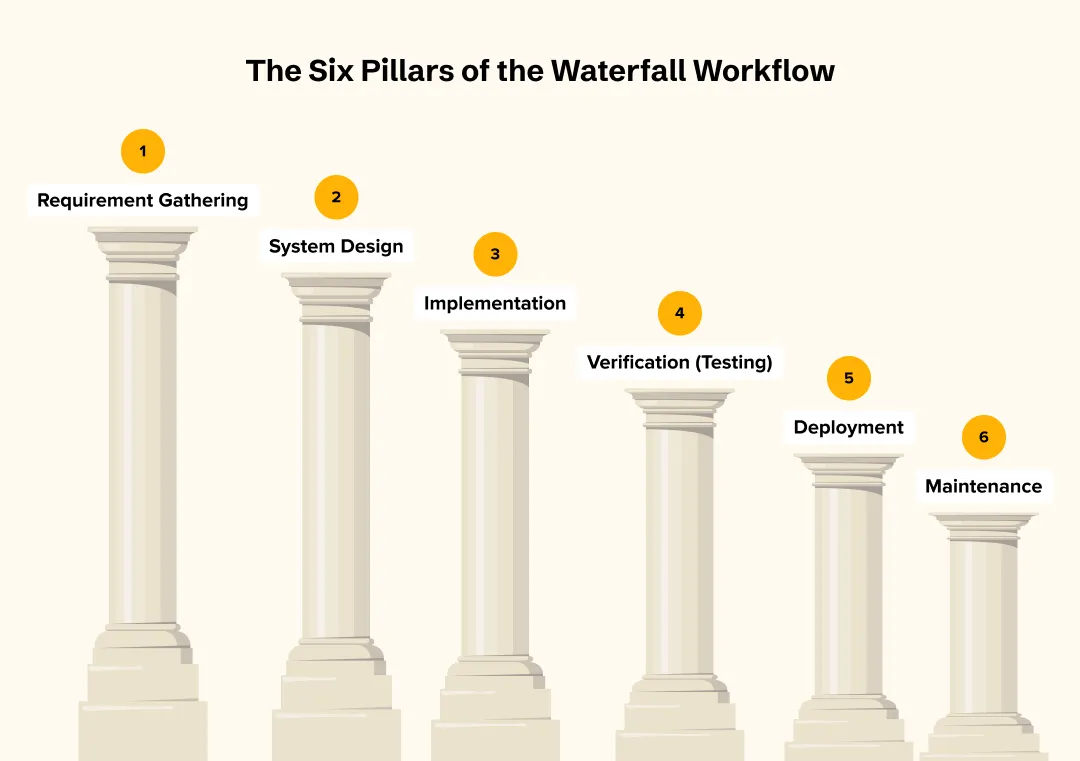
- Requirement Gathering: Stakeholders spend months documenting every technical detail and business rule, ensuring that the agile software development vs waterfall model comparison starts with a locked-in project scope.
- System Design: Technical architects map out the entire infrastructure, selecting the right software development languages and data schemas required to support high-load enterprise environments before any coding begins.
- Implementation: The development team builds the entire solution based strictly on the approved blueprints, ensuring zero deviation and maintaining consistency across the software development life cycle (SDLC).
- Verification (Testing): Quality assurance teams execute comprehensive end-to-end testing only after the full build is complete, which can present significant software development challenges if architectural flaws are discovered.
- Deployment: The finalized product is delivered to the B2B client in a single, massive release, requiring careful coordination to avoid disrupting existing business operations or legacy systems.
- Maintenance: Post-launch teams provide ongoing support, security patches, and minor updates, adhering to the original documentation created during the initial software development guide phases.
The Modern Engine: Decoding Agile Software Development
If Waterfall is a train on a fixed track, Agile is a high-performance off-road vehicle. Agile software development focuses on breaking the project into small, manageable increments called ‘Sprints.’ The goal is not to deliver the final product at once, but to deliver value early and often.
Agile thrives on the principle that we don't know what we don't know. In the fast-moving B2B SaaS market, user requirements can change in a matter of weeks. By using an iterative process, teams can pivot their strategy without scrapping months of work. This is where AI in software development has become a game-changer, allowing for rapid prototyping and automated testing within these short cycles.
The Six Pillars of the Agile Software Development Cycle
These pillars are built for speed. They provide a competitive edge for projects where the cost of being ‘too late to market’ is the greatest risk.
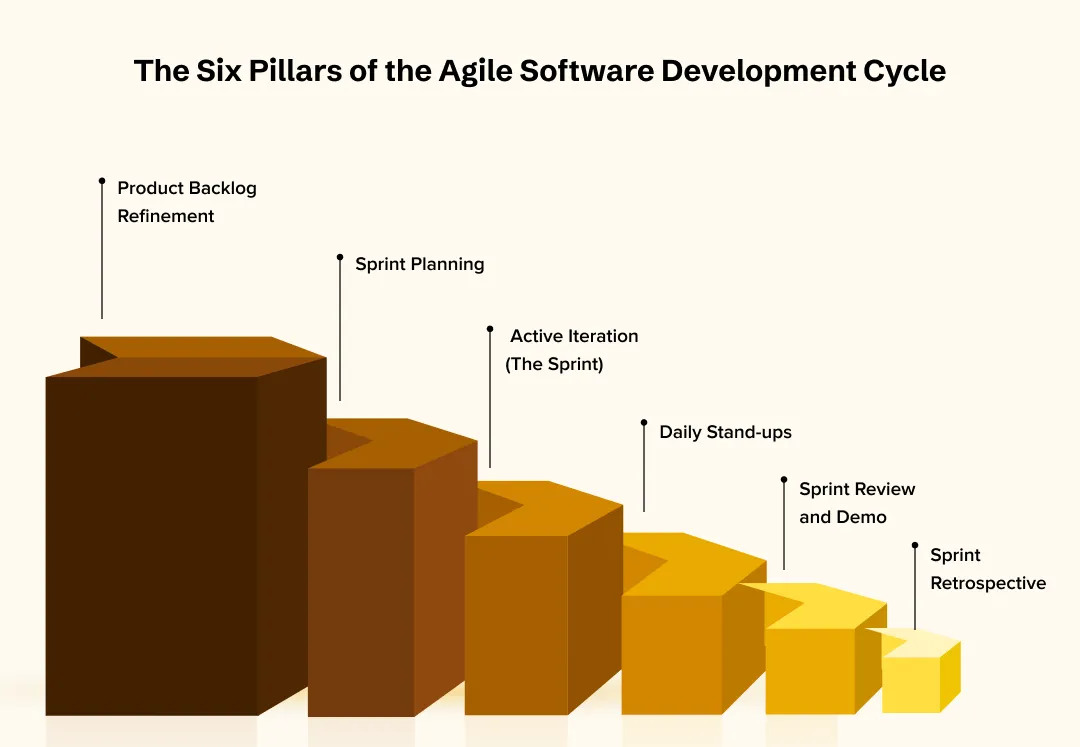
- Product Backlog Refinement: The product owner and stakeholders maintain a dynamic list of features, prioritizing them based on market value and technical feasibility to ensure the team always works on high-impact tasks.
- Sprint Planning: At the start of each iteration, the cross-functional team selects a manageable set of items from the backlog, defining the specific goals and technical approach for the upcoming two-to-four-week cycle.
- Active Iteration (The Sprint): Developers, designers, and testers collaborate daily to turn the selected backlog items into a functional, "shippable" increment of software, utilizing the best AI tools for software developers to maintain high velocity.
- Daily Stand-ups: The team conducts brief, synchronized meetings to discuss progress, identify immediate technical blockers, and ensure that the software development life cycle (SDLC) remains on track without bureaucratic delays.
- Sprint Review and Demo: At the end of the sprint, the team demonstrates the working software to B2B stakeholders to gather immediate feedback, ensuring the project aligns with the custom software product development goals.
- Sprint Retrospective: The team analyzes their own performance and internal processes from the previous sprint to implement immediate improvements, fostering a culture of software development trends and continuous operational optimization.
The Great Divide: Key Differences Between Agile and Waterfall
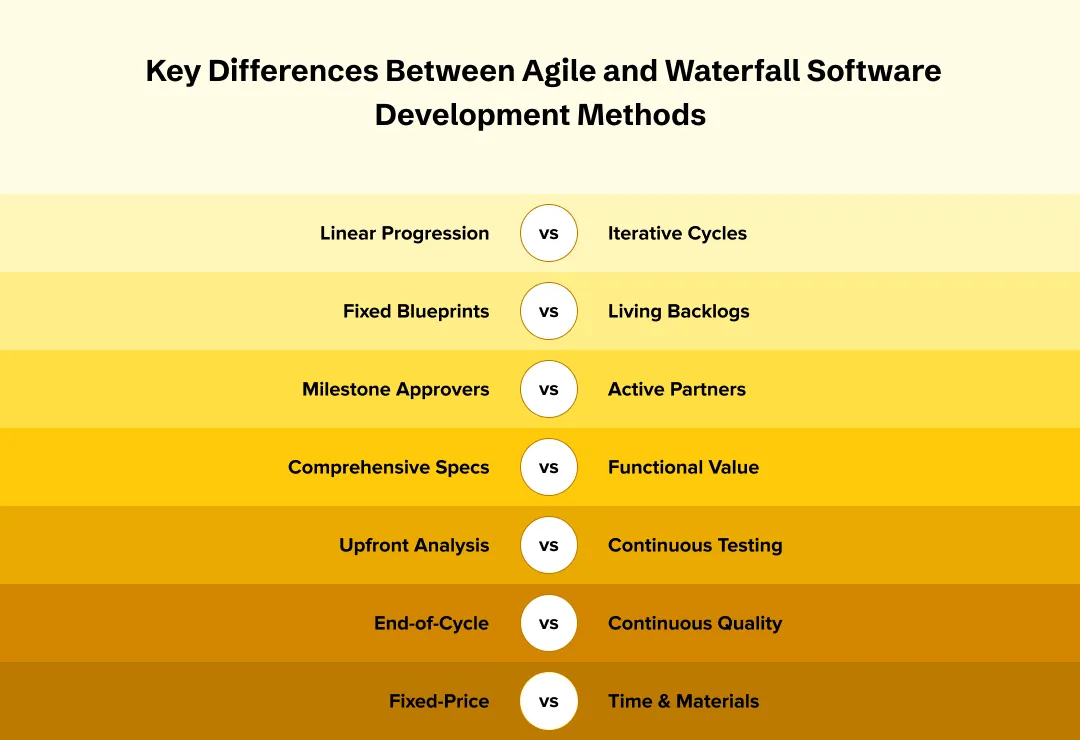
While both aim to deliver high-quality software, their internal mechanics, risk management strategies, and operational philosophies are worlds apart. Here is the key difference between agile and waterfall model:
1. Workflow Structure: Linear Progression vs. Iterative Cycles
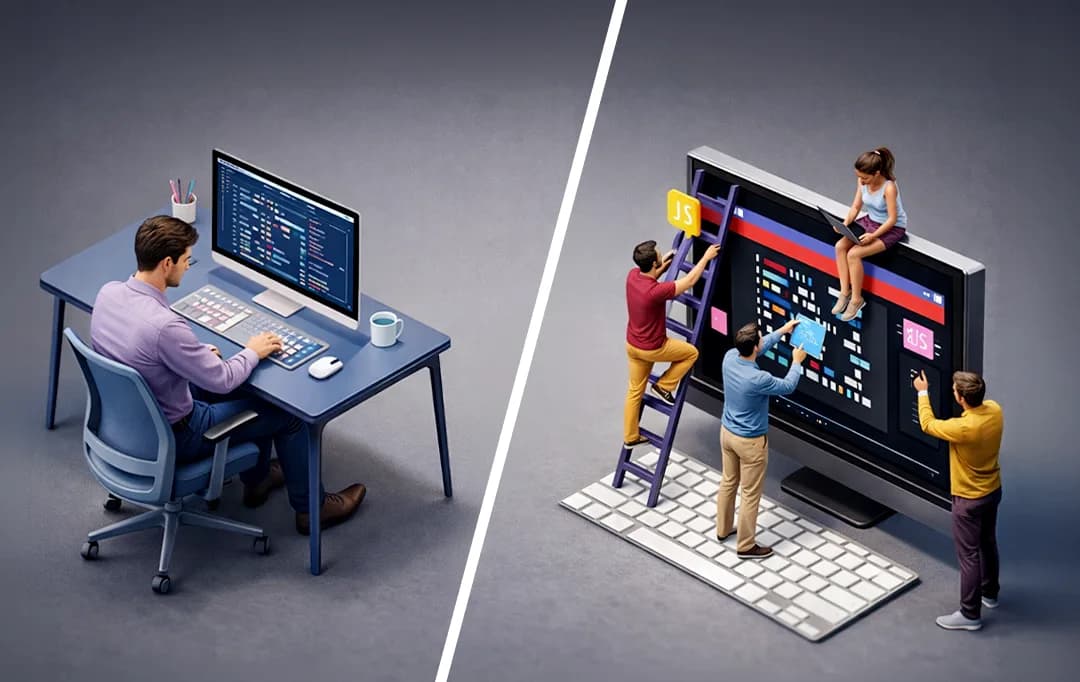
The most glaring architectural contrast lies in how work moves from concept to code. The waterfall method operates on a linear, sequential timeline where one phase must reach 100% completion before the next begins. It is a one-shot approach to delivery. Conversely, the Agile method is fluid and cyclical. The project is broken into ‘Sprints’ that allow the roadmap to be constantly recalibrated based on real-world performance data and evolving market conditions.
2. Approach to Requirements: Fixed Blueprints vs. Living Backlogs
In the waterfall vs agile methodology comparison, Waterfall treats requirements as a fixed legal contract established at the project's inception. This provides a sense of security but leaves little room for pivots. Agile utilizes a ‘Product Backlog’ - a dynamic, living list of features that are continuously prioritized. This allows B2B firms to adapt their custom software product development strategy if a competitor launches a disruptive feature mid-build.
3. Client Involvement: Milestone Approvers vs. Active Partners
Waterfall typically involves the client heavily during the initial discovery and the final handover, which can lead to a dangerous ‘expectation gap.’ Agile closes this distance by requiring stakeholders to be active participants. By reviewing progress every 2 to 4 weeks, the client ensures the development team is always building toward the current business objective rather than a stale requirement document from six months ago.
4. Documentation Philosophy: Comprehensive Specs vs. Functional Value
Waterfall relies on ‘Big Upfront Documentation,’ which serves as a technical and legal safety net. While this is helpful for long-term maintenance, it can slow down initial momentum. Agile favors ‘Just-Enough’ documentation, prioritizing working software over exhaustive paperwork. For leaders following a software development agile vs waterfall documentation philosophy, it means Agile requires a higher level of trust, whereas Waterfall provides a more detailed audit trail.
5. Risk Mitigation: Upfront Analysis vs. Continuous Testing
In a Waterfall environment, risk is managed through massive upfront software risk analysis. The goal is to predict every possible failure before it happens. Agile manages risk through exposure; by releasing small increments of the software frequently, the team identifies technical bottlenecks or user-interface friction points early. This prevents the big failure that often plagues large-scale Waterfall deployments.
6. Testing Integration: End-of-Cycle vs. Continuous Quality
In the agile software development vs waterfall debate, the timing of QA is a critical differentiator. Waterfall saves testing for the final stages, which often leads to crunch time and delayed launches if a fundamental bug is found. Agile integrates AI in software testing into every single sprint. This Shift-Left approach ensures that quality is baked into the code from the first day, rather than being treated as an afterthought.
7. Financial and Contractual Logic: Fixed-Price vs. Time & Materials
For procurement teams, the difference between agile and waterfall model often comes down to the invoice. Waterfall is tailor-made for fixed-bid contracts, providing a clear ‘Total Project Cost.’ Agile is more compatible with ‘Time and Materials’ or iterative funding models. This requires B2B firms to have a more flexible financial governance structure, but it often prevents the hidden ‘Change Order’ fees that can inflate a Waterfall budget post-signing.
The Strategic Trade-offs: Advantages of Waterfall and Agile in B2B Ecosystem
Choosing a development path is not about which methodology is better in a vacuum; it is about which one provides the most leverage for your specific business constraints. In the B2B world, where software development cost is often a multi-year investment, understanding the unique benefits of each model is the difference between a successful deployment and a costly write-off.
The Waterfall Advantage
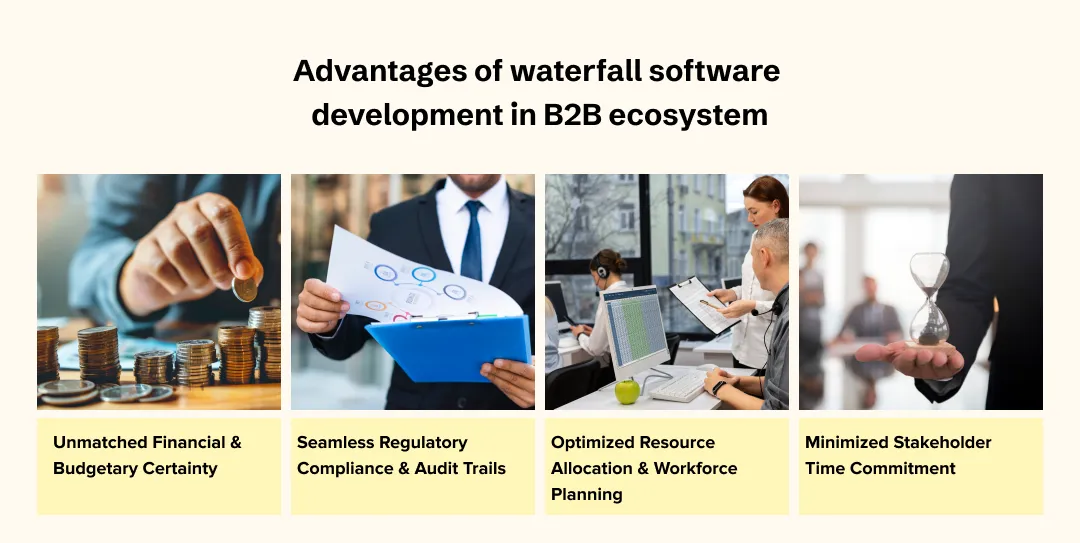
1. Unmatched Financial and Budgetary Certainty
For many B2B organizations, the procurement process is as rigid as the software itself. Waterfall is the gold standard for projects tied to strict capital expenditure (CapEx) budgets. Because the scope is finalized before a single line of code is written, stakeholders receive a fixed-price quote that aligns perfectly with annual fiscal planning. This predictability eliminates the mid-project budget anxiety often found in more fluid models.
2. Seamless Regulatory Compliance and Audit Trails
In sectors like FinTech, MedTech, or government contracting, documentation isn't just a byproduct; it is a legal requirement. Waterfall’s documentation-first approach ensures that every requirement is mapped to a specific design element and testing protocol. This creates a robust audit trail that is essential for passing rigorous industry certifications and maintaining long-term software risk analysis standards.
3. Optimized Resource Allocation and Workforce Planning
Waterfall allows project managers to operate with extreme precision. Since the roadmap is static, leadership knows exactly when and how to hire software developers with specific niche skills, such as database architects or security experts, for defined periods. This prevents the resource benching cost where expensive talent sits idle waiting for a sprint to be defined.
4. Minimized Stakeholder Time Commitment
C-suite executives are often spread thin. Waterfall respects this by front-loading the decision-making process. Once the initial requirements are signed off, the client can largely step back, trusting the software development guide established at the start. This prevents the meeting fatigue that can frustrate senior leaders in highly iterative environments.
The Agile Advantage
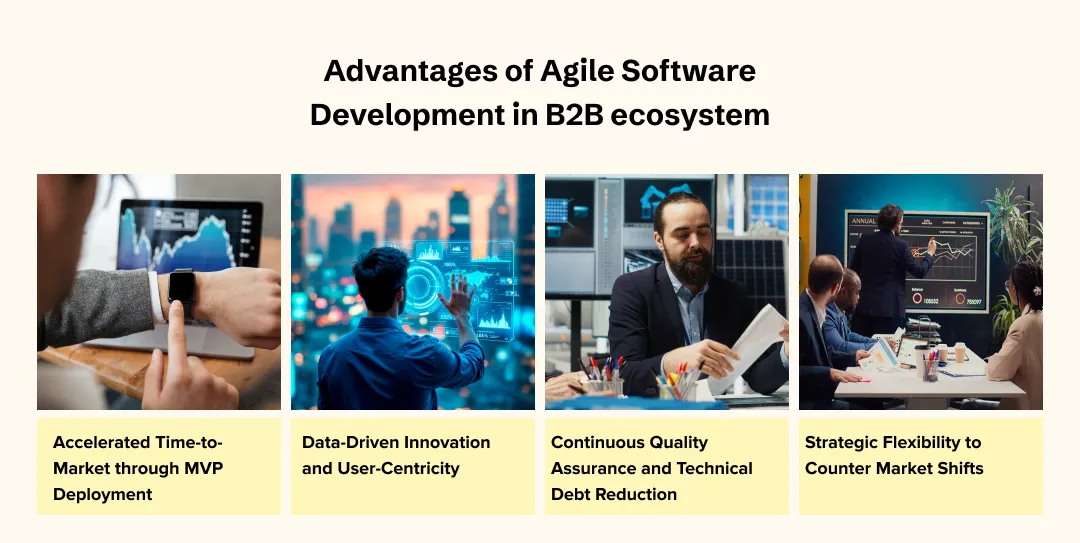
1. Accelerated Time-to-Market through MVP Deployment
In a competitive B2B SaaS landscape, being first is often more valuable than being perfect. Agile allows you to release a Minimum Viable Product (MVP) containing core functionality months before a full suite would be ready in a Waterfall model. This enables your business to start capturing market share and generating revenue while the secondary features are still in development.
2. Data-Driven Innovation and User-Centricity
Agile replaces boardroom assumptions with real-world user data. By releasing functional code every two weeks, the team can see exactly how clients interact with the platform. If a feature isn't being used, it is discarded; if a workflow is confusing, it is fixed in the next sprint. This ensures your custom software product development results in a product that the market actually needs.
3. Continuous Quality Assurance and Technical Debt Reduction
By integrating AI in software testing into the daily workflow, Agile teams catch bugs as they are written. This continuous delivery mindset ensures that the codebase remains clean and scalable. It significantly reduces technical debt, as the team isn't rushing to fix six months' worth of architectural flaws during a final, high-pressure testing phase.
4. Strategic Flexibility to Counter Market Shifts
The B2B market can shift overnight, due to new regulations, economic changes, or a competitor’s surprise launch. Agile is built for this volatility. Because the roadmap is never locked, stakeholders can reprioritize the backlog at the start of any sprint. This adaptability ensures that your investment in software development outsourcing remains strategically aligned with your current business goals.
The Strategic Risk: Disadvantages of Waterfall and Agile in the B2B Ecosystem
Every methodology has a ‘dark side’ that can derail a project if not managed with professional oversight. Recognizing these pitfalls is essential for maintaining your project health, which is why a comprehensive software development checklist is vital for identifying hidden risks before they compromise your delivery.
The Waterfall Downside
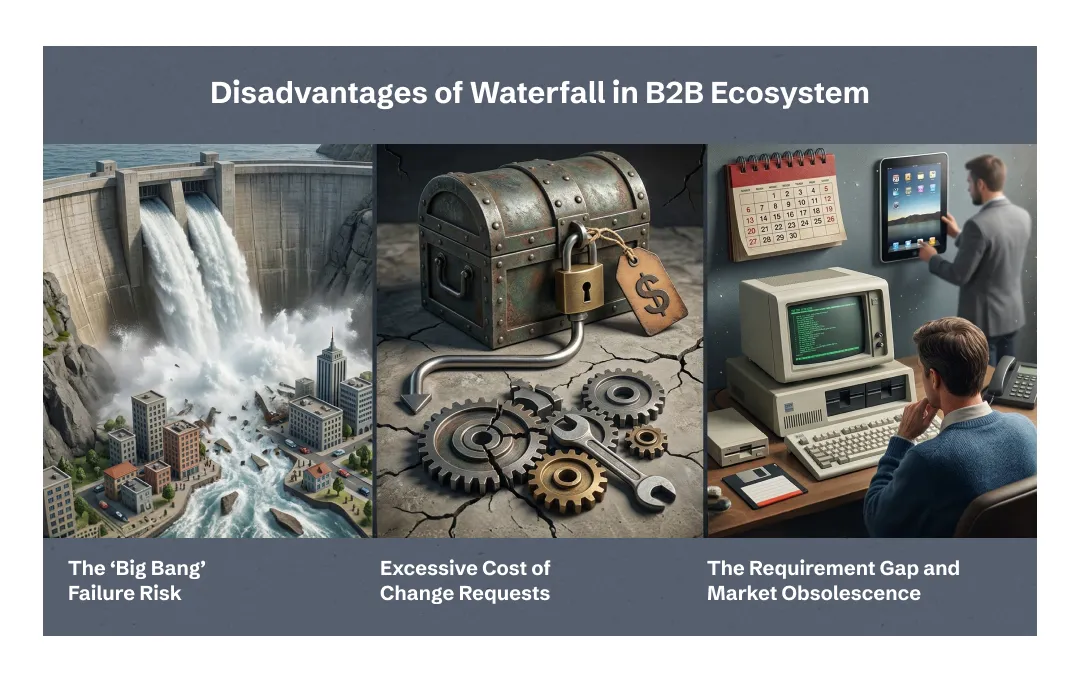
1. The ‘Big Bang’ Failure Risk
The greatest danger of Waterfall is that testing only occurs at the very end. If there is a fundamental flaw in the initial architecture, it might not be discovered until the project is 90% complete. Fixing a core issue at this stage is exponentially more expensive and often results in significant launch delays that can damage a B2B firm's reputation with its clients.
2. Excessive Cost of Change Requests
In Waterfall, any change to the original plan is treated as a ‘Change Order.’ This requires re-opening the contract, renegotiating the software development cost, and shifting the entire timeline. This rigidity can lead to ‘Requirement Stagnation,’ where a team continues to build obsolete features simply because it’s too bureaucratic to change the plan.
3. The Requirement Gap and Market Obsolescence
B2B development cycles can take 12 to 18 months. In Waterfall, you are building for the market as it existed on the day you signed the contract. By the time the product is delivered, your clients’ needs or the technological landscape may have moved on. This risk of delivering a technical masterpiece that no one wants is a common cause of common software project failures.
The Agile Downside
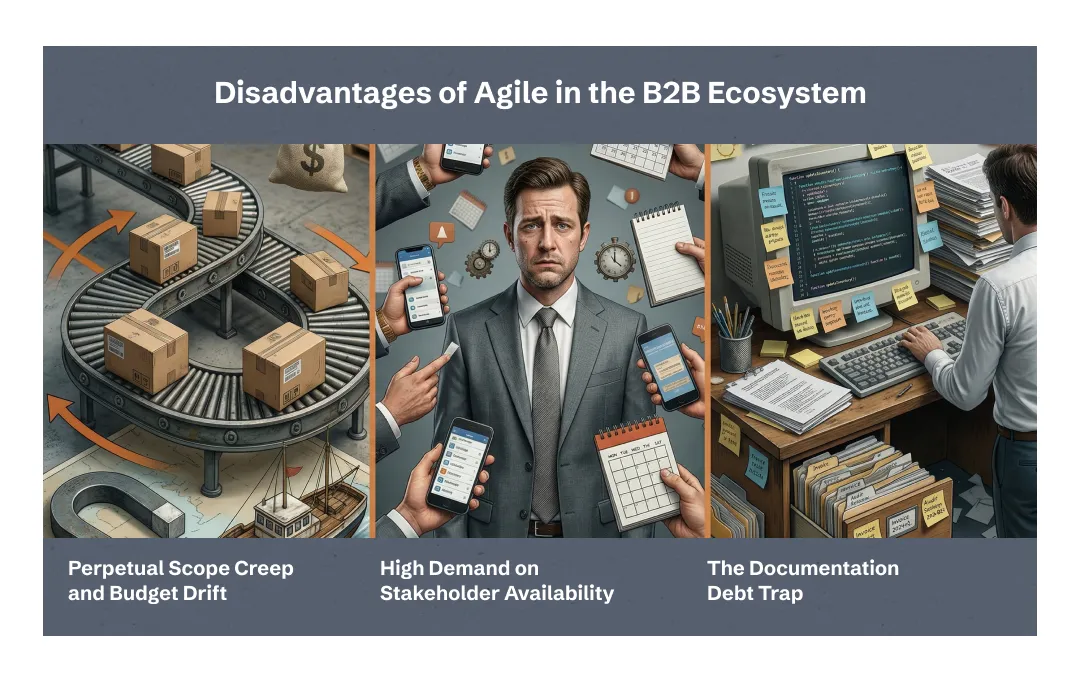
1. Perpetual Scope Creep and Budget Drift
Without a disciplined Product Owner to say no, Agile projects can turn into never-ending stories. Because it is so easy to add new features, the final product date keeps sliding further into the future. This lack of a definitive endpoint can lead to budget exhaustion, where the in-house vs outsourcing software development costs exceed the projected lifetime value of the software.
2. High Demand on Stakeholder Availability
Agile is not a ‘hands-off’ model. It requires constant engagement from the B2B client to provide feedback and approve sprint goals. If your senior subject matter experts are unavailable for these bi-weekly demos, the dev team will start making assumptions. These assumptions often lead to technical debt and a product that fails to solve the specific business pain point it was intended for.
3. The Documentation Debt Trap
In the world of two-week sprints, documentation is often considered a low priority. While this speeds up initial coding, it creates major issues during the software developers onboarding process. Without a clear technical manual, future maintenance or hand-offs to other teams become incredibly difficult, leading to a brittle system that is hard to scale.
The C-Suite Decision Framework: A Binary Comparison for B2B Readiness
Choosing between Waterfall and Agile is not a matter of following the latest industry trend; it is a clinical assessment of your project’s constraints and your organization’s risk threshold. The table below serves as a high-impact checklist for stakeholders. It breaks down the most critical operational factors to show exactly where each methodology offers a strategic advantage and where it poses a potential bottleneck for your software development models.
| Decision Factor | Waterfall Suitability | Agile Suitability |
|---|---|---|
| Fixed-Bid Contracts (Non-negotiable Budget) | ✅ | ❌ |
| Strict Regulatory Compliance (FinTech/MedTech) | ✅ | ❌ |
| Legacy System Transition (Spiral Model Logic) | ✅ | ❌ |
| Distributed Teams (Document-First Communication) | ✅ | ❌ |
| SaaS Product Development (Competitive Niche) | ❌ | ✅ |
| Undefined Markets (Custom Product Discovery) | ❌ | ✅ |
| Rapid AI Innovation (Iterative Prototyping) | ❌ | ✅ |
| Hybrid Sourcing (In-house vs Outsourcing Mix) | ❌ | ✅ |
The Hybrid Reality: Best of Both Worlds
In practice, most world-class software development companies no longer force a choice. They use "Agile-Fall." They use Waterfall for the high-level roadmap, budgeting, and legal milestones, giving the board of directors the certainty they crave. However, the actual development teams operate in Agile sprints, giving the engineers the flexibility they need to solve complex problems.
By blending the two, you can have the spiral model in software engineering level of risk management with the speed of a modern startup. This hybrid approach is particularly effective when you hire software developers who are comfortable working in structured environments but possess an iterative mindset.
The Executive Verdict: Strategizing for Resilience and ROI
Following the right methodology is an exercise in risk management. If your project demands strong compliance and fiscal predictability, opt for the Waterfall software development methodology to protect your capital. However, if you are chasing market disruption, Agile development is your engine for growth.
At MobileAppDaily, we advocate for a ‘business-first’ lens; don't let a process dictate your goals. Analyze your stakeholder bandwidth and technical complexity honestly before signing any contract. The right choice isn't the most popular one; it is the one that secures your long-term operational success.
Frequently Asked Questions
Is Agile always more expensive than Waterfall in B2B projects?
Agile usually seems pricier because its scope remains fluid. Traditional methods offer a set price early. However, iterative cycles often yield better value. They prevent you from wasting your budget on features that enterprise clients will never actually use or buy.
Can Waterfall handle modern AI-driven software development?
It can work for structural security. But machine learning demands constant refinement. Purely linear paths struggle with the "learn and adapt" nature of neural networks. You might end up with a rigid model that cannot scale as your data grows.
What is the biggest risk of switching from Waterfall to Agile mid-project?
Internal culture usually breaks first. B2B teams used to slow approvals often panic when forced to make daily choices. Productivity drops sharply. Without a veteran lead, the project likely stalls. It is a massive shock to any corporate system.
How does the choice of methodology affect software maintenance?
Linear builds require a perfect handover. If documentation is weak, future support fails. Iterative models build maintenance into the weekly grind. This keeps technical debt low. It requires a permanent budget line rather than a simple, one-time launch fee.
Is a Hybrid model the safest bet for enterprise B2B?
Most large firms prefer this middle ground. You get the fiscal safety of big milestones while developers keep their creative speed. It satisfies the CFO and the engineers. It is the most realistic way to manage complex corporate software needs.
Does the methodology impact the choice of software development languages?
Methodology dictates your framework speed. Iterative teams prefer modular tools that support fast deployment. Sequential models work fine with older, monolithic systems. Your choice should reflect your need for either total system stability or rapid, cloud-native feature growth.
How much client involvement is actually required for Agile?
You cannot be hands-off here. It demands a dedicated owner who attends every demo. If your stakeholders are too busy for weekly check-ins, do not choose this path. Traditional setups are much better for clients who prefer "set and forget."
Which model is better for nearshore software development?
Shared time zones make iteration easy. You can talk in real-time. If your partners are halfway across the world, documented sequences are safer. This prevents the messy communication gaps that usually destroy fast-paced projects across vast, difficult time differences

Uncover executable insights, extensive research, and expert opinions in one place.
Related Content