Share It On:
 An insight into software developer onboarding that drives results, not just paperwork
Your newest software developer isn't just a hire. They're an investment of time, money, and future innovation. Yet, a messy, disorganized onboarding process can kill that potential before they even write a single line of code.
That’s because most of the time, the software developer onboarding process is treated as some kind of basic HR checklist. This only leads to new hires ending up confused and unproductive. In contrast, a robust, disciplined, and well-planned onboarding process can increase new hire retention and help you gain a long-term asset.
Therefore, it's time to treat onboarding as the first and most important step in assembling a successful engineering team. This blog will talk more about developer onboarding, best practices, a basic onboarding checklist, and more.
Let’s begin!
Developer Onboarding: A Look into the Process
Developer onboarding is a specialized process designed to accommodate a software engineer into a company's unique technical and cultural environment. Now, a general onboarding might stop at company policies and a desk setup, whereas a developer onboarding goes much deeper.
It’s a three-pronged approach:
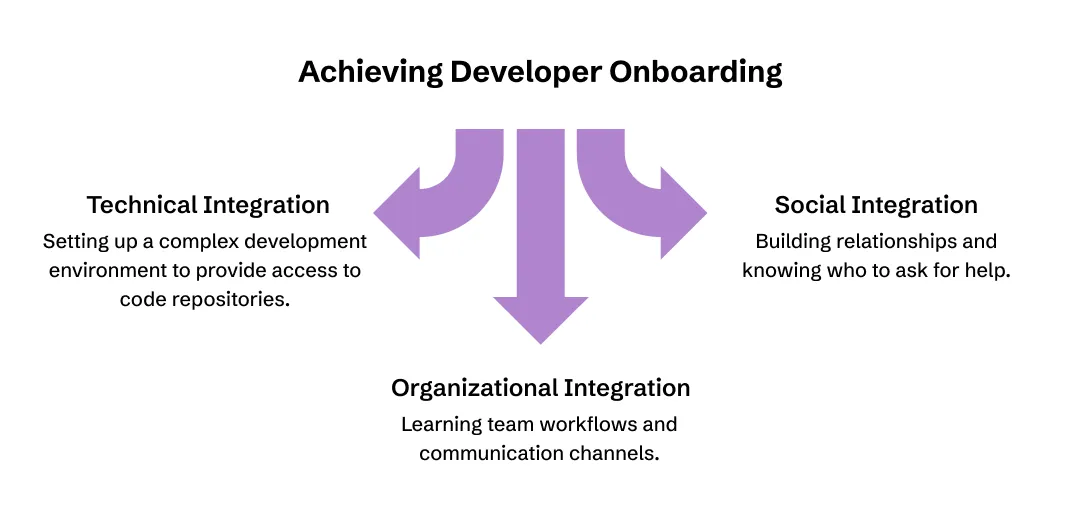
- Technical Integration: This is the core and involves setting up a complex development environment to provide access to code repositories for understanding the specific architecture and coding standards your team lives by.
- Organizational Integration: This focuses on how the work gets done. New hires learn the team’s specific workflows, agile processes, communication channels (like Slack or Teams), and some rules of how code gets built, tested, and shipped.
- Social Integration: This step is the responsibility of the engineering manager. They assign an "onboarding buddy" to integrate the new hire into the team culture, answer informal questions, and build the relationships required for successful collaboration..
Benefits of a Strong Developer Onboarding Process
A well-structured onboarding process is one of the most strategic investments an engineering team can make. Here’s a list of 3 key benefits of software development team onboarding.
1. Accelerated Time-to-Value
An excellent onboarding process provides a clear roadmap for new hires to contribute meaningful code, fast. For example, instead of spending their first week battling a complex local setup, a developer is given a small, well-defined "first ticket." Thus, shipping a minor bug fix to production within the first few days provides a tangible win that builds momentum and confidence.
2. Improved Talent Retention
The onboarding experience is the first and most lasting impression of your company's culture. A chaotic process where a developer waits three days for database credentials signals disorganization. In contrast, a smooth, respectful process that values their time demonstrates a high-performance culture, making talented engineers want to stay and build their careers.
3. Enhanced Developer Experience (DevEx)
63% of developers say DevEx is a factor in their decision to stay at a job. A chaotic onboarding directly damages that experience. For instance, forcing a developer to scan through old Slack messages for an API key creates unnecessary friction. A strong process, which might introduce a centralized developer portal on day one, removes these roadblocks and shows respect for the developer's time, directly contributing to job satisfaction.
5 Phases of an Effective Developer Onboarding Process
A great onboarding plan is a roadmap that turns a new hire into a confident, productive member of your team. Here’s how to structure it.
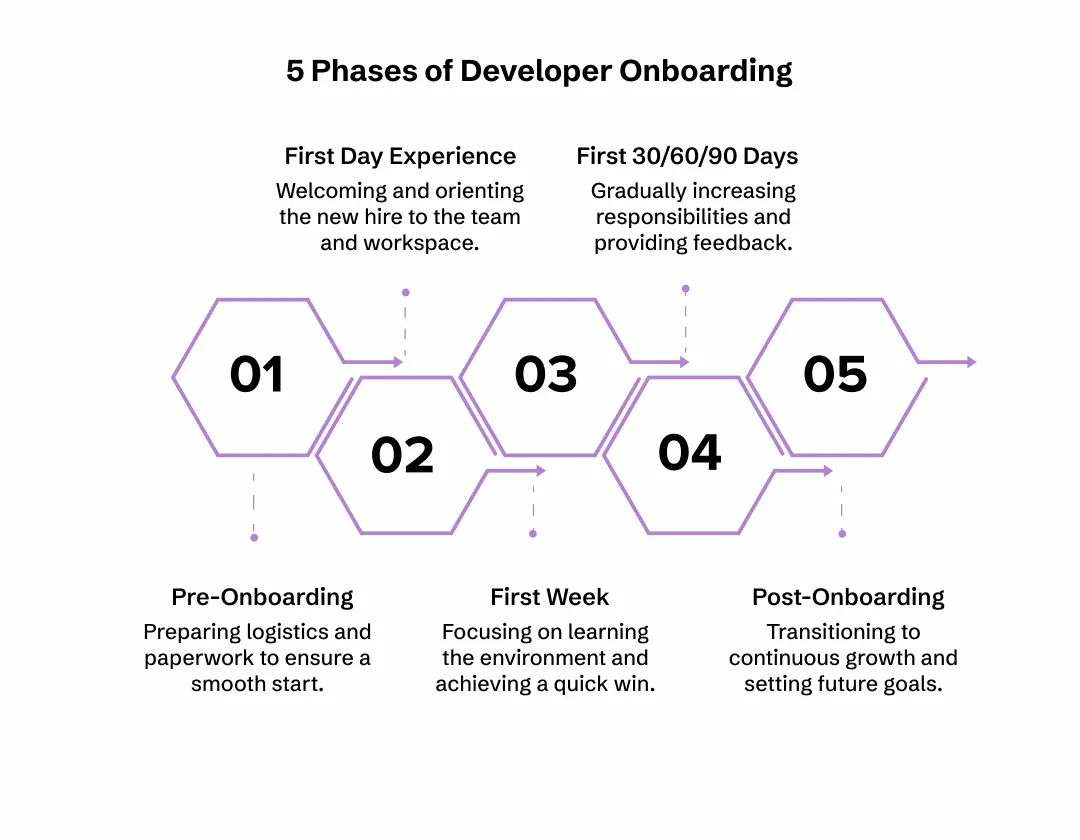
1. Pre-Onboarding Preparation
The goal here is to make day one feel enthusiastic for any software developer. A developer should be able to start engaging right away, not spend hours waiting for access.
- Get the Logistics Ready: Before they arrive, their laptop should be prepared, accounts created (email, code repos, project management tools), and all necessary access granted. Following a structured software development checklist can help ensure that no critical setup step is overlooked during onboarding.
- Handle the Paperwork: Send contracts and HR forms to be filled out digitally before their start date. Day one should be about people and code, not paperwork.
- Set the Stage: A simple welcome email from the manager a few days before they start makes a huge difference. It sends an optimistic message that you’re thrilled and excited to have them on board, and also shares a point of contact for them to ask any questions.
2. The First Day Experience
The first day at work sets the tone. Make it about connection and orientation.
- A Warm Welcome: Kick things off with a dedicated welcome meeting. Introduce them to the immediate team and make sure they have a designated buddy or mentor whom they can easily reach out to without hesitation.
- Tour them through the Essentials: Brief them about the digital workspace. Show them where to find documentation, how the team communicates, and the key tools you use daily.
- Provide a Clear Plan: Hand them a simple agenda for their first week. Knowing what to expect reduces anxiety and helps them feel in control.
3. The First Week
For the first 7 days, the focus should be on learning the environment and scoring an early, simple win.
- Dive into the How and Why: Start explaining to them about the product and the culture. Explain to them what services the company offers, how and why you build things the way you do. Walk them through the codebase, your git workflow, and your technical standards. Providing access to a comprehensive software development glossary can also help new developers quickly understand technical terms, processes, and team-specific terminology.
- Assign a Quick Win: Give them a small, low-risk, well-defined task like fixing a minor bug, updating documentation, or making them perform software or app testing.
- Check in Constantly: The manager and their buddy should have daily, informal check-ins. It’s not for status updates; it’s to answer questions and make sure they aren’t stuck.
4. The First 30/60/90 Days
This is where the training wheels slowly come off. The focus shifts from basic orientation to meaningful contribution and integration.
- Begin Assigning Responsibilities: Gradually introduce more complex tasks. Move toward areas with more ambiguity.
- Make Sure they Participate Well: Have them shadow key meetings to understand how decisions are made. This will help them understand the team’s approach to any problem, basic workflows, and even allow them to pitch in ideas from their past experience.
- Provide Constructive Feedback and Review Sessions: Set up regular one-on-one meetings to review progress, discuss challenges, and set goals for the next 30/60/90 days. This ensures they know how they're aligned and what's expected of them.
5. Post-Onboarding
Onboarding doesn't end at 90 days. The final step is to transition the process into a continuous growth plan.
- Set Future Goals: Shift the conversation to career growth. Work with them to define their long-term goals and what success looks like in their role a year from now.
- Build a Learning Plan: Identify areas for growth and create a plan to support it, whether through mentorship, online courses, or conferences.
- Keep the Feedback Loop Going: The habits of regular check-ins and performance reviews established during onboarding should simply become the new normal.
Challenges in Onboarding the Software Development Team
Onboarding process IS fraught with predictable failure points. Just in case, if your onboarding fails, the costs are substantial. It leads to lost productivity, decreased team morale, and, ultimately, the premature attrition of valuable talent. Let’s look at the four main challenges of onboarding a software development team:
- Information Overload & Navigating Codebase Complexity: Overwhelming new hires with excessive documentation and a complex, undocumented codebase causes cognitive overload.
- Technical Environment and Access Impediments: Delays in getting the right hardware, software access, and a working local development environment can kill a new hire's initial momentum and create significant frustration.
- Lack of Deliberate Social Integration: A structured process for building relationships are essential for new hires, as they might feel isolated and hesitate to ask questions. This blocks their learning and productivity.
- Ambiguous Expectations and Lack of Clear Milestones: Lack of clear, measurable goals for the first 30, 60, and 90 days leaves new hires feeling adrift. This prevents managers from providing effective, data-driven feedback.

Best Practices for Developer Onboarding
Most companies realize their onboarding is broken only after good developers quit. The numbers are grim: reports show that 30% of new employees quit within the first three months. This massive 90-day churn often happens because businesses treat onboarding like an HR checklist, not a designed system built for success.
If you want to stop this churn and get new developers shipping quality code faster, these practices are non-negotiable. They are designed to solve the core challenges of the software development team onboarding and turn new hires into productive, long-term team members.
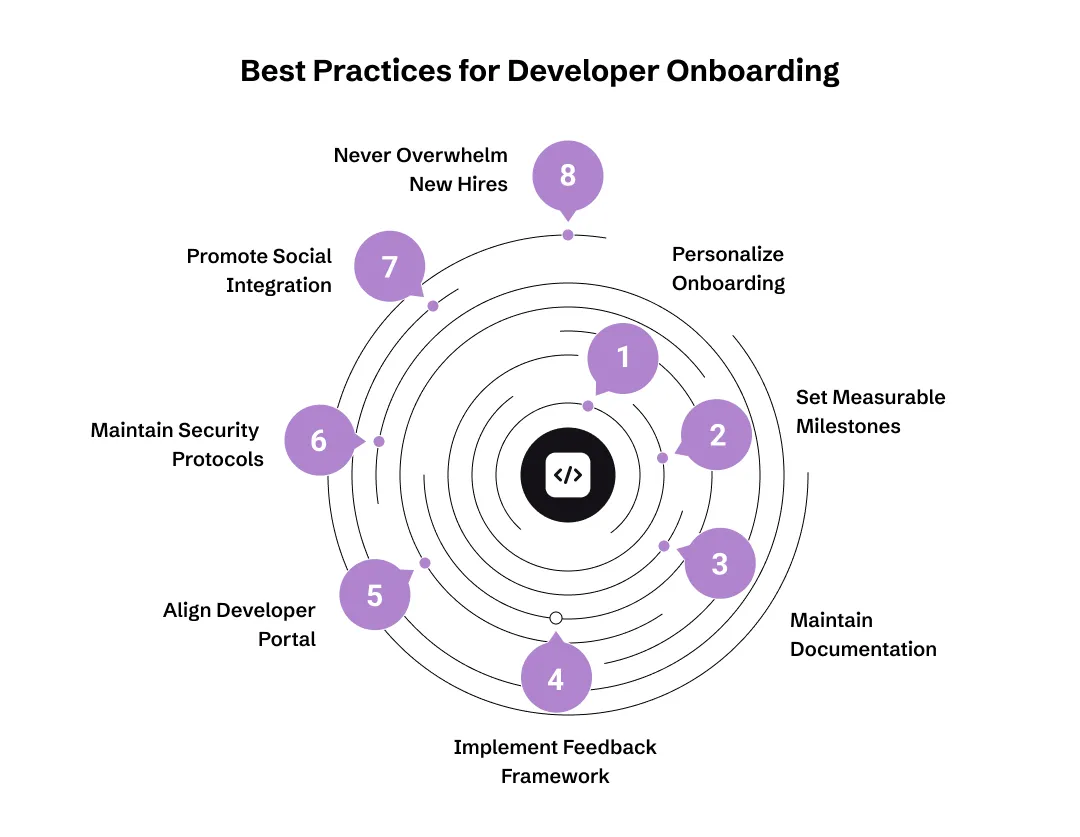
1. Overwhelm New Hires
Dumping 47 Confluence pages and three architecture diagrams on day one doesn't make developers productive; it makes them panic. The same goes for meeting 20 people in two days or throwing them into full sprint commitments before they can build the code locally. Space learning over weeks, introduce people gradually, and start with observer status before real work.
2. Provide Personalized & Role-Based Onboarding
Not every developer needs the same onboarding experience. Senior engineers will waste time in basic Git tutorials when they should be learning about why we chose our microservices architecture. Meanwhile, junior developers need those fundamentals. Therefore, it's important for you to create separate tracks that respect people's existing expertise and roles offered, while filling in the gaps specific to your organization.
3. Set Measurable Milestones
Nobody likes vague expectations, so you need to set clear targets. Ask them to: ship something to staging in week one, own a real feature by month's end, and handle production issues solo by month three. These can easily be tracked in project management software like Jira, to spot when someone's struggling before they burn out or quit. It also helps managers have better conversations about progress instead of relying on gut feelings.
4. Documentation Architecture
Your documentation will make or break the onboarding experience. So, you need to keep everything in one place, organized by when people actually need it. For instance, week one needs environment setup and login credentials, not deep architectural philosophy. You can even assign someone to update the docs quarterly, or all this documentation might just become useless at the time of use.
5. Place Proper Feedback Framework
Don't wait for the 90-day review to discover problems. Daily standups catch immediate blockers, weekly one-on-ones build trust with managers, and buddy check-ins provide a safe space to ask questions. For this, you can even use simple feedback forms that can help you spot patterns across new hires of what's broken in your process.
6. Align Developer Portal
Stop making developers hunt through Slack for that one message about database access from six months ago. A good developer portal puts service catalogs, APIs, deployments, and monitoring in one place. Let developers provision their own environments and pull their own logs. The hours you'll save in the first month alone will eventually justify the setup effort.
7. Maintain Security Protocols
Provide new developers with minimal access and expand it as they prove themselves. This protects them from accidentally breaking production. You should also run security training in week one while they're still forming habits. Additionally, make security part of every code review so it becomes muscle memory, not a checklist they forget about after onboarding.
8. Promote Social Integration
Never neglect social integrations; they create a happy and friendly workspace. Schedule virtual coffees, choose buddies who actually have capacity, and include new hires in everything from day one, even if they're just observing. They need to see how your team debates and celebrates, not just how they talk about work.
9. Treat Onboarding Like a Product
The best onboarding systems are never "done"; they are improved continuously. This means actively collecting feedback through monthly retrospectives, using metrics to fix bottlenecks, and standardizing what works. This turns onboarding from a static checklist into a living system that gets better with every new hire.
Remote vs. On-site Developer Onboarding
The goal of onboarding is the same for all new developers: get them integrated and productive as quickly as possible. However, the process for remote and on-site hires is fundamentally different. Understanding these differences is the first step to creating a remote onboarding system that truly works.
Here's a quick comparison:
| Onboarding Aspect | On-site Environment | Remote Environment |
|---|---|---|
| Getting Help | Spontaneous & immediate, can tap a colleague on the shoulder. | Requires scheduling a call or send a message on Slack/Teams. |
| Learning | Organic, and happens through "learning osmosis" by overhearing conversations. | Must be structured, as it relies on excellent documentation and scheduled meetings. |
| Social Integration | Natural & informal, as it occurs during lunch breaks and coffee runs. | Must be deliberately engineered through virtual events and a buddy system. |
| Tech & Equipment | Centralized & fast, as it might just involve a 5-minute walk to the IT department. | Decentralized & requires planning, as hardware is shipped, and support is remote. |
Hurdles of Remote Hiring
When a developer is remote, they can't just lean over and ask a question. They miss out on the casual conversations where real learning happens. This creates specific challenges:
- Information Silos: In an office, developers can learn by immediately reaching out to their colleagues about any doubts or coding bottlenecks. A remote hire can't do that; they are completely cut off from the office environment.
- Lack of Learning Osmosis: A simple access issue can burn half a day. In the office, that's a 5-minute walk to the IT support office. But, for remote developers, it can be a prolonged issue because of the lack of proximity and might just affect the entire day’s productivity.
- Isolation: Your new hire feels disconnected. That feeling quickly turns into disengagement that can even influence them to look for other opportunities.
Best Practices for Remote Developer Onboarding
Your standard onboarding process might not be built for remote developers, and it’s bound to fail. Let’s address the process of remote developer onboarding in detail here.
- Ship the Required Assets First. Their first day should be spent meeting the team, not struggling with a laptop setup. The more they spend on logistical issues, the more they might feel disconnected because it ultimately affects their day’s output.
- Buddy System is Non-Negotiable. The buddy is their go-to person for every doubt. It also provides a safe space for questions and acts as their social link to the team.
- Force Human Connection. Yes, force it. Schedule the virtual meetings, team lunches (with a food delivery stipend), or online games. It might feel forced, but these planned interactions are the only way to replicate the spontaneous social bonds of an office.
Overall, your goal should be for the remote developer to feel just as supported and integrated as an on-site one. The entire conversation for distributed teams, backed by data from industry leaders, is about creating a level playing field. If you’re not actively designing your processes for remote-first, you are choosing to make your remote talent less effective, and that's a strategic disadvantage.

Conclusion
Good onboarding isn't about elaborate programs or expensive tools; it's about getting the basics right. You can begin by setting up their laptop before they arrive, assigning a buddy who actually has time to help, giving them a small win in week one, and gradually increasing complexity.
Measure what works, fix what doesn't, and remember that developers who feel supported from day one don't just write better code, they stick around to write it for you. The difference between a developer quitting at month two and becoming your next tech lead often comes down to their first 90 days. Therefore, it’s always important to have a remarkable plan for the software developers' onboarding process.
Frequently Asked Questions
What are the four phases of onboarding?
The four phases are pre-boarding. This includes setting up equipment and accounts before day. Thes second phase is orientation, which holds the first-day welcomes and introductions. The second phase is integration, where in the first 30-90 days of gradual responsibility increase. The last phase is ongoing development that transitions to long-term growth and regular performance reviews. Each phase builds on the previous one to create a complete onboarding experience.
How to set up a software development team?
Start by defining clear roles and technical requirements, then hire for both skills and culture fit. Establish your tech stack, development workflows, and communication channels before the team grows. Set up proper documentation, code review processes, and CI/CD pipelines early. Most importantly, create a safe space where developers can ask questions and make mistakes without fear.
What are the 5 pillars of onboarding?
The five pillars are technical integration (development environment and codebase), organizational alignment (understanding company goals and processes), social connection (building team relationships), role clarity (defining specific expectations and success metrics), and continuous feedback (regular check-ins and performance reviews). Missing any pillar leaves new developers feeling disconnected or unproductive.
What's the biggest mistake companies make with developer onboarding?
Treating developer onboarding as an HR checkbox rather than an engineering process is the biggest red flag. Companies dump documentation on day one, assign busy buddies who can't help, and expect developers to figure things out alone. This drives away good ones who have other options. Structured support and gradual complexity increase retention and productivity.
How do you onboard remote developers effectively?
Remote onboarding requires intentional over-communication since you lose hallway conversations and desk drop-bys. Ship equipment early, schedule extra video check-ins during week one, and assign a dedicated buddy with explicit time allocation for help. Create virtual coffee chats and paired programming sessions to build connections. Document everything clearly since they can't just lean over and ask. The goal is to make remote developers feel as supported as on-site ones.

Uncover executable insights, extensive research, and expert opinions in one place.
Related Content