Share It On:
 Learn why the Spiral Model is the critical choice for managing risk and changing requirements.
The biggest fear in any large software project is that it will become obsolete after months of work and investment. All because the initial plan couldn't handle real-world surprises.
So, how do you build a system that's designed to embrace change and tackle risk from day one? That’s where understanding the spiral model in software engineering becomes essential. It’s basically a smart, flexible strategy for navigating the messy reality of complex projects, used to great effect in industries from video games, where it helps create playable prototypes early on, to the evolution of Microsoft Windows version 3.1.
This article will help you understand more about the spiral model in software engineering, where it shines, and help you decide if its risk-centric approach could be the secret weapon your team needs.
What is the Spiral Model in Software Engineering?
According to a BCG report, only 30% of large-scale tech programs meet expectations on time, budget, and scope, while 35% fail entirely. That’s where the spiral model in software development comes to the rescue.
It is a software development approach that combines iterative development with a systematic approach to risk management. Instead of following a linear path from start to finish, a project progresses through a series of repeated cycles, or ‘spirals’.
The absolute center of this model is risk management. So, before any code is written in a new cycle, the engineering team is forced to confront the question: "What are the highest-priority technical and business risks that could derail this specific iteration?" This neutralizes threats in the model's core function before it becomes a huge problem.
Additionally, the spiral model was originally identified by Dr. Barry Boehm in his 1986 seminal paper. He identified that large-scale, mission-critical systems required a more robust method for managing the constant threat of failure points. That’s where the spiral model, which works on the philosophy of iteration, was his proposed solution.
Philosophy of Iteration
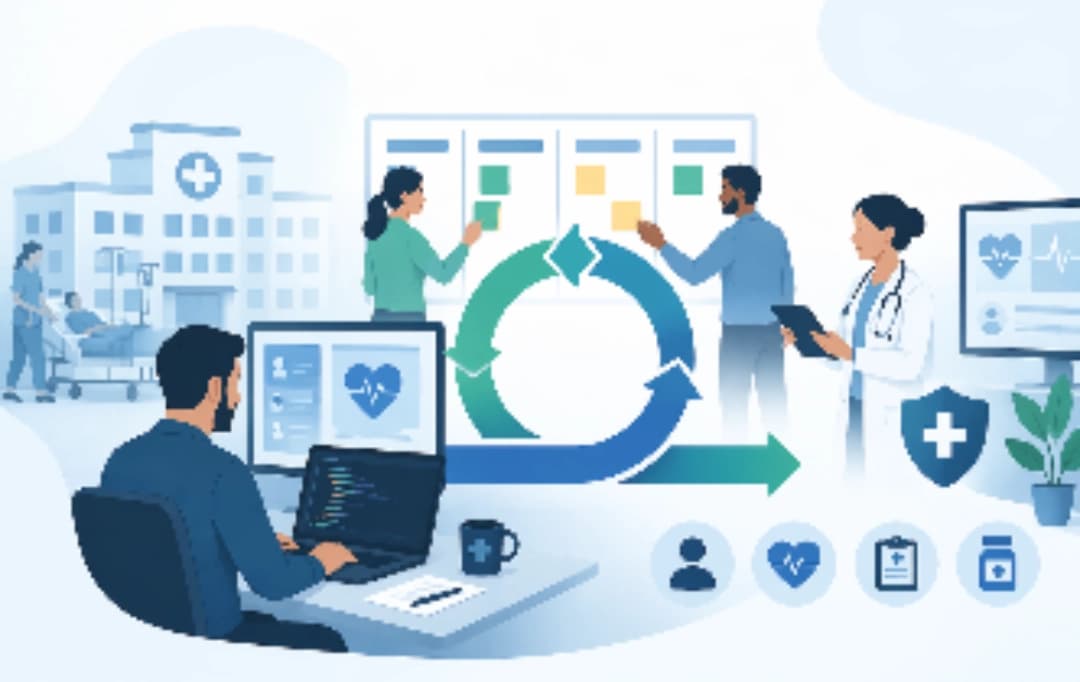
The spiral model operates on a simple, repeating loop:
- Plan a small step or increment.
- Analyze the dangers and risks of that step.
- Build that increment.
- Evaluate the result with user or client feedback.
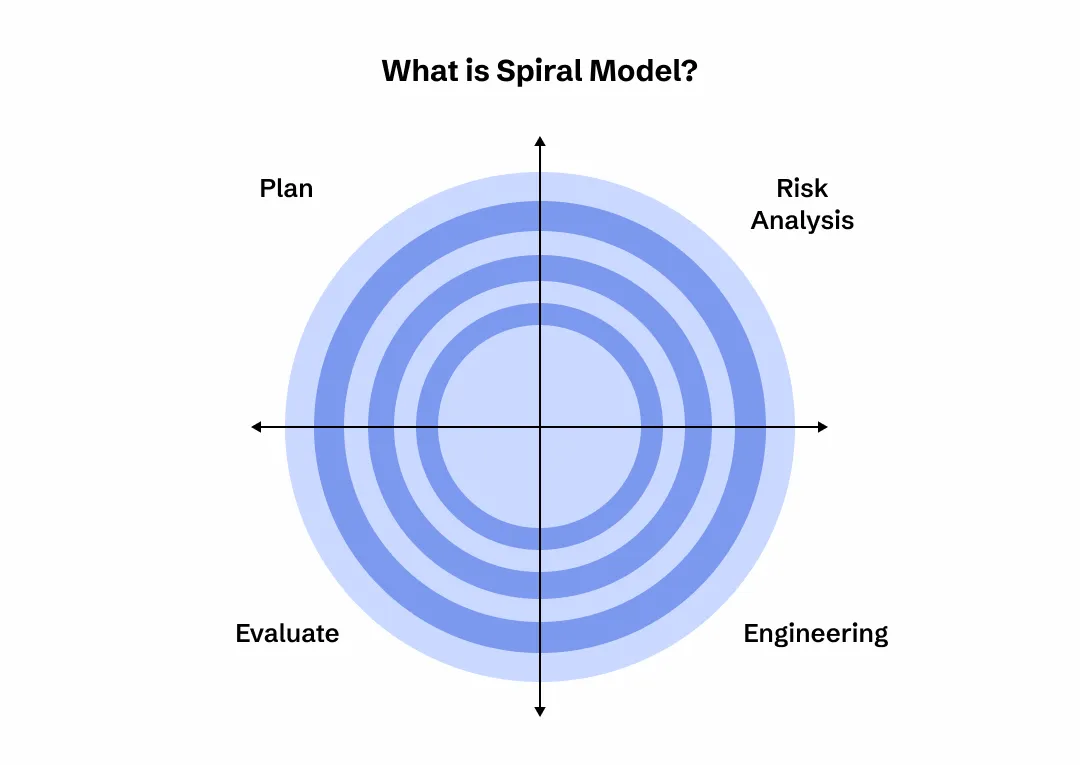
This loop repeats, spiraling outward with each cycle. Adhering to this model, the project grows progressively, adding another layer of functionality and polish with each full rotation. Moreover, this structure is a direct fusion of older, established ideas. It effectively combines the best of both worlds:
- From the Waterfall Model, it takes rigid, stage-based planning and discipline.
- From Iterative Models, it takes the build-test-feedback cycle that allows for adaptation.
The Four Stages of a Spiral Model in Software Engineering
As discussed, the Spiral Model's effectiveness lies in its structured, cyclical progression. This process ensures that development is aligned with business objectives and that project risks are systematically neutralized. Below is a breakdown of these phases of the spiral model in software engineering, illustrated with an example of the Spiral Model for constructing an enterprise e-commerce platform.
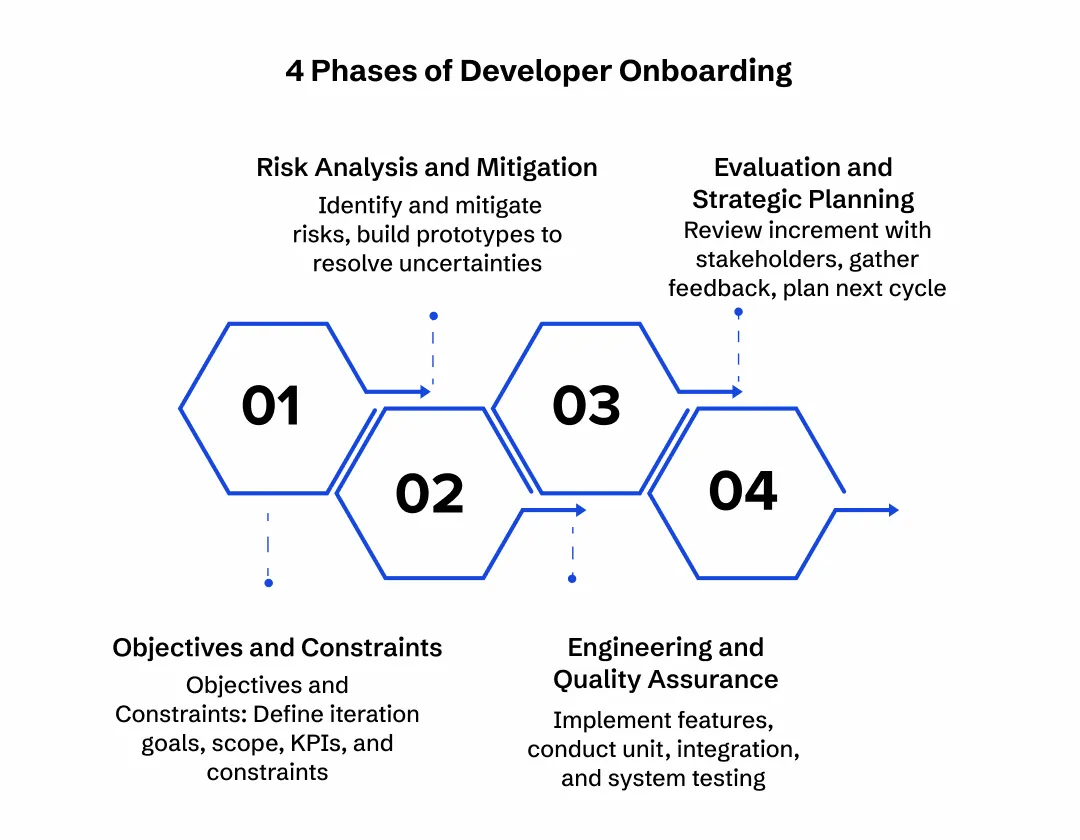
Stage 1: Determine Objectives and Constraints
Every software development life cycle initiates with a strategic planning phase. Here, stakeholders and the development team define the precise objectives for the current iteration. This involves formalizing scope, identifying key performance indicators (KPIs), outlining alternative solutions, and clarifying the budget and constraints.
- E-commerce Example: In the first spiral, the primary objective is to validate the core business concept for a B2B wholesale e-commerce platform. Key objectives include creating a basic product catalog with 100 SKUs, implementing user authentication for wholesale buyers, and designing a simple homepage that showcases featured products.
Stage 2: Risk Analysis and Mitigation
Now, in this phase, before significant capital is invested in development, the software development companies conduct a rigorous analysis of all risks that could threaten the objectives of the current cycle. These risks are identified, and mitigation strategies are developed. Prototypes are often built in this phase specifically to resolve high-priority uncertainties.
- E-commerce Example: After initial approval, the next iteration’s objective is a functional shopping cart. A primary risk identified is the security of payment processing. To mitigate this, a prototype integrating a third-party payment gateway is developed and tested in an environment to prove its security and reliability before full-scale development.
Stage 3: Engineering and Quality Assurance
In this stage, risks are addressed, and the process moves to implementation. This is more like an engineering phase where the focus is more upon development, followed by end-to-end testing of what’s developed. This includes unit, integration, and system testing to verify that the new features meet the specified requirements and do not compromise existing functionality. At this stage, understanding the role of DevOps in software engineering becomes important, as continuous integration, deployment automation, and monitoring help maintain quality throughout iterative development cycles.
- E-commerce Example: With risks mitigated, the engineering team develops a functional product catalog with search and filter capabilities, a secure login system with role-based access for different buyer tiers, and a homepage with featured products. The QA team conducts extensive testing. All functionality is verified against the initial requirements from Phase 1.
Stage 4: Evaluation and Strategic Planning
Now, the developed increment is presented to stakeholders for evaluation against the objectives that were defined in stage 1. This is a formal review that generates feedback, confirms that the project is on track, and informs the next decision for the new investment cycle. The output of this phase directly shapes the planning for the subsequent spiral.
- E-commerce Example: The platform, now feature-rich, is evaluated by the client in a staging environment. Feedback from this review, along with performance metrics, informs the final pre-launch plan. The objectives for the next spiral are defined: final security audits, performance optimization, and planning the public deployment strategy.

Risk Handling in the Spiral Model
The Spiral Model makes risk management the core driver of the entire operation. It treats risk as a systematic challenge that must be actively identified, analyzed, and neutralized. This is achieved through its iterative structure: each cycle forces the team to formally confront potential issues while the project's scope and financial investment are still limited. This approach systematically de-risks the project, ensuring that each subsequent phase is built upon a validated foundation.
A key technique in the Spiral approach is the use of prototypes or Minimum Viable Products (MVPs). These are often narrow, sometimes disposable, developments built specifically to address the highest-priority uncertainties of a project. For Example, if a project's success hinges on an unknown algorithm, a small, technical prototype is built to prove its performance and feasibility.
By using these targeted models, teams can tackle crucial risks with minimal spending of money and time before committing valuable resources to large-scale engineering.
Risk Management: A Comparative Analysis
Not all software development methodologies treat risk equally. While some acknowledge its existence, others make it the foundation of their entire approach. Understanding these fundamental differences is critical when selecting the right framework for high-stakes projects. Here’s a direct comparison of how the Spiral Model handles risk versus the Waterfall and Agile methodologies of software development.
| Aspect | Spiral Model | Waterfall Model | Agile Models |
|---|---|---|---|
| Risk Philosophy | Explicitly resolves risks in every cycle | Assesses risk only once at the start | Mitigates risk via rapid feedback |
| Timing | Continuous & Formal: Mandatory risk assessment per cycle | Upfront Only: Performed once before development begins | Continuous & Informal: Addressed as issues arise during sprints |
| Key Tool | Builds targeted prototypes to resolve specific risks | Relies on the accuracy of the upfront plan and documentation | Uses rapid iteration and customer feedback to pivot |
| Ideal Use Case | High-Risk Projects: Large, complex projects with technical uncertainty | Low-Risk Projects: Simple projects with stable, well-defined requirements | High-Change Projects: Projects with evolving requirements and market uncertainty |
Spiral Model Advantages and Disadvantages
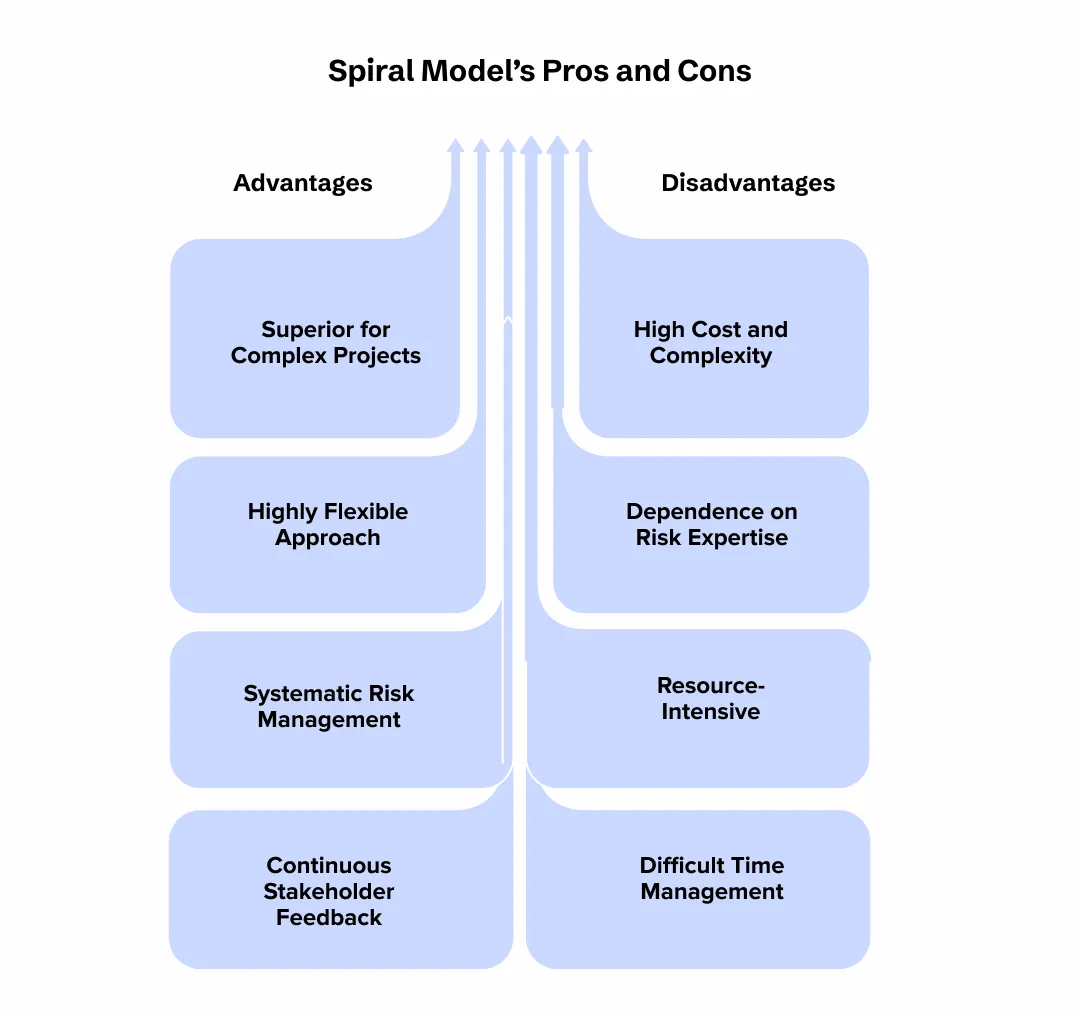
The Spiral Model provides a distinct framework engineered for environments where complexity and uncertainty are primary concerns. Despite its power, the Spiral Model's implementation carries significant overhead and dependencies that make it unsuitable for all project types. Let’s look at some of the pros and cons of the spiral model here:
Advantages of the Spiral Model
1. Superior for Large, Complex Projects: The model's greatest strength lies in breaking down monumental tasks into a series of small, manageable, iterative cycles. Such a structure offers a phased, controlled approach to development that permits teams to cope with the uncertainty that exists within large projects.
2. Highly Flexible Approach: The model is established upon the basic premise that requirements will change for the project. Each iteration ends with an assessment, providing a natural checkpoint for stakeholders to bring in alterations or clarify goals. This enables the project to make strategic shifts at a fraction of the cost and schedule disruptions that occur with more rigid methodologies.
3. Systematic Risk Management: Risk management is not a preliminary phase but the central driver of the process. Forcing a rigid software risk analysis at the onset of every cycle helps the model identify and address threats prior to failures that could undo the project at the end.
4. Continuous Stakeholder Feedback: The recurring evaluation ensures an ongoing check of whether the business objectives are met over a prolonged period. This also ensures that the end-product meets strategic goals instead of solely technical requirements.
5. Improved Software Quality: An iterative process involves key functionalities and fine-tuning. This ensures that flaws are discovered early and addressed in a timely manner, so that the ultimate quality of the final software is optimal.
Disadvantages of the Spiral Model
1. High Cost and Complexity: The formal procedure and paperwork of each cycle are time-consuming. The repeated costs of risk analysis, planning, and prototyping become extremely expensive and an inefficient choice for short-lived, low-risk projects.
2. Heavy Dependence on Risk Analysis Expertise: The model's success is entirely contingent on the skill and experience of the risk analysis team. It is a high-skill methodology; if the team fails to accurately identify and assess risks, the model's primary advantage is nullified.
3. Difficult Time Management: The iterative nature, the overall number of spirals will not always be known at the start of the project. This unpredictability creates challenging situations for estimating accurate end dates and ultimate costs, a huge negative for projects with hard, fast timelines and budget parameters.
4. Resource-Intensive: The model needs continuous and intense use of senior analysts, developers, and influential stakeholders throughout its lifetime. This will consume valuable and expensive manpower for an extended period of time, impacting their deployability on other business initiatives.
When Do You Use the Spiral Model?
A company's use of the spiral model is a strategic choice best reserved for projects that are large and involve a huge investment. It is best suited for situations as follows.
1. Uncertain or Changing Requirements
The model is designed for uncertainty. When a project starts off with an unclear set of requirements or we know that the scope will change over time, then the Spiral Model offers the kind of flexibility that you need. Unlike the linear models that need a stable, comprehensive set of requirements at the very start, the spiral model has an iterative approach that permits learning and adjustment within every cycle. Hence, with the spiral model, the end product meets the evolving business requirements.
2. For Evaluating Risks and Costs
For high-stakes, capital-intensive projects, risk is a direct financial liability. The Spiral Model’s mandatory phased risk analysis in every iteration makes it ideal for these scenarios. It forces a continuous, disciplined evaluation of technical and managerial risks, allowing stakeholders to make informed decisions at each phase. This protects the investment by ensuring that major flaws are discovered before they become catastrophic. It also helps stakeholders make better budgeting decisions when comparing engagement structures such as the hourly vs fixed price model for long-term software development projects.
3. Frequent Releases and Prototypes
If the success of your project lies in early and ongoing input from end-users or stakeholders, then the Spiral Model can be the best choice. Each spiral finishes off with a concrete deliverable—prototype, design document, software increment—the kind of thing that can be inspected. This approach ensures there are frequent checkpoints for verification, such that the development team stays close to the client's intentions at every stage of the lifecycle.
4. Long-Term & Large-Scale Projects
Throughout a long timeframe, technological, market, and business strategy changes will occur. The Spiral Model is appropriate for long-duration projects because change is built directly into the model. The iterative nature of the model allows new requirements or technologies that become available later on to be incorporated within later spirals, such that the project always remains applicable and feasible for its full duration.
Conclusion
The Spiral Model is a software development project approach that places flexibility and risk management at its center. This systematic planning with iterative development provides a formal approach to uncertainty and changing requirements that might hamper large projects.
Though the model requires large resources, experience, and time commitment, its ongoing stakeholder input and systematic analysis of risk ensure that the model is preferred for high-risk systems. Success depends on knowing when your project's features—such as variability of requirements, high risk, high investment, or prolonged scope- match the strengths of the model.
For development teams, the Spiral Model converts project risk into an organized and controllable process that guides right decisions at each stage of development.
Frequently Asked Questions
What are software development life cycle models?
Software development life cycle models are structured frameworks that define phases, activities, and deliverables for building software systems. Popular models include Waterfall, Agile, V-Model, and Spiral, each offering different approaches to managing development processes and project requirements.
What is risk-driven software development?
Risk-driven software development prioritizes identifying, analyzing, and mitigating project risks throughout the development lifecycle. This approach ensures potential threats are addressed early, preventing costly failures and ensuring project success through systematic risk management strategies.
What is risk analysis in software engineering?
Risk analysis in software engineering involves systematically identifying potential project threats, evaluating their probability and impact, and developing mitigation strategies. It encompasses technical, schedule, budget, and operational risks to ensure informed decision-making throughout development.
Why is the Spiral Model called Meta Model?
The Spiral Model is called a meta model because it incorporates elements from multiple software development life cycle models. It combines Waterfall's structured phases with iterative development approaches, creating a flexible framework that adapts to other methodologies.
When to use the spiral model?
Use the Spiral Model for large-scale, high-risk projects with uncertain requirements, significant financial investment, long development timelines, and a need for frequent stakeholder feedback. It's ideal when systematic risk management and adaptability are critical project success factors.

Uncover executable insights, extensive research, and expert opinions in one place.
Related Content