Share It On:
 Smart folks are now using AI in software testing to save money, time, and maintain their digital assets smartly. This is the blog that throws light on how!
|
TL;DR What is AI in software testing? AI in software testing isn’t magic—it’s muscle. It spins up new test cases, patches broken scripts, predicts where bugs might lurk, and notices odd system behavior long before a crash. It doesn’t replace testers. It backs them up. Machines grind through the boring stuff, while people focus on strategy, usability, and the messy human side of software. The shift is big: QA moves from chasing errors after release to stopping them earlier. Faster cycles, fewer surprises, lower costs—that’s the real payoff. |
In the race to ship flawless software, your QA team is likely running a marathon with ankle weights. Traditional testing, for all its merits, is buckling under the pressure of agile sprints and labyrinthine codebases. This isn't a future problem; it's happening right now. The stopgap? Artificial intelligence in software testing. It’s a shift that's rapidly separating the market leaders from the laggards.
Forget the hype. We're talking about tangible, bottom-line impact. The market for AI in testing isn't just growing; it's exploding, soaring from $414.7 million in 2023 toward a $1.63 billion valuation by 2030, a reality confirmed by Grand View Research.
This explosion is fueled by one simple truth: implementing AI in software testing isn't about replacing humans. It's about unleashing their full potential.
Decoding the Types of AI Testing
When we discuss the use of AI in software testing, we’re not talking about a single magic wand. Think of it as a specialist's toolkit, with a precise instrument for every potential fracture in your application. The various types of software testing are being fundamentally reimagined.
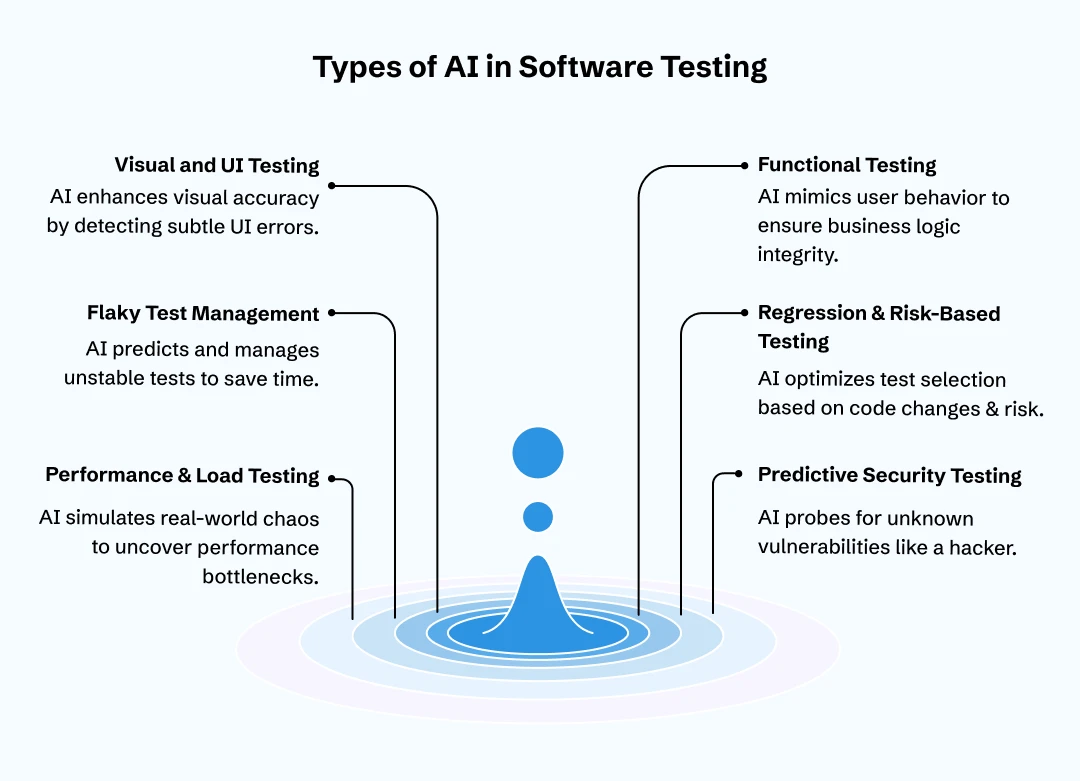
- Visual and UI Testing Gets Eagle Eyes: Humans are good at spotting glaring errors, but what about a button that's two pixels off-center? Or a color hex code that's almost, but not quite, right? AI doesn't get tired. It performs pixel-level comparisons and analyzes the Document Object Model (DOM) to catch subtle visual regressions and component misalignments that users feel, even if they can't articulate them.
- Functional Testing with AI: Beyond UI, functional testing ensures business logic, APIs, and workflows behave as expected. AI augments this with AI-powered exploratory testing to mimic unpredictable user journeys.
- Taming the Beast of Flaky Tests: Every developer knows the pain of a "flaky" test—it passes, it fails, and nobody knows why. It’s a massive time sink. AI-driven flaky test management analyzes patterns over thousands of executions to predict which tests are unstable, flagging them for review so your engineers aren't chasing ghosts.
- Intelligent Regression and Risk-Based Testing: Running a full regression suite after every minor code change is like pressure-washing your entire house because of one muddy footprint. AI employs smart test case optimization, analyzing the code changes and historical defect data to select and run only the most relevant, high-risk tests. This sharpens your risk assessment in software testing from a guessing game into a science.
- Performance and Load Testing on Steroids: Instead of just simulating 10,000 users, AI can create dynamic load models that mimic real-world chaos—sudden traffic spikes, specific user journeys, and unpredictable behavior. This uncovers performance bottlenecks under realistic stress, not sterile lab conditions.
- Predictive Security Testing: Old-school security scans look for known vulnerabilities. AI-powered security testing thinks like a hacker. It uses adversarial testing techniques to probe for unknown weaknesses and zero-day exploits, a critical function for platforms managing sensitive data under regulations like HIPAA or PCI DSS.

What is the Role of AI in Software Testing, Really?
Beyond the different types, how does this technology actually function on the ground? The roles and applications of AI-powered software testing are about offloading cognitive burdens and injecting intelligence into the entire software testing process. AI is your smartest intern, your most vigilant analyst, and your most tireless automator, all at once.
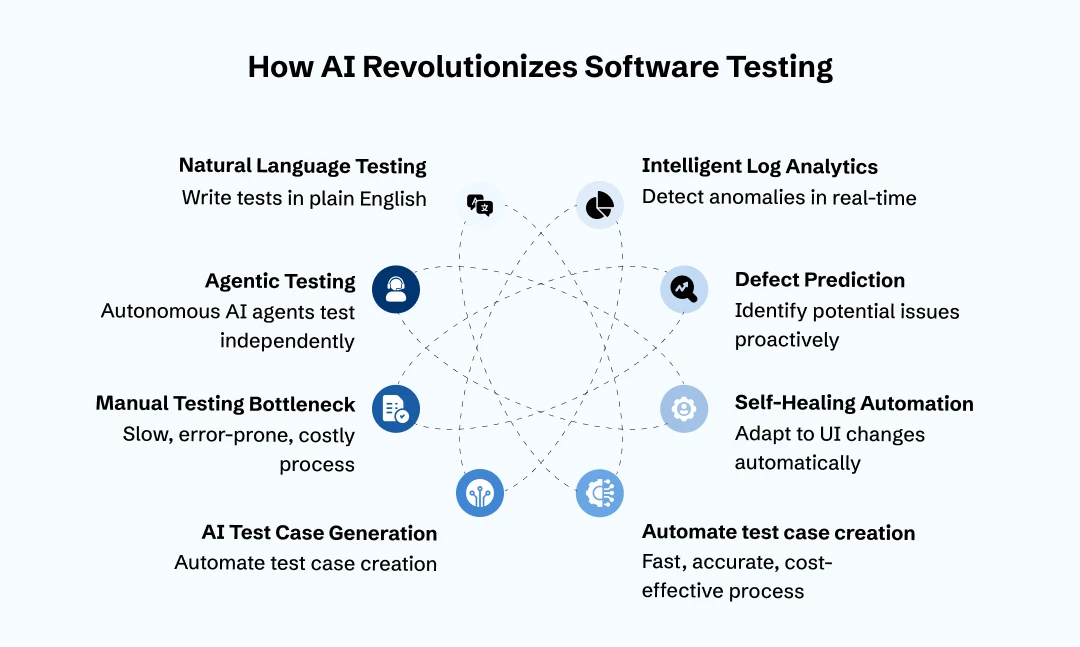
1. AI-Driven Test Case Generation
Generative AI in software testing reads your requirements documentation—user stories, Gherkin files—and automatically writes relevant, comprehensive test cases. It understands intent, which means it can generate not just the "happy path" but also the negative tests and edge cases a human might overlook.
2. Self-Healing Test Automation
This is the game-changer. Historically, the biggest headache for automation is maintenance; a developer changes a button's ID, and a dozen test scripts shatter. Self-healing automation, a core tenet of modern app testing tools, uses machine learning in software testing to understand UI elements contextually. When a button's ID changes, the AI finds it by its label, location, or other attributes and updates the script on the fly. No human intervention needed.
3. Defect Prediction and Root Cause Analysis
AI doesn’t just run tests—it looks for patterns. By scanning your code repository, old bug reports, and recent test results, it starts to see which modules are most likely to break next. That’s defect prediction in action.
And when something does fail? Instead of sending your team on a wild chase, the system points straight to the commit, sometimes even the exact line of code. This kind of root cause analysis cuts debugging from hours down to minutes.
4. Intelligent Log Analytics and Anomaly Detection
Your applications generate mountains of log files every minute. No human can parse them effectively. AI, however, can ingest this data in real-time, learning the normal operational "heartbeat" of your system.
It then flags any deviation—a sudden spike in error codes, a weird latency pattern—as a potential issue, enabling anomaly detection before it leads to a catastrophic failure.
5. Natural Language Test Automation
The barrier to writing automated tests is often the coding itself. This is changing. With nlp-based keyword-driven testing, team members can write test steps in plain English ("Click the 'Login' button," "Verify the welcome message appears"). The AI engine then translates this natural language into executable code, democratizing test creation.
6. The Dawn of Agentic Testing
The newest frontier is the rise of the autonomous AI agent. You give it a high-level goal, like "ensure the checkout process works for European users," and the AI agents take it from there.
They explore the application, devise their own test strategies, execute them, and report back with findings. It’s a quantum leap in automation, and as we're already seeing AI agents replacing app menus and buttons in UI design, their role in testing is the logical next step.
AI-Powered vs. Manual Testing
This isn't a battle for supremacy; it's an efficiency audit. Placing AI-driven methods next to purely manual efforts highlights a fundamental evolution in how we approach quality. The classic debate of automated vs manual testing gets a whole new dimension.
| Feature | Manual Testing (The Artisan) | AI-Powered Testing (The Smart Factory) |
|---|---|---|
| Speed | Thorough but slow. Constrained by human work hours. | Blisteringly fast. Executes thousands of tests across multiple platforms in minutes. |
| Coverage | Deep but narrow. Focused on specific user journeys. | Broad and deep. Explores countless permutations and edge cases that humans wouldn't consider. |
| Accuracy | Subject to human error, fatigue, and interpretation. | Unwavering. Executes the exact same way every single time, eliminating false positives from tester error. |
| Cost | Seems cheaper upfront, but carries high long-term salary costs. | Requires initial investment but delivers massive ROI by reducing manual hours and catching bugs earlier. |
| Maintenance | A constant, time-draining effort to update scripts. | Drastically reduced through self-healing and dynamic test generation. |
| Data Insights | Relies on the tester's experience and anecdotal evidence. | Generates rich, actionable data, predictive dashboards, and heatmaps of at-risk application areas. |
Benefits of Using Artificial Intelligence in Software Testing
So, how AI improves software testing is clear, but what are the strategic business outcomes? The benefits of AI in software testing ripple across the entire organization. This is why many leading artificial intelligence companies are pivoting to QA solutions.
- Shatter Time-to-Market Barriers: Faster testing cycles mean faster releases. It’s that simple. You ship features quicker, respond to market demands faster, and out-maneuver the competition.
- Actually Improve Software Quality: This isn’t just about finding more bugs; it’s about finding the right bugs earlier. AI-powered testing catches critical architectural flaws and security holes before they become catastrophic, multi-sprint ordeals.
- Slash Costs and Skyrocket ROI: The math is compelling. A Capgemini report found AI can slash testing costs of detecting and responding to branches by up to 64%. This is why many firms outsource software development to partners who already have this capability baked in.
- Boost Developer Morale: Nothing kills productivity like a developer spending a day hunting down a bug from a flaky test. By providing stable, reliable, and fast feedback, AI lets developers do what they love: build.
- Achieve True End-to-End Coverage: AI doesn’t just stop at the UI. It follows the full journey—API calls, database layers, multi-step workflows—and checks if your end-to-end testing strategy can handle the pressure.
- Enable Data-Driven Decisions: Forget pass/fail checklists. AI test reports come with dashboards that tie failures to business outcomes. That context helps product managers decide what needs fixing first, not just what failed.
- Scale Testing for Complex Architectures: Systems built on IoT, microservices, or big data are nearly impossible to test manually at scale. AI manages the parallel runs and the heavy data loads, making sure those modern setups stay stable.
The software development life cycle isn’t linear anymore; it’s a constant loop. AI is the engine that helps software development companies keep loops running smoothly.
Challenges and Limitations of AI in Testing
Adopting AI is not a plug-and-play fantasy. If you dive in without understanding the challenges of AI in software testing, you're setting yourself up for frustration. Here's the unvarnished truth:
- The "Black Box" Problem: The biggest hurdle is often trust. If an AI model flags a risk, but you can't understand why, it's hard to act on it. The need for explainability and interpretability is paramount.
- Data is Your Biggest Asset and Liability: AI models thrive on clean, detailed history. Feed them sloppy bug logs or half-baked test results, and the output suffers. Garbage in, garbage out. And if you’re handling user data, there’s no dodging compliance rules like GDPR.
- The Talent Gap is Real: It’s not enough to hire QA engineers anymore. You need people who also grasp data science. That blend of skills—rare, costly, and hard to hold on to—has become the real bottleneck.
- Integration with Legacy Systems: Many teams underestimate this. Dropping a new AI tool onto a ten-year-old monolithic system with brittle APIs isn’t plug-and-play. It’s a grind, and often a nightmare.
- Model Drift and Maintenance Overhead: An AI model isn’t static. As codebases and user behavior evolve, accuracy drifts. This “model drift” demands retraining and ongoing monitoring—essentially a new layer of maintenance.
- Where Humans Still Reign Supreme: Some jobs can’t be automated away. True usability and exploratory testing, the emotional feel of an app, the judgment call on accessibility—especially under WCAG standards—still belong to human testers.
The Horizon: Latest Trends of AI in Software Testing
The current state of AI in software testing is just the opening act. The AI trends on the horizon are poised to redefine quality engineering entirely. Tech leaders need to be watching these developments closely.
- Hyper-automation in CI/CD: We're moving toward a "zero-touch" testing pipeline. Code is committed, and AI autonomously provisions the right environment, selects the optimal test suite, executes it, analyzes the results, and promotes the code to the next stage—all without a human clicking a button. This is one of the most transformative software development trends today.
- Generative AI for Richer Testing: Think bigger than just test cases. Generative AI in software testing is now creating entire synthetic user personas with realistic behaviors and data sets, allowing for nuanced A/B testing tools and scenarios that were previously impossible to simulate. This is a core part of the future of AI in the app development landscape.
- AI-Human Symbiosis: The future role of a QA engineer isn't "test executor" but "AI Test Strategist." They'll be responsible for training the models, setting strategic quality goals, and focusing their human intelligence on the most complex, creative testing challenges. It's about how you implement Artificial Intelligence and Machine Learning as a partnership.
- From Bug Detection to Defect Prevention: This is the holy grail. The ultimate future of AI in software testing lies in predictive analytics becoming so accurate that AI can analyze code as it's being written and flag potential architectural flaws or logical errors before they even become bugs.
Many top AI companies, including specialized artificial intelligence companies in India, the USA, the UK, etc., are driving this innovation, making the task of choosing the right AI development platform a critical strategic decision.

How to Use AI in Software Testing
So, How Can AI Optimize Software Testing for you? Don't try to boil the ocean. A strategic, phased adoption is the key to success. This is your roadmap.
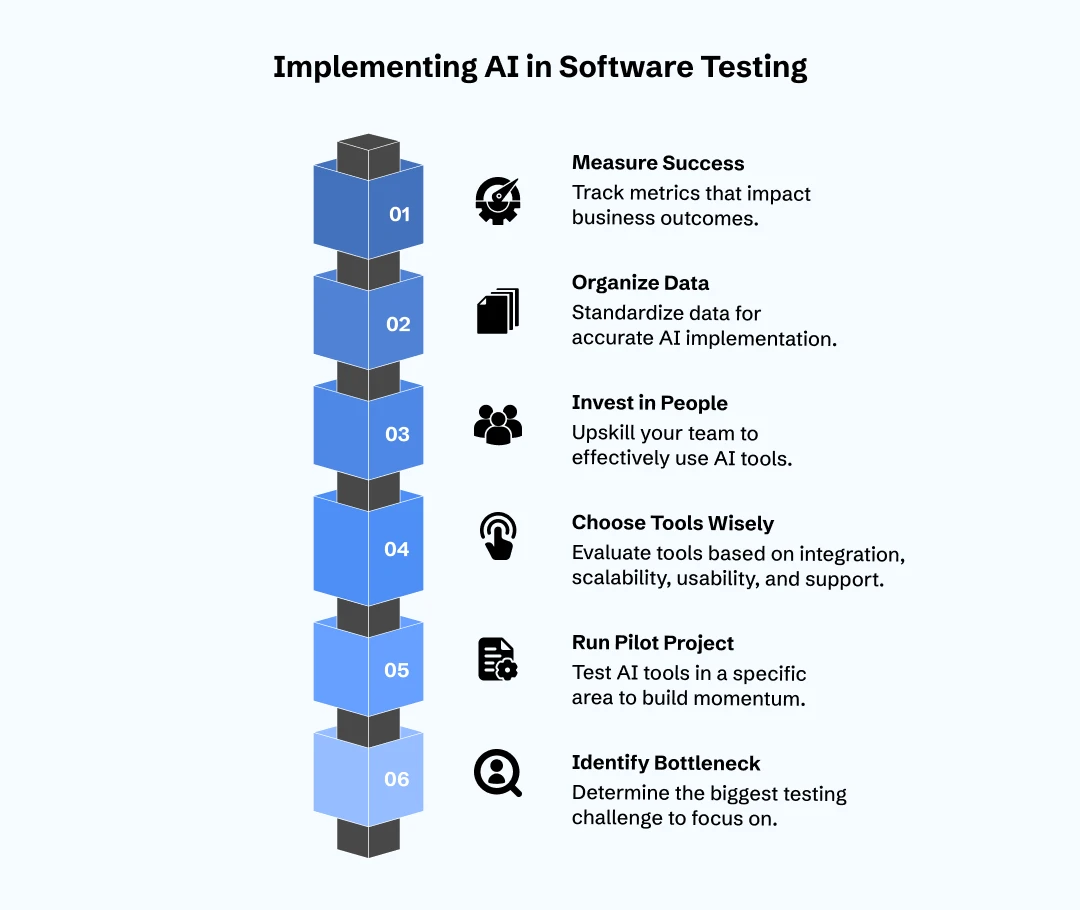
1. Start with the "Why" (and the Pain): Before you even look at a tool, identify your biggest bottleneck. Is it the time spent on regression testing? The cost of test script maintenance? Flaky tests derailing your sprints? Get specific. Frame the problem in terms of business impact. This is your north star.
2. Run a Focused Pilot Project: Pick one high-pain, high-impact area and run a small, time-boxed pilot. This allows you to test a tool, learn the process, and generate a quick win that builds momentum and secures executive buy-in for a wider rollout. Effective performance testing practices are often a great candidate.
3. Choose Your Tools Like a Pro: The market is crowded. Evaluate potential platforms on more than just their feature list.
- Integration: How well does it plug into your existing ecosystem (Jira, GitHub, Jenkins, etc.)?
- Scalability: Can it handle the future complexity of your applications?
- Usability: Can your current team learn it without needing a PhD in data science?
- Support: What does vendor support look like when you inevitably hit a roadblock?
4.mInvest in Your People (Fiercely): Your team is your greatest asset. Upskill them. Send them to workshops. Foster a culture of data literacy and experimentation. An AI tool in the hands of an unprepared team is just expensive shelfware.
5. Get Your Data House in Order: You can start this today. Enforce consistent tagging in your bug reports. Standardize your test case documentation. The cleaner your data is now, the faster and more accurate your AI implementation will be. A clear understanding of your software development cost can help justify this internal effort.
6. Measure What Matters: Define your success metrics upfront, and be ruthless about tracking them. Don't just measure vanity metrics like "number of tests automated." Measure things that impact the business:
- Reduction in regression testing cycle time.
- Decrease in the number of bugs found in production.
- Improvement in your conversion rate through A/B testing based on higher-quality releases.
Whether you build this capability with in-house experts or partner with savvy software development companies in the USA, the strategy is the same: start smart, empower your team, and iterate.
The Inevitable Conclusion
The conversation around AI in software testing has moved past "if" and landed squarely on "how soon." Sticking with purely traditional QA methods in this environment isn't just inefficient; it's a competitive liability.
By embracing AI-driven automation, you’re not just buying a tool; you're investing in a smarter, faster, and more resilient development culture. The time to act was yesterday. The next best time is now.
Frequently Asked Questions
How can AI optimize software testing?
AI optimizes testing by automating tedious tasks, but its real power lies in intelligence. It prioritizes tests based on risk, predicts where bugs will appear, self-heals broken scripts, and generates comprehensive test data, allowing teams to achieve far greater coverage and accuracy in a fraction of the time.
What is Generative AI in software testing?
Generative AI uses large language models to create new content. In testing, it can read application requirements and automatically write test cases, generate realistic user data and personas for testing, and even create code for test scripts from plain English descriptions. It’s about creating, not just validating.
What is the future of AI in software testing?
The future is proactive and autonomous. We're heading toward a state where AI agents manage the entire testing lifecycle with minimal human guidance. The focus will shift entirely from finding bugs after they're created to using predictive analytics to prevent them from being written in the first place.
Will AI replace my QA team?
No, it will transform it. AI will handle the repetitive, machine-scale tasks, freeing up your human testers to become quality strategists.
Their job will be to train the AI, analyze its complex findings, and apply human creativity and domain expertise to solve the most challenging quality problems.

Uncover executable insights, extensive research, and expert opinions in one place.
Related Content