Share It On:
 Here’s a Seven-step Framework to Help You Hire Software Developers Who Won't Pull a Houdini on You!
|
TL;DR: Hiring software developers is a strategic decision, not a transaction. It starts with defining business needs, choosing the right model (in-house, freelance, or outsourcing), and selecting talent hubs like the USA, Eastern Europe, or India. The best results come from sourcing beyond job boards, vetting with real-world tests, and balancing competitive salaries with ROI-driven onboarding. The real win lies in building a dedicated team that delivers long-term business outcomes. |
Here’s the thing: Hiring software developers isn't like buying office furniture. It's a high-stakes, often bewildering game where the right move can change your company's destiny, and the wrong one… well, it can bleed your business dry. The market is a battlefield, swarming with companies waving bigger paychecks. So, how do you win?
You don't win by following the same tired playbook. You win by being smarter. We've taken the chaos of the hiring process and forged it into a 7-step framework. This isn't just theory. This is your guide to building a dedicated software development team that doesn't just work, but dominates.

How to Hire Software Developers in Seven Steps
In a startup, a single hire can be the difference between liftoff and implosion. There’s no room for error. This framework isn't a suggestion; it's your new doctrine.
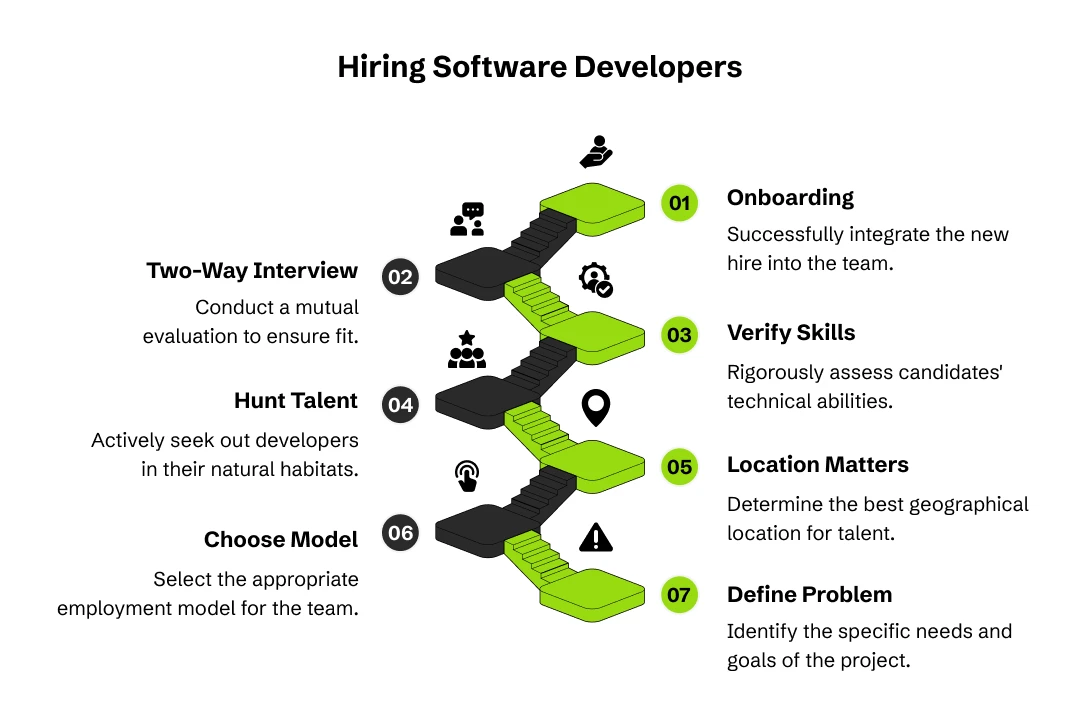
1. Define the Real Problem. Forget job descriptions for a second. What's the actual fire you're trying to put out? Get brutally honest about the "why" before you even think about the "who." Are you scaling infrastructure, shipping a new mobile app, or plugging gaps in your software development process? Be brutally honest about your business requirements and project goals before thinking about candidates.
2. Pick Your Poison: The Employment Model. In-house army? Freelance assassin? Or a full-blown Software Development Outsourcing Company? Each choice has a blast radius that affects your cash flow, your control, and your company's DNA. Insights like in-house vs. outsourced development explain how this choice shapes long-term strategy.
3. Plant Your Flag: Location Matters. The world is teeming with talent, but not all talent hubs are created equal. Outsourcing Software Development to Eastern Europe is a different beast than hiring in Latin America. Do your homework on time zones and work culture. In contrast, companies that prefer compliance-heavy projects often lean toward software development companies in the USA, where proximity and regulations provide an edge.
4. Go Where They Live: The Hunt. The best developers aren't scrolling through massive job boards. They're solving problems on GitHub, arguing in niche subreddits, and building things. You have to go to them. Founders often explore curated platforms designed to hire developers for startups, where early-stage teams can find specialized matches.
5. Trust, But Verify. Aggressively. A slick resume means nothing. The proof is in the pull request. You must dissect their portfolio, check their open-source work, and put them through a real-world technical gauntlet. Strong candidates can articulate why they might choose automated vs. manual testing, how they use app testing tools to improve quality, or how risk assessment in software testing drives product resilience.
6. The Two-Way Interview. This isn’t an interrogation. It’s a chemistry check. Are they smart? Sure. But can you survive a Tuesday afternoon debugging session with them? They're interviewing you just as hard.
7. Stick the Landing: Onboarding. Getting the "yes" is easy. The hard part is the first 90 days. A botched onboarding can sour a great hire and poison the well for your entire team. Don't fumble the ball at the one-yard line.
From Foggy Idea to Sharp Blueprint
"Just get me a good coder" is a phrase that should be banished from the English language. It's a lazy request that guarantees you'll get a flood of candidates who are all wrong. You need a blueprint.
- Map the Mission. What is the absolute core objective? A developer who gets the full software development life cycle is a strategic asset, not just a pair of hands. They see the whole board.
- Declare Your Tech Stack. No ambiguities. List the programming languages, the frameworks, and the front-end and back-end tools. And in today's world, you have to address the elephant in the room: AI. Are you dipping your toes into AI in App Development? Mentioning specific AI Use Cases or the need to work with top AI companies shows candidates you’re not stuck in the past. Businesses are also choosing the right AI development platform to keep pace with fast-evolving AI trends.
- Write a Job Ad, Not a Hostage Note. Your job description should be a magnet for the right people and a repellent for the wrong ones. It needs to scream your mission and culture.
- Character Over Credentials. I’ll take a hungry problem-solver over a credentialed-but-complacent veteran any day. Soft skills aren't a "nice to have"; they are the entire game. Test for grit and curiosity.
The Price of Admission: A Reality Check on Developer Salaries
What you think is competitive might be a joke to the market. Here's a dose of reality—hard numbers to stop you from lowballing and losing your top pick.
Global Developer Stats Before We Dive into Salaries:
- IDC Forecast (2024–2028): The global developer population is expected to grow from 37.0 million in 2024 to 57.8 million by 2028. [IDC]
- Stack Overflow Developer Survey 2026: Based on 49,000+ developers from 177 countries, this survey highlights skills distribution and hiring competition, making it a reliable pulse check for demand. [Stack Overflow Survey 2026]
- The same survey also discusses the rising integration of AI in development processes. For you, that can be beneficial in terms of costs and deadlines, as over 47.1% of respondents agreed that they use such smart tools. [Stack Overflow Survey 2026]
| Role/Region | The USA (Annual) |
The UK (Annual) |
India (Annual) |
|---|---|---|---|
| Junior Developer | $58,000 - $97,000 | £25,000 - £41,000 | ₹400,000 - ₹10,00,000 |
| Mid-Level Developer | $71,000 - $100,000 | £35,000 - £55,000 | ₹600,000 - ₹14,00,000 |
| Senior Developer | $84,000 - $100,000+ | £40,000 - £65,000 | ₹10,00,000 - ₹24,00,000 |
Disclaimer: These are averages taken from Glassdoor. Your mileage will vary. When projecting budgets, always factor in your software development cost—benefits, taxes, and compliance, which often add 20–30% to base salaries.

Best Practices to Follow While You Hire Software Developers
Posting a job is passive. Sourcing is active. It's hunting. And once you have candidates, your vetting process should be a crucible.
1. The Hunt
- Escape the LinkedIn Echo Chamber. Yes, be there. But the real action is elsewhere. Find the interesting conversations on Stack Overflow. See who is building cool things on GitHub. That's where passion lives.
- Niche Boards Work. Platforms like Gun.io cut out the noise. They are curated streams of talent. Knowing the latest software development trends tells you which watering holes are worth your time.
- Show Your Face. Go to a local tech meetup. Buy a developer a coffee. A real human connection is your secret weapon against the faceless recruiting machines of your competitors.
2. The Crucible
- The Resume Autopsy. Don't read resumes; dissect them. Look for verbs that show impact—"launched," "fixed," "grew"—not just a laundry list of tech.
- The Real-World Gauntlet. A good test isn't a puzzle; it's a simulation. Does their approach to end-to-end testing show they think about the user? Ask how they would approach launching an A/B testing program and whether they track improvements in conversion rate through A/B testing.
- Insider Tip: Give them a real, non-urgent bug from your system. Watch them work. Their questions will tell you everything you need to know about how they think.
- The Quality Litmus Test. Do they care about the craft? Probe their knowledge of app testing tools and whether they tie testing practices back to business impact. Ask how they’d use A/B testing tools to actually move the needle on conversion rate through A/B testing. This is how you find people who build products, not just features.
How to Maximize the ROI of Software Development Hiring?
A new hire isn’t an asset until they create measurable value. ROI comes down to aligning talent with business impact. That means tightening feedback loops, standardizing performance testing practices, and making data-driven calls.
Teams that track product impact—using methods like launching an A/B testing program or analyzing conversion rate through A/B testing—move beyond code delivery to business outcomes.
Layer in automation, or even AI agents, and you’re no longer just building software—you’re compounding returns over time.
Common Traps That Might Slow Down Your Hiring of Software Development Teams
This road is paved with good intentions and littered with failed hires. Here's what to watch out for.
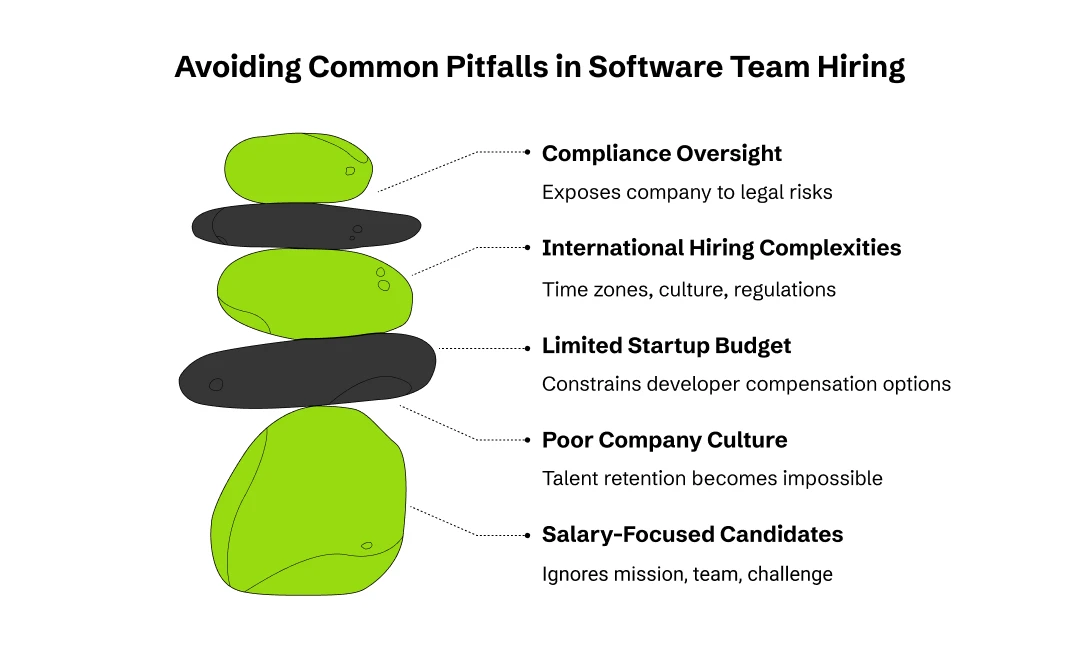
- The Bidding War. You can't always win on salary alone. You have to sell the mission, the team, and the challenge. If a candidate is only talking about money, they might be the wrong fit anyway.
- The Leaky Bucket. Attracting talent is pointless if you can't keep it. A bad culture is a revolving door. Fix your house before you invite guests over.
- The Startup Budget Bind. Money is tight. The pressure to hire dedicated developers for startups on a shoestring is immense. This is where you need to get creative with equity and be brutally honest about what you can truly afford. The total software development cost is more than just a salary.
- The Global Headache. Hiring internationally is powerful, but it’s a minefield of time zones, cultural nuances, and regulations. In such cases, many organizations prefer to outsource software development to trusted partners that already navigate these complexities.
- The Compliance Minefield. Hiring across borders isn’t just about time zones. It drags in regulations like GDPR, HIPAA, PCI DSS, and WCAG, each carrying real liability if overlooked. A great hire who doesn’t understand compliance can expose you to fines and reputation damage. When you’re scaling internationally, you need people—or partners—who treat data privacy and accessibility as part of the build, not an afterthought. That’s where a seasoned software development partner becomes not just convenient, but critical.
To Conclude, Hiring Developers is a Strategic Bet
Hiring software developers is not a transactional task—it’s a high-stakes investment in your company’s future. From defining the problem to choosing employment models, locations, and vetting practices, every decision compounds. Salaries and market demand show just how competitive the field is, but ROI lies in how well you align developers with business outcomes.
The companies that win are not the ones who throw the biggest paychecks but those who treat hiring as a strategy, not logistics. Success comes down to building software development teams that deliver resilience, compliance, and innovation—not just code.
Frequently Asked Questions
So, how much is this really going to cost me?
Look at the table above. A US-based senior dev will run you $100k+, easily. An equivalent talent in India might be half that. But that's just salary. Add another 20-30% for benefits, taxes, and equipment. There's no single magic number.
What's a killer interview question you can give me?
Forget "What's your greatest weakness?" Ask this instead: "Tell me about a time you were wrong about something technical, and how you handled it." This tests for humility, self-awareness, and intellectual honesty—three traits worth their weight in gold.
Seriously, where are all the good software developers?
Well, you will find them in countries like the USA, India, the UK, Indonesia, the UAE, the Netherlands, and at plenty of other such locations. But the journey of identifying the right development partners can demand exploring through Google reviews, Upwork profiles, and much more.
Where to Find the Right Software Development Company?
Use keywords like “software development companies near me” if you’re looking for firms as near as possible. Such keywords help you outsource to nearshore firms. But if you’re open to long-distance partnerships, explore online directories and focus on locations like India, the USA, the UK, etc., depending on your budget.

Uncover executable insights, extensive research, and expert opinions in one place.
Related Content