Share It On:
 Choosing the wrong billing structure can inflate your project costs before you even hit the testing phase. If you aren't aligning the pricing with your project scope, you’re essentially writing a blank check for inefficiency.
You are not looking for an hourly-based team or a fixed-price structure. Instead, you are looking for a financial architecture that treats your product as a strategic asset; something that won’t stall due to budget exhaustion, scope creep, or misaligned incentives.
Software development pricing is not a static line item. It is a risk-sharing agreement. Behind every successful product launch or enterprise-scale digital transformation sits a billing decision that most teams treat as an afterthought. Hourly rates, fixed-price contracts, and dedicated team retainers are not just administrative choices. They are business variables that dictate how your infrastructure behaves when requirements shift or the market demands a pivot.
The reality? Most stakeholders underestimate the total cost involved in developing software because they focus on the "price" rather than the "model." One model optimizes for predictability; the other optimizes for agility. Choosing the wrong software development models is a silent liability that leads to friction between you and your development partner.
In the B2B tech space, there are brilliant products that die on the vine because the contract was too rigid for the latest software development trends or too loose for the CFO’s comfort. This editorial is built for the decision-maker who calculates ROI before signing and evaluates software risk analysis before committing. We are going to cut through the marketing fluff and dissect the hourly vs fixed price model to see which one actually protects your bottom line in 2026.
What Are Software Development Pricing Models?

When we talk about pricing models in software development, we are talking about the legal and financial "rules of engagement." These models define the boundaries of cost, time, and deliverables. Without a clear framework, your software development guide is just a wish list.
The primary purpose here is to distribute risk. In some models, the client takes the risk of a project taking longer than expected; in others, the development agency bears the burden. While the software development industry has dabbled in performance-based metrics, the heavy lifting is still done under hourly rate vs. fixed price structures.
According to data from Mordor Intelligence, the software outsourcing market has reached $618.38 billion and will grow to $564.22 billion by 2031. This shows a growing shift toward flexible models as Artificial Intelligence in software development accelerates development cycles and makes rigid scoping more difficult.
While there are several niche structures such as dedicated teams, outcome-based pricing, and hybrid arrangements, the industry remains anchored by two primary pillars: the hourly rate (often called Time & Materials) and fixed price software development. Understanding these is the first step in ensuring your Software Development Life Cycle (SDLC) stays on track and within budget.

Hourly vs Fixed Price Model: An Overview
The decision between an hourly vs fixed price model isn't just a line item in a contract; it is a fundamental choice that dictates your project’s DNA. To choose correctly, you must understand the underlying philosophy of each approach and how they influence the daily operations of software development companies.
Here is a high-level overview to help you distinguish between these two software development pricing models at a glance:
| Parameter | Hourly Rate Model (T&M) | Fixed Price Model |
|---|---|---|
| Core Philosophy | Pay for the effort and expertise applied | Pay for a specific, predefined outcome |
| Scope Management | Dynamic; features can be added or removed anytime | Rigid; defined in a Software Development Agreement |
| Financial Risk | Shared; the client pays for time, the vendor provides talent | Vendor-centric; the agency absorbs costs if they over-promise |
| Primary Incentive | High-quality, polished, and scalable code | Efficiency and meeting the specific deadline |
| Ideal Methodology | Agile methodology in software development | Waterfall or V-Model development |
| Best For | Long-term partnerships and R&D-heavy products | MVPs, small tools, and standardized updates |
How the Hourly Pricing Model Operates?
The hourly model, often referred to in technical circles as Time & Materials (T&M), is the personification of flexibility. Unlike a rigid contract that locks you into a specific set of features from day one, the hourly model is a pay-as-you-go system. You are essentially renting the brainpower and technical clock-hours of a dedicated team.
The process is straightforward but requires high transparency. Every week or month, the development team provides a detailed breakdown of the tasks performed. This includes everything from writing core logic and implementing AI in software testing to attending sprint meetings. You are billed based on the hourly rate of each specialist, be it a Senior Architect, a UI/UX Designer, or a DevOps Engineer.
Strategic Applications: When Does Hourly Billing Make Sense?
This model is the standard for projects where the final outcome isn't fully defined. If you are experimenting with the latest software development trends or building a Minimum Viable Product (MVP), the hourly rate allows you to pivot without renegotiating a contract.

1. Developing Disruptive AI and Machine Learning Tools
Artificial Intelligence in software development has become a standard practice. However, AI projects are notoriously unpredictable. You might start with one data model only to find that another performs better during training. The hourly model allows you to follow the data without having to tear up a contract every time a breakthrough occurs.
2. Long-Term Maintenance and Incremental Scaling
If you are managing a large-scale platform, such as a custom ERP software, the work is never truly "finished." You need a team that can handle bugs, security patches, and the integration of the latest software development trends as they emerge. Hourly billing ensures you have consistent access to talent without overpaying for downtime.
3. Prototyping and MVP Discovery
Startups rarely get their first version 100% right. By using an hourly rate, you can build a Minimum Viable Product, launch it to a small user base, and immediately use the feedback to tweak the next sprint. This iterative loop is the hallmark of Agile methodology in software development.
Also Read: 60+ Software Development Terms You Must Know
The Business Advantages of Hourly Billing
The move toward hourly vs fixed price model structures is largely driven by the need for speed and quality. Here is why many software development companies and their clients prefer this route:
1. Unmatched Pivot Potential
Markets move fast. If a competitor launches a feature that renders your current "fixed scope" obsolete, the hourly model lets you change course mid-week. No "Change Requests," no friction, just progress.
2. Total Transparency and Control
You aren't just paying for a black box of code. You get to see the developers' onboarding process, track their daily velocity, and use AI tools for software developers to audit the quality of work in real-time.
3. Better Code Quality
When developers aren't racing against a fixed-price clock to protect their margins, they tend to write cleaner, more maintainable code. They have the "time" to conduct thorough software risk analysis and optimize for scalability.
4. Avoidance of the "Risk Premium"
As mentioned, fixed prices often include a 20-30% markup to cover the vendor's risks. With hourly billing, you only pay for the actual work performed, potentially saving that "insurance" money if the project goes smoothly.
Navigating The Challenges of the Hourly Price Model
While the benefits are significant, ignoring the risks of software development pricing based on hours can lead to fiscal disaster. Stakeholders must be aware of:
1. The "Bottomless Pit" Syndrome
Without a strict software development checklist, it is easy for a project to drift. If management isn't vigilant, "polishing" a feature can take twice as long as originally estimated.
2. Budget Unpredictability
For companies with a very strict fiscal year budget, the hourly rate vs fixed price debate is tough. Hourly models make it difficult to tell your board exactly what the total cost involved in developing a software solution will be 12 months from now.
3. High Management Overhead
This isn't a "hands-off" model. You or your project manager must stay deeply involved in the day-to-day progress. You need to understand the software development guide inside and out to ensure the team is staying on track.
4. Timeline Variance
While you get a faster start (since you don't need weeks to define every single requirement), the end date is often a moving target. If your product launch is tied to a specific trade show or marketing event, the hourly model requires a very disciplined internal lead to meet that deadline.

How Does the Fixed Price Model Work?
The fixed price software development model stands as the bastion of financial certainty. This approach is akin to buying a custom-built house for a single, locked-in price. Before the first line of code is ever written, both the client and the vendor must agree on a granular set of requirements, a definitive timeline, and a total project cost.
The process is heavily weighted toward the discovery and planning phases. It follows the Software Development Life Cycle with clinical precision. Because the vendor assumes the financial risk of any overruns, they require an exhaustive software development checklist and a signed-off scope of work. If the project takes longer than anticipated, the development company absorbs the cost, making this model highly attractive for stakeholders who need to report a "final figure" to their board of directors.
Ideal Use Cases for Fixed Pricing Model
This is ideal for small-to-medium projects with a concrete "Definition of Done." If you are calculating the cost to develop ERP software with a standard feature set, a fixed price provides the financial security your CFO likely demands.

1. Minimum Viable Products (MVPs) with Tight Constraints
For startups operating on a "seed" budget, knowing the exact cost involved in developing a software prototype is essential for survival. By defining a core feature set, you can launch a product without the fear of burning through your entire runway before you hit the market.
2. Legacy System Migrations and Compliance Updates
If you are migrating a database or updating an app to meet new 2026 data privacy laws, the requirements are rigid and non-negotiable. There is no "discovery" needed here, just execution. These projects are the perfect candidates for a fixed-price Software Development Agreement.
3. Standardized Web and Mobile Applications
Projects that don't require heavy research or Artificial Intelligence in software development (like a standard e-commerce platform or an internal HR portal) benefit from the fixed model. The "how-to" is already established, allowing the vendor to provide an accurate quote with high confidence.
The Strengths of Fixed Pricing
The core appeal of fixed price software development is the total removal of financial ambiguity. For enterprise leaders, this model acts as a safeguard against the "black hole" of escalating costs. Here is why it remains a top choice for stakeholders focused on the bottom line:
1. Absolute Financial Predictability
You walk into the project with a locked-in number for your software development cost. This level of clarity is vital when you are presenting a budget to the board or trying to calculate a precise ROI.
2. Direct Incentive for Vendor Efficiency
The development agency bears the risk. If they work slowly, they lose money. This flips the script and forces them to be hyper-efficient. They are naturally motivated to integrate the most advanced AI tools for software developers, ensuring they hit their milestones without burning through their own profit margins.
3. Minimal Operational Drag
This is a "delegate and deliver" model that works perfectly for busy executives. Because the technical requirements are agreed upon upfront, you don't need to be involved in the minutiae of the software developers onboarding process or attend daily stand-up meetings.
4. Synchronized Market Timing
Fixed-price contracts are built around hard deadlines. It gives the marketing and sales departments a fixed date to work toward. You can plan your launch events, PR campaigns, and user training sessions with the confidence that the software will be ready for the big reveal on the day you promised.
Navigating the Limitations of Fixed Prices
The "safety" of a fixed price often comes at the cost of agility. In the software development pricing world, rigidity can be a double-edged sword. Here are some of the challenges of fixed pricing model:
1. The "Change Request" Trap
If the developer discovers a smarter way to implement a feature halfway through, they cannot simply change it. Any deviation from the original document requires a "Change Request," which usually comes with hefty fees and administrative delays.
2. Lower Creative Flexibility
Because the price is set, the vendor is less likely to experiment with the latest software development trends or innovative solutions that weren't in the original plan. They are focused on meeting the contract, not necessarily exceeding it.
3. Inflated Quotes
To protect themselves against software risk analysis failures, companies often add a "buffer" to the price. You might end up paying 20% more than you would have in an hourly model just for the "peace of mind."
4. Quality Concerns at the Finish Line
If a project runs over budget, a vendor might be tempted to rush through AI in software testing to avoid further losses, potentially leading to technical debt.

Factors to Consider When Choosing a Software Development Pricing Model
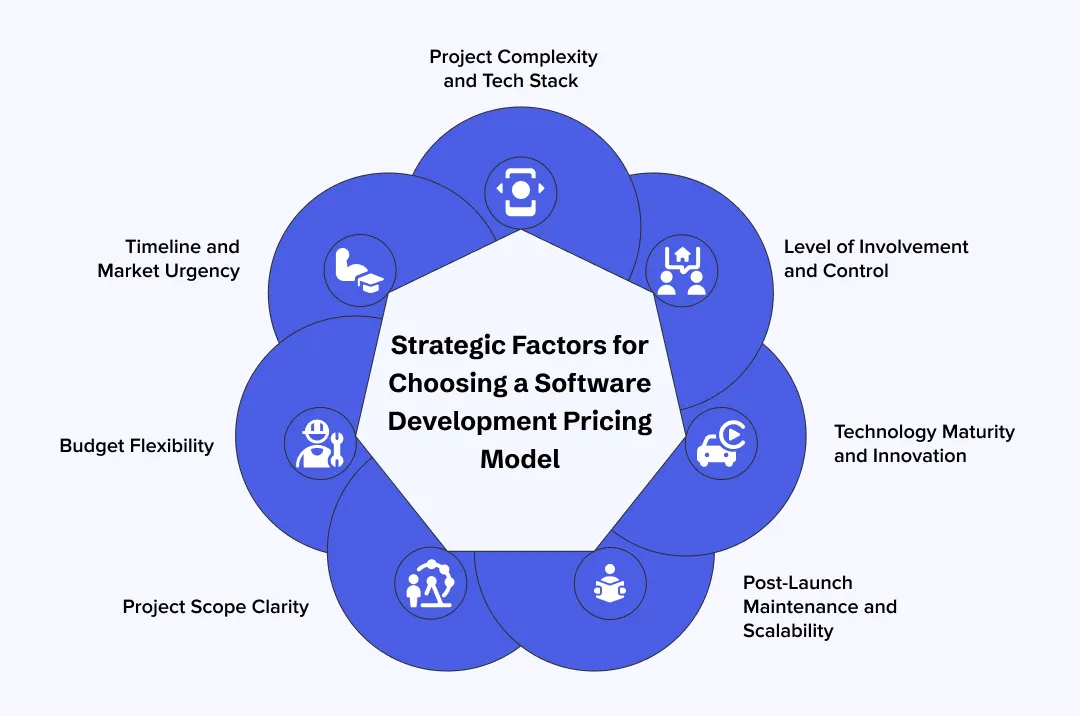
Finding the right pricing model is more about how you manage operational friction. From a strategic perspective, your goal is to find a balance in which the vendor delivers quality, and you are protected from unwanted costs. To protect your investment and ensure efficiency, you must understand the following factors:
1. Project Scope Clarity
Let’s be real: how well do you actually know your product right now? If you can map out every API call, user flow, and third-party integration, you are in a strong position to use software development pricing models that favor predictability. However, most disruptive apps evolve during the build phase. If your software development checklist is a living document rather than a locked PDF, you need the flexibility of a model that allows for mid-sprint changes without a legal overhaul.
2. Budget Flexibility
Every CFO wants a fixed number, but the "cheapest" quote often becomes the most expensive after accounting for technical debt. When you analyze the different pricing models, you have to look at your funding source. Is this a rigid grant with zero room for error, or an R&D budget designed for measurable optimization? If you have a hard cap on spending, fixed price software development offers a safety net, provided you have accounted for a 20% risk buffer in your initial planning.
3. Timeline and Market Urgency
Speed to market is often a non-negotiable business metric. If you have a hard deadline, like a product launch at a major trade show, the hourly rate vs fixed price debate takes on a new dimension. Fixed-price contracts often require weeks of upfront "Discovery" before a single line of code is written. If you need to start tomorrow, opting for an hourly rate allows your team to tackle the challenges of developing software in real-time, bypassing the long negotiation phase that stalls momentum.
4. Project Complexity and Tech Stack
Are you building a standard payment app or a high-frequency trading platform? The more "unknowns" there are in your tech stack, the more dangerous a fixed price becomes for both parties. This complexity usually demands an iterative approach. If your project involves complex software development languages or legacy system migrations, an hourly model ensures that the developers focus on robust architecture rather than cutting corners to stay within a fixed-fee milestone.
5. Level of Involvement and Control
How much "steering" do you want to do? Some stakeholders want to be in every stand-up meeting, while others just want a finished product delivered to their inbox. Your software pricing comparison metrics should reflect your management capacity. The hourly model requires a high level of trust and frequent communication. If your internal team is stretched thin, outsourcing software development via a fixed-price model might be better, as it shifts the day-to-day management burden.
6. Technology Maturity and Innovation
If you are working with stable, mature technologies, costs are easy to estimate. But if you are integrating Artificial Intelligence in software development, the landscape changes weekly. For innovative projects, an hourly rate is a strategic investment in R&D, whereas a fixed price can stifle the very creativity that leads to a competitive edge in the marketplace.
7. Post-Launch Maintenance and Scalability
A project is never truly "finished" on launch day. You need to consider what happens during the "Day 2" operations. Most software development cost models focus on the build, but the long-term ROI comes from maintenance. Choosing an hourly rate often fosters a long-term partnership where the agency stays invested in the product's health. This makes the software developers' onboarding process for future updates much smoother, as the team already has a deep, documented understanding of your codebase and business logic.
Real-World Scenarios Showing Which Pricing Model Fits Your Project
Theoretical comparisons are helpful, but in the trenches of software development, the decision between choosing an hourly and fixed price model often comes down to the specific nature of your software build. As a strategic decision maker, you need to look at your software development project through the lens of the latest market reality.
To give you a clearer and broader picture, let us break down three distinct software development scenarios where the choice of pricing significantly impacted the outcome.
Scenario 1: The Iterative Product Build (Hourly Pricing)

Picture a Fintech founder building a groundbreaking digital wallet. This product uses Artificial Intelligence in software development to see how users spend their money. At the start, the vision is clear, but the actual algorithms require constant changes based on live data testing results.
In this situation, an hourly rate approach is the only logical path forward. Because the project involves heavy research and development, setting a final price at the start is impossible. Developers need the room to test different software development languages to find the most secure and efficient performance. This means that hourly billing allows the team to change direction every two weeks during sprint reviews. The outcome is a product that actually solves a user problem instead of one that just follows an outdated contract.
Scenario 2: The Regulatory Compliance Overhaul (Fixed Price)

Contrast that startup with a large healthcare company. They must update a patient portal to follow the new 2026 data privacy laws. These requirements are absolute. The system needs specific encryption levels, defined user access, and a completion date that aligns with a federal audit.
This is the ideal environment for fixed price software development. There is no need for deep discovery because the law already provides the blueprint. By choosing a fixed fee, the healthcare provider locks in the total software development cost. This shift also moves the risk of technical delays over to the vendor. The vendor knows the scope is final, so they use their most skilled engineers to complete a software development checklist and deliver the system without budget surprises.
Scenario 3: The Hybrid Approach (Combined Strategy)

Many leading software development companies no longer force a choice between hourly or fixed billing structures. They now offer hybrid models that mix predictability with the ability to change.
One common hybrid setup starts with a fixed-price discovery phase followed by an hourly development phase.
The Discovery Phase: You pay a set amount for the agency to perform a thorough software risk analysis. They create wireframes and document all technical specifications during this time.
The Development Phase: Once the map is ready, the actual coding happens on an hourly basis. This gives you a better idea of the total cost involved in developing a software solution.
You still keep the freedom to add new features as the latest software development trends appear. This model is becoming the norm for enterprise-level tools where the risks are too high for a blind hourly contract, but the scope is too complex for a rigid fixed fee.
Wrapping Up: Making the Right Strategic Choice
When evaluating software development pricing, many stakeholders overlook the "risk premium." In a fixed-rate setup, developers often add a buffer of 20% to 30% to the quote to protect themselves against the challenges of developing a software solution that might be more complex than it appears on paper.
In the hourly model, you skip this hidden "insurance" cost, but you trade it for the responsibility of managing the timeline closely. If your internal team has the bandwidth for a software developer onboarding and active project management, the hourly model often proves to be more cost-effective in the long run. However, if you need a "set it and forget it" approach to manage your software development cost, the fixed price model remains the industry standard for predictability.
Navigating the global tech corridor requires more than just a search engine; it requires curated, expert-level intelligence. MobileAppDaily serves as the central knowledge hub for founders, CTOs, and product owners who cannot afford to make a $100,000 mistake. We do not just list companies; we vet them. Our platform provides the deep-dive software development guide you need to move from a concept to a market-ready application.
Frequently Asked Questions
Which software development pricing models are better for a startup MVP?
For a startup MVP, the hourly rate is generally superior. Startups operate in a state of high uncertainty, requiring constant pivots based on early user feedback. Using a fixed price software development model for an MVP often leads to expensive "Change Requests" that can drain a startup's limited seed funding before the product even launches.
Is fixed price software development actually cheaper than paying by the hour?
Often it is not. Vendors add a 25% risk premium to these quotes to cover their own potential losses. If your project stays on track, you end up paying for "ghost hours" that never happened. Hourly billing removes this hidden insurance fee.
Can I switch pricing models in software development mid-project?
Yes. Many teams start with a flat fee for the discovery phase to map out the technical requirements. Once the roadmap is clear, they move to hourly billing for the build. This transition supports a more iterative and scalable development process.
What software development cost models are standard in 2026?
The market relies on three structures: Fixed Fee, Time & Materials, and Dedicated Teams. Some agencies now offer "Output-Based" billing. This focuses on specific feature delivery. It is a modern alternative to traditional contracts that often fail to account for speed.
How do AI tools change the hourly vs fixed price model?
AI is making manual coding faster. Because of this, charging by the hour is becoming less profitable for high-speed agencies. The industry is moving toward value-based pricing. You pay for the specific business outcome or tool functionality instead of the total hours.
What is the biggest risk in current software development pricing models?
Scope rigidity is the primary risk. Markets move fast. If a competitor launches a new feature, a rigid contract prevents you from reacting quickly. You risk releasing a product that is already obsolete because you could not change the plan during the build.

Uncover executable insights, extensive research, and expert opinions in one place.
Related Content