- 1. Retrieval-Augmented Generation (RAG): Grounding Models in Verified Data
- 2. Context Engineering: Structuring Prompts to Constrain Output
- 3. Fine-Tuning on Domain-Specific, High-Quality Data
- 4. Guardrails, Output Filters, and Constitutional AI Techniques
- 5. Structured Output Constraints and Schema Enforcement
- 6. Agentic AI and Tool-Use Patterns for Factual Accuracy
 Share It On:
 AI systems are creating court cases, drug interactions, and generating data with confidence. For enterprises betting their operations on GenAI, hallucinations are not a glitch. They are the biggest threat sitting between adoption and execution.
In June 2023, a New York federal judge sanctioned two attorneys who submitted a legal brief packed with case citations that did not exist. The cases, the quotes inside them, and even the internal citations referencing other fake cases were all generated by ChatGPT. The attorneys were fined $5,000, the case made international headlines, and the legal profession scrambled to figure out what just happened. (Source: CNBC)
The AI hallucination problem remains the single greatest barrier to the mass adoption of Large Language Models (LLMs). It is the defining obstacle between proof-of-concept enthusiasm and production-grade generative AI security. This editorial breaks down what hallucinations actually are, why they happen, the causes, and how to architect enterprise systems that keep them in check.
What are AI Hallucinations?
An AI hallucination happens when Large Language Models (LLMs) generate output that is factually wrong, completely fabricated, or doesn't have any verifiable source. Yet it delivers with the same tone and confidence as accurate information. The model does not know it is lying. It predicts the most statistically probable next word in a sequence.
LLMs are prediction engines, not knowledge databases. They pattern-match against billions of training tokens to produce text that sounds plausible. When the model encounters a query where it lacks a strong signal, a court ruling, it does not stop and say, 'I don’t know.' It fills in the gap with whatever combination of tokens produces the most plausible-sounding continuation.
For consumer use, this might mean a wrong trivia answer. For AI hallucinations in enterprise deployment, financial forecasting, legal compliance, medical guidance and regulatory reporting, the same behavior becomes catastrophic.
There is also a difference between closed-domain and open-domain hallucinations. In a closed-domain setting, where the model is given specific documents and asked to answer from them, hallucination means the model invents information not present in the provided context. Whereas in an open-domain setting, where there is no specific source material, hallucination means the model states something as fact that contradicts real-world knowledge.
Both these types of hallucinations are dangerous for enterprises. But closed-domain hallucinations are particularly insidious because enterprises often assume that giving the model the right documents eliminates the problem. But actually, it does not. Even with retrieval-augmented generation, models can still build fake information.

Types of AI Hallucinations You Need to Know
Not all hallucinations AI systems give look the same. And the type of hallucination determines which detection and mitigation approach will actually work. If you are building or deploying AI in IT services, understanding these categories is table stakes.
1. Factual Hallucinations: When the Model Invents Facts
The model states something as true that is verifiably false. It invents statistics, cites papers that do not exist, references court cases that never happened, or fabricates product specifications. Factual hallucinations AI tools are giving are relatively easy to catch if you have the infrastructure. Automated cross-referencing against verified databases flags them quickly. The danger is in organizations that skip that verification step.
2. Contextual Hallucinations: Correct Information, Wrong Context
The model retrieves accurate data but applies it to the wrong situation. Imagine asking an enterprise AI system about the specifications of your latest product release, and it responds with specs from the previous version. The numbers are real. The data is accurate. But it is answering the wrong question, and if someone acts on that answer, the consequences can be problematic. Contextual hallucinations are common in customer support bots, internal knowledge bases, and any scenario where multiple versions of similar information exist.
3. Logical Hallucinations: Coherent but Internally Inconsistent
The response reads well. The sentences flow. The argument sounds convincing. But the reasoning chain contains internal contradictions or invalid logical steps. This type is particularly dangerous in legal analysis, financial modeling, and medical applications, where internal consistency is not optional; it is the entire point. A model might argue that a regulation both permits and prohibits a specific action within the same response. Or it might calculate a risk score using one methodology in paragraph one and a contradictory methodology in paragraph three. Without careful human review, these inconsistencies slip through.
4. Identity Hallucinations: Fabricated People, Sources, and Authorities
The model invents authors, cites regulatory bodies that do not exist, or attributes statements to real people who never said them. For example, in a conference, accepted papers were found to contain fabricated citations: altered author names, invented journal titles, and fictional research papers. This has direct implications for AI compliance, legal risk, and reputational exposure in any enterprise context.
Also Read: AI Safety - Learn How To Prevent AI Failures
AI Hallucinations Examples: What Enterprise Failures Actually Look Like
The cases below are not theories; they are documented risks of AI hallucinations. They are incidents with measurable consequences. For enterprise leaders evaluating whether AI safety should be a budget line item, this is where theory meets reality.
| Industry | Case/Incident | What Went Wrong? | Outcome & Impact |
|---|---|---|---|
| Legal | Mata v. Avianca, Inc. (S.D.N.Y. 2023) | ChatGPT generated six entirely fictitious cases with fake names, judicial opinions, and citations. The attorney relied on them despite verification prompts. | $5,000 fine under Rule 11. Attorneys had to notify judges falsely cited. Triggered ABA ethics guidance on GenAI use. |
| Healthcare | Health Chatbot Misinformation (Flinders University / ECRI, 2025) | Clinical AI chatbots produced inaccurate medication guidance, creating potentially harmful misinformation for patients. | ECRI listed AI misinformation as a top 2025 health tech hazard. Highlighted institutional liability risks in clinical AI deployment. |
| Financial Services | Fabricated Regulatory Provisions in Banking & Insurance AI Tools | AI systems generated fictional compliance rules, risk figures, and regulatory provisions that appeared credible but were entirely fabricated. | Compliance risks, audit failures, and trust erosion. Zero tolerance for inaccurate regulatory data increases sector vulnerability. |
| Enterprise Chatbots/CX | Moffatt v. Air Canada (2024 BCCRT 149) | Air Canada’s chatbot provided incorrect bereavement fare policy information, misleading the customer during booking. | Tribunal ruled negligent misrepresentation. Air Canada ordered to pay $812.02 plus interest and fees. |
The pattern across all four cases is the same: the AI sounded confident, the human trusted it, and nobody checked until the damage was done. Detection and verification are not optional extras. They are the minimum viable defense.
How to Detect AI Hallucinations Before They Cause Damage?
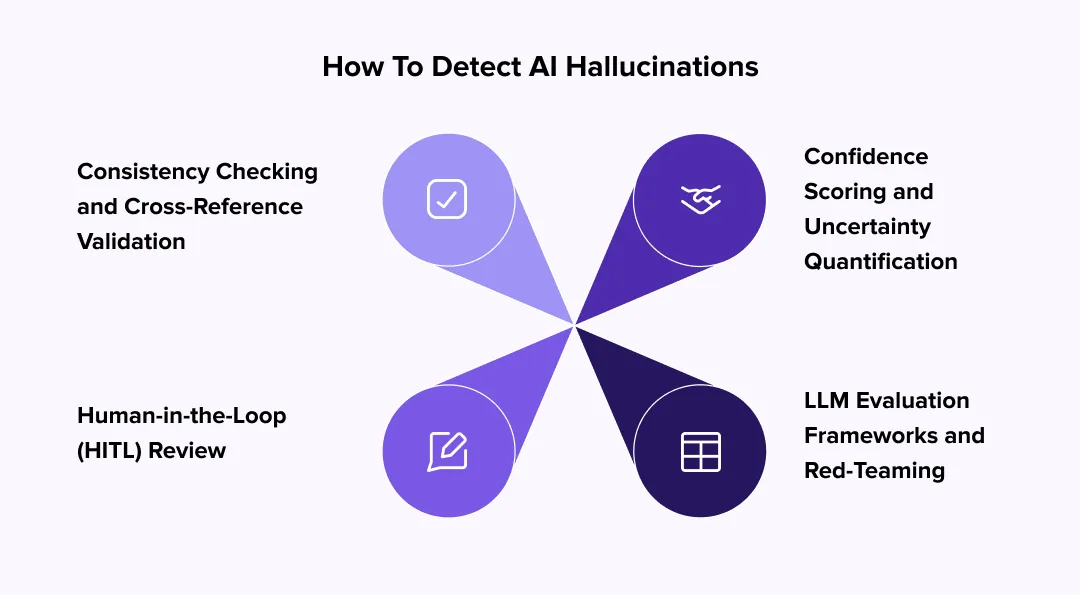
Detection is your first line of defense in a secure enterprise architecture. You cannot manage what you cannot measure. Many enterprises are now running human-in-the-loop processes to catch hallucinations before deployment; the industry is clearly treating this as operational infrastructure.
1. Automated Consistency Checking and Cross-Reference Validation
Modern pipelines use a multi-model approach. One model generates the answer, and a second, more restricted model (like Claude AI) audits that answer against a verified knowledge base. If the facts don't align, the system flags it for review.
2. Confidence Scoring and Uncertainty Quantification
Advanced AI hallucination solutions involve surfacing the model's internal doubt. By adjusting temperature settings and using entropy-based estimation, enterprise systems can be programmed to say, "I’m only 60% sure of this," rather than bluffing. For high-stakes tasks, any score below 95% should trigger a manual check.
3. Human-in-the-Loop (HITL) Review for High-Stakes Outputs
Despite the hype, humans are still the ultimate truth-checkers. For medical, legal, or high-level strategic outputs, architectural guardrails must mandate a human signature before the AI output is finalized. This is a core pillar of modern AI programming languages and frameworks.
4. LLM Evaluation Frameworks and Red-Teaming
Before deployment, use frameworks like DeepEval to run stress tests. Red-teaming, the process of intentionally trying to make the AI hallucinate, is now a standard part of the development lifecycle for top artificial intelligence development companies.
Solving AI Hallucinations: An Enterprise Architecture Playbook
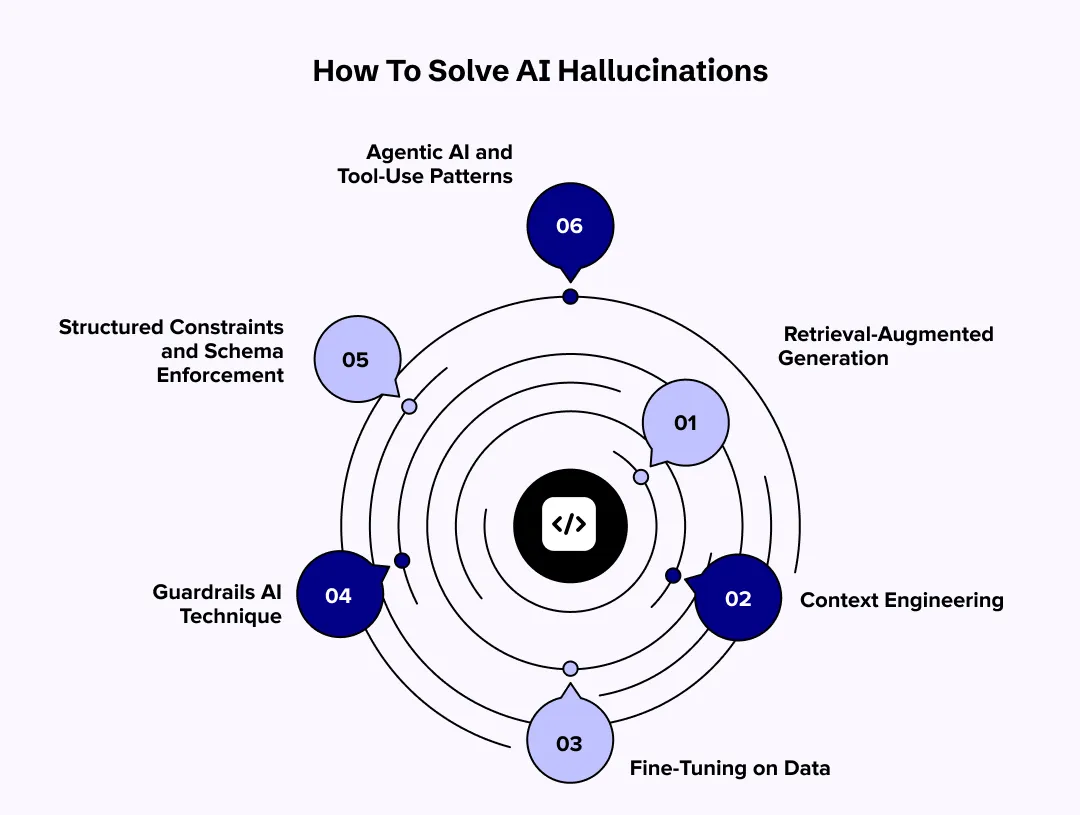
It is not about picking one silver-bullet tool. It is about layering complementary architectural controls into enterprise AI solutions and security posture. Think of it as defense in depth. No single layer is sufficient, but together they reduce the attack surface for hallucination. If you are building a secure architecture around large language models (LLMs), every layer below should be on your checklist.
1. Retrieval-Augmented Generation (RAG): Grounding Models in Verified Data
RAG is the 'Golden Child' of hallucination mitigation. Instead of letting the model answer from its own (often outdated) memory, RAG forces the model to look up information in a private, vetted database first. By providing the open book, you significantly reduce the chance of the model making things up. It’s the difference between a student taking an exam from memory vs. a student using a textbook.
2. Context Engineering: Structuring Prompts to Constrain Output
The way you talk to an AI matters. By using sophisticated AI prompts, you can box the AI into a specific logical space. Phrases like 'Only use the provided text' or 'If you don't know the answer, state that you do not know' are simple but effective starting points.

3. Fine-Tuning on Domain-Specific, High-Quality Data
Sometimes a general-purpose model is too broad. Fine-tuning a model on your specific industry data helps it understand the language of your business, reducing errors caused by jargon or niche industry standards. However, be warned: fine-tuning on dirty data will only bake the hallucinations deeper into the weights.
4. Guardrails, Output Filters, and Constitutional AI Techniques
Tools like NeMo Guardrails act as a firewall for AI. They sit between the model and the user, scanning the output for prohibited topics or factual inconsistencies. If the AI tries to hallucinate, the guardrail kills the response before the user ever sees it.
5. Structured Output Constraints and Schema Enforcement
Force your AI to speak in JSON or XML. By requiring a specific structure, you limit the model’s ability to wander off-script. It’s much harder for a model to hallucinate when it’s forced to fill out a rigid data schema.
6. Agentic AI and Tool-Use Patterns for Factual Accuracy
Don't ask an LLM to do math; give it a calculator. By using tool-calling (where the AI sends a query to a deterministic API), you ensure that factual data comes from a database, not a probabilistic guess. This is how the AI revolutionizing the IT industry is actually happening, by making AI the manager of reliable tools.
Preventing AI Hallucinations at the Organizational Level
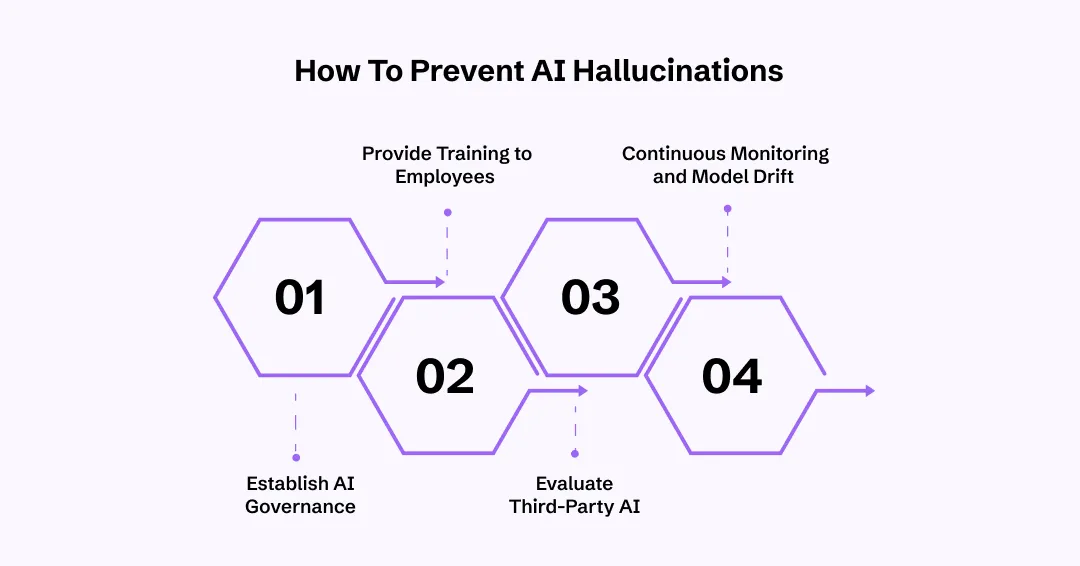
Technical architecture is only half the equation. Without organizational practices that support detection, reporting, and governance, even the best technical controls will eventually fail.
1. Establishing an AI Governance Framework Before Deployment
An enterprise AI governance policy should include model cards documenting capabilities and known limitations, use-case approval gates that specify which applications are authorized and acceptable. There should be output standards that define the level of accuracy required for each use case, escalation paths for hallucination incidents, how the output is quarantined, and what the remediation process looks like.
2. Training Employees to Recognize and Report Hallucinations
AI literacy programs should teach employees what hallucinations look like, how to verify AI-generated claims, and that they should report suspicious outputs rather than just quietly correcting them. Unreported hallucinations are invisible hallucinations, and invisible hallucinations do not get fixed. For organizations still early in their AI journey, including those implementing AI and ML in an app for the first time, building this muscle early prevents costly corrections later.
3. Vendor Due Diligence: Evaluating Third-Party AI for Hallucination Risk
When procuring AI solutions, hallucination benchmarks should be a core evaluation criterion alongside price, latency, and feature set. Ask vendors for their models’ performance on established hallucination benchmarks, such as Vectara’s HHEM leaderboard and the AA-Omniscience index. Ask for audit transparency: can you see how the model was trained, what guardrails are in place, and what the model’s known failure modes are?
If a vendor’s AI generates a hallucination that leads to a compliance failure or legal exposure, what is the vendor’s liability? If the contract is silent on this, that is a gap. The comparison between solutions like Claude AI, GPT-4, and Gemini should include published hallucination rates as a primary evaluation dimension.
4. Ongoing Monitoring, Model Drift, and Retraining Cadences
Hallucination rates are not static. They can worsen as models encounter novel inputs, as the world changes around the training data, and as usage patterns shift. Continuous evaluation pipelines that track hallucination rates in production, drift detection that flags when model performance degrades, and scheduled retraining cadences are all non-negotiable for enterprise deployments. Enterprises have learned the hard way that deploy-and-forget does not work with generative AI.
6. Related Google Cloud Products and Services
For organizations building on Google Cloud, Vertex AI offers a set of grounding and hallucination-mitigation capabilities. Vertex AI Search provides managed RAG infrastructure that connects to enterprise data, such as documents, databases, third-party applications like Jira and Slack, with built-in OCR, smart chunking, embedding, indexing, and ranking. Vertex AI’s grounding capabilities anchor model outputs to verified data sources, providing inline citations and confidence scores that make hallucination detection measurable rather than guesswork.
Vertex AI Agent Builder lets enterprises build AI agents with grounding baked into the architecture, supporting both Google Search grounding for public-web queries and enterprise data grounding for internal knowledge bases. The platform also includes APIs for layout parsing, text embeddings, semantic ranking, and a check-grounding fact-checking service.
How Google Cloud Can Help Prevent Hallucinations
Google has built an entire ecosystem around the idea of "Verifiable AI." Here is how you can leverage it:
- Grounding with Vertex AI: This allows your ChatGPT 4.5 or Gemini models to verify their responses against Google Search or your internal databases in real-time.
- Text Embeddings for Grounding: By converting your corporate data into vectors, Google Cloud allows your AI to perform semantic searches that are far more accurate than simple keyword matching.
- Vertex AI PaLM 2 & LangChain: Google’s integration with LangChain makes it easy to build complex, multi-step chains that include verification steps, ensuring that every answer is double-checked before delivery.
The Road Ahead: AI Hallucinations as a Solvable Engineering Problem
Are we ever going to reach 0.0% hallucinations? Perhaps not. But we are reaching a point where they are a manageable risk. As we look at how artificial intelligence is affecting daily life in 2026, the focus is shifting toward Neurosymbolic AI: combining the probabilistic power of LLMs with the rigid, symbolic logic of traditional programming.
The enterprises that win the next decade won't be the ones with the smartest AI, but the ones with the most reliable architecture. Solving AI hallucinations is the price of admission for the future of business.
Wrapping Up
You already know the problem is real. You have seen the court rulings, the financial exposure numbers, and the architectural options. The question now is straightforward: what are you going to do about it in your own organization?
Here is where most enterprises stall. They acknowledge the risk, they nod at the playbook, and then they keep scaling AI deployments without actually wiring in the controls.
So before you greenlight the next AI rollout or expand scope on an existing one, run this check against your current stack.
Do you have RAG grounding against verified internal data? Do your high-stakes outputs pass through human review before they reach a customer, a regulator, or a courtroom?
Is there a monitoring pipeline tracking hallucination rates in production, or are you flying blind?
Is there an escalation path when someone spots a fabricated output, or does it just get quietly corrected and forgotten?
If the answer to any of these is no, that is your priority. Not the next feature release. Not the next use case. The controls.
The benefits of artificial intelligence are massive, and nobody is arguing otherwise. But the enterprises that actually capture those benefits long term will be the ones that treated hallucination governance as a first-class engineering and business problem from day one, not the ones that treated it as someone else’s job until an incident forced their hand.
Audit your AI deployment for hallucination exposure this quarter. Map every output that touches customers, compliance, legal, or financial decisions. Close the gaps. Then scale.
Frequently Asked Questions
What are AI hallucinations?
An AI hallucination occurs when a language model generates an output that contains fabricated facts, non-existent citations, or invented data points, yet delivers it in the same confident tone as a verified, accurate response.
How to detect AI hallucinations before they reach production?
Run every model output through automated cross-reference checks against your ground-truth databases. Pair that with confidence scoring at the inference layer and mandatory human review on any output tied to legal, financial, or compliance workflows.
How to prevent AI hallucinations in enterprise deployments?
Combine retrieval-augmented generation for data grounding, structured output schemas to constrain response format, programmatic guardrails to enforce topic boundaries, and a governance framework that mandates human sign-off on high-stakes decisions.
What causes AI hallucinations in large language models?
LLMs generate text by predicting the statistically probable next token, not by verifying facts. When the training data lacks sufficient signal for a given query, the model fills that gap with plausible-sounding content rather than flagging uncertainty.
What are the main types of AI hallucinations?
Factual hallucinations fabricate data that does not exist. Contextual hallucinations apply accurate information to the wrong scenario. Logical hallucinations produce internally contradictory reasoning. Identity hallucinations invent authors, sources, or regulatory bodies.
Why do AI hallucinations pose a threat to enterprise AI security?
Hallucinated outputs carry the same formatting, tone, and apparent confidence as accurate responses. Without a dedicated validation infrastructure, teams act on fabricated information, creating compliance exposure, legal liability, and reputational damage before the error surfaces.

Uncover executable insights, extensive research, and expert opinions in one place.
Related Content