Share It On:
 From startup ad spend to enterprise budgets, here's everything that shapes your PPC cost in 2026, minus the agency sales pitch.
So you're thinking about running paid ads, and you've hit the same wall every founder hits sooner or later: nobody seems to give you a straight answer on what this is actually going to cost.
One agency quotes you $500 a month. The next one says $8,000. A freelancer on LinkedIn says they'll do it for $300. And somewhere in your inbox, there's a pitch deck promising "transparent pricing" that's somehow still 40 pages long with three asterisks and a footnote.
It's a mess. And honestly, most articles you'll read on this topic dance around the real numbers because the people writing them are usually trying to sell you something at the end.
This one isn't. We're going to walk through what PPC actually costs in 2026, what you're paying for at each tier, where the hidden fees hide, and how to figure out a budget that won't burn through your runway in six weeks. Whether you're an early-stage startup with $1,500 to test the waters or a mid-market company ready to spend $20K a month, by the end, you'll know exactly where you stand.
The Short Answer: What PPC Actually Costs
If you're skimming and just want a number, here it is:
- Ad spend on the platform: $100 to $100,000+ per month, depending on industry and scale
- Average cost per click: $0.11 to $9.87 (yes, that's a huge range, and we'll explain why)
- Management fees (if you hire someone): $500 to $10,000+ per month, or 10–30% of ad spend
- Total monthly investment for most small-to-mid businesses: $2,000 to $15,000
That's the lay of the land. But these ranges are about as useful as saying "a car costs between $5,000 and $500,000" — technically true, practically useless. The real cost of PPC advertising depends on who you are, what you sell, and how competitive your space is.
Below, we get specific.
How PPC Pricing Actually Works (The Pricing Models)
Before we get into hard numbers, you need to understand that pay-per-click pricing comes in two layers stacked on top of each other:
Layer one is what you pay for the ad platform — Google, Meta, LinkedIn, Microsoft. This is your raw ad spend. Layer two is what you pay the human or team running those campaigns for you. This is the management fee. Plenty of business owners conflate the two and end up wildly miscalculating their budgets.
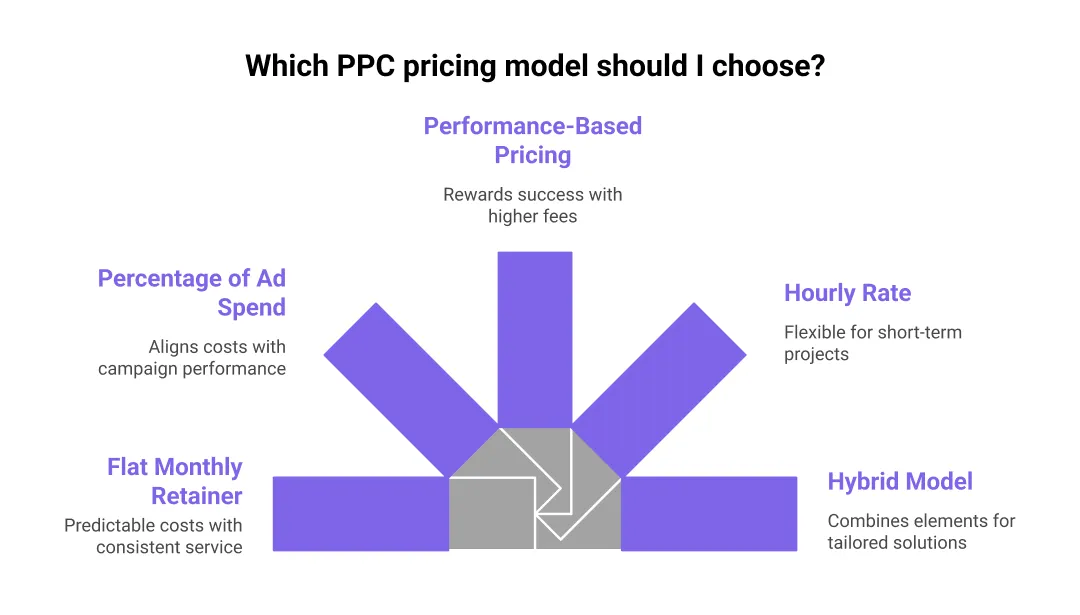
Now, here are the five main models you'll run into when you start shopping around for ppc companies.
1. The Flat Monthly Retainer
You pay a fixed fee every month. Doesn't matter if you spent $2,000 on ads or $20,000 — the management fee stays the same. For small businesses, this usually lands somewhere between $500 and $2,500 a month. For mid-market accounts, it climbs to $2,500–$5,000. Larger or more complex setups can easily push past $10,000.
What's good about it: predictability. You know exactly what you're paying, no surprises.
What's not so great: if your ad spend grows fast, the agency may quietly start cutting corners on attention because the math no longer works for them.
2. Percentage of Ad Spend
The agency charges you a cut of your monthly ad budget — typically 10% to 20%, sometimes climbing to 30% for smaller or messier accounts. So if you're spending $15,000 a month on Google Ads, a 15% fee comes out to $2,250.
Sounds fair on paper. But there's a problem nobody likes to admit: this model rewards the agency for getting you to spend more, not for spending it well. If they convince you to push your monthly budget from $20K to $40K, their fee just doubled, whether or not your sales doubled with it.
Smart agencies use progressive tiers (12% on the first $50K, dropping to 7% on amounts over $200K), which keeps incentives a bit more honest. If you see flat percentages with no tiering, ask why.
3. Performance-Based Pricing
You only pay when the agency delivers results. Leads, sales, qualified calls, whatever the agreed metric is. Sounds like a dream, right? Until you read the fine print.
Performance pricing usually comes with steep per-lead fees ($75–$300 per lead is common, way more in legal or B2B), no transparency into actual ad spend, and contracts that lock you in for 6–12 months. It can work great for businesses with simple, well-defined conversions. For everyone else, it gets murky fast.
4. Hourly Rate
Pretty self-explanatory. PPC freelancers and consultants typically charge $50 to $200 an hour, with the best advertising experts in the U.S. and Western Europe sitting at $100–$150. Agencies on platforms like Clutch report average rates between $100 and $149 per hour.
This works well for one-off audits or short projects but gets expensive fast for ongoing management. A campaign needs roughly 20–30 hours of work a month minimum to be done properly. Do the math.
5. The Hybrid Model
Some agencies combine a base retainer with a smaller percentage of spend, or a base fee plus a performance bonus. This is usually the most aligned setup if you can get it — you're paying for the work plus rewarding good outcomes.
PPC Services Pricing by Business Size
Now let's talk real numbers based on where your business sits. Because what PPC costs for a bootstrapped SaaS founder and what it costs for a 200-person enterprise are two very different conversations.
| Business Stage | Monthly Ad Spend | Management Fee | Total Monthly Cost |
|---|---|---|---|
| Startup / Solo founder | $500 – $2,000 | $500 – $1,500 | $1,000 – $3,500 |
| Small business | $2,000 – $5,000 | $1,000 – $2,500 | $3,000 – $7,500 |
| Mid-market | $5,000 – $20,000 | $2,500 – $5,000 | $7,500 – $25,000 |
| Enterprise | $20,000 – $100,000+ | $5,000 – $15,000+ | $25,000 – $115,000+ |
PPC Advertising for Startups: The Honest Take
If you're running a startup, here's some real talk: PPC can either be your best growth channel or the fastest way to burn through your seed round. There's not much middle ground.
For most startups, $1,000–$3,000 a month is the sweet spot for testing. That's enough budget to gather real conversion data within 4–6 weeks. Anything below $500 and you're basically buying lottery tickets, you won't have enough click volume to know whether your targeting is broken, your landing page is broken, or your offer just doesn't resonate.
A few things to keep in mind if you're early-stage:
- Don't spread your budget thin across five platforms. Pick one (usually Google Ads for intent-driven searches) and go deep before you branch out.
- Plan for at least 90 days before judging results. Month one is setup, month two is learning, and month three is when optimization actually starts paying off.
- Track lifetime value, not just first-touch revenue. A $200 customer acquisition cost looks terrible if your AOV is $80, and looks brilliant if those customers come back five times.
The math gets brutal at the small end. If your management fee is $1,200 and your ad spend is $1,500, you're paying 80% in management. That's not sustainable. Either get the ad spend up to a level where the fee makes sense (a rule of thumb: management should be 10–25% of total spend), or look at running it in-house with occasional consultant audits.
Why Your Industry Massively Changes the Math
Here's something most people don't realize until they're already deep in the auction: your industry might be the single biggest factor in what you pay per click. We're not talking about small differences. We're talking 5x to 10x.
Some quick context. The cross-industry average CPC on Google Search in 2026 is around $5.26, but that average hides a wide range. Take a look:
| Industry | Average CPC | Why It Costs This Much |
|---|---|---|
| Attorneys & Legal | $8.58 – $9.87 | Each case can be worth thousands; everyone bids hard |
| Home Improvement | $7.85 – $8.33 | High ticket jobs, urgent demand, dense competition |
| Dentists & Dental | $7.85 – $8.00 | New patients have high lifetime value |
| Finance & Insurance | $5.25 – $6.40 | Massive customer LTV, regulatory friction |
| B2B SaaS / Tech | $3.50 – $6.00 | Long sales cycles, high-value contracts |
| E-commerce (general) | $1.16 – $2.50 | Lower margins force advertisers to bid tighter |
| Travel | $2.05 – $2.14 | Volume game with thin per-booking margins |
| Arts & Entertainment | $1.60 – $1.63 | Lowest in the pack; broader demand pool |
If you're a personal injury lawyer in a major metro, individual keywords like "motorcycle accident lawyer Houston" can hit $50 per click. "Personal injury lawyer" alone can hit $100+ on bad days. Meanwhile, a niche ecommerce brand in pet accessories might be running clicks at $1.30.
This matters because when you're benchmarking pay-per-click advertising cost against what you read online, you have to filter through your industry first. A $4 CPC is awful for a t-shirt store and a steal for a tax attorney.
Google Ads vs Meta vs LinkedIn vs Microsoft: Platform Pricing Compared
Different ad platforms work like different neighborhoods. Each has its own rent, its own crowd, and its own ROI math. Here's the rough breakdown of what you'll pay across the major ones.
Google Ads (The biggest dog): Average CPC across all industries in 2026 sits around $2.96 to $5.42 (different reports, different methodologies). Google ppc cost is on the higher end because intent is on the higher end; these people are actively searching for what you sell. For most B2B and high-consideration purchases, this is where the money goes. Expect minimum spends of $1,000–$2,000/month to gather meaningful data. Below that, you're guessing.
Meta (Facebook + Instagram): CPCs typically run $0.50 to $2.00. Display-style, interruption-based, great for visual products and lower-intent awareness funnels. Bad fit for emergency-style services where someone needs you right now.
LinkedIn Ads: The most expensive sandbox in B2B. CPCs of $5 to $12 are normal. Cost per lead can easily hit $200–$500. But if you're selling enterprise software with a $50K ACV, the math can still work beautifully.
Microsoft Ads (Bing): Generally 20–30% cheaper than Google. Smaller audience but older, more affluent demographic on average. A lot of advertisers ignore it entirely, which is exactly why CPCs stay lower. Worth running as a complement to Google, not a replacement.
YouTube Ads: Cost per view (CPV) runs $0.10 to $0.30. Better for brand building than direct response, with some exceptions for review-style or how-to content.
What's Actually Included in PPC Services Pricing?
A quote that says "$2,500/month for PPC management" tells you almost nothing. The real question is what's inside that fee, and what's quietly being kept out so they can charge you for it later.
Here's what a properly scoped engagement should include:
- Initial account audit and strategy (one-time, sometimes billed separately as a setup fee)
- Keyword research and ongoing keyword expansion
- Campaign and ad group structure
- Ad copywriting — multiple variations for testing
- Bid management and budget allocation
- Negative keyword maintenance (this matters more than people think)
- Conversion tracking setup and quality assurance
- Monthly performance reporting
- Regular optimization — at least weekly check-ins on active campaigns
- A/B testing of ads and landing pages
Things that are often NOT included (read your contract carefully):
- Landing page design and development — easily $1,000–$10,000 per page
- Creative production (graphics, video, banners)
- Third-party tool subscriptions (Semrush, Ahrefs, call tracking, heatmap tools)
- Setup fees for new platforms or new campaign types
- Significant strategy pivots or restructures
- Custom reporting dashboards beyond basic templates
This is what the industry calls the scope creep tax. The headline fee looks reasonable, then six months in, you've paid an extra $4,000 for "deliverables outside the scope." If the proposal you're reading is vague about what's included, push back hard before signing anything.
The Hidden Costs Nobody Quotes You Upfront
Now we're getting to the part most pricing articles politely avoid. When you're calculating total PPC budget planning, here's everything you should factor in — not just the line item on the invoice:
- Landing pages: Sending PPC traffic to your homepage is one of the biggest money-burners in digital marketing. A dedicated landing page for each campaign typically costs $1,000 to $10,000+ to design and develop, depending on complexity. And you'll probably need 3–5 of them to A/B test.
- Conversion tracking and analytics: If you don't have proper tracking, you have no idea what's working. Setup runs anywhere from a few hundred dollars to a few thousand, depending on your tech stack. CRM integration and proper attribution can easily add another $1,000–$3,000 in setup.
- Creative production: For Meta, YouTube, or display ads, you need creative — and good creative gets expensive. Custom graphics: $200–$800 per set. Video production: $500–$10,000+, depending on quality. Most agencies don't include this in the management fee.
- Tool stack: A serious PPC operation uses tools beyond what Google gives you for free. SEMrush or Ahrefs ($120–$500/month), call tracking ($50–$200/month), heatmap software like Hotjar ($30–$200/month), and competitive intelligence tools ($100–$1,000/month). For most small-to-mid businesses, this adds $300–$800 a month.
- Your time: Even with an agency, expect to spend 2–5 hours a week on approvals, reviews, and strategic input. That's real time with a real opportunity cost. Bake it in.
PPC Budget Planning: How to Figure Out What You Should Spend
Forget industry averages for a second. The actual right number for your business comes from a simple formula based on your unit economics. Here's how to work it out.
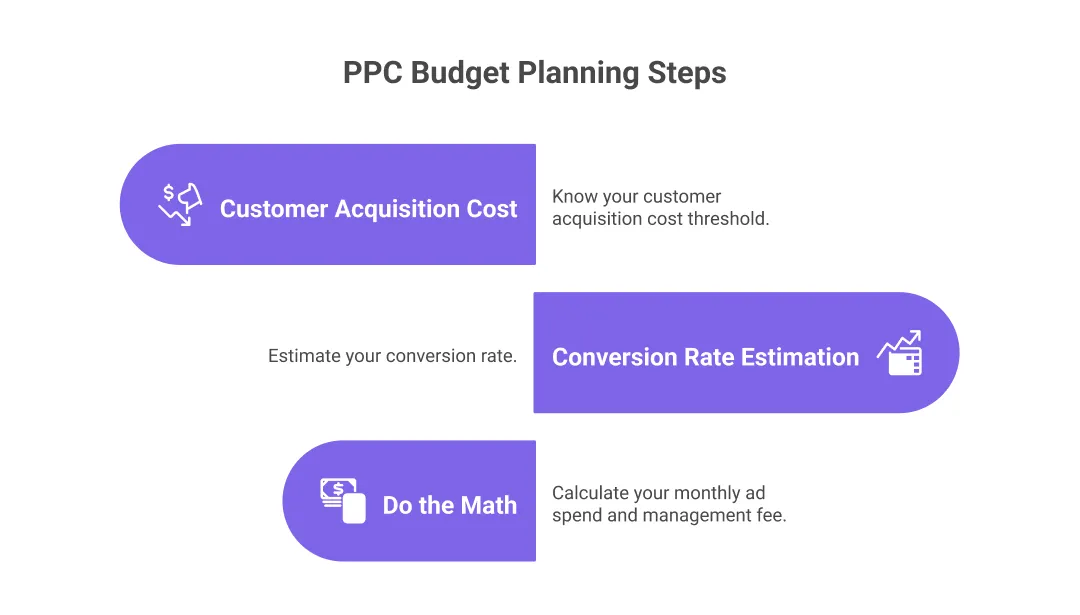
Step 1: Know your customer acquisition cost threshold
How much are you willing to pay to get one new customer? This is your max CAC. As a rough rule, it should be 25–33% of your customer lifetime value. If your average customer is worth $1,200 over their lifetime, you can comfortably pay $300–$400 to acquire them.
Step 2: Estimate your conversion rate
How many website visitors actually buy? Industry averages for paid search land around 4–8%, but it varies enormously by category. If you don't have data, assume 2–3% to be safe.
Step 3: Do the math
Let's say your target is 20 new customers a month, you can pay $300 each, and your conversion rate is 4%. That means:
- Cost per click target: $300 × 4% = $12 per click (this is your max bid)
- Clicks needed: 20 customers ÷ 4% conversion = 500 clicks
- Monthly ad spend: 500 clicks × $12 = $6,000
- Plus management fee at 15%: $900
- Total monthly budget: ~$7,000
Build in 20% wiggle room for testing and bad weeks, and you're at $8,400 a month. That's your real number, not what some random blog tells you the "average" small business spends.
Why Two Agencies Quote You Wildly Different Prices
You'll get a quote for $800 from one place and $5,200 from another, and on paper, they're offering the same services. So what's actually going on?
- Geography: Agencies based in the U.S., U.K., or Western Europe charge significantly more than those in Eastern Europe, Southeast Asia, or Latin America. Whether that's worth it depends on your needs. If you require deep market knowledge of American consumers, paying U.S. rates makes sense. If you just need solid execution on global ecommerce campaigns, an offshore team at $800/month might serve you better than a U.S. shop at $4,000.
- Experience and specialization: A generalist agency that does "all marketing" usually charges less than a specialist who only does PPC for, say, dental practices. The specialist costs more because they bring vertical expertise that shortens your learning curve. For high-CPC industries, the specialist almost always wins on ROI.
- Team size and account manager quality: A $1,500/month account at a budget shop usually means a junior strategist juggling 30+ accounts and giving yours maybe two hours a week. A $5,000 account at a mid-tier agency typically means a senior strategist handling 8–12 accounts. The work is just different.
- Reporting and communication: Monthly PDF reports cost less to produce than real-time dashboards, plus weekly strategy calls. Both are valid; the question is what you actually need.
When PPC Might Not Be Worth It (Yes, Sometimes It's Not)
Most blogs won't tell you this because they're trying to sell you PPC services. But honestly? There are situations where pay-per-click cost just doesn't match, and you'd be better off putting that budget somewhere else.
Hold off on PPC if any of these apply:
- Your average order value is under $30, and you have no repeat purchase loop. The math rarely works at this scale.
- Your website converts poorly, and you haven't fixed it yet. Paid traffic doesn't fix a broken funnel, it just helps you lose money faster.
- You can't commit to at least 3 months of budget. PPC requires data, and data takes time. If you can only afford one month, save it.
- Your industry has near-zero search demand. Paid search assumes people are looking for what you sell. If they don't even know it exists yet, content marketing or social ads might be a smarter start.
- You're in a hyper-local business with maybe 50 potential customers a month. SEO and word-of-mouth are usually more efficient at this scale.
- PPC is a tool, not a religion. Use it when it fits.
What Kind of ROI Should You Expect?
A well-managed PPC campaign typically returns $2 in revenue for every $1 spent. That's a 2:1 ratio, solid but not life-changing. Some businesses see 5:1 or even 9:1, but those are outliers with strong product-market fit, well-tuned funnels, and patient optimization.
Here's a reality check: month one rarely shows profit. You're paying for setup, learning, and the platform's algorithms, figuring out who actually converts. Month two is when you start cutting wasted spending. Month three is when optimization compounds, and you typically see the first profitable month.
Anyone promising profit in week one is either lying or showing you cherry-picked numbers that won't scale. Pay attention to that red flag.
Real PPC ROI takes 6–12 months to evaluate properly because you need enough conversion data to understand the quality of leads, not just quantity. Track not just sales but customer lifetime value, return rate, and how those PPC customers behave compared to organic ones.
Red Flags to Watch for When Hiring a PPC Agency
If you're shopping for an agency or consultant, here's a quick checklist of things that should make you walk away, or at least ask very pointed questions.
- They won't show you the account: If you can't have admin access to your own Google Ads account, that's a hard no. The data is yours.
- They guarantee specific results: Anyone promising "100 leads in the first month" is either lying or about to spend recklessly to hit the number.
- They charge a percentage of spend with no tiering: This rewards bloat. Look for progressive models or flat fees.
- They can't explain their reporting clearly: If your monthly report is a dump of Google Ads screenshots, you're paying for a button-clicker, not a strategist.
- Long lock-in contracts: 12-month contracts with no exit clauses are old-school. Good agencies earn the work month by month.
- Vague case studies with no real numbers: "We helped a client grow 300%" — growth from what? Over how long? At what cost?
- They're not asking about your business: If the discovery call is all about their service tiers and nothing about your customer LTV, they're going to manage your account the same way, generically.
Wrapping It Up
If there's one takeaway from all of this, it's that there's no single "right" answer to how much does ppc cost. The number depends on your industry, your goals, your platform mix, and how much of the work you want to hand off.
But here's a clean framework to walk away with:
- Test with $1,500–$3,000/month if you're starting from scratch
- Plan for total monthly spend (ad + management + tools + creative) of $3,000–$8,000 for most small businesses
- Budget at least 90 days before judging performance
- Demand transparency — on accounts, fees, scope, and reporting
- Measure what matters: customer lifetime value and return on ad spend, not just clicks
PPC done right can be one of the best growth levers your business has. Done wrong, it's just a fancy way to set money on fire. The difference usually isn't the budget — it's whether the strategy behind it is built around your actual unit economics.
Frequently Asked Questions
What's the minimum I should spend on PPC to see results?
Most credible sources point to $1,000–$3,000 a month in ad spend for meaningful data. Below $500/month you're guessing, not optimizing.
How long until I see ROI?
Realistically, 3–6 months for break-even and 6–12 months to know if it's a long-term winner. Anyone promising faster is either incredibly lucky or selling you a story.
Should I hire an agency, freelancer, or do it in-house?
Under $3K/month ad spend: freelancer or do-it-yourself with occasional audits. $3K–$30K/month: specialist freelancer or boutique agency. Above $30K/month: dedicated agency team or build in-house. These are guidelines, not commandments.
Can I just use Google's automated bidding and skip the agency?
Google's smart bidding has gotten genuinely good, especially Performance Max. For accounts with 30+ conversions a month, the AI can outperform manual optimization. But it still needs a human to set the right targets, structure campaigns intelligently, and feed it clean data. The agency isn't gone — their role just shifted.
How do agency ppc pricing packages compare to in-house hires?
A solid in-house PPC manager runs $70K–$120K a year in the U.S., plus benefits and tools. That's $7,000–$11,000 a month all-in. An agency at $3K–$5K a month with the same skill level is often cheaper until your ad spend gets really large (think $100K+/month), at which point in-house starts making sense.

Uncover executable insights, extensive research, and expert opinions in one place.
Related Content