Share It On:
 Explore how ML models transform raw data into intelligent decisions through fundamental architectures and training methodologies.
Your competitors are making faster, smarter decisions while you're still waiting for quarterly reports. The difference? They've figured out how to put machine learning models to work. Honestly, these ML models are the real engines behind turning your mountains of customer data, sales figures, and market trends into actual competitive advantages.
Machine Learning models are incredibly sophisticated pattern detectors. While your best analyst might catch trends in hundreds of data points, these models process millions, identifying connections that humans might overlook. They help you predict which customers will churn, optimizing supply chains in real-time, and automating decisions that used to take weeks.
Here’s your ultimate guide on types of machine learning models, their workings, and more.
Let’s begin!
Key Components of an ML Model
Machine Learning models are evolving, and here are three pillars that determine how machine learning works:
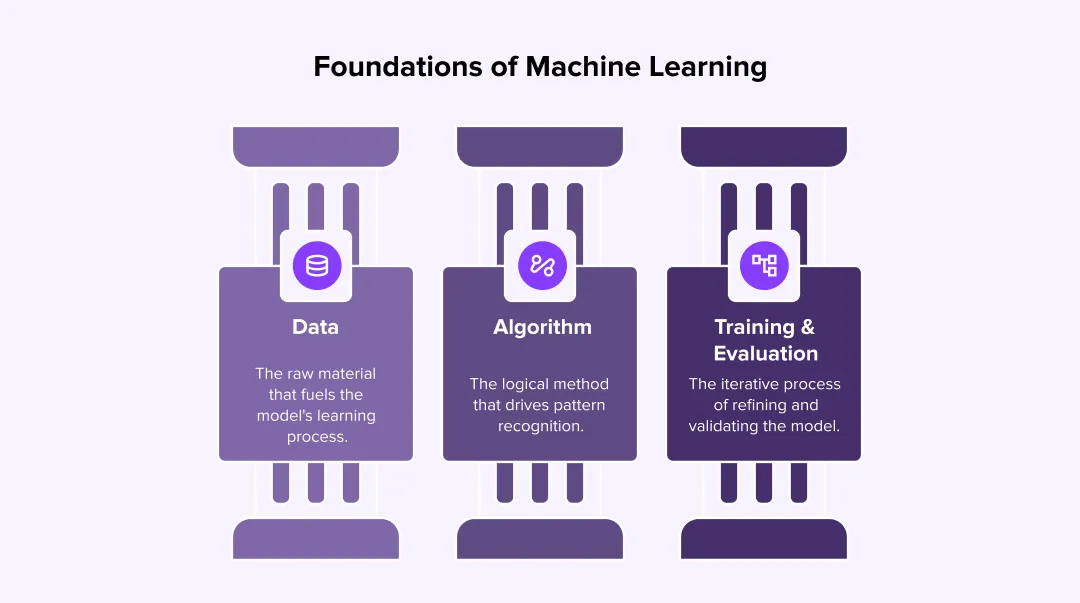
- Data: It’s the foundation of any ML model, which holds raw material (numerical values, images, text, etc.) used to train the algorithm. The quality, quantity, and relevance of this data are crucial, as they directly impact the model's accuracy.
- Machine Learning Algorithm: This is the logical or mathematical method that the model uses to find patterns within the data. It's the engine that drives the learning process and determines how the model will create its rules.
- Training & Evaluation: This is the process of training the algorithm on a dataset. During training, the model iteratively adjusts its internal parameters to minimize prediction errors. Afterward, it's evaluated on a separate dataset to ensure it can generalize its learning to new data.
What are the Common ML Models
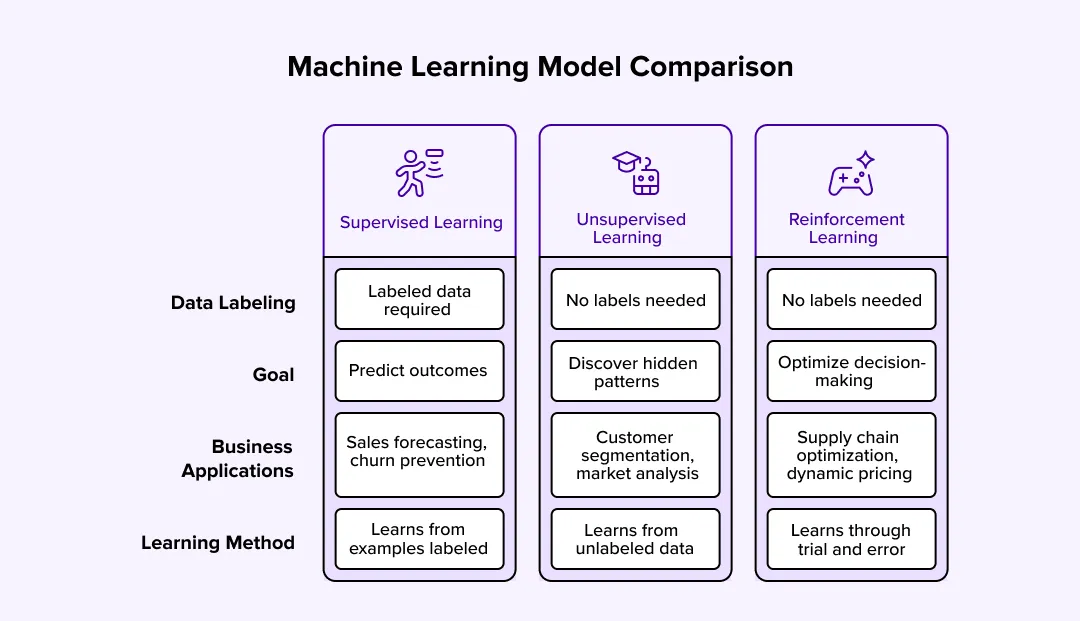
Machine learning algorithms are an evolving technology. You can think of them as a specialized toolkit. Here, each tool is uniquely designed for a specific job, from forecasting sales to identifying spam or grouping similar customers. Now, let’s look at the three distinct methodologies that tackle challenges from unique angles.
1. Supervised Learning
Remember when Netflix started predicting what shows you'd actually watch? That's supervised learning at work. You provide the model with an example of thousands of viewers who watched Show A, also loved Show B, and it figures out the underlying rules.
Now, for this, you will need labeled data, which tells it what the ‘right answer’ looks like during training. Once it comprehends the basic patterns, it can predict outcomes for even new scenarios with on point accuracy.
Supervised Machine Learning Applications in Business:
• Sales forecasting and revenue prediction
• Customer churn prevention and lifetime value estimation
• Credit risk assessment and loan approval automation
• Email classification and spam filtering
2. Unsupervised Learning
Unsupervised learning is a type of machine learning where the algorithm works with unlabeled data with no predefined correct answers. The main goal is for the model to explore the data on its own and discover hidden patterns or intrinsic structures.
For example, you can give it a whole lot of transaction data, and it categorizes them into high spenders and bargain hunters. Following this, it spots subtle behavioral clusters that traditional analysis would never catch. It will help detect a sudden drop in expenditure during the month ends from mobile devices.
Unsupervised Machine Learning Applications in Business:
• Customer segmentation for targeted marketing campaigns
• Market basket analysis for product recommendations
• Anomaly detection in financial transactions
• Pattern recognition in operational inefficiencies
3. Reinforcement Learning
Unlike other models that make isolated predictions, reinforcement learning occurs through a system of trial and error. It interacts with an environment, it receives rewards for positive actions and penalties for negative ones. Furthermore, it continually improves its decision-making strategy.
For example, in training a self-driving car, the agent observes its environment (the road, other cars, traffic lights) and takes actions like accelerating, braking, or steering. It is given a positive reward for safely staying in its lane and reaching its destination, but a negative reward (penalty) for driving off the road or colliding with another vehicle. Eventually, the model achieves optimal performance, based on a set of actions that maximize its long-term rewards, allowing it to drive safely and efficiently.
Reinforcement Machine Learning Applications in Business:
• Supply chain optimization and inventory management
• Dynamic pricing strategies and revenue optimization
• Energy consumption management in facilities
• Autonomous system control and robotics

Popular Machine Learning Use Cases
Machine learning systems are a fundamental driver of business innovation across industries. Organizations worldwide are discovering new ways to use these intelligent systems to solve complex problems, automate processes, and unlock insights from vast amounts of data—often by partnering with experts from a list of AI development companies in USA
1. Healthcare Diagnostics
Remember when getting test results used to take weeks? Now, AI in healthcare has enabled hospitals to run scans through computers that catch details that even doctors might overlook. These systems use pattern recognition algorithms trained on millions of medical images to identify abnormalities like tumors or fractures. Machines learn from past diagnoses to spot disease indicators.
For instance, PathAI gives pathologists an AI-powered assistant. Their platform analyzes tissue samples to help identify cancer cells with greater accuracy, reducing diagnostic errors and helping doctors create more effective treatment plans for patients
2. Product Recommendations
Lately, Netflix knows you better than your friends do sometimes. You watch one true crime documentary, and suddenly your homepage fills with murder mysteries. The same goes for Amazon—buy a yoga mat and watch the meditation cushions roll in. You must have seen that people buy a lot of stuff from "you might like" suggestions.
Now, that’s because these platforms use collaborative filtering algorithms that compare your viewing or purchase history with millions of other users or buyers to predict what you'll enjoy watching and purchase next. These recommendation engines analyze factors like genre preferences, viewing times, purchase history, and even how long you hover over titles.
3. Credit Risk Assessment
Getting approved for loans isn't just about that three-digit score anymore. Banks feed hundreds of data points into machine learning models that identify patterns linked to loan defaults or successful repayments. The algorithms weigh factors like payment history, income stability, and spending behaviors to calculate risk scores more accurately than traditional credit formulas ever could.
For instance, American Express uses machine learning to analyze real-time transaction data and predict a cardholder's financial behavior. This allows their models to spot early warning signs of potential default, enabling them to proactively manage risk by adjusting credit limits or offering assistance before a payment is missed.
How do you build an ML model?
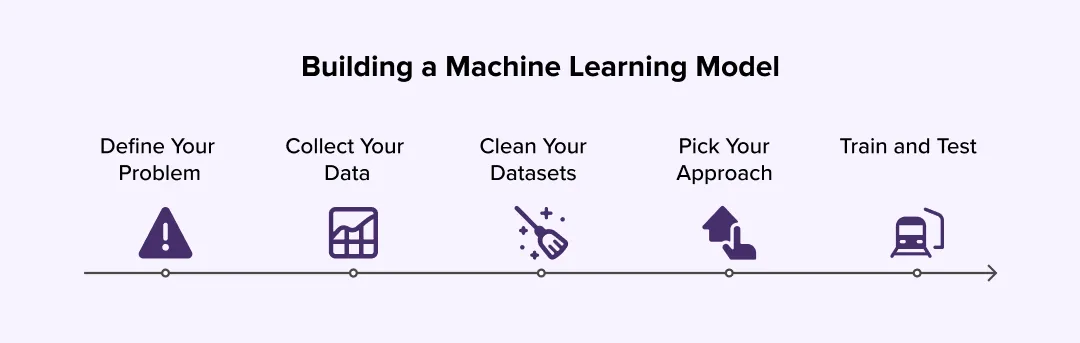
The process of constructing a machine learning system follows established phases that transform raw data into functioning prediction systems.
1. Define Your Problem
Figure out what you're actually trying to solve—a step that many businesses refine with the help of artificial intelligence development companies. For example, a bank wanting to "reduce losses" needs to get specific: are they catching fraudsters or predicting loan defaults? It’s essential because clear goals determine everything else, and it prevents teams from wasting months building sophisticated models that are distanced from solving the actual problem.
2. Collect Your Data
Gather examples and data that represent the full spectrum of scenarios the model will encounter. Credit risk models require loan applications from various income levels, employment types, and geographic regions. Volume matters as most algorithms need thousands of examples to identify reliable patterns, and limited or biased samples create models that fail when deployed.
3. Clean Your Datasets
Raw datasets contain errors, gaps, and inconsistencies that derail analysis. At the same time, duplicate records require removal and data formats need standardization, such as grouping correctly in terms of dates, currencies, and text. They must follow consistent structures. This preprocessing might just consume most project timelines, but it determines the model’s ultimate quality.
4. Pick Your Approach
Algorithm selection depends on problem type and data characteristics. Like, classification tasks use different methods than regression problems, and small datasets favor simpler algorithms. So, you can begin with basic methods to establish performance benchmarks before exploring advanced techniques.
5. Train and Test
Divide data into training, validation, and test segments. Training data teaches patterns, validation data guides parameter tuning, and test data measures final performance. You should monitor both training and validation metrics to detect overfitting. Moving forward, iterate through multiple configurations until an optimal result or performance is achieved.
Helpful read: How to Implement Artificial Intelligence and Machine Learning?
What are Machine Learning Operations (MLOps)?
Machine Learning Operations (MLOps) transforms experimental machine learning projects into revenue-generating production systems. Its primary goal is to automate and streamline the entire machine learning lifecycle. This includes data preparation, model training, deployment, and ongoing management in a production environment.
By implementing practices like continuous integration, continuous delivery (CI/CD), and continuous training (CT). This framework allows for robust monitoring, validation, and governance of ML models, ensuring they remain accurate and provide consistent value over time.
MLOps prevents these costly failures through systematic deployment practices. Here, automated pipelines catch data quality issues before they corrupt predictions. The monitoring systems detect accuracy drops within hours instead of weeks. Additionally, version control enables instant rollback when new models underperform, thereby protecting revenue streams.
What are Machine Learning Libraries?
Machine learning libraries are toolkits that save developers from writing complex math code themselves. These packages contain pre-written algorithms, mathematical functions, and optimization tricks that took years to perfect. TensorFlow runs Google Photos' face recognition, PyTorch powers Tesla's autopilot features, and Scikit-learn helps startups predict customer churn without hiring experts. Hence, different tools fit into performing various jobs.
Building neural networks from scratch means coding thousands of matrix multiplications, activation functions, and backpropagation steps. But, Machine Learning Libraries reduce this to importing a package. What took research teams months now happens quickly, as developers can test five different approaches in just hours.
Today, when Nvidia releases new GPUs, library maintainers quickly optimize their code to leverage the new hardware capabilities. When researchers publish breakthrough papers, implementations appear in updates weeks later. Hence, companies get advanced capabilities without maintaining their own research divisions.
Future of Machine Learning Models
The future of machine learning is a massive economic shift. The global machine learning market size is expected to reach a value of $282.13 billion by 2030. This explosive growth signals the next wave of innovation.
Here’s what that future looks like:
- From Big Data to Smart Data: Models won't need massive datasets anymore. They'll learn from just a handful of examples, like humans do, using techniques like few-shot learning.
- Quantum-Powered Insights: Quantum computers will crack optimization and simulation problems that currently take months to solve, revolutionizing fields like drug discovery and financial modeling.
- The Democratization of AI: Building ML systems won't require a team of PhDs. Low-code and no-code platforms will empower business analysts and domain experts to create and deploy their own models.
Further, small businesses will compete with tech giants using the same tools. Healthcare gets personal treatment plans, factories catch defects before they happen, and banks stop fraud attempts before anyone loses money.
Ultimately,
Companies using these models will continue to spot trends that competitors miss, and automate decisions that used to take weeks. Now, companies understand customers in ways that seemed impossible years ago. Plus, today, the winners aren't necessarily the biggest companies—they're the ones who figured out which model type fits their problem, built solid data pipelines, and kept everything running smoothly in production.
Read More: Machine Learning vs Deep Learning - Unveiling the Core Differences
Frequently Asked Questions
What's the difference between machine learning vs. artificial intelligence?
Artificial intelligence covers any system mimicking human intelligence, from chess programs to robots. Machine learning specifically means systems that improve through data exposure rather than explicit programming. Think of AI as the whole smartphone, while ML is just the predictive text feature learning your typing habits.
How do AI vs machine learning compare in business applications?
AI includes rule-based systems, expert systems, and robotics alongside learning algorithms. Machine learning focuses on pattern recognition and predictions from data. Spam filter uses ML, but the chatbot following scripted responses might just be basic AI without any learning capability.
What machine learning methods work best for beginners?
Beginners can start with supervised learning using decision trees or linear regression; they're straightforward and interpretable. Most business problems fit these approaches. Remember, you should focus on understanding your data before chasing complex algorithms.
How does machine learning work behind the scenes?
Models find patterns by adjusting internal parameters through repeated exposure to examples. Each wrong guess triggers small adjustments. Eventually, patterns emerge that work on completely new data.
Is ChatGPT a machine learning model?
Yes, ChatGPT uses a transformer architecture trained on massive text datasets. It learned language patterns by predicting missing words in sentences billions of times. Unlike traditional programs with fixed responses, it generates new text based on patterns absorbed during training, making each conversation unique.

Uncover executable insights, extensive research, and expert opinions in one place.
Related Content