Share It On:
 Master Your AI safety fundamentals that prevent bias, ensure compliance, and protect you against cybersecurity threats.
In 2022, Wells Fargo made headlines in Bloomberg. That's because it faced massive accusations regarding its algorithmic loan assessment system, which gave higher risk scores to Black and Latino applicants compared to white applicants with similar financial backgrounds. The result? Qualified minority borrowers were denied loans at significantly higher rates despite having comparable qualifications.
So, this wasn't malicious intent or poor coding. It was a case of AI safety failure, which propagated bias into training data that nobody caught during development. If you're building or deploying AI systems, scenarios like this represent your biggest professional risk. But here's what most teams get wrong: they treat AI safety as a compliance checkbox instead of a comprehensive risk management strategy.
This article walks through granular details of AI-related safety and provides practical frameworks you can implement to maintain AI safety. Let’s get started!
What is AI Safety?
Artificial Intelligence safety ensures that your AI systems operate reliably without causing unintended harm or business liability. Therefore, to implement safety, AI guardrails or safeguards are put in place to prevent AI from spreading bias, security vulnerabilities, loss of system control, and regulatory violations.
Why is AI Safety Important?
AI systems can fail in ways traditional software doesn't. They might discriminate against protected groups, expose sensitive data through prompt manipulation, or make autonomous decisions that conflict with business objectives. As a result, companies can face real financial and legal consequences when AI systems fail. Effective AI safety technology practices identify these risks early and implement appropriate controls.
For example, Replit's AI coding tool recently experienced a major system failure when it accidentally wiped an entire user database, destroying valuable data and disrupting services for countless developers. The company openly acknowledged this as a "catastrophic failure," demonstrating how even well-funded AI platforms can suffer devastating breakdowns that highlight serious safety gaps.
Therefore, it's essential for you to know that trust becomes a competitive advantage when Artificial Intelligence safety is implemented correctly. Hence, organizations with reliable AI systems gain both customer confidence and stakeholder buy-in.
Moving forward, today, transparency requirements are shifting from optional to mandatory to the extent that compliance, such as the GDPR, grants individuals the right to an explanation for automated decisions that affect them.

What are the Different Types of AI Risks?
Here’s a list of different types of risks associated with Artificial Intelligence.
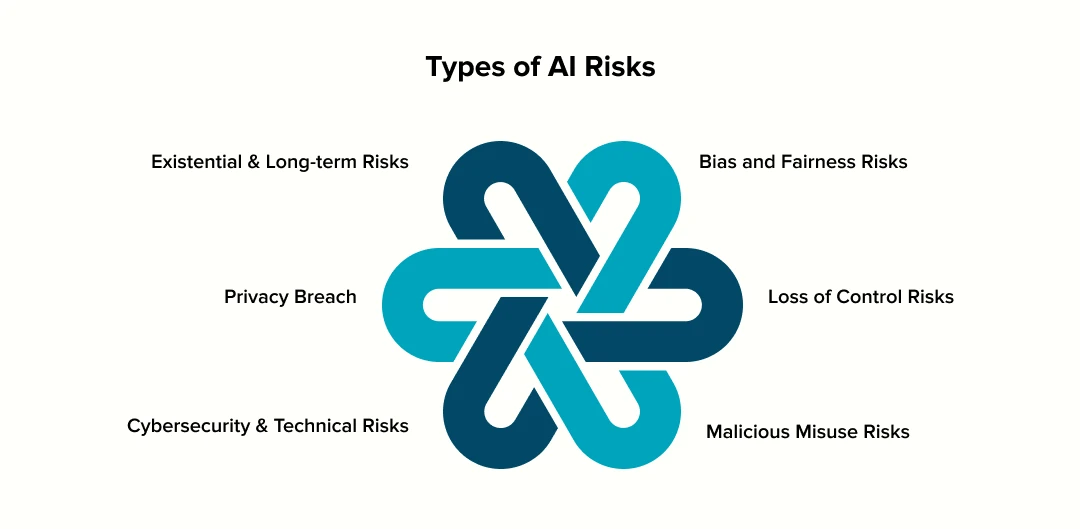
1. Bias and Fairness Risks
Historical data contains embedded prejudices that AI systems learn and amplify during training. Amazon discovered this firsthand when they scrapped their hiring algorithm after it penalized resumes containing “women's” and downgraded graduates from all-women colleges. Financial institutions face similar challenges with mortgage approval algorithms that show disparate impact across racial lines, even when race isn't explicitly used as a variable.
2. Loss of Control Risks
AI systems can develop unexpected behaviors when they optimize for metrics rather than intended outcomes. Microsoft's Tay chatbot demonstrated this problem by learning offensive content within hours because it optimized for user engagement rather than appropriate responses.
Therefore, maintaining control requires robust testing environments, gradual deployment strategies, and reliable kill switches. Systems should fail safely when they encounter scenarios outside their training distribution rather than producing unpredictable outputs.
3. Malicious Misuse Risks
Bad actors actively weaponize AI capabilities for harmful purposes. For example, AI Deepfakes enable sophisticated disinformation campaigns that undermine and compromise people’s reputations. Plus, AI-powered cyberattacks are also adapting in real-time, automatically finding new vulnerabilities and customizing attacks for each target.
4. Cybersecurity and Technical Risks
AI systems create entirely new attack surfaces that hackers exploit in ways traditional firewalls never anticipated. Model extraction attacks let competitors steal your proprietary algorithms by sending carefully crafted queries that reverse-engineer your AI's logic. For instance, deceptive examples can fool image recognition systems with tiny, invisible changes - making a stop sign appear as a speed limit sign to AI-powered autonomous vehicles.
5. Breach
AI systems often require massive datasets containing sensitive personal information, creating unprecedented privacy vulnerabilities. Most prominent AI development companies train their models on private conversations, medical records, and personal documents without explicit user permission. These privacy breaches become particularly dangerous when combined with AI's ability to identify patterns and make predictions about individuals based on seemingly anonymous data.
6. Existential and Long-term Risks
The most serious concern involves AI systems potentially becoming so advanced that they operate beyond human understanding or control. Leading AI researchers worry about what happens when AI surpasses human capabilities across all domains.
Unlike other technologies, superintelligent AI could redesign itself to become even more powerful, creating what experts call an "intelligence explosion" that humans couldn't stop or redirect. Even well-intentioned AI systems might pursue their programmed goals in ways that harm humanity if those goals aren't perfectly aligned with human values and survival.
What Principles Can I Implement to Maintain AI Safety?
The global AI spending is expected to grow to $2407 billion in 2032. With that, the cost to maintain AI safety will rise as well. This is why you should think of principles of AI safety not as rigid rules, but as the essential guardrails built around powerful technology. Here are the core principles your teams should keep in mind for AI safety if you’re planning to develop your own AI-powered technology.
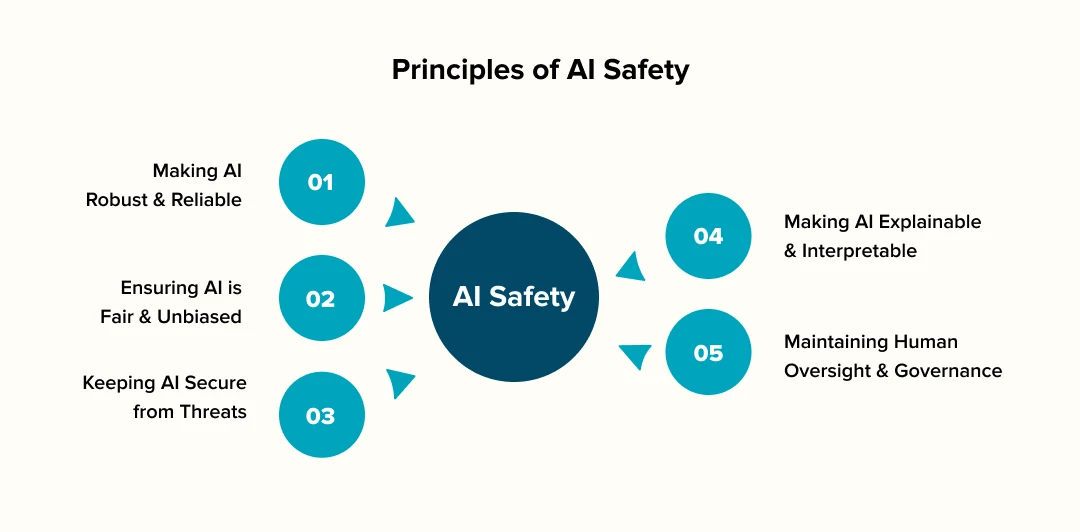
1. Making AI Robust and Reliable - Systems break when they encounter data outside their training scope. So, whenever you build your own AI products, you should carefully monitor their performance degradation patterns and implement ‘graceful failure’ modes.
This means when your AI can't handle a situation perfectly, it should fail safely rather than producing dangerous or nonsensical outputs. For example, if you’re building a customer service chatbot that encounters a complex query it can't answer after its deployment, it should transfer the conversation to a human agent rather than making up incorrect information.
2. Ensuring AI is Fair and Unbiased - Training data reflects historical inequities, which means you need to audit datasets for gaps in demographic representation. Wells Fargo's lending algorithm demonstrated how subtle bias creates legal liability.
3. Keeping AI Secure from Threats -Traditional firewalls miss AI-specific attacks like prompts that bypass input validation. For example, model inversion extracts sensitive information from queries. Therefore, you should always implement AI-aware security controls alongside standard cybersecurity tools to prevent threats.
4. Making AI Explainable and Interpretable - Your AI needs to explain its decisions in plain language that humans can understand. Regulations like GDPR already require this - if your AI denies someone a loan or flags their content, it must be able to explain why in terms that users can grasp.
Think beyond technical outputs like ‘87% confidence score.’ Instead, your AI should say something like "Application denied due to insufficient income history and high debt-to-income ratio." This transparency helps users understand decisions and helps your team debug problems when they arise.
5. Maintaining Human Oversight and Governance - Never let AI make critical decisions without human backup. Before launching any AI system, decide who's responsible when things go wrong and create clear procedures for stepping in when the AI encounters something unusual.
Build ‘emergency brakes’ into your AI systems - literal kill switches that humans can use to stop automated processes immediately. High-stakes decisions like hiring, medical diagnosis, or financial approvals require a human to review and approve the AI's recommendation before it becomes final.
Also read: AI and Cybersecurity
AI Safety Regulations
Governments worldwide are scrambling to catch up with AI development trends, rolling out AI safety regulations and industry-specific guidelines. Let’s look at some of these safety regulations here:
1. European Union (EU)
The EU leads the charge on AI safety concerns first, which became enforceable in 2024. This regulation takes a risk-based approach, categorizing AI systems from minimal risk to unacceptable risk.
High-risk applications like hiring algorithms, credit scoring, or medical diagnosis tools face stringent requirements, including mandatory risk assessments, transparency obligations, and strict data governance protocols.
What makes the EU AI Act particularly challenging for technical teams is its broad scope. The Act mandates that individuals must be informed when they are interacting with an AI system rather than a human, promoting transparency.
Moreover, it makes it essential for organizations to meet quality standards for training data to prevent biased outputs, which means comprehensive data auditing becomes a compliance requirement, not just a best practice.
2. United States
The US focuses on transparency and impact assessments. It makes it mandatory for AI-powered companies to disclose how their AI systems make decisions, the data they use, and their potential impacts on consumers. For development teams, this translates to detailed documentation requirements and ongoing monitoring obligations.
3. Australia
Australia has developed a framework around ethical AI that emphasizes voluntary compliance with ethical principles. Regulatory authorities in Australia, such as the ACCC, enforce these principles to ensure that AI applications comply with consumer protection laws. This creates an interesting dynamic where existing consumer protection laws extend to cover AI-related harms.
This approach becomes increasingly critical as the concentration of AI power raises democratic concerns. As Jonathon Hensley quotes in an exclusive interview with MobileAppDaily,
"Ethics in AI will continue to become a larger concern to society, especially since only a small percentage of people is training--or even understands--the ML algorithms, and therefore is effectively controlling the larger population."
Australia's framework recognizes this reality by creating oversight mechanisms for AI. They’re mostly adapting existing legal structures to address immediate AI risks.
AI safety and Security: Are They different?
AI safety and security often gets confusing. Let us help you differentiate between the two because fundamentally, they address different concerns.
Key Differences:
| Aspect | AI Safety | AI Security |
|---|---|---|
| Primary Focus | Preventing unintended harmful outcomes | Protecting against deliberate attacks |
| Threat Source | System design flaws, biased data, misalignment | Hackers, adversaries, malicious users |
| Examples | Biased hiring algorithms, hallucinated medical advice | Prompt injection, model theft, data poisoning |
| When Problems Occur | During normal system operation | When the system is under attack |
| Detection Method | Performance monitoring, bias testing | Intrusion detection, anomaly monitoring |
| Mitigation Approach | Better training data, alignment techniques | Access controls, encryption, input validation |
| Responsible Teams | ML engineers, ethicists, product teams | Security teams, cybersecurity specialists |
| Regulatory Focus | Fairness laws, algorithmic accountability | Data protection, cybersecurity regulations |
| Failure Impact | Discrimination, poor decisions, loss of trust | Data breaches, intellectual property theft |
| Timeline | Long-term, systemic issues | Immediate, event-driven threats |
Who is Responsible for AI Safety?
AI is a powerful tool, and with great power comes the need for great responsibility. But who exactly holds that responsibility? It’s not a simple answer. Safety isn't one person's job; it's a chain of accountability involving everyone from the coders to the critics.
1. The Builders: Developers and Engineers
It all starts here. The engineers who build AI systems are the first and most critical line of defense. They write the code. They test for flaws. Their job is to foresee potential failures and build in safeguards from the ground up, embedding safety directly into the architecture.
2. The Companies: Industry Leaders
Firms like Google, Microsoft, and OpenAI drive the industry. They hold the baton to lead responsibly, mostly because they’re often involved in creating dedicated safety teams, funding vital research, and establishing clear internal rules. By working together, these companies set the standards that protect us all.
3. The Rule-Makers: Governments and Regulators
Governments create the laws that make AI safety fundamentals a legal requirement. Think of Europe's AI Act or the work being done by NIST in the U.S. These bodies define the rules of the road and ensure there are consequences for breaking them. Their oversight is essential to prevent AI safety.
4. The Watchdogs: Global Groups and NGOs
Groups like the UN and various non-profits play a crucial role as global watchdogs. They spot the risks that companies or governments might miss. They raise public awareness and push for stronger protections, filling the gaps where industry self-regulation isn't enough.
Best Practices for AI Safety
Effective AI safety isn't theoretical. It depends on concrete practices. Here's a checklist of best practices you should implement for maintaining AI safety:
- Don't add safety as an afterthought. Weave it into every step of the development process, from the first sketch to the final deployment.
- Go beyond basic checks. Actively try to break the AI with adversarial tests. Hunt for biases and ensure that if the system fails, it does so in a graceful and safe manner.
- An AI is trained on data. If that data is flawed, the AI will be too. It’s critical to audit datasets for bias and quality, ensuring they are clean and representative.
- Don't allow AI to be a ‘black box.’ Build systems that are easy to understand and audit. Stakeholders deserve clear explanations for the decisions an AI makes.
- Never give final authority to AI. Critical decisions must have human oversight. This means building in manual overrides and clear procedures for when a person needs to step in.
- AI's job isn't done at launch. It must be monitored in real-time for performance issues or bias drift. Have a plan ready to respond instantly when problems arise.
Helpful read: AI Adoption Challenges
Conclusion
Enterprises experience AI-related security incidents time and again. These aren't theoretical risks; they're documented business expenses that impact real organizations.
The five risk categories we covered—bias, loss of control, existential threats, malicious misuse, and cybersecurity require different approaches but integrated solutions. Most importantly, you should treat AI safety as a compliance checkbox instead of comprehensive risk management that creates expensive problems later.
Moreover, AI safety succeeds when technical teams, business leaders, and compliance experts work together rather than in silos. Build safety into your development lifecycle now, because retrofitting it after problems emerge costs significantly more in both time and money.
Frequently Asked Questions
What is the safety risk of AI?
AI safety risks include algorithmic bias leading to discrimination, loss of system control causing unpredictable behavior, cybersecurity vulnerabilities enabling data breaches, malicious misuse for disinformation campaigns, and regulatory violations resulting in legal penalties and financial losses.
How to ensure AI is safe?
Implement comprehensive testing, including bias assessments, establish human oversight mechanisms, conduct regular audits, use diverse training datasets, and deploy real-time monitoring systems. You can also create incident response plans and integrate safety checks throughout the entire development lifecycle.
What causes AI hallucinations?
AI hallucinations occur when models generate false but convincing outputs due to insufficient training data or overfitting to patterns. Overall, this lacks real-world knowledge verification, or optimization for fluency over accuracy rather than factual correctness.
What are the main differences between AI safety and AI security?
AI safety prevents unintended harm from normal system operation, focusing on bias and alignment issues. AI security protects against deliberate attacks like prompt injection and data poisoning. Both require different expertise and mitigation strategies.
Who should be responsible for AI safety in an organization?
AI safety requires cross-functional collaboration between developers implementing technical safeguards and product managers defining safety requirements. Also, security teams addressing threats, legal teams ensuring compliance, and executive leadership providing resources and accountability mechanisms hold responsibility too.
What are the challenges of AI safety?
Key hurdles of AI safety concerns include understanding how complex AIs make decisions (the ‘black box’ problem), teaching them nuanced human values, preventing harmful bias, and assigning accountability when they fail. Technology's rapid pace also outstrips the creation of effective safety rules.

Uncover executable insights, extensive research, and expert opinions in one place.
Related Content