Share It On:
 A practical look at how paid search intelligence helps modern advertisers cut wasted spend, outsmart competitors, and run sharper PPC campaigns.
In 2026, the average cost per click on Google Search has climbed to roughly $2.96, up about 12% from the year before. Legal, insurance and B2B verticals are getting hit harder. And yet, somewhere between a quarter and a third of every PPC budget out there is still being torched on underperforming keywords, audiences and creatives that nobody is auditing closely enough.
So when people say PPC is "getting harder," what they actually mean is this: the cost of running the same campaign you ran last year just went up. The cost of running it badly went up even more.
That's the gap paid search intelligence is built to close.
This guide is for the founder or in-house marketer, or agency lead who's tired of pulling reports that explain what happened last week but never tell you what to do next week. We'll get into what paid search intelligence actually means, the components that matter, the workflow that turns data into decisions, and the tooling that punches above its weight in 2026.
What Paid Search Intelligence Actually Is (and Isn't)
Paid search intelligence is the discipline of collecting, analysing and acting on data from your paid campaigns and the wider competitive landscape, so you can make sharper decisions about where your money goes, what your ads say, who they target, and what they're worth. It's the layer that sits above standard reporting.
Some people call it PPC intelligence. Some call it PPC competitive intelligence. There's also "paid search analytics" floating around.
- Paid search analytics mostly look inward. Your CTRs, CPCs, conversion rates, ROAS. This kind of paid search analysis tells you what your account is doing, but stops short of telling you why.
- PPC competitive intelligence looks outward. What your rivals are bidding on, how much they're spending, what their ads say, where they're sending traffic.
- Paid search intelligence is the umbrella. It pulls both together so you stop optimising in a vacuum.
Now, what it isn't. It isn't a dashboard, a tool subscription, or a quarterly competitive audit nobody reads. Intelligence is more of a habit, a cadence of looking, interpreting and acting. The tools just give you the inputs. If nobody on your team is making different decisions because of the data, you don't have a paid search intelligence function. You just have software.
Why This Even Matters in 2026
A few stats first, because the case kind of writes itself.
Roughly 89% of PPC professionals now use generative AI and automation tools as a standard part of their workflow. About 78% of Google Ads spend is being run by Smart Bidding or Performance Max. The auction is more crowded, the algorithms are doing more of the bidding, and your competitors are getting smarter and faster than they were a year ago.
A few things follow from this.
First, the basics are no longer where you win. They're where you survive. Negative keywords, conversion tracking, ad relevance: if you don't have those locked, you're not competing. You're donating.
Second, AI bidding is only as good as what you feed it. Accounts using Smart Bidding report around 22% lower cost per conversion than manual bidders, but only when the conversion data is clean and the inputs are right. Garbage in, expensive garbage out.
Third, the moat is now in strategy, not execution. The execution part is increasingly automated. What you bid on, where you compete, what story you tell, where you choose not to spend — that's where humans still have an edge. Paid search intelligence is what makes that strategy non-random.
Then add this on top: roughly 20% of ad impressions are invalid traffic, and around 40% of digital ad spend produces zero return. So you're not just trying to win more clicks. You're trying to stop bleeding budget on clicks that were never going to convert.
The Six Pillars of Paid Search Intelligence
Most guides on this topic blur it all together. I'd rather break it into the actual components so you know what you're looking at and what you're missing.
1. Competitive intelligence
This is the spy work. Who else is showing up in your auctions, what they're bidding on, how aggressive they are, what creative they're running, and where their traffic is going. Google's own Auction Insights gives you a baseline: impression share, overlap rate, position above rate and outranking share. It won't show you their bids or their copy, but it tells you exactly who you're up against and how hard they're pushing.
Layer a competitive tool on top of that (more on tooling later), and you start seeing the stuff that actually moves the needle.
- Which competitors are increasing spend?
- Which ones quietly pulled out of a keyword cluster you care about?
- What ad angles are they A/B testing right now?
- Which landing pages are they funneling traffic to?
The mindset shift here: you're not looking at competitors to copy them. You're looking to find the gaps they've left wide open.
2. Keyword intelligence
Beyond your own search terms report (which you should be reading weekly, by the way), keyword intelligence is about understanding the wider search market. What's growing? What's seasonal? What's saturating? Where the cheap-but-converting long-tails are hiding.
A useful frame: branded search terms typically deliver around 10:1 ROAS and 12-15% conversion rates. Non-branded is a different game entirely. If you don't segment the two in your analysis, you'll keep getting flattered by your own brand traffic while missing the fact that your prospecting is bleeding cash.
This is also where you find what competitors are not bidding on. Sometimes the best keyword opportunity isn't the one with the highest volume. It's the high-intent term nobody else has noticed yet.
3. Ad creative intelligence
Ad copy is now a signal market. Generative AI has flooded the auction with serviceable, generic copy. Which means the bar to stand out has dropped and risen at the same time. Dropped because mediocre copy is cheap to produce. Risen because if your copy reads like everyone else's, you're invisible.
Things worth looking at:
The hooks competitors are leading with (price, social proof, urgency, problem statement)
The CTAs they're testing
Whether their headlines actually match what their landing page promises (a lot of them don't)
How they're using ad extensions and sitelinks
Spot the patterns, then deliberately don't follow them. If everyone in your category is running "Get a Free Quote," that's exactly the headline you shouldn't be using.
4. Audience and intent intelligence
This is where most accounts still leave money on the table. Modern paid search isn't just keywords anymore. It's keywords layered with audience signals: in-market segments, custom intent audiences, customer match lists and remarketing pools.
The intelligence work here is figuring out which audience layers actually shift performance. Are your in-market audiences converting better than cold traffic? Are your remarketing pools running too small to be useful? Are you applying audience signals as "Observation" first to gather data before bidding higher?
Most accounts I've seen (and probably most you've audited) treat audiences as a set-it-and-forget-it layer. They're not. They're a constant testing surface, and they reward whoever pays attention.
5. Budget and bid intelligence
This is the boring one. It's also where the biggest wins live.
Track CPC trends at the segment level, not the account level. Account-wide averages hide everything important. Broad match clicks often cost 40-60% more than exact match while converting worse, but you only see that if you've segmented the data. Match-type drift is one of the most common silent killers in Google Ads accounts.
Quality Score economics are also worth obsessing over. Accounts with QS 8+ pay roughly 37% less per click than the median. Moving an account from QS 5 to QS 7 can cut your effective CPC by more than 40%.
For a $20K/month budget, that's like getting $8K of clicks for free. Nobody is coming to hand you that money. You have to go take it. Of all the Google Ads optimization techniques people obsess over, Quality Score is the one with the biggest direct impact on your PPC cost, and it's also the one most accounts neglect.
6. Conversion and attribution intelligence
This one's where B2B advertisers especially get themselves in trouble.
If your sales cycle is six months, a 30-day attribution window misses something like 80% of the journey. Same story for B2C verticals with long consideration cycles. Cross-device, cross-session, multi-stakeholder buying is the norm now, not the edge case. Cookies don't survive the journey. First-party data is the only thing that does.
The intelligence question here isn't "what's our ROAS?" It's "which touchpoints actually moved the deal, and which ones just took credit for it?" Answering that means connecting your ad platform to your CRM, your revenue data and your close rates. Not just the dashboard view.
How to Actually Run a Smarter PPC Campaign: The Workflow
Theory's fine. Here's what real PPC campaign optimization looks like in practice, week to week. Steal it verbatim if you want.
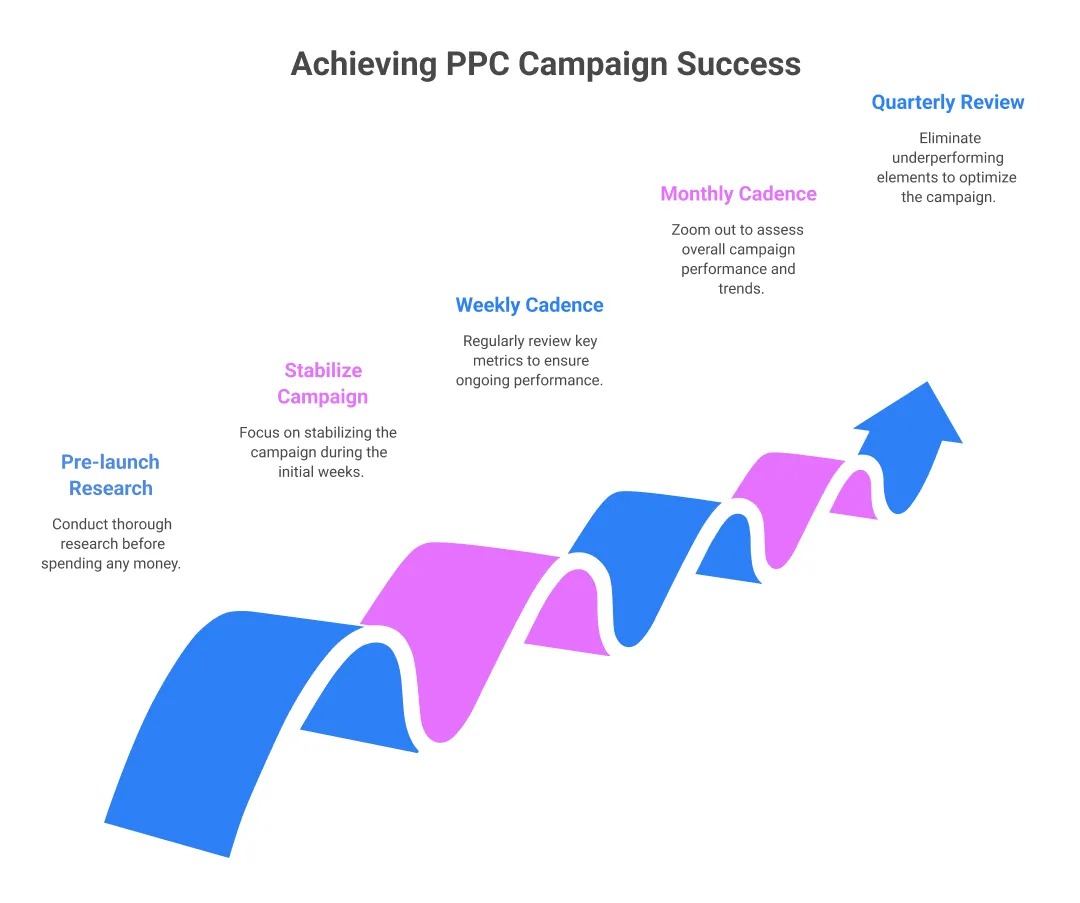
1. Pre-launch: research before you spend a dollar
Before any campaign goes live, your intelligence work should have already produced:
- A keyword map segmented by intent (informational, commercial, transactional, branded)
- A competitor inventory: who's bidding on what, estimated spend, ad copy themes, landing page patterns
- A baseline forecast for CPC, CTR and conversion rate using actual benchmarks for your industry, not last quarter's averages
- A starter negative keyword list built from competitor data and search term research
This is the bit that gets skipped most often. It's also the bit that prevents 80% of the waste downstream.
2. Week 1 to 4: stabilise, don't optimise
When a new campaign or major change launches, Google's algorithm needs a learning period. Usually, two to four weeks, and you want at least 30 conversions before you start fiddling. Don't touch bids aggressively. Don't add or remove keywords on a whim. Watch, take notes, document hypotheses.
The instinct to "fix" things in week one is the single most expensive mistake new account managers make.
3. Weekly cadence: five things to look at, every time
- Search terms report. Add negatives, find new keyword candidates.
- Auction Insights. Who's gained share, who's lost it, and what that tells you about competitor strategy.
- Conversion data quality. Are tracking pixels firing? Are offline conversion imports working? Are CRM sync points still alive?
- Ad performance by ad group. Which creative angles are pulling weight? Which ones are dead?
- Quality Score trend. Not the absolute number, the direction. Trending down is the alarm bell.
4. Monthly cadence: zoom out
Once a month, the strategic layer:
- Match-type performance breakdown
- Audience layer performance (which segments over- and under-perform)
- Competitor activity shifts: anyone new in the auction, anyone gone quiet
- Channel-level ROI comparison if you're running paid search alongside other channels
- Wasted spend analysis: how much money went to clicks that were never going to convert
This is also when you should be running structured experiments. Bidding strategies, landing pages, ad copy themes, audience configurations. Write down the hypothesis, the result, the action you took. Over a year, this becomes your own private benchmark library, and that's more valuable than any external report you'll ever buy.
5. Quarterly: kill what doesn't work
Every quarter, be ruthless about cutting things:
- Keywords with QS under 3 or CTR under 1% (usually dead weight)
- Audiences that haven't shifted performance in 90 days
- Campaign structures that have grown too complex to maintain
- Ad copy that's been running too long without testing
Bloat kills accounts. Pruning is intelligence work too.
A Note for B2B: Why Traditional PPC Playbooks Don't Work
If you're running a B2B paid search strategy and using the same logic that works for e-commerce, you're going to have a rough time. Here's why.
B2B deals take six to eighteen months to close. They involve five to seven stakeholders. The person who clicks your ad isn't always the person who buys. Sometimes they're doing initial research and forwarding the info to a procurement team that searches for completely different things.
What this means for your intelligence work:
- Stretch your attribution windows. 180 days minimum for opportunity-level attribution. 270 days for closed-won. Anything shorter is throwing away the signal.
- Track at the account level, not the user level. Three different people from the same company hitting your site is one account, not three leads.
- Stop optimising for cheap leads. A $20 cost-per-lead that produces no opportunities is worse than a $200 CPL that produces a qualified pipeline. Smart B2B PPC measures everything in opportunity or revenue terms.
- Use first-party data hard. Customer match, CRM-integrated audiences, closed-loop reporting. The platforms can only optimise toward what you tell them is actually valuable.
The PPC managers who win in B2B aren't the ones running the most campaigns. They're the ones connecting paid search activity to actual pipeline movement, and then telling the algorithm what to chase.
The Tooling Stack: What You Actually Need
You don't need fifteen tools. You need three or four that cover different jobs. The honest functional breakdown:
- Your ad platform's native analytics: Auction Insights, Search Terms reports, change history, recommendations. Non-negotiable. Use it daily.
- One competitive intelligence tool: This is where you get the outside view: competitor keywords, ad copy, estimated spend and landing pages. Pick one that integrates with the rest of your stack. Don't pay for three different ones.
- One cross-platform reporting layer: If you're running paid search on multiple platforms or alongside other channels, you need a single view of the world. Pulling reports manually every Monday is how the intelligence function dies a slow death.
- A CRM-to-ads integration: This is the single biggest upgrade most accounts can make. Pushing offline conversions and revenue data back into your ad platform lets the algorithm optimise toward the metric that actually matters (money), instead of platform-level proxies.
- Optional but useful: a landing page optimisation tool, a click-fraud monitor if you're in a high-fraud category like legal or insurance, and a generative AI layer for ad copy ideation. Use AI for variants, not finals.
- The trap to avoid: thinking the tool is the intelligence. The tool surfaces data. A person interprets it and makes decisions. I've seen plenty of in-house teams and digital marketing agencies pay for premium platforms they barely log into. If nobody on your team is going to act on what these tools tell them, save the subscription fee.
How to Measure ROI Across Multiple Marketing Channels
The question of How to Measure ROI Across Multiple Marketing Channels comes up constantly. Most accounts running paid search alongside SEO, social, email and content struggle to figure out which channel actually drove what. The honest answer is that nobody can give you perfect cross-channel attribution. Anyone selling you "perfect" is selling you something else entirely.
What you can do is more practical:
- Use multiple attribution models in parallel. First-touch tells you what brings them in. Last-touch tells you what closes the deal. Time-decay weights both. Compare them and look for channels that show up consistently across all three. Those are your reliable performers.
- Run incrementality tests. Turn off a channel in one geo for two weeks. See what happens to total conversions. That's a real signal. Reported attribution is just a model.
- Connect to revenue, not to conversions. Conversions are platform-defined. Revenue is real. If your CRM doesn't talk to your ad platforms, that's the first integration to fix.
- Accept directional accuracy over precise attribution. A model that's roughly right and lets you make confident budget shifts is more useful than a model that's "perfect" but takes six weeks to update.
Channel ROI measurement isn't really a math problem. It's a discipline problem. Most teams just don't have the discipline to keep the data clean over time.
Common PPC Mistakes Even Experienced Marketers Make
- Optimising for clicks instead of customers: Higher CTR doesn't mean higher revenue. Sometimes it means you're attracting the wrong people more efficiently.
- Ignoring landing page experience: Quality Score has three components and most teams only optimise two. The landing page is the one with the biggest gap between top and bottom performers. Loading time matters. Message match matters. Mobile responsiveness matters. A lot.
- Running Performance Max with no signals: PMax optimises toward whatever you feed it. Feed it weak conversion definitions and weak creative, and it'll happily spend your budget on garbage.
- Treating a broad match like exact match: Broad match works with Smart Bidding and solid conversion tracking. It does not work as a "find me more traffic" lever. Used wrong, broad match is the fastest way to torch a budget in 2026.
- Not knowing your own break-even CPA: If you can't tell me, off the top of your head, what a new customer is worth and what you can afford to pay to acquire one, you're flying without a compass.
- Daily tweaking: Algorithms need learning periods. Constantly changing bids and budgets resets the learning. Resist the urge to fiddle.
Where This Is Going
A few honest predictions for the next 12 to 18 months in paid search.
AI bidding will keep taking over. The performance gap between AI-optimised and manually managed accounts is going to widen further. Advertisers who win will be the ones who get the inputs right, not the ones trying to outsmart the algorithm.
Competitive intelligence will get more important, not less. As more of the execution gets automated, strategy becomes the actual differentiator. Knowing what your competitors are doing, and just as importantly what they're not doing, is strategic gold.
First-party data is going to keep eating third-party data's lunch. Without a clean customer list, a real CRM integration and proper offline conversion tracking, you'll be optimising blind while better-instrumented accounts pull steadily ahead.
Measurement is going to get messier before it gets better. Privacy changes, cookie deprecation, AI-driven attribution noise — there's a lot of static in the signal right now. Teams that lean into incrementality testing, multi-model attribution and direct revenue tracking will adapt fine. Teams still chasing the perfect dashboard will keep getting confused, and they'll keep blaming the platforms for it.
Bringing It All Together
If you take one thing from this guide, take this. Paid search intelligence isn't a tool or a report or a quarterly review. It's a way of running campaigns where every decision is made on evidence, the data flows in daily, and the strategy gets sharper every month instead of staler.
The best advertising experts I've come across don't really have secret techniques. They just have boring habits. They check the search terms report religiously. They keep their negative keyword lists current. They push offline conversions back into the platform. They kill underperforming things without sentimentality. They run experiments, write down what they learn, and they don't confuse activity with progress.
If you've been winging it, or running campaigns the same way you did three years ago and wondering why the numbers don't add up anymore, start small. Pick one of the six pillars. Build the habit. Then add the next. That's the work. The rest is just software.
Frequently Asked Questions
How much does PPC cost for a small business per month?
Most small businesses spend $3,000 to $7,500 monthly all-in — that's ad spend plus management. Your exact PPC cost depends on industry competition, platform choice, and whether you hire an agency or run campaigns yourself.
Is PPC pricing worth it compared to the results you get?
It can be, if your funnel converts. A solid campaign returns roughly $2 for every $1 spent. But poor tracking or a broken landing page turns PPC cost into wasted spend fast, no matter your budget.
What affects the cost of PPC advertising the most?
Your industry is the biggest factor — legal clicks hit $9+, while ecommerce sits near $1. Keyword competition, platform, ad quality score, and geographic targeting also push your pay per click cost up or down significantly.
Why is PPC cost so different between agencies?
Geography, experience, and team quality drive the gap. A budget shop spreads juniors across 30 accounts; a specialist gives yours real attention. Same services on paper, wildly different PPC pricing — and very different results month to month.
How much should startups budget for PPC cost when starting out?
Start with $1,000 to $3,000 monthly in ad spend. That's enough to gather real data within six weeks without draining your runway. Below $500, your PPC cost buys too few clicks to learn anything useful or actionable.

Uncover executable insights, extensive research, and expert opinions in one place.
Related Content