Share It On:
 Essential strategies and best practices to secure your generative AI systems from cyber threats.
The pursuit to integrate generative AI feels like a new gold rush, where everyone is trying to grab unprecedented gains in creativity and efficiency through gen AI models. But in this haste, a critical question is often ignored: What happens when your most powerful generative AI tool becomes your biggest security vulnerability?
Honestly, lurking beneath these chatbots can be a generative AI security risk. This can eventually make your system vulnerable and exposed to attacks that can steal proprietary information through simple conversation, and turn your most trusted tool into an insider threat.
Before your greatest asset becomes your most dangerous liability, it’s crucial to understand generative AI security implications. This article will walk you through gen AI security risks, best practices to prevent them, and more.
Let’s get started!
What is Generative AI Security?
Generative AI tech is widely accepted and running on almost everyone’s personal and professional devices. In a McKinsey survey, it was reported that 78% of respondents say their organizations use AI in at least one business function, up from 72% in early 2024 and 55% in 2023.
But this power brings a new class of threats, as your old security playbook has become obsolete. As businesses continue exploring new generative AI use cases across customer service, software development, content creation, and operations, securing these systems has become a critical business priority. That’s because now, we’re not defending against simple network breaches. Attackers can now poison its logic or trick Gen AI into exposing the company’s data with just a simple prompt. Therefore, gen AI security scans threats through the entire AI lifecycle, from data collection and model training to deployment and ongoing operations.
Key Objectives of Generative AI Security
Generative AI security focuses on four core areas:
1. Protecting Models: Following AI safety regulations and safeguarding AI models from tampering, theft, and corruption during training, and ensuring only authorized model versions reach production.
2. Protecting Data: Securing training datasets, user inputs, and preventing AI systems from leaking sensitive information through their responses.
3. Protecting Outputs: Implementing controls to prevent AI from generating harmful, biased, inaccurate, or inappropriate content that violates policies or regulations.
4. Protecting Users: Ensuring user privacy, preventing manipulation, maintaining transparency about AI interactions, and implementing proper access controls.

Key Security Risks in Generative AI
Organizations deploying generative AI tools face unprecedented security challenges that extend beyond traditional cybersecurity frameworks. These multifaceted risks in AI and cybersecurity require strategic assessment and mitigation approaches tailored to the unique characteristics of AI systems. Let’s look at some of the key security risks associated with generative AI.
1. Model Vulnerabilities
- Adversarial attacks: Here, attackers craft specialized prompts that exploit model weaknesses, causing unintended behaviors or bypassing security controls that even minor perturbations to input data can trigger significant model failures.
- Data poisoning: This compromises model integrity during the training phase. Malicious data introduced into training datasets creates persistent vulnerabilities that manifest during production and deployment.
- Model theft: Here, sophisticated extraction techniques enable competitors to replicate proprietary models through systematic querying. Pharmaceutical companies investing millions in drug discovery AI face risks of competitors reverse-engineering their models.
2. Data-Related Risks
- Sensitive data exposure: This emerges when models inadvertently retain and disclose confidential information from training datasets. Microsoft experienced this vulnerability publicly when its Bing Chat assistant, Sydney, leaked internal development information. Similar concerns have fueled broader discussions around chatgpt security risks, particularly regarding how AI systems handle sensitive business and user data.
- Data breaches: The AI infrastructure carries amplified consequences compared to traditional database compromises. Breached training repositories expose not merely raw data but algorithmic insights and learned patterns.
- Privacy violations: It has manifested through the indirect inference capabilities of advanced models. Hence, employment screening systems have revealed applicants' health conditions through linguistic pattern analysis, creating legal exposure under disability discrimination statutes.
3. Misuse and Output Risks
- Deepfakes and misinformation: They undermine trust in digital communications and evidence. This has led corporate executives to face impersonation risks through voice synthesis technologies that enable unauthorized transaction approvals. Additionally, media organizations struggle with authenticating content as synthetic generation capabilities advance.
- Inappropriate or biased outputs: Biased inputs have exposed organizations to regulatory penalties and reputational harm. Lending institutions have faced enforcement actions when AI systems exhibited discriminatory patterns in credit decisions.
- Hallucinations: AI hallucinations are one of the biggest challenges of NLP, which generate factually incorrect yet superficially credible information, creating liability across professional domains.
4. Compliance and Governance Risks
- Navigating regulations: Compliance demands reconciling AI capabilities with evolving legal frameworks. For instance, GDPR requirements for algorithmic transparency conflict with the inherent opacity of neural networks. Therefore, MNCs must implement governance structures accommodating divergent regional requirements while maintaining operational efficiency. Italy demonstrated regulatory enforcement power by banning ChatGPT nationwide in March 2023 after identifying GDPR violations.
- Intellectual property concerns: It creates uncertainty throughout the AI value chain. Creative agencies question ownership rights over AI-generated assets.
Types of GenAI Security
Protecting generative AI deployments requires distinct security categories, each addressing specific vulnerabilities within complex AI ecosystems. Organizations must implement diverse security measures rather than relying on a single protective measure for AI safety. Let’s check out different types of GenAI security!
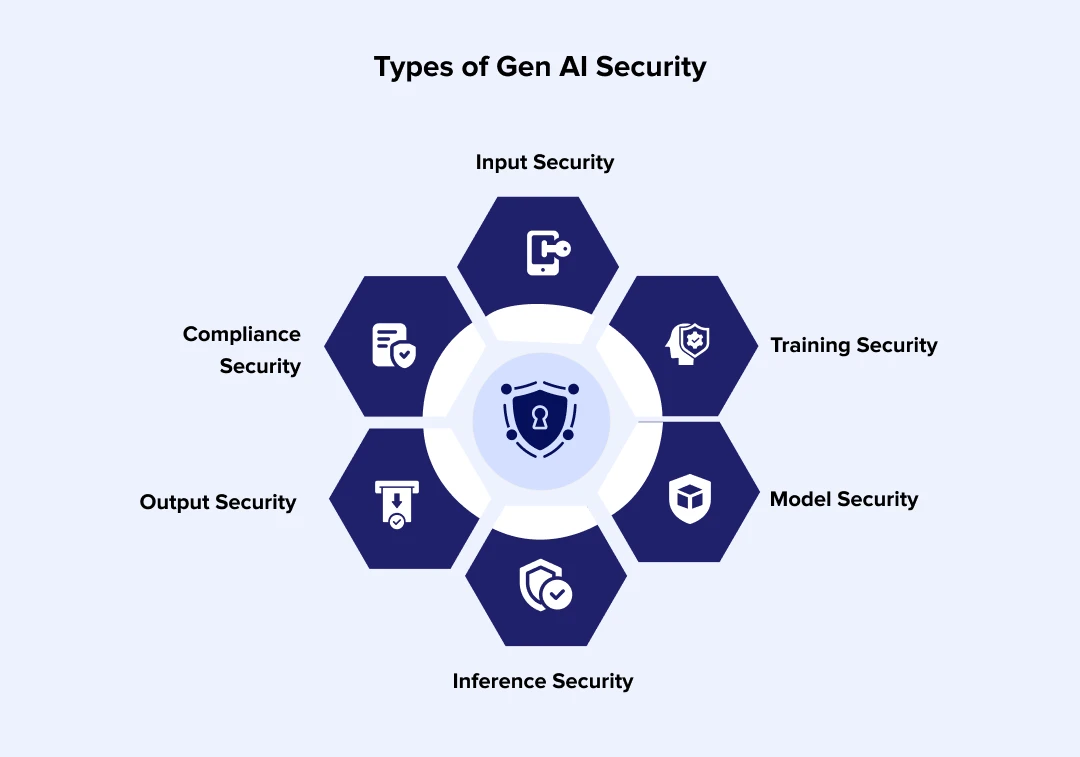
1. Input Security
Input security focuses on controlling what enters AI systems. Organizations establish AI prompts with filtering mechanisms that block injection attempts and malicious instructions. For instance, banks processing loan applications through AI implement character limits and syntax validators, preventing code execution attempts. These input sanitization strips potentially harmful elements while preserving legitimate queries.
2. Training Security
Training security protects the model development process from security vulnerabilities. These procedures examine training sets for poisoned samples that could create security threats. For instance, healthcare organizations developing diagnostic AI verify medical image authenticity before inclusion in training pipelines.
3. Model Security
Model security safeguards the AI algorithms themselves from theft and manipulation. Watermarking techniques embed hidden signatures proving model ownership. Pharmaceutical companies researching drug interactions protect models through homomorphic encryption, allowing computation on encrypted models without exposing parameters. Regular integrity checks verify models haven't been tampered with during storage or deployment.
4. Inference Security
Inference security governs the prediction and generation phase when models process real requests. These runtime monitors evaluate each model decision for signs of adversarial manipulation. For example, retail companies using recommendation engines implement confidence thresholds, blocking outputs when certainty falls below acceptable levels.
5. Output Security
Output security controls what AI systems produce and share with users. Content filters scan generated text, images, and code for sensitive information leakage. For instance, legal firms using contract generation AI employ multi-stage review processes, checking for confidential data exposure. Fact-checking modules verify claims against trusted databases before releasing responses.
6. Compliance Security
Compliance security ensures AI operations meet regulatory requirements across jurisdictions. Thus, audit mechanisms document model decisions for regulatory review. Additionally, data residency controls keep information within required geographical boundaries, and privacy-preserving techniques satisfy data protection regulations while maintaining model utility. Regular assessments verify ongoing compliance as regulations evolve.
What are Some Frameworks and Principles That Can Help Secure GenAI?
Organizations navigating the complex landscape of generative AI security can use established frameworks and emerging standards specifically tailored for AI risks. These guidelines provide structured methodologies for identifying vulnerabilities and implementing comprehensive protective measures.
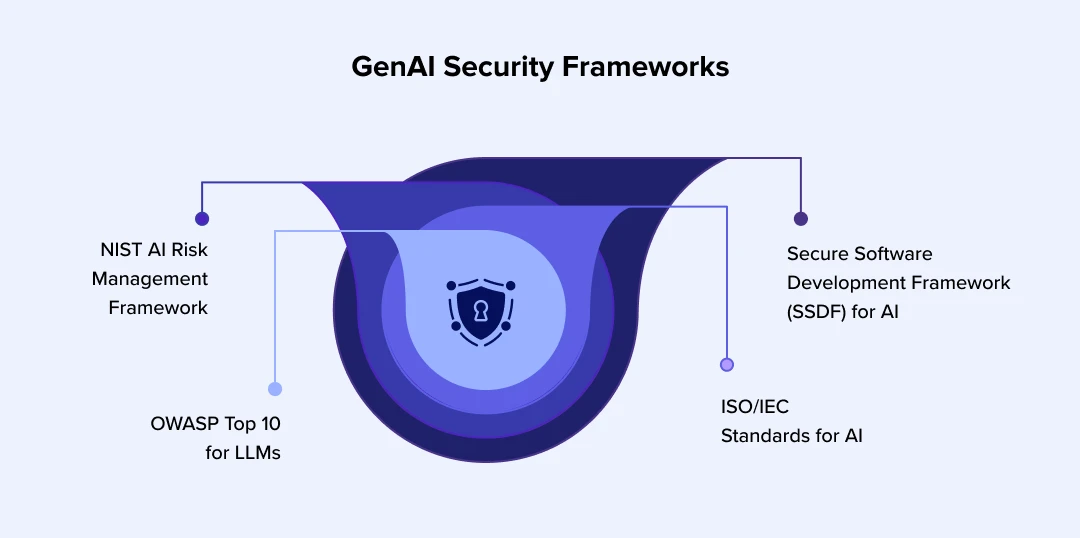
1. NIST AI Risk Management Framework
The National Institute of Standards and Technology released its AI Risk Management Framework with a dedicated Generative AI Profile in July 2024. It specifically addresses risks like hallucinations, content moderation failures, and model extraction attempts.
The framework operates through four core functions: governing AI programs through policies, mapping risks across technical and societal dimensions, measuring impacts quantitatively, and managing risks through targeted controls.
Organizations implementing NIST guidelines maintain model inventories, establish performance thresholds, and create fallback procedures for system failures. Manufacturing companies report that the framework's continuous risk assessment reveals vulnerabilities that technical teams previously overlooked.
Though voluntary, the framework has gained significant traction, with enterprises increasingly asked by partners whether they follow NIST AI RMF principles.
2. OWASP Top 10 for LLMs
The Open Web Application Security Project adapted its security expertise for large language models, creating a specialized framework that addresses conversational AI vulnerabilities. Released initially in 2023 and updated through 2024 and 2026, this framework identifies critical risks, including prompt injection, training data poisoning, supply chain vulnerabilities, and sensitive information disclosure.
Healthcare organizations implementing OWASP guidelines use its testing methodologies to verify that diagnostic AI cannot reveal patient records through crafted queries. The framework provides practical code examples and mitigation strategies, making it particularly valuable for development teams building applications for implementing AI in healthcare.
3. ISO/IEC Standards for AI
International standards establish baseline security requirements across global operations. ISO/IEC 23053 defines terminology ensuring organizations share a common understanding of AI risks. ISO/IEC 23894 provides risk management guidance specifically for machine learning applications. The newer ISO/IEC 42001, launched as the first certifiable AI management standard, gained prominence when Anthropic achieved certification in January 2026.
European companies pursuing certification demonstrate compliance through documented security controls, regular audits, and comprehensive governance structures. This certification provides competitive advantages, particularly for organizations bidding on government contracts requiring demonstrated AI security maturity.
4. Secure Software Development Framework (SSDF) for AI
NIST released SP 800-218A in 2024, augmenting its Secure Software Development Framework with AI-specific practices. This profile adds recommendations for model development throughout software lifecycles, addressing unique challenges like reward model separation and weight protection.
Software development companies often implement requirements such as storing reward models separately from AI models, permitting only indirect access to model weights, and performing all development within approved environments. The framework emphasizes protecting training, testing, and alignment data from unauthorized modification.

GenAI Security Best Practices
Organizations deploying generative AI must establish comprehensive security best practices that address the technology's unique challenges. These best practices for GenAI security governance extend beyond conventional cybersecurity measures to encompass AI-specific vulnerabilities and regulatory requirements.
1. Inventory and Visibility
You can begin by prioritizing the AI Bill of Materials (AI-BOM) that documents every component within AI systems, from training datasets to third-party libraries. Financial institutions maintain AI-BOMs that track model lineage, enabling rapid vulnerability assessment when security flaws surface in upstream components. This documentation proves invaluable during regulatory audits and incident investigations.
Next, you can start by mapping data flows and dependencies. It reveals how information moves through AI pipelines. These maps identify critical junctures where security controls provide maximum protection. Here, dependencies on external APIs, cloud services, and open-source frameworks get catalogued systematically, highlighting potential breach points.
2. Access and Identity Controls
You should also implement Zero-trust security. It treats every interaction skeptically, requiring continuous verification regardless of source. Healthcare providers implementing diagnostic AI authenticate each component connection, preventing threats from accessing broader systems.
Also, role-based access and monitoring restrict model interactions based on business necessity. For instance, engineers receive training environment access while customer service representatives query production models within defined parameters. Organizations can further strengthen protection by implementing mandatory access control policies that enforce strict permissions across AI systems and data repositories. Also, activity logs capture who accessed which models, what queries they submitted, and what outputs resulted, and any anomalous usage patterns trigger immediate alerts.
3. Data Protection and Privacy
Encryption, anonymization, and input sanitization form defensive barriers around sensitive information. For example, manufacturing companies encrypt training data at rest while anonymizing employee records used for workforce optimization models. Further, input sanitization strips SQL commands, script tags, and other potentially executable content from user queries.
Next, data minimization reduces attacks by limiting information collection to essential elements. For example, insurance companies' training risk models exclude unnecessary personal details, retaining only relevant factors. This practice enhances privacy compliance and reduces data breaches.
4. Secure Development and Deployment
Secure coding practices adopted by the best AI development companies prevent common vulnerabilities. Development teams validate all user inputs, implement proper error handling, and avoid hardcoded credentials in model serving code. Additionally, version control systems track changes across model iterations, configuration files, and deployment scripts.
Continuous monitoring and vulnerability management maintain security throughout model lifecycles. Pharmaceutical companies researching drug interactions scan AI components weekly for known vulnerabilities.
5. Incident Response Planning
AI-specific response playbooks guide teams through breach scenarios unique to machine learning systems. When detecting model poisoning, playbooks specify rollback procedures, data validation steps, and retraining requirements. Telecommunications companies maintain separate runbooks for data breaches, model theft, and output manipulation incidents.
Automation in detection and response accelerates threat mitigation. Security orchestration platforms automatically isolate compromised models, restore clean versions, and redirect traffic to backup systems. Alert correlation engines are also able to distinguish genuine threats from false positives, preventing alert fatigue among security teams.
6. Compliance Management
Regulatory mapping and technical controls align AI operations with legal requirements. European operations implement GDPR-compliant data handling, while American deployments comply with state-specific privacy laws.
Documentation and audits demonstrate regulatory compliance through comprehensive record-keeping. Organizations maintain training data inventories, model decision logs, and bias testing results. Also, quarterly audits verify controls remain effective, and documentation stays current.
7. Specialized Tools and Solutions
AI Security Posture Management (AI-SPM) tools provide centralized visibility across AI deployments. These platforms' inventory models track vulnerabilities and enforce security policies consistently.
Continuous monitoring and automated remediation maintain security without manual intervention. Monitoring agents detect configuration drift, unauthorized modifications, and performance anomalies. An automated remediation then reverts unauthorized changes, patches vulnerabilities, and adjusts access controls based on risk scores.
Challenges and Future Directions For Gen AI Security
The security landscape for generative AI presents persistent obstacles while new protective technologies emerge. Organizations must navigate current difficulties through generative AI and security while preparing for evolving threats.
1. Ongoing Difficulties
- AI still lacks transparency and explainability, creating fundamental security challenges. They’re still non-transparent and cannot fully explain why applications get rejected when models process millions of parameters.
- Ethical use challenges compound security risks in unexpected ways. Marketing firms have discovered that their AI produces culturally insensitive content despite extensive filtering, creating legal exposure and reputational damage.
2. The Importance of Human Oversight
Human judgment proves irreplaceable despite advancing automation. Security analysts use contextual understanding to distinguish real threats from false positives. For instance, it’s always the legal professionals who catch dangerous loopholes in AI-generated contracts that automated systems miss.
Organizations still require human approval for critical AI decisions and report fewer security incidents. However, finding personnel with combined AI and security expertise remains challenging. Traditional cybersecurity skills alone cannot defend machine learning systems effectively.
Leading Generative AI Tools for Security Operations
Generative AI is transforming how security teams detect threats, respond to incidents, and manage vulnerabilities. Here's a breakdown of key tools and their primary use cases:
| Tool/Platform | Primary Use Cases | Key Capabilities |
|---|---|---|
| Microsoft Security Copilot | Incident response, threat hunting, security reporting | Analyzes security alerts, generates incident summaries, provides remediation guidance, and automates threat investigation workflows |
| Google SecLM (Security Large Language Model) | Threat intelligence analysis, malware detection | Identifies malicious code patterns, analyzes threat intelligence reports, and detects zero-day vulnerabilities in real-time |
| Darktrace AI Analyst | Autonomous threat detection, incident investigation | Generates natural language explanations of security events, automates initial triage, and prioritizes alerts based on severity |
| CrowdStrike Charlotte AI | Threat detection, vulnerability management | Provides conversational security insights, assists in policy creation, accelerates threat response through natural language queries |
| IBM Watsonx Code Assistant for Red Hat Ansible | Security automation, policy enforcement | Generates security playbooks, automates compliance checks, and creates incident response scripts |
Anticipated Trends in Generative AI Security
The next decade will witness fundamental shifts in how organizations protect AI systems. The AI in the Security Market is expected to reach $86.34 billion by 2030 at a CAGR of 22.8% from 2026 to 2030, and these emerging trends will reshape security strategies across industries:
- AI-powered defense systems: Security vendors are developing AI systems specifically designed to protect other AI deployments, where defensive models must evolve as rapidly as attack methods. These automated defense systems already demonstrate superior detection rates for novel threats that traditional rule-based security cannot identify.
- Mandatory security certifications: Governments worldwide are transitioning from broad ethical guidelines to enforceable technical standards, with critical sectors like healthcare and finance facing mandatory security certifications for AI deployments.
- Federated security approaches: Organizations are pioneering federated security approaches that enable competitors to share threat intelligence without compromising proprietary data. They will use blockchain technology to create tamper-proof audit trails across company boundaries.
- Quantum computing impact: The advent of quantum computing introduces both unprecedented risks and opportunities. This will potentially break current encryption methods protecting model parameters while enabling the detection of vulnerabilities invisible to classical computing.
Moving forward, this shift transforms AI security from a specialized technical concern into a fundamental business infrastructure.
Conclusion
The rush to adopt generative AI has created a security paradox. Companies pour millions into AI capabilities while their security teams scramble to catch up with threats they barely understand. A single poisoned model can turn your competitive advantage into a corporate nightmare overnight.
The frameworks, like NIST Risk Management, and practices like identity control and data protection, are survival tools for businesses navigating uncharted territory. So, it’s important for you to build generative AI security into your foundation now, while systems remain manageable. Most importantly, the companies investing in proper defenses will define the next era of business innovation.
Frequently Asked Questions
What are the security risks of generative AI?
The primary risks include model poisoning, where attackers corrupt training data, and prompt injection attacks that manipulate outputs. Moreover, data leakage exposes confidential information from training sets, deepfake generation for fraud, and intellectual property theft through model extraction techniques.
What is the difference between GenAI and cybersecurity?
Cybersecurity protects networks, systems, and data from digital attacks. GenAI security specifically addresses AI model vulnerabilities, training data integrity, and output control. Traditional firewalls can't stop someone from poisoning your training dataset or extracting your model through repeated queries.
How can organizations detect if their AI models have been compromised?
Watch for performance degradation, unexpected outputs, or unusual query patterns. Security teams monitor confidence scores dropping below thresholds, outputs deviating from baseline behaviors, and access logs showing repetitive identical queries that suggest extraction attempts.
What budget should companies allocate for AI security?
Industry benchmarks suggest 15-20% of total AI investment should address security. A company spending $1 million on AI development typically needs $150,000-$200,000 for security tools, training, and monitoring. Costs vary based on data sensitivity and regulatory requirements.
Can existing security teams handle AI threats without specialized training?
Not effectively, as AI security requires understanding model architectures, training pipelines, and attack vectors unique to machine learning, companies report security incidents dropping to a certain extent after training teams on AI-specific threats versus relying solely on traditional cybersecurity expertise.

Uncover executable insights, extensive research, and expert opinions in one place.
Related Content