Share It On:
 Your choice of an e-commerce developer is the difference between a static storefront and a high-performance engine built for the future of global shopping. This guide reveals the roadmap for finding the right ecommerce app development company.
The global e-commerce market is projected to reach $77.58 trillion by 2031 from $36.21 trillion in 2026, according to Mordor Intelligence. That's a massive opportunity, but here's what most business leaders don't talk about: many companies won't capitalize on it, not because their strategy was wrong, but because they picked the wrong development partner.
The rules of e-commerce have changed. Shoppers expect mobile-first experiences, AI-powered recommendations, and checkout flows that don't make them think twice. Building for that isn't a simple coding job; it's a complex, high-stakes system that has to work for real customers and the AI tools quietly influencing their decisions at the same time.
And if the team you hire doesn't understand that? You're not just looking at delays. You're looking at an app that breaks under pressure, can't scale, and falls behind competitors before it even finds its footing. That's an expensive mistake to undo.
Most comparison guides will point you to portfolios and pricing tables. But the things that actually make or break a development partnership are rarely that visible. This guide is about finding those parameters, so you can make the right call before it costs you.
Let's begin!
How to Choose an Ecommerce App Development Company
Understanding how to select ecommerce app developers is a multi-phase process that begins with internal alignment and ends with a technical "trial marriage." Below are the critical steps to ensure your investment delivers high-yield returns.
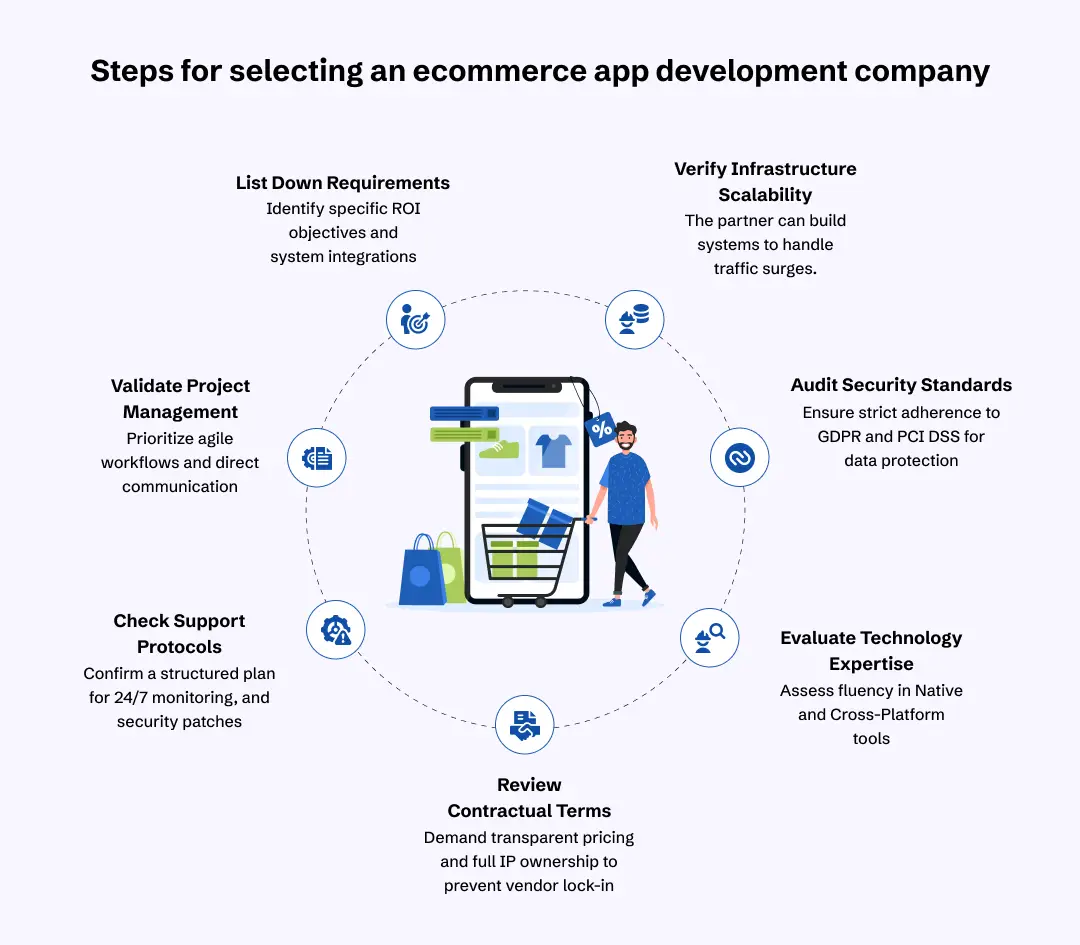
1. Identify Your Project Requirements
Before interviewing candidates, use this ecommerce app development guide to clarify your technical priorities. This ensures you select a partner based on their ability to handle your specific business logic, not a generic portfolio.
- Focus on ROI Objectives: Identify a company that excels in high-leverage growth drivers such as AI-powered app personalization and one-tap wallet integration. According to a McKinsey report, AI-powered experiences can increase customer satisfaction by 15 to 20 percent. Your developer should demonstrate their ability to use these tools to reduce checkout friction and increase sales.
- Evaluate Phased Scalability: Your developer should demonstrate that they can successfully walk this line of a stable Minimum Viable Product (MVP) and trending features. By staying on top of emerging ecommerce app development trends, they will be able to grow your app from a basic inventory-syncing level to a future state that uses AR/VR and AI-powered agents.
- Audit Integration Expertise: Your developer should demonstrate expertise in integrating your mobile app with existing ERP, CRM, and 3PL logistics systems. API integration is key to a seamless, timely data flow across all your retail operations.
2. Review Portfolio for Scalability
Commerce is moving from human clicks to machine-driven transactions. McKinsey research indicates that this shift toward agentic commerce could generate up to $1 trillion in projected US retail revenue and $3 trillion to $5 trillion globally by 2030.
A viable partner must show they can build the infrastructure required for this transition. Ask for evidence of platforms that maintained speed while scaling to meet complex, data-heavy requirements. Choosing a developer who has already mastered these high-volume, automated environments ensures your business is ready for the trillion-dollar growth in autonomous buying.
This readiness depends on a partner who moves beyond generic templates to implement a modular or "composable" architecture. Preserving uptime during modifications is possible if software engineers manage search and checkout functions as separate, independent units. Such a strategy allows adjustment of specific components without jeopardizing the health of the entire software environment.
This flexible, repeatable ecommerce app development process enables quick adjustments based on live consumer data. It also functions to verify that growth into new territories or payment gateways remains viable.
3. Check for Compliance
The firm you hire should ensure that GDPR and PCI DSS mastery is embedded directly within its architecture when creating an ecommerce mobile application. It is critical to prioritize firms that have automated and implemented auditing directly within the application, as this is a critical component of ensuring your business is not at risk of catastrophic fines or even closure in a high-stakes environment such as ecommerce.
This foundational component of compliance must be extended to the application's data-sharing protocols and session management. In a world of high-velocity commerce, it is critical to ensure that end-to-end encryption is implemented so that data is not at "rest" on any given device.
Identifying and neutralizing potential security violations or legal alignment gaps occurs instantly once automated logging and anomaly detection are fully integrated into the system architecture. Verifying that your mobile platform remains a safe fortress is achieved through this proactive approach, regardless of how legal rules evolve. Managing massive, ongoing sales while maintaining consumer confidence and legal compliance is made possible by this protection.
4. Evaluate the Technology Stack
A developer’s value lies in their ability to select the right tool to create an ecommerce app rather than forcing every project into one framework. Your partner must be fluent in multiple mobile app development frameworks and paths, knowing when a Native build is required for power, when Cross-Platform tools are better for speed, and how Headless systems keep your brand flexible.
This versatility ensures they architect a custom engine tailored to your specific traffic and growth needs.
The Ecommerce Mobile App Development Technology Stack
The following represents a tentative technology stack; specific project requirements may necessitate adjustments to these recommendations.
| Component | The Choice | Why Your Partner Needs This Knowledge |
|---|---|---|
| System Flexibility | Headless Architecture (e.g., Shopify Hydrogen) | A partner who masters this can update your app’s interface instantly without touching the core logic. It allows for rapid design pivots without the risk of system crashes. |
| App Performance | Flutter or React Native | A partner skilled in these frameworks ensures near-native responsiveness and efficient resource management. They optimize the interaction between code and hardware to maintain system stability and speed across varying network conditions. |
| Scaling Capacity | Serverless Backend (e.g., Node.js or Go) | This knowledge is vital for surviving surges. A Serverless setup automatically expands to handle millions of shoppers and shrinks when quiet, so you never overpay for power. |
| Core Power | Native (Swift / Kotlin) | For high-performance needs like AR or complex 3D visuals, your partner must know when to switch to native code to extract maximum speed from the phone’s hardware. |

5. Look for Suitable Locations
Overall project expenses, production speed, and how well teams exchange information are all governed by the geographic location of the engineers. Deciding on this placement is a fundamental step that shapes the whole venture. Use these five criteria to determine which global hub hosting the best ecommerce app development companies best serves your business objectives:
- Competitive Advantage: Ecommerce app development companies in India offer a strategic edge for businesses prioritizing budget without sacrificing quality. With the Indian e-commerce market projected to grow at a 19.6% CAGR by 2030, this rapid expansion has created a massive pool of high-tier talent. Choosing a partner here provides access to world-class expertise at a fraction of Western development costs.
- Timezone Synchronicity: It is vital for real-time collaboration and rapid feedback loops. For example, if your business operates in the Asia-Pacific region, you should prioritize ecommerce app development companies in Australia to ensure alignment with daylight hours and seamless communication during standard business hours.
- Geographic Proximity: If you operate your business in nearby markets such as Ireland, France, or Belgium, partnering with an ecommerce app development company in London offers a perfect balance of proximity and high-tier expertise.
- Regulatory Compliance: European markets demand strict data sovereignty. Selecting ecommerce app development companies in Germany ensures your app architecture is built natively for GDPR and EU financial regulations, protecting your business from legal friction and privacy breaches.
- Specialized Technical Skillsets: The US market, which generated USD 7,168.8 million in 2023 and is expected to reach USD 19,380.4 million by 2030, hosts an ecosystem of ecommerce app development companies in the USA with the deepest expertise in AI-native architecture and next-gen spatial commerce tools necessary for a dominant market edge.
6. Evaluate Pricing Transparency and Partnership Terms
A vague proposal is a trap. If you want this partnership to be financially sustainable—and legally bulletproof—you have to scrutinize exactly how a developer handles pricing and ownership before signing anything. Here is our unvarnished framework for testing their transparency and long-term flexibility.
- Transparent cost breakdowns: A single, opaque lump sum is a massive red flag. You should look for highly granular, line-item quotes that drag hidden expenses into the light—specifically API fees, cloud storage buckets, and third-party security audits.
- Adaptive engagement models: One size rarely fits all. The agency should offer true contract fluidity: fixed-price agreements when your targets are carved in stone, or time-and-materials billing for those highly fluid, evolving project workflows.
- Guaranteed IP ownership: This is non-negotiable. From day one, every shred of documentation must explicitly grant your firm absolute ownership of the source code and all project assets. Vendor lock-in is a rookie mistake; you shouldn't make it.
- Structured maintenance expectations: What is their exact post-launch survival plan? Typically, you need them to budget 15% to 25% of the initial build cost annually. That is the baseline just to keep the lights on, the app secure, and the system functional.
- Scalability and third-party clarity: When your user base spikes, what happens to the invoice? A reliable developer will clearly demonstrate how base infrastructure costs and external service fees (like AI processing or third-party messaging tools) will inevitably shift as your platform scales.
7. Proactive Support and Maintenance
Hitting "publish" on the app store is merely the starting line. True long-term success requires an agency that doesn't just walk away, but actively delivers a structured, aggressive plan for sustaining system speed and locking down security over the long haul.
- Constant System Monitoring: Catch the fire before it spreads. We favor partners deploying 24/7 monitoring hardware. The whole point is to flag server errors and performance lags long before a user ever complains. When technical teams catch anomalies early, neutralizing those glitches becomes a routine chore rather than a midnight crisis.
- Regular OS Compatibility: Google and Apple relentlessly update their software. Developers have to rigorously test and tweak our codebase so it never breaks on new hardware. That constant technical alignment is the only way you keep customer satisfaction consistently high.
- Rapid Security Fixes: Digital risks evolve daily, and your response needs to be faster. To truly protect user data and maintain our legal compliance, your partner must slam shut vulnerabilities with immediate security patches the second a threat hits the radar.
- Performance Refinement: Growth usually breeds sluggishness. To prevent the app from choking under the weight of a massive user base, an elite partner runs routine database and backend optimizations. You need the architecture fine-tuned to handle the blistering demands of modern 6G networks.
- Iterative Feature Growth: You can't rely on guesswork. The right firm digs into actual user data and live feedback to steer a cycle of small, rapid-fire updates. That iterative hustle keeps the mobile product sharp and fiercely competitive long after launch day.
- Predictable Maintenance Costs: Look for a partner that offers a transparent, tiered app maintenance cost breakdown (typically 15–20% of initial development costs annually) to prevent budget surprises as the app scales.
8. Review Communication and Project Management
Success relies on a partner that develop an ecommerce app through a transparent, flexible mobile app development process. The right firm moves beyond old-school planning to ensure your mobile app stays on track during complex builds.
- Transparent Communication Channels: Choose a partner who provides direct access to their project tracking tools. This visibility allows you to see daily progress and prevents delays. Real-time updates ensure that everyone stays aligned on the project goals.
- Structured Milestone Delivery: Selection of a firm that breaks the project into small, usable parts is necessary. This method lets you test specific features early in the process. It ensures the final product meets your standards through constant feedback.
- Dedicated Product Ownership: A qualified partner assigns a specific lead to manage your project from start to finish. This person acts as the bridge between your business needs and the technical team. This single point of contact (SPOC) simplifies decision-making and reduces confusion.
- Risk Mitigation Strategies: The right firm identifies potential technical or timeline risks before they happen. They create backup plans to handle staffing changes or software conflicts. Proactive planning of this kind keeps the launch date secure.
- Data-Driven Reporting: Prioritize developers who provide weekly reports on budget usage and time spent. Understanding exactly how resources are applied helps you make smart financial choices. This honesty builds a stronger, more reliable partnership.
|
Turn your e-commerce app into your most powerful asset. Partner with top-rated e-commerce mobile app development companies to build your next project. |
Strategic Red Flags to Avoid When Choosing Your Ecommerce App Development Partner
Protection of your investment from vendor failure occurs when you recognize early warning signs. Evaluation of potential partners for specific behaviors that show a high risk of project collapse is required. These are some red flags you need to keep an eye out for when finding the right ecommerce app development company:
- Excessive Agreement Without Pushback: Teams that accept every request without questioning the logic must be avoided. Business outcomes succeed when true experts challenge assumptions and flag technical risks early.
- Vague Milestone Definitions: Major risks exist in proposals that lack specific dates and clear deliverables. High-quality firms provide roadmaps with verifiable checkpoints because vague language often leads to scope creep and financial disputes.
- Restricted Technical Transparency: Partners must provide immediate access to source code and management tools. Delays or poor quality are often hidden by a black-box approach, where daily progress remains unseen. You need to ensure a timeline is clearly defined in the agreement you sign with them.
- Unrealistic Financial and Time Estimates: Future change orders are often hidden in quotes that are significantly lower than the market average. Testing and security protocols are usually ignored when firms promise impossible launch dates.
- Inadequate Post-Launch Strategy: Firms focusing only on the build phase should be avoided. An application becomes vulnerable to future technical debt if a partner lacks a clear plan for updates and maintenance.
- Lack of Documentation Standards: Failure to provide clear technical documentation is a red flag. Transitioning to a new team becomes nearly impossible and expensive without detailed records of the code and architecture.
Criteria for Choosing an Ecommerce App Development Company
Locating a firm to build your online retail app involves much more than finding someone who writes code. You must identify a visionary ally who understands your organization's distinct trajectory. Assessment of prospective firms for engineering suitability and future expansion potential should be done using these eight standards.
- Strategic Advisory Capability: Guiding the brand through growth obstacles and changing sector patterns is the primary function of an agency.
- Business Model Compatibility: Proficiency in your operational framework is vital, whether you run a B2C, B2B, D2C, or marketplace business, or a subscription commerce entity.
- Target Market Alignment: Tailoring the app to your exact geographic location, local payment methods, and regional transaction tools requires a proven track record of success.
- Mobile Commerce Strategy Fit: Aligning with your corporate goals through a creation logic that ranges from conversion optimization to omnichannel retail is a key requirement.
- Innovation Capability: Possessing the engineering skills to put new technologies like AI recommendations and immersive shopping into practice defines a top-tier firm.
- Product Thinking Approach: Providing input for high-level plans and consumer interactions takes priority over simply completing basic programming or development tasks.
- Long-Term Partnership Potential: Sustaining consistent software advancement and enduring stability requires finding an ally built for lasting professional bonds.
Conclusion
Selecting the right ecommerce developer is a high-stakes decision that determines whether your platform becomes a scalable asset or a technical liability. To ensure long-term success, your evaluation must prioritize modular or "composable" architectures over rigid templates, ensuring your app can adapt to unique business logic and the rise of automated commerce without system-wide failures.
Beyond the build, a viable partner must demonstrate technical versatility by knowing exactly when to deploy cross-platform tools for speed versus native code for high-performance features like AR or complex 3D visuals.
Strategic success also requires total financial and legal transparency from day one. You should move beyond the initial quote to secure full IP ownership and establish a structured maintenance plan to prevent vendor lock-in and unexpected scaling fees.
Ultimately, the most valuable firms act as strategic advisors rather than mere order-takers, challenging your assumptions and ensuring your mobile ecosystem integrates seamlessly with your existing ERP, CRM, and logistics networks to serve as your primary competitive advantage.
Frequently Asked Questions
How should I judge the technical competency when I compare ecommerce app development companies?
Review of their previous work with Headless Architecture and API-first designs is a priority. Technical skills are proven when a developer explains their specific methods for handling security and server load balancing. You should ask for a code sample or a technical audit of their past work to ensure their engineering meets current market standards.
What specific details should I look for when checking companies' references for my ecommerce app development project?
Direct feedback from past clients provides the most honest insights during the vetting process. You should ask these references how the team handled unexpected bugs or missed deadlines. Reliability is demonstrated when a firm admits past mistakes and explains the specific steps it took to fix them.
How can I tell if a development company’s project management style matches my business?
Immediate access to real-time tools like Jira or Trello should be a requirement for any partner you hire. If a developer provides weekly reports and daily updates, their management is likely thorough and honest. A fit exists when their communication speed and reporting style align with your internal team's needs.
Why is a paid discovery phase a better evaluation tool than a free proposal when evaluating potential app development agencies for my ecommerce project?
When you plan to hire an ecommerce app development team, starting with a small project helps you test the partnership without a large financial risk. This period shows if the developer understands your business goals and meets your quality standards in a real-world setting. Because this phase is low-cost, it acts as a final filter before you sign a full contract for the entire build.
How do I evaluate if an app development company can handle my ecommerce application's future growth?
Capacity for growth is confirmed by checking their experience with cloud-native builds and modular code. You should look for firms that use independent components that can expand as user traffic increases. A developer who plans for your success will discuss server limits and performance testing during your very first meeting.
What are the key factors to consider when choosing an ecommerce app development team?
Finding a suitable collaborator needs a mix of engineering talent and business alignment. Past work with headless architecture and the ability to integrate intricate ERP/CRM systems must be prioritized.
Furthermore, building expandable software that manages heavy user volumes is a vital trait to look for. Openness about intellectual property rights and legal safety rules, such as the GDPR, is another area for careful review. A vision for lasting assistance and a clear upkeep method are also mandatory.
What are the top tips for choosing an ecommerce app development firm?
To secure a high-performance partner, you should audit their technical logic via a code review of their past headless architectures, verify their mobile-first expertise in biometric security and one-tap checkouts, and review their maintenance SLAs for 24/7 server monitoring.

Uncover executable insights, extensive research, and expert opinions in one place.
Related Content