Share It On:
 If your brand isn’t showing up when customers are searching, you’re handing ready-to-buy traffic straight to competitors. Search engine marketing is where demand already exists; the question is whether you’re capturing it or missing out.
Google processes over 16 billion searches per day and most clicks go directly to the first three results. When you are not in these spots, you are virtually out of sight to your audience. Search Engine Marketing (SEM) is your VIP ticket to the first position of SERP, providing a straight-forward journey to high-intent customers who are willing to make purchases.
However, it is also the quickest means of wasting your marketing money unless you have a strategic execution plan. This search engine marketing guide can give you the rundown of how the auction model works and how to create a watertight strategy.
From winning bids to maximizing ROI, this search engine marketing guide gives you a clear roadmap to reaching high-intent users.”
What is SEM in Digital Marketing?
Search Engine Marketing (SEM) is a type of digital advertising that is paid, where companies bid on keywords to have their ads appear at the top of the search engine results page (SERP). As opposed to organic traffic approaches, SEM places your brand in front of high-intended users as they actively search for products or services similar to yours.
To understand what is SEM in digital marketing with examples, think of how ads appear instantly when users search for products like running shoes or insurance services.
For instance, when a customer enters the search query "best running shoe under 3000" into Google, an auction is conducted in the background. All this happens in less than a few milliseconds. The advertisers who have won a bid on relevant keywords compete, and the winners are shown at the very top: usually even before any organic listing.
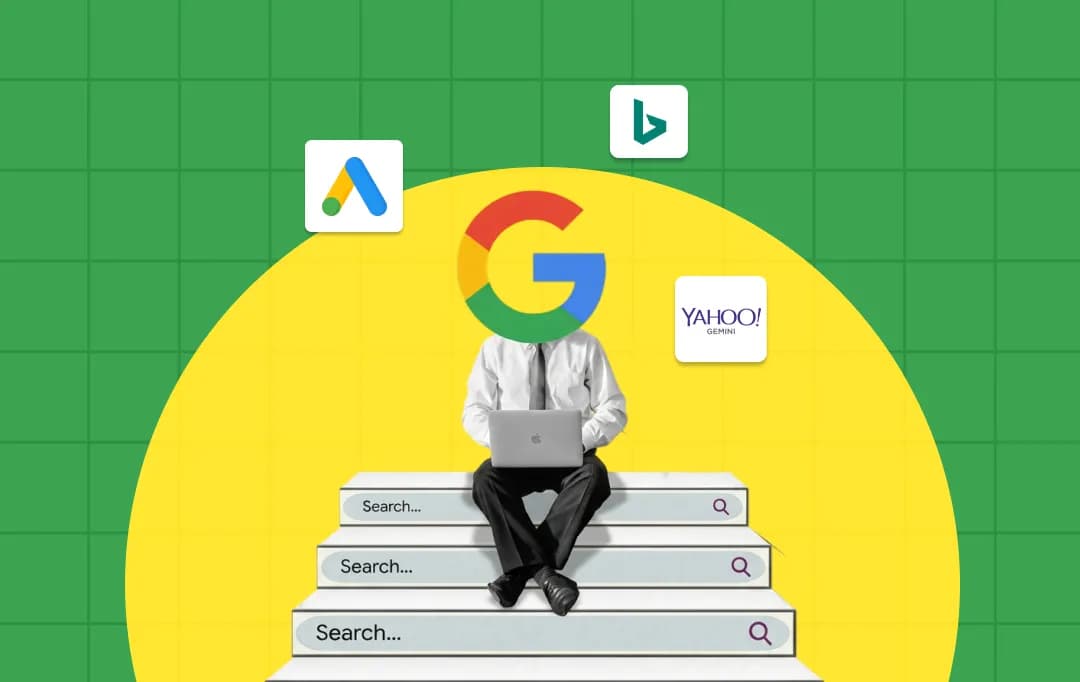
SEM is also referred to as Pay-Per-Click (PPC) advertising. The key platforms are:
- Google Ads -The biggest player that has the highest volume of search all over the world.
- Microsoft Advertising ( Bing Ads ) - Smaller but typically lower CPCs.
- Yahoo Gemini - This is especially applicable to some demographics.
Before diving deeper, if you're new to advertising concepts altogether, brushing up on the fundamentals of marketing will give you a stronger foundation for understanding where SEM fits in the broader landscape.
What is the significance of SEM in Marketing?
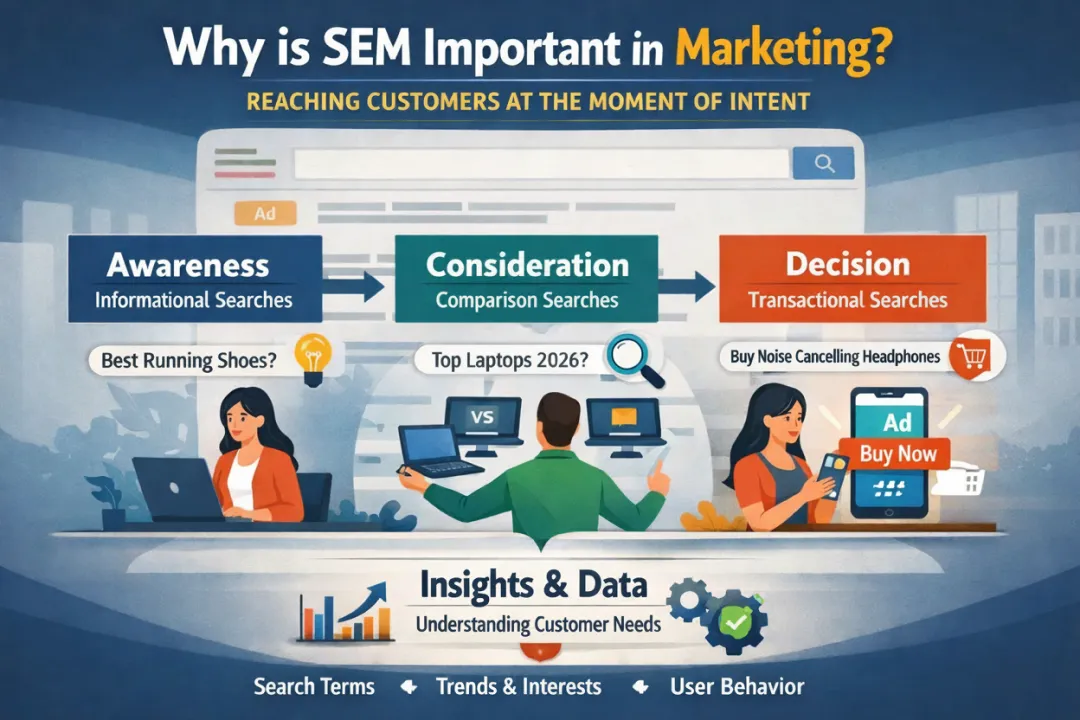
Why is SEM important in marketing, more than merely getting clicks? Since it is at the point of both intent and reach.
Each SEM campaign links your offer with a user at the specific moment when they are stating a need. It is essentially unlike social media advertisements that cut in between people as they scroll. These ads appear in the middle of the purchase process, when a buyer is most receptive.
The contribution of search engines in digital marketing has increased tremendously. Today, search is involved in each phase of the funnel: awareness (informational searches), consideration (comparison searches), and decision (transactional searches). A sound SEM campaign addresses the three.
Furthermore, SEM marketing campaign data is not only invaluable when it comes to the advertisements. The search term reports tell you what your customers actually search, what product features they are interested in, and what problem they are attempting to resolve, which you can use to drive your content, product, and the overall importance of search engine marketing.
How Does SEM Work in Marketing?
To begin with, the key to the functioning of SEM is the keyword auction. Every time a user enters a search query, an automated real-time auction determines which ads show, in what order, and at what cost. Here's how search engine marketing works step by step:
1. Keyword Research & Selection
Advertisers select keywords, the search terms they desire their advertisements to be activated by. These can be:
- Broad match: Triggers of loosely related queries.
- Phrase match: Matches when the phrase is found in the query.
- Precise match: Matches that query only.
2. Ad Creation
In search engine marketing, advertisements are composed in a way that makes them persuasive, pertinent and congruent to a landing page. A typical Google Search Ad consists of a headline (with up to 3 parts), a display URL and description.
3. Bidding
You establish a top CPC (cost-per-click) - the highest price you can pay when someone clicks on your ad. This means that your ad can still appear in front of your target audience without incurring any cost unless they actively engage with it. So you’re not just paying for clicks but also gaining visibility, recall, and brand familiarity every time your ad is shown.
4. Quality Score
Google doesn't just reward the highest bidder. It measures Quality Score, which is a rating based on:
- Foreseen click-through rate (CTR)
- Ad relevance to the keyword
- Landing page experience
A higher Quality Score can lower your actual CPC and improve your ad position, helping you get better results without necessarily increasing your bid.
5. Ad Rank & Placement
Your Ad Rank = Bid × Quality Score × Expected Impact of Ad Extensions. A quality ad with a low bid may be ranked higher than a bad quality ad with a high bid - this is wonderful news to small businesses with limited budgets.
To sum it up, it is pretty easy to get familiar with the SEM world, as long as you get the basics right.
What is the Difference Between S.E.M. and S.E.O?
The debate is, is SEM better than SEO? It is one of the most popular questions in the field of digital marketing. The candid response is - it will depend on your objectives, time and costs.
| Factor | SEM | SEO |
|---|---|---|
| Speed of Results | Immediate | Months |
| Cost | Pay per click | Time/resource investment |
| Visibility | Guaranteed (paid) | Earned (organic) |
| Longevity | Stops when budget ends | Compounds over time |
| Click Trust | Lower (labeled "Ad") | Higher (organic) |
So, is SEM better than SEO? Absolutely. Introducing a new product, marketing a time-sensitive event, or exploring a new market - SEM provides immediate exposure. SEO establishes long term equity.

Creating an Effective Search Engine Marketing Strategy
A haphazard approach to SEM squanders resources. A successful search engine marketing plan is constructed on organization, information and constant optimization. These are the steps that search engine marketers take:
Step 1: Determine Your Objectives
Do you promote brand awareness, lead generation, eCommerce conversions, or app installs? It is your objective that will influence all the next choices you make, from keyword selection to bidding strategy to landing page design.
Step 2: Audience Research
Know your buyer. Which language do they speak? What is the purpose of their search? Are they in the research stage (what is SEM) or in the purchase stage (hire SEM agency)? Keywords Map: Search intent: informational, navigational, commercial, transactional.
Step 3: Keyword Strategy
A healthy sem strategy sets up keywords in narrowly themed Ad Groups. For example:
Ad Group 1: "online purchase of running shoes.
Ad Group 2: "best running shoes with flat feet"
Ad Group 3: "running shoes under ₹3000"
The groups must be provided with customized ad copy and landing pages. This improves Quality Score and decreases wasted spend.
Step 4: Compelling Ad Copy
Your advertisement has milliseconds to get the click. Use words that catch the attention of your target audience:
- Numbers and details ("Save 40% Today")
- Emotional appeal (Stop Losing Customers to Competitors)
- CLCL CTAs ("Get a Free Demo")
These are some examples of what actually works.
Step 5: Alignment of the Landing Page.
It is pointless to send traffic to your home page. Each ad must redirect to a special landing page, featuring a similar message and one conversion objective. This ensures a seamless user journey, increasing the chances of conversion by matching user intent from click to action.
Step 6: Conversion Tracking
Create Google Ads conversion goals and Google Tag Manager, so you can easily manage and deploy these tracking codes without manual code changes. Without tracking, you're flying blind.
Step 7: Optimize Continuously
SEM is never "set and forget." Review search term reports weekly, pause underperforming keywords, A/B test ad copy, and adjust bids based on device, time of day, and geography.
By combining a powerful SEM strategy with a variety of marketing tools, a complete funnel system can be formed to address demand at each buyer experience phase.
The Essential Benefits of SEM to Businesses
The benefits of SEM are tangible and measurable; this is what makes it one of the most potent instruments of a marketer:
1. Instant Visibility
SEM places you in the top of search results on Day 1 as opposed to SEO which may take 6-12 months to deliver results. The need for search engine marketing within time-sensitive campaigns cannot be overestimated. However, it is best to connect with the best SEO companies for your long-term goals.
2. Highly Targeted Reach
SEM has the option of targeting through keywords, location, language, device, time of day and even audience demographics. You are not shooting arrows in the dark, but at the right people at the right time.
3. Measurable ROI
Each click, impression and conversion is monitored. You know exactly how much you spend and the income you receive, so it is easy to justify the budget. This degree of responsibility is one of the key advantages of SEM that could not be found in traditional advertising.
4. Only Pay by Results
In PPC, you only pay when a person actually clicks on your advertisement. Thousands of impressions do not cost you anything when no one clicks, which is perfect in brand awareness campaigns.
5. Scalable and Flexible
Start with $10/day and scale to $1000/day when you find what works. Stop, start or re-optimize campaigns on the fly. SEM is the only ad format that provides such agility.
6. Competitive Advantage
The significance of SEM is made obvious when you realize that your competitors are doing the same. Losing out on paid search implies giving customers to competitors who appear when you do not.
7. Remarketing Capabilities
SEM platforms provide the ability to re-engage the visitors to your site. A customer who has viewed your pricing page is a hot prospect - remarketing advertisements will reintroduce them to make a purchase.
If you wish to reap these benefits, but are just starting out and feeling unsure, check out how small businesses can strategically get the most out of SEM.
SEM Plan of Strategy for Small Businesses
It’s just a myth that SEM is fruitful only to enterprise-level brands with ad budgets in the six figures. That is not the reality. It can be an incredibly low cost strategy when done in a disciplined manner.
The following is what a SEM strategy for a small business should be based on:
- Start Local: Limit your ads to your city, district or region with location targeting. A local bakery in Idaho does not have to compete with a national chain on the keyword “cakes” but it can saturate the market for “custom cakes in Idaho.”
- Utilize Long-Tail Keywords: Long-tail keywords such as “have lower competition, lower CPCs, and higher conversion rates than broad terms. They're the small business owner's best friend.
- Limit your Budget: You can begin with a very small budget of your liking, and only when you find profitable keywords can you raise that amount. You should not fall into the trap of investing in campaigns without the data informing you on what is working.
- Plan Smart: Schedule advertisements when you are working or at the optimum time of purchase. A restaurant that advertises lunch deals between 10 AM and 1 PM does not need to spend money on impressions at midnight.
- Leverage Ad Extensions: Call extensions, location extensions, and sitelink extensions make your ad larger and more informative at no extra cost. This is quite important when competing against larger brands.
Hiring seasoned digital marketing agencies may help in shortening your learning curve with regard to SEM, particularly when you are new in running campaigns.
How Much Does Search Engine Marketing Cost?
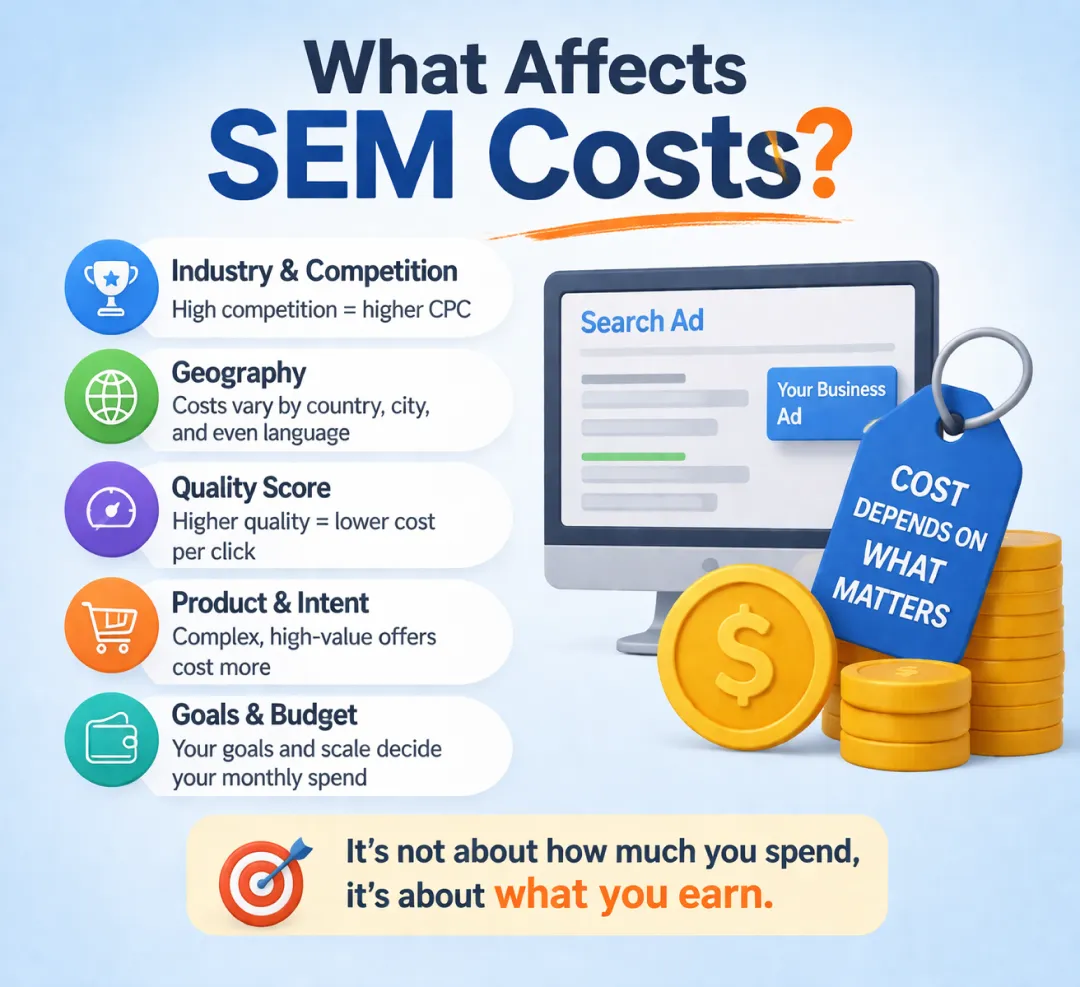
If you’re still wondering “how much does SEM cost?” there is no standard answer - it depends on industry, competition, geography, and Quality Score. But the following are realistic standards:
- Average CPC (global): Around $2.5 – $5+ per click for search ads
- Competitive industries (legal, finance, insurance): Can go $6 – $20+ per click
- E-commerce & retail: Typically $0.80 – $3 per click, depending on product and intent
- Monthly budget for SMBs: Roughly $200 – $5,000+, based on goals and scale
It’s less about how much SEM costs and more about what you earn from it. If your average customer brings in $120 and you acquire them for $4, that’s a strong return.
Conclusion: Unlocking Growth Through SEM
The importance of search engine marketing is reflected as more than a mere advertising strategy; it is a growth engine. It reduces the time gap between a customer's need and your brand's solution to milliseconds. It provides some of the best and most quantifiable returns of all the types of digital marketing, when constructed on the correct search engine marketing approach.
Be it a startup seeking its first 100 customers or a well-known brand seeking to regain lost grounds, the role of search engine marketing in the current competitive world cannot be compromised. Those businesses that get it right with SEM are getting a real-time flow of high-intent traffic - and that's a compounding benefit that only improves with time.
Frequently Asked Questions
What do you mean by a search engine marketing strategy?
Search engine marketing strategy involves how companies use paid advertisements to appear on search engines when users make relevant searches. It involves the choice of keywords, bidding, creating advertisements and optimizing constantly. An effective strategy is one that reaches high-intent users and delivers the best ROI with minimal waste.
What is the process of Google Ads campaign management?
Management of Google Ads campaigns entails establishing, tracking and optimizing paid campaigns in order to enhance performance. It involves the process of choosing keywords, bids, refining ad copy, and metrics analysis such as CTR and conversions. Good management will guarantee superior positioning of your ads, reduced expenses and increased ROI on your SEM endeavors.
What is the meaning of pay-per-click (PPC) advertising?
Pay-per-click advertising is an online marketing format in which advertisers only pay when users click on their advertisements. It also works based on the principle of a keyword auction, as it offers the ad in front of the users who are actively searching for the features of the services or products related to them, making it one of the most specific and quantifiable types of advertising.
What is the difference between SEM and SEO?
SEM concentrates on paid advertising to get instant exposure in search engines, whereas SEO depends on organic activities to rank with time. SEM provides rapid outcomes but ceases when the money is exhausted, whilst SEO generates long-term traffic. Balanced growth can be short-term and long-term; businesses usually combine both.
What is the price of Google Ads?
The price of Google Ads depends on the industry competition, the demand of the keywords and quality score. CPC is generally less than a dollar in low competition areas and above 20 in competitive areas such as legal or finance, so strategic bidding is necessary to ensure affordability.
Should small businesses use SEM?
Yes, with a strategic implementation, small-to-medium businesses can make great use of SEM. They can even compete with larger brands, generate qualified traffic, and attain quantifiable outcomes by targeting local audiences, utilizing long-tails, and managing budgets without investing colossal sums of money in advertising.

Uncover executable insights, extensive research, and expert opinions in one place.
Related Content