Share It On:
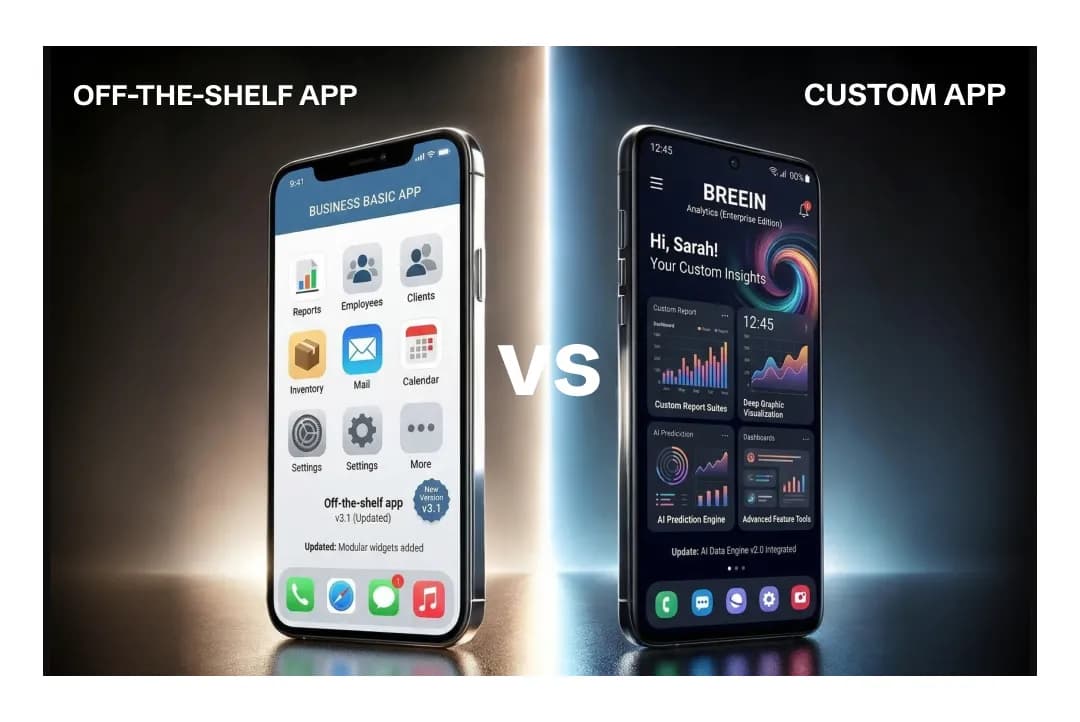 The choice between building a custom app or buying off-the-shelf will dictate profit margins for years. We break down the real-world costs and performance of both paths. Get clarity and choose a strategy that actually supports the long-term roadmap.
The decision you make today regarding your tech stack will dictate your operational agility long before the first user logs in. Early-stage startups often buy ready-made apps to preserve limited capital and hit the market by the weekend. Meanwhile, market disruptors and scaling enterprises typically build bespoke code to protect their proprietary logic and avoid vendor lock-in.
The debate is simple: do you rent a vendor’s roadmap or build a proprietary engine? One path offers lower upfront costs, while the other creates a defensible technical moat. In this editorial, we are moving past the surface-level marketing talk. We are going to break down the definitive app development frameworks to help you choose between an off-the-shelf solution and investing in custom app development, ensuring your investment aligns with your actual growth trajectory, not just a temporary fix.
A Quick Overview of Off-the-Shelf vs. Custom App Development
| Factor | Off-the-Shelf | Custom App Development |
|---|---|---|
| Initial Investment | Pay a manageable monthly or annual subscription fee | Requires an initial capital outlay for discovery, design, and coding |
| Time-to-Market | Most platforms can be configured and deployed within a few days | Requires a dedicated mobile app development process from scratch |
| Delivery Phase | Features are ready to use out of the box with zero development time | Longer to launch, the features are built specifically for your launch goals |
| Customization | Restricted to the settings and templates provided by the vendor | Every button, workflow, and data field is built to match your operations |
| Ownership & IP | You do not own the code; you essentially rent a license to use it | You own the source code, which adds value to your company’s valuation |
| Security | Uses standard security protocols that protect a wide, generic user base | Security measures tailored to data risks and industry compliance needs |
| Maintenance | The app provider handles all server updates, bug fixes, and security patches | The owner decides when to update, patch, or add new features |
| Integrations | Offers "one-click" syncs with popular tools such as Slack and QuickBooks | Can be built to talk to any internal database or legacy ERP system |
What Is Off-the-Shelf?
Think of off-the-shelf as a ‘ready-to-wear’ outfit. It’s designed to fit the average person reasonably well. These are pre-packaged applications developed for a broad audience, often referred to as COTS (Commercial Off-the-Shelf), built to handle the standard, everyday functions that every business shares, like accounting, basic CRM, or team communication.
When companies opt for an off-the-shelf solution, they aim for the mass market. Think of platforms like Shopify, Slack, or Salesforce. They offer a specific set of features that work for most businesses right out of the box. You don't own the code; you rent it through a license or subscription.
Key Characteristics of an Off-the-Shelf Solution
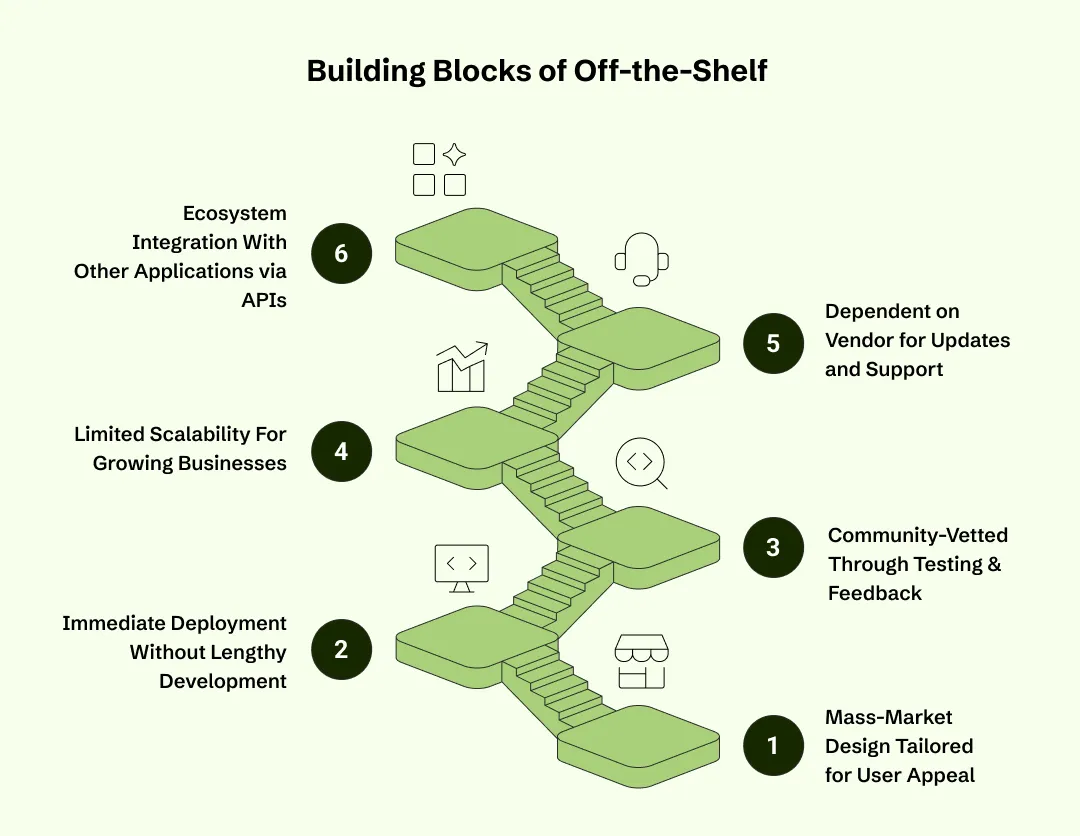
- Mass-Market Design Architecture: These applications use a ‘one-to-many’ model. The primary goal is to create a feature set that appeals to a global audience. This means the UI is designed to be intuitive for the average user, and the features are generalized. While this ensures broad utility, it also means the app is ‘feature-heavy’; you will likely find yourself paying for a dozen modules your team never uses.
- Immediate Deployment Readiness: One of the standout advantages of off-the-shelf is its ‘plug-and-play’ nature. There is no discovery phase, no sprint planning, and no testing cycles on your end. The moment the license is paid for, the app is live. For businesses that need to react to mobile app development trends instantly or launch a department during a sudden pivot, this characteristic is often the deciding factor.
- Community-Vetted Reliability: Because thousands of organizations use these COTS, they have been ‘battle-tested’ in environments you haven't even encountered yet. If there is a critical security patch or a bug in the latest OS update, the vendor’s team is already on it. You benefit from the collective feedback of an entire market, ensuring a level of stability that is hard to achieve with a first-generation custom build.
- Limited but Managed Scalability: In the off-the-shelf world, scalability usually means ‘tier jumping.’ If you need more storage or more users, you simply upgrade your plan; this is ‘horizontal’ scalability. If you need ‘vertical’ scalability, meaning the app needs to perform a task it wasn't originally built for. This is where most businesses start to feel the ‘friction’ of the off-the-shelf solution.
- Vendor-Locked Support and Roadmap: When you opt for a ready-made tool, you are essentially outsourcing your R&D. The vendor decides which features to build next and which to retire. You don't have a seat at the table. This characteristic is perfect for companies that want to ‘set it and forget it,’ but it can be a nightmare for those whose growth depends on a specific, non-standard feature that the vendor refuses to build.
- Ecosystem Integration via APIs: Modern off-the-shelf systems are rarely silos. They are designed to live within a tech stack. Most come with pre-built ‘connectors’ for popular tools such as Slack, Gmail, and QuickBooks. While these integrations are convenient, they are often ‘shallow.’ If you need a deep, data-intensive sync between systems, you might find the vendor’s API limits to be a significant bottleneck.
Off-the-Shelf Solution: Pros And Cons
| Pros | Cons |
|---|---|
| Extremely low upfront app development cost since the R&D is shared across thousands of users. | High lifetime cost due to recurring monthly subscriptions and ‘per-seat’ licensing. |
| Deployment is near-instant, bypassing the traditional 6–12 month app development process. | Restricted by the vendor's roadmap, and cannot accelerate the release of the features you need. |
| Vendor handles all security patches, server uptime, and version updates at no extra charge. | Zero control over ‘forced updates’ that might break existing workflows or remove features you require. |
| Extensive libraries of tutorials, community forums, and YouTube guides make onboarding fast. | UI is ‘bloated’ with hundreds of features you’ll never use, which can confuse your staff. |
| Standard integrations with big names like Slack, Gmail, and QuickBooks are ‘one-click’ and ready. | Custom or niche integrations require expensive third-party ‘middleware’ or restricted API access. |
When to Choose an Off-the-Shelf Solution
Choosing a pre-built COTS is about recognizing when a problem has already been solved at scale. You don't need to reinvent the wheel for standard business operations. If a commercial product meets 80% of your requirements right out of the box, the remaining 20% can often be addressed through minor process adjustments or third-party integrations. For startups, especially, the app development cost associated with a custom build is a heavy anchor that can sink a project before it even finds market fit.
Here is a breakdown of when you should confidently lean into a ready-made platform:
- When Speed-to-Market is Non-Negotiable: If your industry is moving rapidly and you need to capitalize on mobile app development trends immediately, you cannot wait nine months for a custom build. Off-the-shelf allows you to go from ‘signing’ to ‘onboarding’ in a matter of days.
- When Your Processes are Standardized: For ‘utility’ functions like accounting, email marketing, or HR payroll, the process is identical. There is no competitive advantage in having a unique way to process a paycheck. Using app development strategies for business efficiency often means picking the best SaaS tool for these back-office tasks, so your team can focus on your core product.
- When You Need to Validate an MVP: Startups often make the mistake of building an expensive, bespoke system for a product that hasn't been tested in the market. Use a white-label or no-code tool to prove the concept first; once you have 10,000 paying users, you can justify the investment in a custom migration.
- When You Have Limited Technical Bandwidth: Building a custom app is just the beginning. The real problem comes when you have to maintain it as well. If your company lacks a dedicated DevOps or security team, you are better off relying on a vendor who handles the app development process, security patches, and server uptime for you. This ‘hands-off’ maintenance is one of the most underrated advantages of an off-the-shelf solution.
- When Budget is the Primary Constraint: Let’s be direct: a custom app is a capital-heavy asset. If your current cash flow only supports a monthly subscription rather than a $150,000 upfront development fee, off-the-shelf is your only realistic path. It allows you to leverage world-class app infrastructure on a ‘pay-as-you-go’ basis, keeping your capital free for customer acquisition and growth.
What Is Custom App Development?
On the other side of the spectrum, custom app development involves building an app that acts as a digital mirror of your unique business operations. There is no filler here, no unused features cluttering the UI and no forced workflows that make your team's life harder. It is a bespoke asset created for a single client.
Whether you are looking into android app development frameworks to build a specialized field-service tool or a complex web app development for business efficiency, the focus remains on exclusivity. Because custom mobile app development starts with a blank canvas, every line of code is an investment in your specific intellectual property.
You own the IP, you control the security protocols, and you decide when and how the app scales. It’s an upfront commitment, but it ensures that the technology bends to your will, rather than forcing your business to fit into a pre-made box.
Key Characteristics of Custom App Development
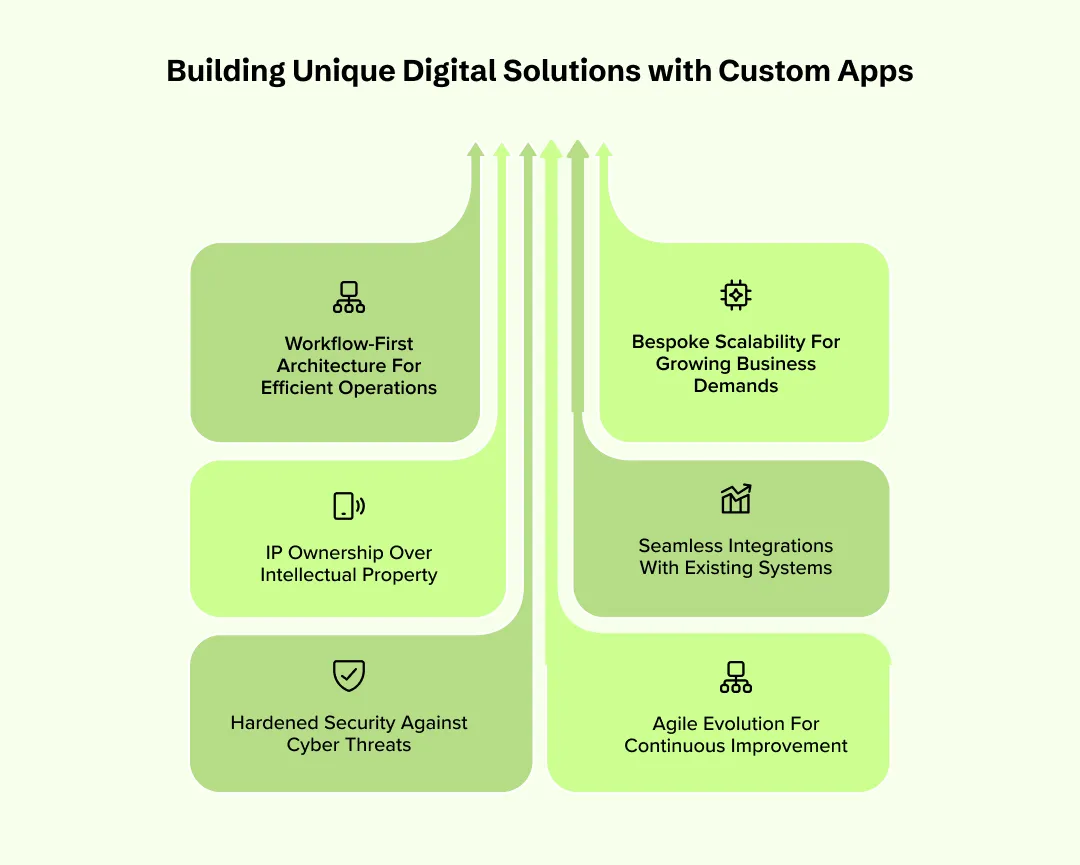
- Workflow-First Architecture: Mass-market tools often force users to change their habits. Custom apps do the opposite because they are built around existing successful processes. Engineers map out specific user journeys and administrative tasks during the mobile app development process. Application transitions become easier when the final product feels like a natural part of the team. This removes the ‘learning curve friction’ that often stops productivity.
- Bespoke Scalability and Elasticity: What industry experts call ‘vertical scalability’ is a core part of custom builds. You do not just add more users through horizontal scaling. Instead, you add deeper capabilities. A custom codebase can be restructured and expanded without hitting the ‘vendor ceilings’ found in SaaS. This remains true whether you apply AI in app development to automate predictive analytics or use an Android app development framework to grow your reach.
- Full IP Ownership and Strategic Asset Value: Intellectual property ownership is the most important trait here. Building custom means you own the code. Your technology changes from a monthly expense (OpEx) into a tangible company asset (CapEx). Proprietary technology acts as a moat to protect your market position. This ownership often becomes a major factor during mergers or acquisitions when determining business valuations.
- Seamless, High-Fidelity Integrations: Siloed data and messy workarounds often plague off-the-shelf apps. Custom solutions are different because they act as the glue for your technology stack. You can sync legacy ERP software or specific third-party tools at a deep level. Data flows across departments without manual entry because of this. Enterprises run lean and fast when they use web app development for business efficiency.
- Hardened, Purpose-Built Security: Cybersecurity has been a major priority for the past few years. Off-the-shelf vendors are big targets for mass attacks. A custom app is different because it is a small and unique target. Developers follow a custom mobile app development guide to set up specific encryption protocols and multi-factor authentication. These are tailored to the sensitivity level of your data.
- Agile Evolution and Roadmap Control: There is no need to wait for a global community to vote on a feature you need immediately. Your development partner can change the roadmap based on real-time feedback or new mobile app development trends. Businesses that must out-innovate larger and slower competitors use this agility as a secret weapon.
- Optimized Performance and UX: Lightweight performance is a hallmark of these apps because they do not have to support 50,000 different business types. Loading times stay fast without feature bloat. Higher engagement rates occur because the UX/UI is made for your specific audience. IDC numbers suggest that tailored enterprise applications save teams over 62,800 work hours per year. This happens by removing unnecessary steps from the daily workflow.
Custom App Development: Pros And Cons
| Pros | Cons |
|---|---|
| Hold 100% of the intellectual property, turning your app into a high-value company asset. | Solely responsible for the long-term roadmap, security audits, and technical documentation. |
| Eliminate recurring per-user licensing fees, which significantly improve your long-term profit margins. | A large upfront capital investment is required before the first line of code is even written. |
| App is built to mirror your exact internal workflows, removing the need for clunky workarounds. | Discovery phase requires significant time from management team to define specific requirements. |
| Freedom to scale "vertically," adding complex layers like AI or custom APIs. | Rapid growth requires a dedicated in-house team or maintaining a long-term agency partnership. |
| Custom security protocols ensure a unique, non-standard defense protecting sensitive information. | Designing a personalized UI from scratch adds weeks to the timeline compared to using pre-built templates. |
| Every pixel and interaction is designed for your specific audience, leading to higher adoption and satisfaction. |
When to Choose a Custom App Development
If the application is the primary way you deliver value to your clients or manage high-stakes internal data, good enough off-the-shelf features will eventually become a liability. You need a solution that mirrors your exact intellectual property. In the 2026 digital economy, app development statistics and predictions show that firms owning their tech stack are twice as likely to successfully integrate advanced automation compared to those stuck on third-party roadmaps.
You should choose to build a custom application in the following business situations:
- When Your Logic is Your Secret Weapon: If your business depends on a proprietary algorithm, a unique pricing model, or a specialized matching system, a generic app will fail you. Custom app development involves building an app that protects and runs your specific trade secrets. This ensures your secret weapon stays yours and is not shared with a vendor who also works with your rivals.
- When Data Privacy is a Legal Pillar: In sectors like FinTech and Healthcare, off-the-shelf tools often fail to meet the granular compliance standards required for sensitive data. By following a custom app development guide, you can build a security architecture that meets HIPAA or GDPR requirements at the code level. This gives you total control over how data is encrypted, stored, and accessed.
- When You Need to Connect Legacy Systems: Many established enterprises run on old but essential ERP or CRM systems. Custom engineering allows for deep syncs that ensure app development for improving business efficiency is actually achieved. It removes the need for manual data entry and slow CSV exports that hold back your staff.
- When Scale Dictates Your Profit Margins: For a small team, a $50-per-user monthly fee is a minor cost. But as you grow to hundreds or thousands of users, those licensing fees will eat your profits. Choosing custom mobile app development early in your growth phase removes these per-seat costs. Once the initial build is paid for, the cost to add your 1,000th user is essentially zero, which greatly improves your long-term ROI.
- When You Want to Lead the Market UX: Generic apps follow generic patterns. If your goal is to offer a revolutionary user experience that sets a new industry standard, you cannot do it with a template. Building your own app allows you to refine the mobile app development process based on direct feedback from your specific users. You can add features like AI in app development to provide personalized recommendations that a standard SaaS tool simply cannot offer.

The Cost Realities of Off-The-Shelf vs. Custom App Development
The choice between off-the-shelf vs. custom app development isn't just about functionality; it is a major financial pivot. While ready-made apps offer a low barrier to entry, custom engineering builds a proprietary asset that increases your company’s valuation.
To help you calculate your Total Cost of Ownership (TCO), here is a breakdown of the typical pricing structures. This table highlights why geography and scaling strategy are the two biggest levers in your development budget.
| Cost Component | Off-the-Shelf | Custom App Development |
|---|---|---|
| Initial Setup / Build | $500 – $5,000 (Configuration & Branding) | $40,000 – $250,000+ (Discovery to Launch) |
| Recurring Monthly Fees | $50 – $250 per user (Standard SaaS pricing) | $200 – $1,500 (Server hosting & Cloud storage) |
| Global Talent Rates | Fixed Vendor Tiers (Non-negotiable) | USA: $150–$250/hr (Supreme Expertise) India: $25–$80/hr (Affordable Scale) |
| Customization Costs | High. Requires "Enterprise" upgrades. | Integrated. Features are built to your spec. |
| Long-Term ROI | Decreasing. Cost grows with headcount. | Increasing. Fixed cost, zero per-user fees. |
Also Read: How to Choose A Mobile App Development Company
The Global Talent Strategy for Founders
Where you choose to hire mobile application developers will dictate both your burn rate and your code quality. Founders often balance their budgets by looking at two primary markets:
The United States: The Gold Standard for Innovation
Known for supreme talent and architectural innovation, US-based firms are the go-to for high-stakes, complex AI or FinTech projects. If you are looking for the absolute gold standard in security and UX, checking our list of the top mobile app developers in the USA is the best place to start.
The United Kingdom: The Bridge of Compliance and Quality
A massive hub for European financial standards and enterprise app solutions. It offers a middle ground, providing high-quality engineering with a deep focus on strict GDPR compliance. Founders looking for elite design and rigorous testing turn to the top app development firms in the UK to build apps that need to scale across the European market.
The United Arab Emirates (UAE): The Rising Hub of Luxury and Scale
It has quickly become a global destination for high-end digital transformation. With a government-backed push toward becoming a "smart city" leader, the UAE mobile app development experts specialize in luxury retail, government tech, and rapid-scale logistics. It is an ideal market for founders targeting the Middle Eastern expansion with high-performance, polished applications.
India: The Global Engine for Affordable Scale
Offers deep technical expertise at highly affordable prices. This market is the global leader for scaling teams without draining your Series A funding. For founders looking to maximize their development hours, the mobile app development firms in India offer an unbeatable ratio of quality to cost, making them perfect for iterative development and high-volume coding.
Real-World Case Studies: Seeing the "Build vs. Buy" Logic in Action
For many organizations, finding the right fit is the difference between immediate growth and long-term technical debt. Let’s examine two distinct instances that demonstrate how choosing the correct development path, whether focusing on speed through white-label deployment or long-term value through bespoke engineering, directly impacts business resilience and competitive positioning.
Case Study 1: Accelerating Market Entry Through White-Label SaaS Deployment
While Appinventiv is primarily known for bespoke engineering, they developed Ility specifically as a white-label solution designed for rapid deployment. This makes it an ideal example showcasing how businesses can leverage pre-built, brandable frameworks to achieve specialized functionality without the typical 12-month custom development cycle.
The Challenge: A real estate startup needed to provide commercial property owners with a way to manage multi-property portfolios. The typical development timeline for such a complex, feature-rich platform was estimated at 4 to 5 months, which was too slow for the client’s market entry goals.
The Solution: Appinventiv built Ility as a scalable, white-label SaaS platform using a microservices architecture. Instead of a traditional, from-scratch build for every end-user, the platform was designed to be rebranded and deployed for various property owners. They utilized automated infrastructure and an API-first approach to ensure the core logic remained stable while allowing for high-level UI customization.
Case Study 2: Architecting a Competitive Moat via Bespoke AI Engineering
Unlike a ready-made solution, this project for Soniphi was taken on by the bespoke engineering team of Appinventiv. It required building a highly specialized ecosystem from the ground up to solve a unique problem in the healthcare and wellness space. The goal was to translate the science of bio-acoustics into a functional mobile experience, a feat that no "templated" wellness app could achieve.
The Challenge: The client needed to turn simple voice recordings into detailed wellness reports. The technical hurdle was two-fold: first, the app had to isolate human vocal frequencies from background noise with extreme precision; second, it needed to correlate that data against millions of established medical data points to provide actionable insights. A standard off-the-shelf health app simply isn't built to process this level of specialized audio data or handle the proprietary algorithms required for such analysis.
The Solution: Appinventiv undertook a comprehensive custom mobile app development journey to build a proprietary engine for Soniphi. They engineered a custom algorithm capable of assessing 94% of the vocal information provided by the user. By building a bespoke backend, they ensured that the correlation between a voiceprint and a person's physiology remained entirely proprietary and secure.
Decision-Making Framework: Understanding Off-The-Shelf vs. Custom App Development
At this point, you understand that choosing between custom app development and off-the-shelf is not a simple technical preference. It is a fundamental business strategy. To cut through the complexity, use this three-pillar filter to determine which investment path actually supports your three-year growth plan.
Pillar 1. The Value Differentiator Filter
This determines if the tool is a back-office necessity or a market-facing advantage.
| The "Buy" Signal | The "Build" Signal |
|---|---|
| If the task is a standard function, like payroll or internal chat, buy it. | If the app provides a unique experience or a proprietary algorithm, you must build it. |
| Don't waste capital on over-engineering tools. | If your competitors can simply subscribe to the same SaaS tool you use, you have no technical defense. |
| Stick to off-the-shelf tools for your back-office and focus your energy on your other goals. |
Pillar 2: The Integration and Friction Audit
If your team spends two hours a day exporting CSVs or manually syncing data between tools, you are losing money.
| The Off-the-Shelf Gap | The Custom Connection |
|---|---|
| While generic tools have APIs, they are often shallow. You might find that your CRM can't talk to your legacy inventory system without expensive third-party middleware that breaks every time there’s an update. | Custom engineering allows you to build a Unified Data Layer. You can integrate with any android app development framework or legacy database at the root level. |
Pillar 3: The Data Sovereignty and Security Mandate
In a world of increasing data regulation, who holds your data is a massive liability or a major asset.
| Shared Risk | Controlled Defence |
|---|---|
| When you use a COTS platform, your data lives in a multi-tenant environment. | With a custom build, you dictate the security protocols. |
| If a major exploit hits their platform, every one of their customers, including you, is vulnerable at once. | You can follow a guide to implement encryption to meet industry needs, such as HIPAA or FinTech standards. |
| You own the keys, the logs, and the residency of your data. |
Conclusion: The Strategic Verdict
The off-the-shelf vs. custom app development debate isn't about finding the ‘best’ app; it's about finding the best fit for your current runway.
If you are a startup validating a niche or an SMB looking to modernize basic office tasks, an off-the-shelf solution provides the safety and speed you need. It gets you in the game without the six-figure entry fee. However, if you are a scale-up looking to disrupt your industry or an enterprise weighed down by a standard app that can't handle your complexity, it is time to invest in custom app development.
Owning your technology is the only way to ensure that, as the market shifts, you are the one setting the pace, not the one waiting for a vendor's update. Evaluate your 2026 goals: if you want to follow, buy. If you want to lead, build.
Frequently Asked Questions
Which is better: custom app development or off-the-shelf?
Neither is universally better; the right choice depends on your specific business goals. Off-the-shelf is ideal for standard tasks where speed and low upfront cost are key. However, for core business functions that require a competitive edge and 100% control, investing in custom mobile app development is the better long-term strategic move.
Can an off-the-shelf solution be customised?
Most off-the-shelf solutions offer basic customisation, such as branding or simple field changes. However, you cannot alter the core logic or the database structure. If your business requires big architectural changes or unique integrations, you will likely find that an off-the-shelf tool forces you to change your business to fit the app, rather than the other way around.
How long does custom mobile app development take?
Building a custom mobile app from scratch takes four to nine months. This timeline covers the mobile app development process: discovery, design, coding, and testing.
What are the hidden costs of an off-the-shelf solution or investing in custom app development?
Subscriptions never end. They rise annually. An off-the-shelf solution often hides costs in rising per-user fees, expensive add-on modules, and the time your team loses to manual workarounds. For a custom app, the hidden costs involve ongoing maintenance and the need for a reliable team to handle security patches.
Is a custom app more secure for sensitive data?
Proprietary builds offer unique defence layers. Hackers target mass-market platforms. By following a custom mobile app development guide, you can build specific, non-standard security layers that make your app a much harder and less profitable target for cybercriminals.
Can I migrate data from an off-the-shelf solution later?
Migration is possible but often messy and expensive. Planning early prevents data silos. Weigh the different off-the-shelf solutions against future portability before you sign any vendor contracts.

Uncover executable insights, extensive research, and expert opinions in one place.
Related Content