Share It On:
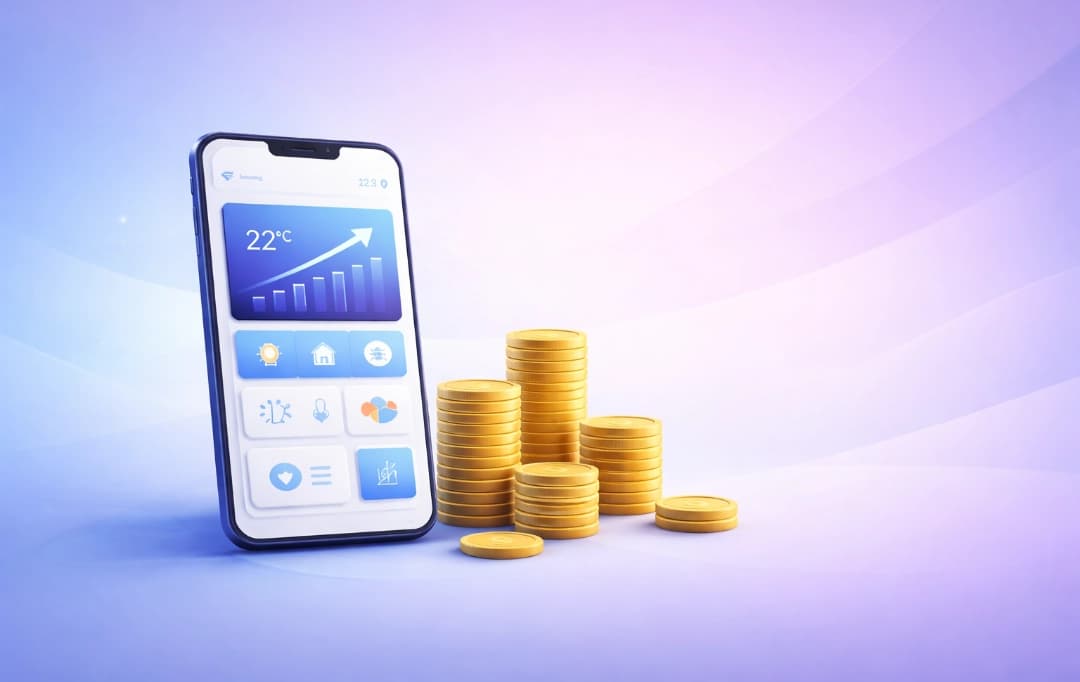 IoT app development costs can vary widely! Here’s exactly what impacts pricing and how to estimate your budget accurately.
If you’re planning to build an IoT app, you don’t need vague estimates; you need a clear starting point. On average, IoT app development costs range from $20,000 to over $500,000, depending on the scope, complexity, and level of integration involved.
Now, this wide range isn’t random, this is based on extensive market research and insights gathered by our experts from real-world projects, costs shift significantly.
Additionally, factors like device connectivity, real-time data processing, security requirements, and the number of features you plan to include can influence the total cost.
So, a simple connected app will sit on the lower end, while enterprise-grade IoT ecosystems can quickly move toward the higher spectrum.
This IoT development cost guide breaks down exactly what drives these costs, where your budget will go, and how to make smarter decisions before you invest, so you’re not just estimating, you’re planning with clarity.
Let’s begin!
Key Highlights of the Blog
- Expect a Wide Baseline: Functional, single-platform MVPs start around $20,000, while complex, enterprise-grade ecosystems with custom hardware and advanced AI can easily exceed $500,000.
- Geography is Your Biggest Lever: Where you hire matters. Partnering with skilled offshore developers in Asia or Eastern Europe can cut engineering costs by 40% to 60% compared to North American rates.
- Backend and Hardware Consume the Budget: UI/UX is important, but the invisible mechanics—cloud data processing and hardware/firmware integration—will take up the largest portion (45%–65%) of your initial spend.
- Plan for the "After-Launch" Costs: The launch is only the beginning. You must forecast an additional 15% to 20% of your initial development cost annually for cloud hosting, security patches, and OS maintenance.
- Optimize Before You Build: You can drastically reduce initial costs by launching a Minimum Viable Product (MVP) first, utilizing off-the-shelf sensors for prototyping, and leveraging cross-platform frameworks like Flutter.
Factors that Drive the IoT App Development Cost
Now that you have an idea about the baseline numbers, let’s look at what actually moves the needle on your budget. Beyond just the rates charged by mobile app developers, your underlying tech choices play a massive role. Here are the core architectural and technical decisions that will affect your IoT development cost:
1. Geographic Location of the Development Team
Who builds your app, and where they live, is the single biggest variable in your total budget. Hourly rates vary massively by geography; hiring in North America costs a premium for proximity and timezone alignment, while offshore regions offer incredibly skilled engineering talent at a fraction of the cost.
| Geographic Region | Average Hourly Rate | Total Cost Estimate (Medium Complexity App) |
|---|---|---|
| North America (US/Canada) | $100 – $200+ | $120,000 – $250,000+ |
| Western Europe / UK | $70 – $130 | $80,000 – $150,000 |
| Eastern Europe (Poland, Ukraine) | $40 – $70 | $50,000 – $90,000 |
| Asia (India, Vietnam) | $25 – $50 | $30,000 – $60,000 |
2. Hardware and Firmware Complexity
Off-the-shelf standardized sensors will definitely keep your development budget for IoT apps lean and development fast. However, if you are looking for a complex hardware integration to manage unique tasks, you will need specialized engineers, which will definitely drive up the cost.
| Complexity Level | Description | Estimated Cost Impact |
|---|---|---|
| Basic | Integration with off-the-shelf sensors and standard APIs | $2,000 – $5,000 |
| Moderate | Custom firmware written for standard microcontroller boards | $10,000 – $25,000 |
| Advanced | Custom PCB design, prototyping, and complex firmware | $30,000 – $80,000+ |

3. Choice of Connectivity Protocols
If you choose to connect a device via standard Wi-Fi or Bluetooth, it will mostly be straightforward and cost-effective since mobile devices natively support them. Conversely, if you choose to architect an app to support low-power, long-range networks, you will be paying a premium for specialized testing, custom gateways, and network planning.
| Connectivity Type | Description | Estimated Cost Impact |
|---|---|---|
| Standard | Wi-Fi, Bluetooth (BLE), RFID | $1,500 – $4,000 |
| Moderate | Zigbee, Z-Wave, Matter protocols | $4,000 – $9,000 |
| Complex | Cellular (NB-IoT, LTE-M), LoRaWAN with custom gateways | $10,000 – $25,000+ |
4. Cloud Infrastructure and Data Handling
Your IoT app needs a backend capable of ingesting and processing thousands of data points per second without crashing. So, you will need to set up scalable cloud environments (like AWS IoT or Azure), real-time telemetry data processing, or localized edge computing layers. This will consequently require heavy backend architecture that drives both upfront and ongoing costs.
| Infrastructure Level | Description | Estimated Cost Impact |
|---|---|---|
| Basic | Simple backend, low data volume, standard cloud hosting | $5,000 – $12,000 |
| Moderate | Real-time syncing, standard AWS IoT/Azure IoT Hub setup | $15,000 – $35,000 |
| Enterprise | Edge computing, ML pipelines, massive data lakes | $40,000 – $100,000+ |
5. Security and Compliance
IoT networks are prime targets for cyberattacks, making security a non-negotiable expense. Implementing end-to-end encryption, secure Over-The-Air (OTA) firmware updates, and ensuring strict compliance with regulations like GDPR or HIPAA requires high-tier cybersecurity expertise.
| Security Standard | Description | Estimated Cost Impact |
|---|---|---|
| Standard | Basic data encryption, secure login/authentication | $3,000 – $8,000 |
| Advanced | Role-based access control (RBAC), secure OTA updates | $10,000 – $20,000 |
| Enterprise | HIPAA/GDPR compliance, biometric security, penetration testing | $25,000 – $60,000+ |
6. UI/UX and App Ecosystem
The cost multiplies based on where the user needs to access the data. Building a single-platform app is straightforward, but using IoT app development platforms to architect native mobile apps (iOS and Android) requires extensive front-end development.
| Platform Scope | Description | Estimated Cost Impact |
|---|---|---|
| Basic | Single platform MVP (e.g., Android only) with standard UI | $8,000 – $15,000 |
| Moderate | iOS + Android + Basic Web Dashboard | $20,000 – $45,000 |
| Complex | High-end data visualization, custom animations, multi-platform | $50,000 – $120,000+ |
IoT App Development Pricing by Development Stage
Let's say you have a budget of $100,000 budget for a medium-complexity IoT app. Here’s the cost breakdown-
| Development Phase | Average Percentage of Budget | Estimated Cost (Based on $100k Total) |
|---|---|---|
| Discovery & Strategy | 5% – 10% | $5,000 – $10,000 |
| UI/UX Design | 10% – 15% | $10,000 – $15,000 |
| Hardware Integration | 20% – 30% | $20,000 – $30,000 |
| Backend & Cloud | 25% – 35% | $25,000 – $35,000 |
| QA & Security Testing | 15% – 20% | $15,000 – $20,000 |
So, when you sign off on a budget, you need to know exactly where your capital is being allocated. To give you complete transparency, let’s break down the development lifecycle.
Here is exactly how your development budget for IoT apps is distributed across each critical phase of building the ecosystem.
Phase 1: Discovery and Architecture Strategy
This phase involves business analysts and system architects defining your tech stack, choosing the right cloud infrastructure (like AWS IoT or Azure), and mapping out how the hardware will communicate with the software. Skipping this leads to expensive rework later.
Phase 2: UI/UX Design
IoT development is inherently complex because these apps process massive amounts of raw data. The goal of your design team is to make that complexity invisible to the user. You are paying for user research, wireframing, and creating intuitive dashboards that allow users to control physical devices seamlessly from a screen.
Phase 3: Hardware and Firmware Integration
This is the bridge between the digital and physical worlds, and what separates an IoT app from a standard software product. The cost to develop an IoT app here goes toward embedded engineers who write the firmware, establish connectivity protocols (Bluetooth, Wi-Fi, LoRaWAN), and ensure your app can actually talk to your specific sensors or devices.
Phase 4: Backend and Cloud Development
This is usually the most expensive phase because it requires building a scalable cloud architecture capable of ingesting, storing, and processing thousands of real-time telemetry data points without lagging or crashing.
Phase 5: Quality Assurance (QA) and Security Testing
If an IoT app crashes, a smart lock fails to open, or a piece of industrial machinery overheats. You must budget heavily for implementing mobile app testing tools, QA, penetration testing, edge-case scenarios, and ensuring the app performs flawlessly under varying network conditions.
Understanding the Ongoing Costs Post IoT App Launch
As a business, you must not make the mistake of treating your app launch as the finish line. This is just the start! Once your app is live and devices are connected in the wild, you enter the maintenance phase, and this comes with its own set of recurring expenses.
Industry standard dictates that you should budget 15% to 20% of your initial development cost per year just to keep the ecosystem running smoothly. If you spent $100,000 to build the app, expect to spend $15,000 to $20,000 annually on upkeep.
Here is exactly what that ongoing budget pays for:
1. Cloud Hosting and Data Storage
IoT devices are relentless data generators. Every temperature reading, location ping, and user interaction needs to be stored and processed. As your user base and device count grow, your AWS, Azure, or Google Cloud monthly bills will scale linearly.
2. Continuous Security Patching
For your IoT networks, you will need ongoing security audits, penetration testing, and rapid deployment of security patches to ensure your users' data (and your company's reputation) remains uncompromised.
3. Third-Party API and Licensing Fees
If your app relies on external services, like Google Maps for fleet tracking, or specialized weather APIs for smart agriculture, you will be paying recurring subscription or usage-based fees.
4. App Maintenance and OS Updates
Apple and Google update iOS and Android every single year. When they introduce new privacy protocols, Bluetooth permissions, or background processing rules, your app must be updated to remain compliant and functional on the latest smartphones.
To help you forecast the total Internet of Things app development cost and operational budget, here is a realistic look at the annual ongoing costs for a medium-complexity, $100,000 IoT application:
| Maintenance Category | What You Are Paying For | Estimated Annual Cost |
|---|---|---|
| Cloud Infrastructure | AWS/Azure hosting, data lakes, server scaling | $4,000 – $8,000 |
| App & OS Maintenance | Adapting to new iOS/Android versions, bug fixes | $5,000 – $10,000 |
| Security & Compliance | Regular penetration testing, SSL certificates, HIPAA/GDPR audits | $3,000 – $7,000 |
| Third-Party Services | API usage limits, mapping tools, SMS gateways | $1,500 – $5,000 |
| Total Estimated Annual Upkeep | (Roughly 15% – 20% of initial build) | $13,500 – $30,000 |
Key Strategies for IoT App Development Cost Optimization
You have a clear idea of the cost breakdown of IoT app development, but does it feel too much? We have compiled 5 strategic ways to trim the fat without compromising the integrity, security, or scalability of your IoT ecosystem.
Here’s how you can keep the app development cost in check-
- Do not build the kitchen sink version of your app on day one. Focus strictly on the core functionality that proves your business model, release it, gather real user data, and fund the advanced features later.
- Custom PCBs and proprietary sensors require expensive embedded engineering and manufacturing. Whenever possible, validate your software using existing, pre-certified hardware and development kits before investing in custom builds.
- Unless your app requires extremely heavy, native-level hardware processing on the smartphone itself, use cross-platform frameworks like Flutter or React Native. This allows you to build for both iOS and Android simultaneously from a single codebase, nearly cutting your frontend costs in half.
- Do not attempt to build a custom backend data engine from scratch. Utilizing managed services like AWS IoT Core, Azure IoT Hub, or Google Cloud provides enterprise-grade device management, security, and scalability right out of the box.
- As mentioned already, geography dictates pricing. Partnering with vetted, highly skilled app development companies in India or Eastern Europe can reduce your engineering costs by 40% to 60% compared to hiring a local North American team.
IoT App Models You Should Know Before Finalizing the Budget
To finalize your budget, you need to know exactly what archetype of app you are building. Not all IoT solutions require the same architecture. Let’s look at three dominant IoT models and what drives their success, so you can benchmark your own project and set realistic financial expectations.
The Consumer Smart Home Ecosystem (e.g., Philips Hue, SmartThings)
The Core Focus: Flawless UI/UX, instant response times, and frictionless user onboarding. Consumers expect a lightbulb to turn on the millisecond they tap the screen.
Where the Budget Goes: Heavy investment goes into mobile app design, cross-device compatibility, and seamless integrations with third-party voice assistants like Amazon Alexa and Apple HomeKit.
Budget Tier: Moderate to High ($75,000 – $150,000+)
Industrial IoT (IIoT) & Asset Tracking (e.g., Fleet Management, Factory Sensors)
The Core Focus: Reliability, massive data ingestion, and predictive analytics. The user interface doesn't need to be overly flashy; it needs to be highly functional and capable of displaying complex telemetry data without lagging.
Where the Budget Goes: The bulk of the capital is spent on robust backend cloud architecture, edge computing capabilities, and integrating low-power, long-range connectivity protocols.
Budget Tier: High to Enterprise ($150,000 – $500,000+)
Connected Health and Wearables (e.g., Oura Ring, Continuous Glucose Monitors)
The Core Focus: Extreme data privacy, continuous background syncing, and battery optimization. These apps must silently pull continuous data from a device without draining the user's smartphone battery.
Where the Budget Goes: Extensive funding is required for complex Bluetooth Low Energy (BLE) firmware development, rigorous security testing, and strict regulatory compliance consulting (such as HIPAA in the US or GDPR in Europe).
Budget Tier: Moderate to High ($100,000 – $250,000+)
Wrapping Up!
Building an IoT app is a strategic move that can redefine how your business operates, scales, and delivers value. The real impact comes from having clear goals, making the right technology choices, and executing with precision.
A well-planned IoT solution creates a connected ecosystem that improves efficiency, enables real-time decision-making, and unlocks new growth opportunities. This is where you start to see meaningful, long-term value.
The Next Step: You now have the blueprint and the numbers. The best move you can make right now is to clearly define the scope of your MVP. Document your core features, identify what hardware you are connecting to, and reach out to a vetted development partner to get a precise, tailored estimate.
Frequently Asked Questions
What does an IoT app usually cost to build?
There isn’t a neat number anyone can give upfront. A simple Bluetooth-controlled MVP often starts around $45,000 to $50,000. However, once you add cloud synchronization, real-time alerts, and firmware integration testing, it’s common for total costs to move past $100,000 quickly.
What ends up affecting the IoT cost more than people expect?
Hardware integration delays. Unlike standard apps, IoT apps rely on physical prototypes. If the hardware team changes a firmware protocol halfway through development, the app team has to rewrite the integration code, causing major budget creep.
Does going cross-platform work for IoT apps, or is that a myth?
It absolutely works and saves money (around 30-40%), but with a caveat. If your IoT app relies heavily on very complex, low-level Bluetooth (BLE) commands or massive background data processing, native development (Swift/Kotlin) might still be required for stability.
How much does cloud infrastructure cost for an IoT app?
In the early days, cloud costs are negligible (often under $100/month on AWS IoT or Azure). The cost scales with usage. If your devices ping the server every second versus every hour, your message volume and your bill will multiply rapidly.
Why is testing an IoT app so expensive?
Because you cannot fully test it in a vacuum. You have to test the app across different smartphones, interacting with different Wi-Fi routers, and talking to varying versions of your physical hardware. This requires setting up physical testing labs, which drastically increases QA time and costs.

Uncover executable insights, extensive research, and expert opinions in one place.
Related Content