Share It On:
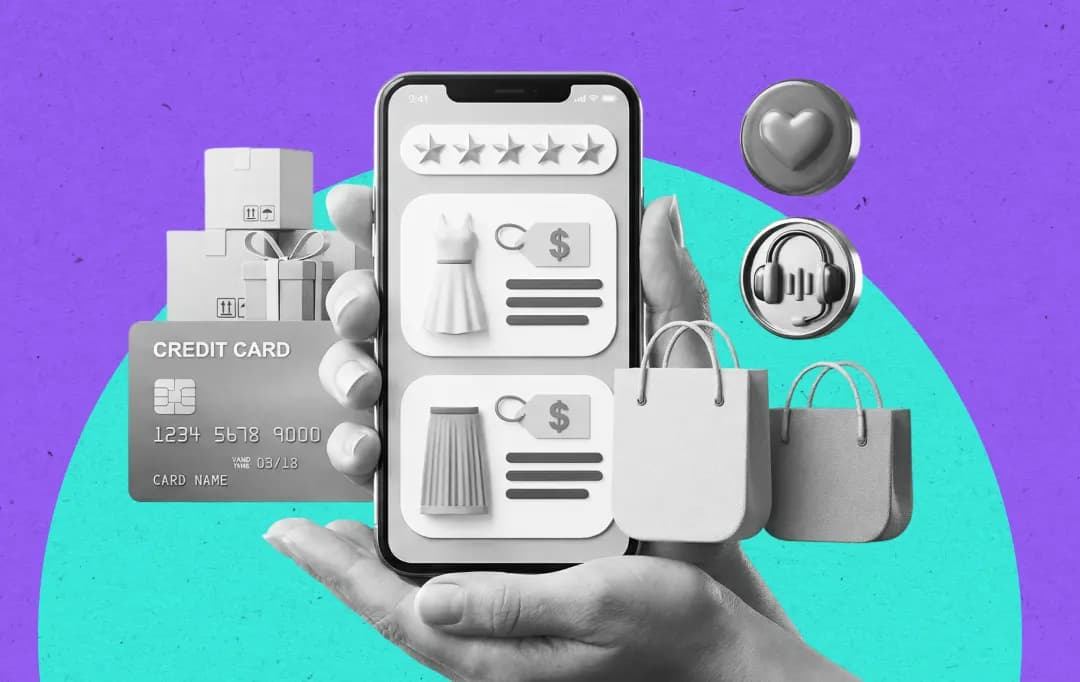 If a responsive website is your entire mobile strategy, this ecommerce app development guide shows why that’s costing you real revenue. It explains why ecommerce apps are now survival tools—not nice-to-haves. Read on to see what most brands get wrong
The retail landscape hasn't just shifted; it has completely mutated. If you are relying solely on a responsive website to drive sales, you are leaving money on the table—specifically, the money currently sitting in the pockets of the 5.6 billion smartphone users globally. This ecommerce app development guide isn't a textbook definition of what an ecommerce app is. It’s a blueprint if you are tired of losing market share to competitors who simply move faster.
Here is the unvarnished truth: building an app isn't a vanity project. It’s a survival mechanism. But the road to launching a successful product is paved with blown budgets, feature creep, and "ghost apps" that nobody downloads. We’re going to dissect the process, from the initial "why" to the final deployment, stripping away the jargon and focusing on ROI.
Ecommerce App Market Overview
If you are building for the ecommerce app trends that’re not in fashion anymore, you are already behind. Voice Commerce is becoming the standard for reordering consumables. AR/VR is shifting from a gimmick to a necessity, especially in fashion and furniture, where return rates are a margin-killer. And Social Commerce is collapsing the funnel entirely—people want to buy right inside the livestream, not click out to a website.
1. Voice Commerce: The Invisible Interface
Voice wasn't just for checking the weather. In 2030, the global voice commerce market won’t just grow; it’s expected to explode to $186.28 billion.
Consumers stopped typing "reorder detergent" and started shouting it at smart speakers while cooking dinner. Over 157.1 million US internet users are expected to use voice assistants in 2026 to look for product information or make purchases. If your app lacks a voice-search schema, you are invisible to the highest-intent buyers in the home.
2. AR & VR: The Margin Defender
Stop calling it a gimmick. Augmented Reality is currently the only viable defense against the retail margin killer: returns.
Shopify's benchmark data shows that products featuring 3D/AR content consistently realize a 94% higher conversion rate than those without. The global AR in retail market was valued at $7.84 billion in 2024, driven by a desperate need to lower return rates (which AR reduces by up to 40%). In a US market where returns cost retailers billions, AR isn't "cool"—it is margin protection.
3. Social Commerce: The Funnel Collapse
The traditional "Click Ad > Visit Site > Add to Cart" funnel is dead.
The US social commerce market is officially expected to hit over $137 billion in 2028. In 2024, over 100 million Americans became social buyers. They didn't click out to your website; they bought right inside the livestream or the influencer's feed. If you are forcing users to leave TikTok or Instagram to buy from you, you are introducing friction that costs you 50% of your potential traffic.
Benefits of Ecommerce App Development
Why go through the hassle? Well, if the numbers above weren’t enough, here are plenty of other reasons. A mobile presence offers an omnichannel experience that a website simply cannot match. We are talking about friction reduction that leads to higher conversion rates.
- Direct Marketing Channel: Apps allow for push notifications that sit right on the user's lock screen, driving retention rates far higher than email.
- Enhanced Data Collection: Using AI-powered app personalization, you can track user journeys with precision, enabling analytics and reporting that feed into personalized recommendations.
- Offline Functionality: An offline mode lets users browse products even in a subway tunnel, syncing data once they reconnect.
- Brand Recognition: Constant visibility on a user's device builds customer loyalty and reinforces brand presence daily.
- Frictionless Checkout: Abandoned carts are the enemy. Native apps integrate with digital wallets (Apple Pay, Google Pay) and biometric authentication (FaceID), turning a tedious form-filling exercise into a one-tap impulse buy.
- Superior Performance: Let’s be honest—mobile websites can be sluggish and clunky. Native apps communicate directly with the device’s hardware, delivering faster load times and smoother transitions. This is one of the biggest ecommerce app development benefits brands experience after moving beyond traditional responsive websites. Speed isn't just a luxury; it is a retention metric.
- Higher Average Order Value (AOV): When you remove the distractions of browser tabs and slow loading, users browse longer. An immersive environment combined with smart, algorithmic upselling encourages users to add "just one more thing" to the cart, significantly boosting your per-transaction revenue.
- Competitive Necessity: This is no longer optional. Users expect a dedicated app from serious brands. Without one, you aren't just missing a channel; you are signaling that you are behind the curve compared to competitors who are already living on your customer's home screen.
|
Planning To Build An Ecommerce App? Outsource to the expert ecommerce app developers that we have featured! |
How Ecommerce Mobile App Development Features Cause Scope Creep?
There is always a temptation to build a "Ferrari" version of the app on day one. It is a natural impulse; you want to impress. But in app development, ambition without discipline is just debt.
Here is the brutal reality: The leading cause behind app failure isn't bad code—it's bad prioritization. Founders fall in love with "nice-to-have" features and forget that every new button requires design, coding, testing, and perpetual maintenance.
You need to be ruthless. The "Must-Haves" aren't exciting—a solid product catalog, a checkout that doesn't crash, and a payment gateway that is actually secure. That is it. That is the app.
1. The "Graveyard of Good Intentions" (Features to Cut Immediately)
If you are pre-revenue or in the early growth stage, these ecommerce mobile app development features are traps. They look great on a slide deck, but they burn cash and delay your launch:
- Proprietary Social Networks: Do not build a "community feed" inside your store. Your users already have Instagram and TikTok. They don't want to chat on your app; they want to buy and leave.
- Complex Gamification: Badges, leaderboards, and avatar customization are complex logic puzzles. Unless you have the engagement metrics of Duolingo, a simple "points-per-dollar" loyalty system is all you need.
- Multi-Vendor Architecture (on Day 1): Trying to build the next Amazon (Marketplace) before you have sold a single item yourself is suicide. Master your own inventory logistics before you try to manage someone else's.
- Augmented Reality (AR): Unless you are selling cosmetics (Sephora) or furniture (IKEA), AR is often a gimmick that bloats the app size and slows down performance.
2. The 1-10-100 Rule
Scope creep doesn't just cost you money during the build; it destroys you later. We recommend that you operate by the 1-10-100 Rule:
- $1 to fix a feature requirement during the planning phase.
- $10 to fix it during development.
- $100 to fix it after the app is live.
Every "small tweak" you add halfway through development doesn't just add hours; it destabilizes the existing code. It forces your QA team to re-test the entire ecosystem, causing a rise in your cost of mobile commerce app development.
3. The Invisible Backbone: The Admin Panel
The "Hook" comes later. Things like advanced search filters and real-time order tracking are critical for retention, but they are useless if the core engine fails. And please, do not forget the Admin Panel.
It is the invisible backbone of your business, yet it usually gets 5% of the attention.
- Can you update a banner image without emailing a developer?
- Can you export sales data to CSV instantly?
- Can you manage refunds with one click?
If you cannot manage inventory or view analytics without calling a developer, you don't own your business; your developers do. Build a boring, functional Admin Panel before you build a flashy customer interface.
Case Studies to Inspire Your Ecommerce App Development Strategy
Stop looking at your competitors' color palettes and start looking at their psychology. The apps winning in the US market right now didn't get there because they had cleaner code or prettier icons. They won because they identified a specific human anxiety and used technology to kill it.
Here is the breakdown of who is winning and why:
1. Domino’s: Selling Certainty, Not Pizza
Domino’s admits they are a tech company that happens to sell food. Their "Pizza Tracker" is the ultimate lesson in anxiety reduction.
- The Problem: The "Black Box" of delivery. Is it coming? Did they forget me?
- The Strategy: Radical Transparency. They didn't just speed up the pizza; they visualized the wait.
- The Takeaway: If your user has to email support to ask, "Where is my order?", your app has failed. You don't need a tracker that looks like a video game, but you do need to address the user's anxiety before they even have time to feel it.
2. Starbucks: The Bank That Sells Coffee
The Starbucks app is essentially an unregulated bank account that pays interest in caffeine. It is the gold standard for Habit Creation.
- The Problem: Buying coffee is a commoditized, daily friction.
- The Strategy: Gamified Frictionlessness. They combined a "reloadable wallet" (locking in your cash) with a "Stars" reward system that gamifies addiction. You aren't buying a latte; you are grinding XP for a free reward.
- The Takeaway: Loyalty isn't a punch card. It’s an ecosystem. If you can get users to pre-load money or chase a status tier, you have moved from a vendor to a habit.
3. Warby Parker: Destroying the "What If" Risk
Buying glasses online used to be insane. Fit is everything. Warby Parker didn't just build an ecommerce store; they built a risk-mitigation engine.
- The Problem: "I don't know if this will look stupid on me." (The Return Rate Nightmare).
- The Strategy: The Home Try-On Program and later, Virtual Try-On (AR). They ate the cost of shipping 5 frames just to sell 1, because they knew that confidence converts.
- The Takeaway: If you are selling physical goods, your biggest competitor isn't another brand; it's the customer's fear of making a mistake. Use AR or generous try-on policies to bridge the gap between "digital image" and "physical reality."
4. TikTok Shop: Collapsing the Funnel
US ecommerce is shifting from "Search -> Click -> Buy" to "Watch -> Buy." TikTok Shop is winning because it removed the "Click Out."
- The Problem: Every time you force a user to leave an app to visit a website, you lose 50% of them.
- The Strategy: Contextual Commerce. You see the product in a video, and you buy it in the video. The entertainment is the catalog.
- The Takeaway: Stop treating content and commerce as separate silos. In 2026, content is the storefront. If your app doesn't have video integration or "shoppable" media, you are boring your users to death.
Types of Ecommerce Applications
Before we get into the "Native vs. Hybrid" technical debate, we need to define the business model. The architecture of your app is dictated entirely by who you are selling to.
- B2C Apps (Business to Consumer): The standard retail model (e.g., ASOS, Nike). The focus here is on emotion and impulse. The UI must be visually rich, the checkout must be under 3 clicks, and the push notifications must be personalized.
- B2B Apps (Business to Business): The wholesale model (e.g., Alibaba, Quill). The focus here is on logic and efficiency. These apps need features like "Quick Reorder," volume-based pricing, and invoice management. Flashy animations don't matter; speed of procurement does.
- C2C Apps (Consumer to Consumer): The marketplace model (e.g., eBay, Poshmark). You are the facilitator, not the seller. The critical features here are trust systems (ratings/reviews) and in-app chat.
- Ecommerce Aggregators: The platform model (e.g., UberEats, Lyst). You don't own the inventory. The challenge here is complex real-time logistics and managing two distinct user bases (the buyer and the vendor).
The Architecture Decision: Strategy Before Code
Before you talk about the budget, you need to talk about structure. You have three choices, and this decision is business-critical, not just technical.
- Native Apps (The Ferrari): Built specifically for iOS (Swift) or Android (Kotlin). They are fast, secure, and have full access to hardware (FaceID, AR). Use this if experience is your product.
- Progressive Web Apps / PWA (The Sedan): Essentially a website that acts like an app. It’s cheaper to build and bypasses the App Store entirely. Use this if you have a tight budget and simple needs.
- Headless Commerce (The Fleet Manager): This separates your frontend (the app) from your backend (the inventory). This is for scaling. It ensures that when your app crashes, your website doesn't go down with it.
What Does It Cost to Build an Ecommerce App?
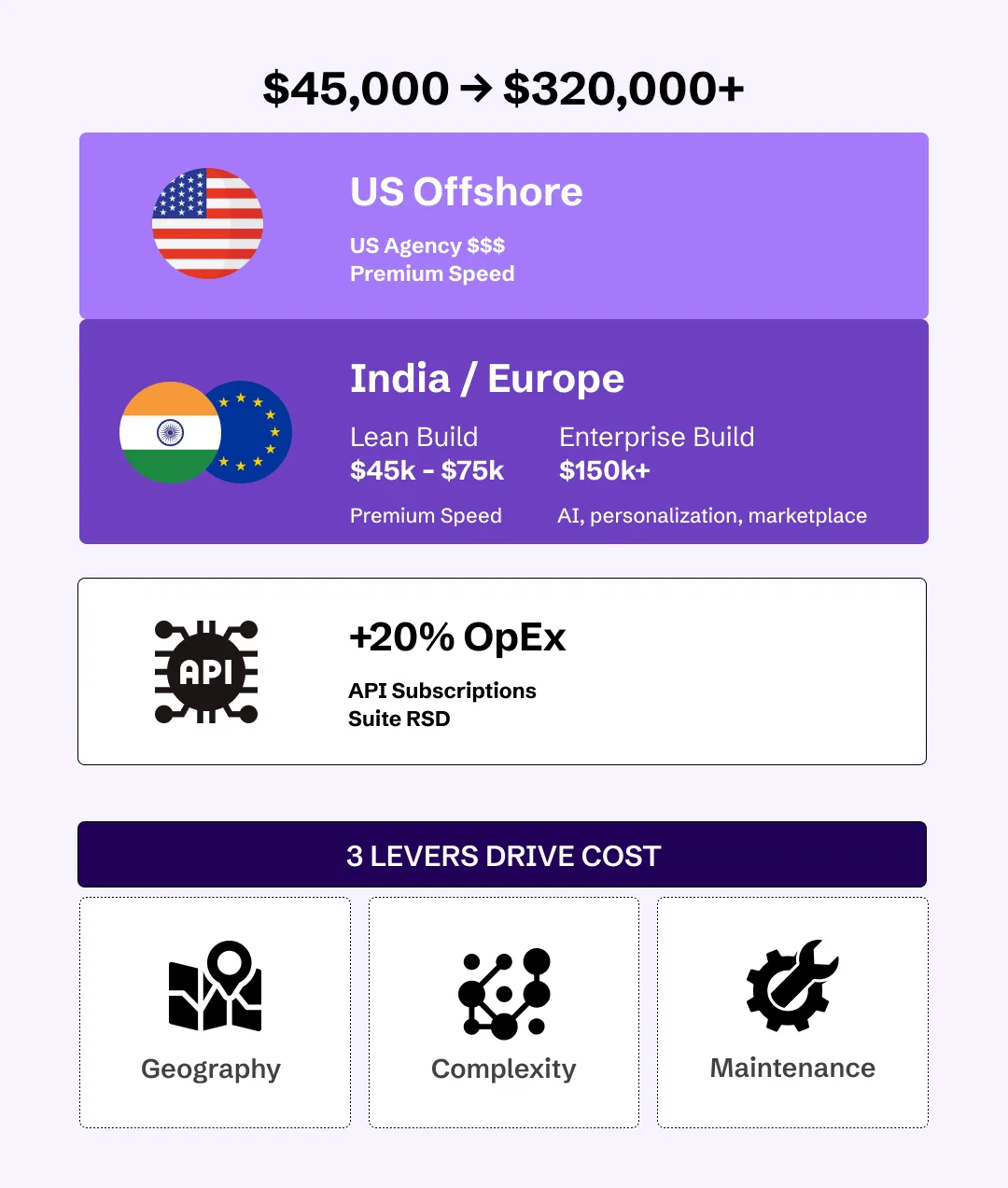
Let’s skip the vague "it depends" answers. Allocating funds for an app is a minefield. One wrong turn in your tech stack, or a single miscalculation in your API usage (hello, Google Maps), and you are bleeding cash before you acquire your first customer.
If you are looking for a quick number, here is the unvarnished truth: A functional, scalable ecommerce app in 2026 will cost you between $45,000 and $320,000+.
What drives the massive gap in ecommerce app development costs? The fact that you aren't just paying for code, you are paying for three specific levers:
1. The Geography Tax
Where your developers sleep dictates your runway. Hiring a US-based agency is buying a Ferrari; it’s high-performance, but you are paying a 5x premium for the brand. The smart money in 2026 is on Senior Offshore Talent (India or Eastern Europe). But before outsourcing, many businesses first learn how to hire ecommerce app developers capable of handling long-term scaling and maintenance. You get the same code quality for a fraction of the burn rate, provided you have strong management.
2. The Complexity Index
"Complexity" is just consultant-speak for "how many features can we cram in?"
- The MVP ($45k - $75k): This is your lean catalog, cart, and checkout. It works, it sells, but it doesn't do magic.
- The Enterprise Build ($150k+): This is where you get the "Amazon" features—AI personalization, multi-vendor marketplaces, and dynamic pricing engines.
3. The Silent Killers (OpEx)
The invoice doesn't stop when the app launches. You need to budget for the "Hidden 20%"—that’s the industry standard for annual maintenance. Between server costs, mandatory iOS updates, and the monthly rent for APIs (like Google Maps and OpenAI tokens), your app is a living expense, not a one-time purchase.
These factors affecting ecommerce app development costs impact more than just simple calculations. You have to plan your development strategy accordingly, the folks who will work on your app, and the roadmap to make it live in the market.

How Ecommerce Apps Actually Die?
Ecommerce apps rarely fail because of bad code. They fail because of invisible erosion. Common failure patterns:
- High installs, low repeat usage
- Features no one touches
- Maintenance costs are growing faster than revenue
- Users returning to the mobile web out of habit
- If retention does not improve within 30 days, the problem is not marketing. It is The Product.
What Happens After Your Ecommerce App is Launched?
Launching the app is not the finish line; it is the starting line. Here is what kills apps after they hit the store:
- The Visibility Problem (ASO): If you don't invest in App Store Optimization (keywords, screenshots, reviews), you have built a billboard in a basement. No one will find you.
- The Legal Landmine (ADA Compliance): In the US, accessibility lawsuits are rising. If your app doesn't work for screen readers, you aren't just alienating users; you are inviting a lawsuit.
- The Code Rot: Operating systems update every year. If you don't update your code to match iOS 19 or Android 16, your app will crash.
How to Choose the Best Ecommerce App Development Company?
Choosing an app development agency is a minefield. While looking for teams, look beyond prices.
- Look at their portfolio—and actually download the apps they built.
- Do they crash? Is the UX confusing? A pretty Dribbble shot proves nothing.
- You need to verify their technical literacy regarding security (PCI DSS, GDPR) and their willingness to support you post-launch.
- Code rots. You need a partner who sticks around.
While outsourcing mobile ecommerce app development to Eastern Europe or Asia can save on hourly rates ($25-$80/hr vs $100+ in the US), make sure the communication gap doesn't cost you more in delays than you saved in wages. You want a partner who understands business logic, not just someone who writes code.
Ecommerce App Development Services
When you look for a partner, do not just buy "coding hours." Coding is a commodity. You need a partner who provides a full-service lifecycle; otherwise, you are just renting a typist. Services featured ahead are a sample of what you can expect from these experts.
- Product Discovery & Strategy: This is the "measure twice, cut once" phase. A real partner will challenge your ideas, refine your MVP, and ensure your business logic holds up before a single line of code is written.
- UI/UX Design: This isn't just about making it pretty. It's about designing for conversion. It involves wireframing user flows to ensure the path from "Search" to "Checkout" is friction-free.
- Custom App Engineering: Connecting your new app to your existing ERP, CRM, and inventory systems without breaking them. This is where the real engineering happens.
- QA & Testing Automation: Using AI-driven testing to simulate thousands of users attacking your app simultaneously to ensure it doesn't crash on Black Friday.
- Maintenance & Support: The post-launch contract. You need a team on standby for OS updates, security patches, and server scaling.
How to Develop an Ecommerce Mobile App In-house?
Retrospectives are mostly fiction. People love to describe app building as a straight line from A to B, but that’s only because they survived it. In the moment? It’s a fog. You start with an app development for ecommerce plan that looks bulletproof, and then reality hits.
Priorities drift, “must-have” features of ecommerce apps turn out to be useless, and things you thought were obvious become technical nightmares. If you go in expecting the app you ship on Day 100 to match the PDF you signed on Day 1, you are going to lose.
This is why the industry abandoned the Waterfall method—that old-school style of building everything in one long, blind sequence. It’s too dangerous. By the time you realize you made a mistake, you’ve already spent the budget. Instead, we use Agile. Not because it’s trendy, but because it admits a hard truth: we don't know what we don't know.
Agile breaks the work into sprints—short bursts of execution followed by a hard stop to look around. You build, you break, you pivot. It’s messy. It feels inefficient compared to a clean Gantt chart. But it prevents you from building a perfect, beautiful product that nobody wants.
- Discovery (The Kill Switch): This is where we define the MVP. If you don’t ruthlessly cut features here, scope creep will eat your timeline alive.
- Design (The Visuals): We fix errors in Figma because fixing them in code costs 10x more.
- Development (The Grind): This is where the backend (plumbing) and frontend (paint) must connect without causing "integration hell."
- QA (The Pessimists): We use AI testing to break the app before your users do.
- Deployment (The Reality Check): Once you are live, only data matters.
Want the full technical breakdown? Read our detailed [Step-by-Step Ecommerce App Development Process Guide] to see exactly how the sausage is made.
Bugs destroy trust. We use continuous integration (CI) pipelines and continuous testing. We are also seeing a rise in AI app testing tools that predict failure points faster than human testers can. Experienced ecommerce app developers will prioritize security audits to protect user data.
Platform & Ownership Risk
Your app does not live in a vacuum.
Apple, Google, payment gateways, and cloud providers can change rules overnight. If your revenue depends on a single API, a single store policy, or a single payment partner, you do not own your business — you are renting it.
Resilience is a feature. Most teams forget to build it.
Build vs Buy: Where Custom Code Actually Makes Sense
You have to understand that not everything in your app deserves custom development.
| Build custom | Buy or leverage platforms |
|---|---|
| Checkout logic | Authentication |
| Personalization and pricing rules | CMS and product management |
| Order lifecycle and fulfillment | Analytics and crash reporting |
Every line of custom code is a future app maintenance cost. A smart ecommerce app is not the one with the most code — it is the one with the least unnecessary code.
Conclusion
Developing an ecommerce app is a complex beast, but it is the only way to own your audience in a rented digital world. From planning to execution, the focus must remain on the user.
Whether you need mobile app developers for a small boutique app or an enterprise solution, the goal is a seamless, frictionless path from "I want that" to "Payment Successful." We are also seeing AI in app development drastically reducing coding time, allowing for faster feature rollouts like dynamic pricing. Speaking of personalization, AI-powered app personalization is no longer a "nice-to-have"; it is the standard.
Frequently Asked Questions
Why should I build an app over a mobile website?
You can, if you are happy with your current conversion rates. A mobile website is a "browse" tool; an app is a "buy" tool. Apps utilize native hardware (FaceID for instant login, push notifications for retention) to reduce friction. If you want traffic, use a website. If you want loyalty, build an app.
How long does it actually take to build an ecommerce app?
Ignore anyone who says "4 weeks" unless you want a template that looks like 2015. A custom MVP (Minimum Viable Product) typically takes 4 to 6 months.
- Month 1: Discovery & Strategy.
- Month 2-3: Design & Core Development.
- Month 4-5: Testing & Integration.
- Month 6: Launch & App Store Review. Speed is expensive; rushing is fatal.
Native vs. Cross-Platform: Which app should I choose?
This is your biggest technical fork in the road.
- Native (Swift/Kotlin): The "Ferrari." Best performance, highest cost. Required for heavy hardware access (complex AR, high-end gaming).
- Cross-Platform (Flutter/React Native): The "Smart Sedan." Write code once, deploy to iOS and Android. It saves ~40% of the budget and maintenance time. For 90% of ecommerce stores, this is the correct business choice.
Why is the cost gap between agencies so wide ($40k vs $300k)?
Because you aren't buying a product, you are buying a service layer.
- The $40k Quote: Likely a template-based solution or a junior team. High risk of bugs, poor security, and zero post-launch support.
- The $300k Quote: Usually a US-based enterprise agency. You are paying for their overhead and brand name.
- The Sweet Spot: Senior offshore talent (Eastern Europe/India) managed by a strong CTO. You get the $300k code quality for $80k-$120k.
What is the biggest
If they say "Yes" to every feature you ask for, run. A partner who cares about your budget will say "No" to bad ideas. They should challenge your scope, ask about your ROI, and prioritize the MVP. If they are just order-takers, they will burn your budget on features users don't need.
Is AI in ecommerce apps just a buzzword?
Not anymore. It is the difference between a "dumb" catalog and a smart salesperson. AI drives Personalization (showing winter coats to users in New York and swimsuits to users in Miami) and Search (understanding "red summer dress" even if the user types "red dress for hot weather"). It’s not hype; it’s your retention engine.

Uncover executable insights, extensive research, and expert opinions in one place.
Related Content