Share It On:
 While you're figuring out where to start, your competitors are ranking on Google, running targeted ads, and converting your potential customers. This guide gives you the exact roadmap to catch up and get ahead.
The architectural integrity of a modern brand determines the maximum level of revenue and customer conversion possible. In this time of fast regulatory change and specific buyer needs, small business digital marketing serves as the main engine for growth instead of a simple secondary tool. Passive web visibility no longer supports business survival. Success now relies on marketing for online business models that prioritize rapid, data-driven shifts to meet the demands of a modern, and increasingly fragmented global consumer base.
This editorial provides a detailed guide for founders and leaders who require clear, high-level insights into modern growth strategies. We focus on the strategic logic behind every investment choice. The analysis looks at small business internet marketing solutions that deliver measurable ROI and help companies avoid the trap of generic, low-value digital tactics.
What is Digital Marketing for Small Business?
At its core, digital marketing for small business is the strategic use of digital channels, such as search engines, social media, email, and mobile applications, to reach, engage, and convert a target audience. Unlike enterprise-level marketing, which often prioritizes broad brand equity, small business marketing must be lean, performance-led, and hyper-targeted.
The Core Pillars of Small Business Digital Marketing
Before diving into execution, here is how the five core channels work and what each one does for your business:
| Pillar | Primary Function | Time to Results |
|---|---|---|
| SEO | Organic discovery via search engines | 3–6 months |
| Content Marketing | Builds authority, drives long-term traffic | 3–12 months |
| Social Media | Brand awareness and community trust | Ongoing |
| Email Marketing | Highest-ROI retention and repeat sales channel | Immediate |
| Paid Advertising (PPC) | Fast visibility and lead generation | Days to weeks |
Key Benefits of Digital Marketing for Small Businesses
The move toward digital marketing for IT startups isn’t just about following a trend. It is a calculated response to a fundamental shift in how capital is converted into growth. The performance gap between brands that embrace data-driven strategies and those that don’t has become a deep pit. For a founder, the true benefits of digital marketing for small businesses lie in the transition from spending on visibility to investing in measurable assets.
1. Capital Efficiency and Lean Scalability
Traditional advertising often requires a pay-to-play entry fee that is prohibitive for emerging brands. In contrast, online marketing for small business allows for extreme capital efficiency. You can launch a targeted PPC campaign with as little as $10 a day, gather data, and only increase your spend once the ROI is proven.
2. Precision Analytics and Attribution Modeling
One of the most significant advantages of small business digital marketing is the elimination of guesswork. In the past, business owners struggled with the ‘half my advertising is wasted’ dilemma. Today, with advanced attribution modeling and tools like Google Analytics 4, you can track the exact path a customer takes from the first social media impression to the final purchase.
Also Read: Digital Marketing Trends
3. Community Building and Social Proof
Small business marketing thrives on authenticity and community strengthening. Digital platforms allow you to engage in two-way conversations, answer queries in real-time, and build a community around the brand values. This combination creates a feedback loop where your customers help refine your product or service, leading to higher retention rates and a lower Customer Acquisition Cost (CAC).
4. Global Reach with Hyper-Local Relevance
Digital channels break the physical barriers of a storefront while simultaneously dominating the local market. A local bakery can reach customers three blocks away or three cities away using the same tools. An SEO-optimized blog post drives traffic indefinitely after it is published. A well-structured email campaign reaches thousands of subscribers simultaneously. The scalability is inherent to the medium.
Leveling the Playing Field Against Corporate Competitors
How does a startup compete with a billion-dollar corporation? The answer is: through online marketing tips for small business that prioritize agility and authenticity.
Small-business online marketing strategies enable startup brands or small businesses to compete for the same high-value keywords as industry giants by leveraging long-tail keywords. While a big company may bid on 'Shoes,' a small business can dominate 'Handmade vegan running shoes in NYC.'
Google serves results based on relevance and authority, not on how large the advertiser's parent company is. A well-optimized local business listing with 80 genuine reviews will consistently outrank a national brand with minimal local presence.
Building brand trust is the other lever. Small businesses that publish honest content, respond to reviews, and maintain consistent messaging across different channels generate a level of credibility. Such credibility is not developed by big corporations. Digital transparency, showing who you are, what you stand for, and what past customers have experienced, is the most durable competitive advantage available to a small business.
Also Read: Digital Marketing for SaaS Companies
Steps To Follow While Setting Up for Digital Success
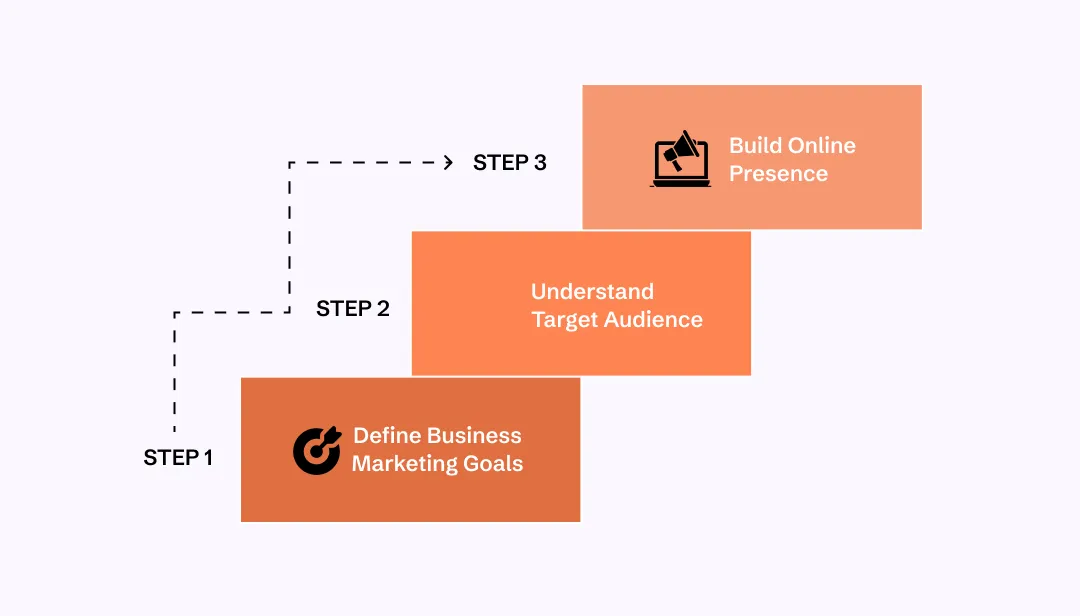
Before executing marketing tips for small business, you must have a structural foundation.
Defining Your Small Business Marketing Goals
Your digital efforts must align with your overarching business objectives. Are you looking for lead volume, brand authority, or direct e-commerce sales?
- SMART Goals: Ensure your goals are Specific, Measurable, Achievable, Relevant, and Time-bound. For example: "Increase organic leads by 20% in Q3 through a dedicated marketing strategies for small businesses."
Understanding Your Target Audience
You cannot market to everyone. You must define your Ideal Customer Persona (ICP).
- Audience Research: Use tools like LinkedIn insights to understand where your audience hangs out and what problems they are trying to solve.
Building a Strong Online Presence
Your website is your 24/7 salesperson. If it is slow, non-responsive, or confusing, you are losing money.
- Mobile Optimization: In 2026, mobile-first isn't a suggestion; it's a requirement for digital compliance.
- Google Business Profile: Essential for local discovery and accumulating the reviews that drive social proof.
Common Challenges in Small Business Digital Marketing (and How to Overcome Them)
The table below covers the most common barriers small business owners face when building a digital marketing operation, along with practical, resource-light solutions for each:
| Category | Challenge | Solution |
|---|---|---|
| Budget | Limited spend makes competing across channels difficult | Prioritize SEO and email for high ROI at low cost; scale paid only after proving organic traction |
| Time & Resources | Owners manage multiple functions; marketing gets deprioritized | Build a monthly content calendar; batch-create and schedule a week's content in one 2-hour session |
| Consistency | Sporadic posting erodes organic reach and brand credibility | Use Buffer, Later, or Meta Business Suite to schedule content in advance; consistency beats frequency |
| Technical Knowledge | SEO, analytics, and ad platforms have steep learning curves | Start with Google's free certifications; consider a fractional marketer before committing to a full agency |
| Channel Overload | Trying to be present on every platform dilutes results and budget | Select two channels based on where your target audience is most active; achieve depth before breadth |
| Attribution | Difficulty identifying which channel is actually driving revenue | Implement UTM parameters and GA4 goal tracking from day one; never rely on platform-reported ROAS alone |
| Trend Fatigue | Constant algorithm and platform changes cause strategy drift | Review strategy quarterly, not weekly; follow one reliable source (Search Engine Journal, HubSpot) for signal, not noise |
| Building Trust Online | New businesses struggle to establish credibility on digital channels | Actively collect reviews, publish case studies, display credentials, and respond publicly to all feedback — positive and negative |
| Ad Performance | Paid campaigns burn budget without converting | Never run ads to an unoptimized page; test creative and copy at a small spend before scaling any campaign |
| Measuring ROI | Connecting marketing activity to actual business revenue | Define conversion events (form fill, phone call, purchase) in GA4; review cost-per-conversion monthly, not CPC or impressions |
Conclusion
The transition from a beginner to a master in digital marketing for small business is not about knowing every tool; it's about understanding your audience and being consistent. The long-term impact of a consistent digital strategy is not just more traffic. It is the creation of a solid, scalable asset that works for you 24/7.
The journey from a startup to an authoritative brand requires a commitment to data, a focus on user intent, and the courage to experiment. Start with the foundation: your website, your Google Business Profile, and one content channel. Build your email list from day one. Track every action that matters. Then expand methodically, with data, one channel at a time.
Frequently Asked Questions
What is the most effective starting point for digital marketing for small business?
Build a fast, clean website first. Accuracy counts. You must verify your Google Business Profile immediately. Local search intent captures the fastest revenue for your company. This is the cornerstone of small business digital marketing.
How do I choose between different small business marketing solutions?
Match your tools to your actual sales volume. Demand deep CRM integration. If the software fails to automate lead follow-up, it is useless. Most effective small business internet marketing solutions focus on removing manual friction. Just focus on closing.
Can you provide actionable online marketing tips for small business owners?
Ignore the hype. You do not need to be on every social media app. Find where your actual buyers live and stay there. One of the best digital marketing tips for small business involves using authentic video content. Trust always beats a high production budget.
Is marketing for online business different from traditional brick-and-mortar?
Human psychology doesn't change. But digital requires proof at every turn. Frictionless UX is your digital lobby. In an online marketing small business, fixing a broken checkout funnel is the only way to stop losing profit. Remarketing handles high abandonment.
What are the primary benefits of digital marketing for small businesses?
You get surgical control over who sees your brand. Stop paying for generic reach. This precision makes marketing far more profitable than old-school print. You can pivot your strategy in minutes based on real data.
What are the best internet marketing tips for small businesses on a budget?
Stop creating from scratch. A single blog can fuel your social feed for an entire month. This is one of the key marketing tips for a business move to lean teams. Target specific, low-competition phrases. They cost less and convert better.

Uncover executable insights, extensive research, and expert opinions in one place.
Related Content