Share It On:
 A no-fluff look at the different types of search engines and how to pick the one that fits your business.
Type something into a search bar, hit enter, and answers show up in less than a second. Feels like magic. Behind that little box sits a piece of software built for a very specific job, and there are way more flavors of it than most people ever stop to think about.
Truth is, most of us only think about one search engine. You know the one. But if you run a business or you're building a product, the different types of search engines start to matter. The tool that's brilliant at finding a pizza spot near you is pretty much useless when you need to search ten million internal documents in seconds.
So this is a plain-English search engine guide. We'll cover how these things really work, the main types you'll bump into, a few niche ones worth knowing about, and how to pick the one that fits what you're doing. Let's get into it.
How Do Search Engines Work
Let's first take a look at the engine before we discuss the search engines available. No matter their type, nearly every one of them follows the same script.
First, there's crawling
Little automated bots (also known as spiders or crawlers) visit and check your content. In the online world, that entails clicking links and reading the web pages. In a company system, it may imply scanning of files, e-mails and databases.
Then comes indexing
The entire content that is scanned is catalogued and sorted into a massive database, similar to a librarian cataloguing books to locate them later. If no index is present, each search would have to read it all over again, which would be very slow.
Last is ranking
As you start typing a query, the engine checks through its index and determines which results to display first. The secret sauce is in there! So each engine has its own rules and signals, and that's why you may get vastly different answers to the same question from two different search engines.
That's the whole loop. Crawl the web, file it, rank it and repeat. Keep in mind, though, that there are not many differences between types of engines, as they mostly differ in what they search and how they rank.
Different Types of Search Engines
Alright, here's the main event. These are the big categories you'll run into most often.
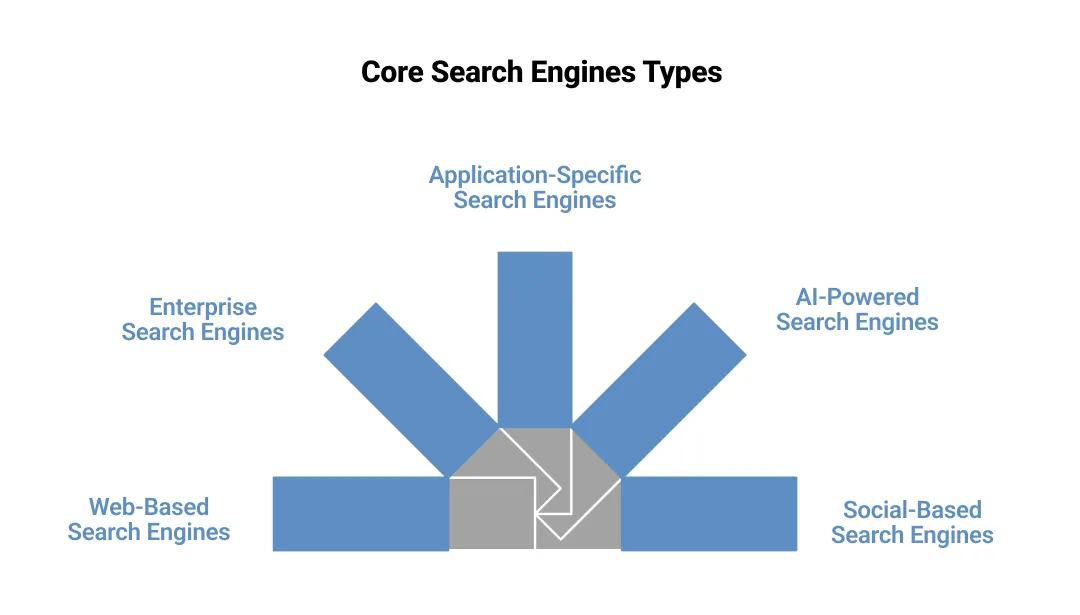
1. Web-based search engines
This is a classic. The general-purpose engine that crawls the open internet and tries to answer literally anything you throw at it. Where's the nearest gym? What year did the Titanic sink? How do I boil an egg? These engines are built for breadth, not depth, and they've gotten scarily good at guessing what you mean.
They make their money mostly through ads, which is worth remembering when you wonder why the top results sometimes feel a little salesy.
Search engine examples: Google, Bing, Yahoo, Baidu, and Yandex.
2. Enterprise search engines
Now we go behind the company firewall. An enterprise search engine doesn't care about the open web. Its whole job is helping employees find stuff inside an organization: documents, spreadsheets, support tickets, chat logs, internal wikis, all of it.
If you've ever worked somewhere with thousands of files scattered across a dozen tools, you get why this matters. A good one saves people hours of digging every single week. These usually come with tight permission controls, too, so folks only see what they're allowed to see.
Search engine examples: Elasticsearch, Apache Solr, Coveo, and Glean.
3. Application-specific search engines
These live inside a single app or platform and only search that platform's content. The search bar on a streaming service that finds you a show. The one on a music app that pulls up a track. The product search on a massive online store.
None of them are crawling the web. They're searching one tightly controlled catalogue, which lets them be lightning fast and weirdly accurate within their own little world.
Search engine examples: the search inside Amazon, YouTube, Netflix, and Spotify.
4. AI-powered search engines
This is the new kid, and it's shaking things up. Instead of handing you a list of blue links to sift through, AI-powered engines use Generative AI to read the sources and write you a direct answer (often with references baked right in). You ask a full question in normal language, and you get something that reads like a person explaining it back to you.
These engines are great for getting a quick grip on a topic, but you still want to double-check anything important. The space is moving fast, and a lot of the classic engines are now bolting AI answers right on top of their normal results (Like Google).
Search engine examples: Perplexity, ChatGPT's search, and Google's AI Overviews.
5. Social-based search engines
A huge chunk of younger users now start their searches inside social apps instead of a traditional engine. They're hunting for a restaurant, a product review, a how-to, and they want to see it, not read ten paragraphs about it.
So the search bar inside a social platform has quietly become a real search engine in its own right. If your audience skews young, social search engine types are not a side note. It's where a lot of buying decisions begin.
Search engine examples: TikTok, Instagram, Pinterest, and Reddit.
Some Niche-Specific Search Engines
Beyond the big buckets, there are a myriad of specialized tools. Not all of them are needed, but it helps to know they are available. These are some search engines that cater to specific needs:
- Site search engines: It is a search box that is located on a particular website and only searches through the pages of that website. With content or products, you don't want visitors to bounce when they can't find it on your website, so a strong search engine for your website is needed. Many of these are powered by tools, such as Algolia.
- Privacy-based search engines: These do not track you or log your searches or create a profile of you to sell ads on. If you've been hunting for the best Google search alternatives because the tracking creeps you out, this is your lane. The go-to alternatives are DuckDuckGo, Brave Search, and Startpage.
- Academic search engines: Built for research papers, journals, and citations rather than blog posts and shopping links. Students and researchers basically live in these. Think Google Scholar, Semantic Scholar, and PubMed.
- Metasearch engines: Instead of running their own index, these pull results from several other engines at once and mash them together. Handy when you want a wider net. Dogpile is the old-school example.
- Shopping and visual search engines: These are created specifically for the goods; they enable you to search with an image rather than by text. Take a picture of a chair that you like, and find stores that sell it.
How To Choose A Search Engine That's Right For You
So which one do you actually need? Depends entirely on what you're trying to do. A few honest questions to ask yourself:
What are you searching for, and where does it live? If it's the open web, a general engine is fine. If it's your own internal mountain of files, you want enterprise search. If it's the content on your own site, you want a dedicated site search setup.
Who's using it? A research team and a sixteen-year-old looking for sneakers do not want the same thing. Match the tool to the human.
How much does privacy matter? For some teams, it's a nice-to-have. For others, the ones handling sensitive data, it's the whole ballgame.
Do you want direct answers or a list to explore? If your users want fast, summarized replies, an AI-powered option makes sense. If they like to browse and compare, a traditional results list still wins.
And if you're thinking about visibility rather than just usage, that's a different game entirely. Showing up across all types of search engine where your customers hang out is its own discipline. A proper search engine marketing guide will walk you through paid and organic strategy, but the first step is just knowing which engines your people use.
Key Components of a Search Engine
Whatever the type, the good ones tend to share the same core parts. If you're ever sizing one up, these are the bits to poke at.
1. The crawler
The component that goes out and gathers content, whether that's web pages or internal files. A weak crawler misses stuff, and you can't rank what you never found in the first place.
2. The index
The organized database where everything gets stored and structured. The better the index, the faster and more accurate the results. This is the unglamorous backbone nobody talks about but everyone relies on.
3. The ranking algorithm
The brain of the operation. It decides what shows up first and in what order. This is where engines really differ from each other, and it's usually the part companies guard most closely.
4. The query processor
The part that figures out what you meant when you typed something messy or half-spelled. Good query processing handles typos, synonyms, and natural phrasing without making you work for it.
5. The interface
The face of the whole thing. The search bar, the filters, the way results are laid out. You can have a killer engine underneath, but if the interface is clunky, people will hate using it anyway.
Conclusion
The thing nobody tells you when they explain the different kinds of search engines out there: you almost never have to pick just one.
The smartest setups mix and match. A business might run a general web engine for everyday lookups, an enterprise tool behind the scenes for its own files, a slick site search for its customers, and lean on AI-powered answers when speed matters. Each one does what it's best at, and together they cover way more ground than any single tool could on its own.
So instead of asking "which search engine is the best," the sharper question is "which combination fits how my people really work?" Figure that out, and you stop fighting your tools and start finding things. Funny how rare that feels these days.
Frequently Asked Questions
What are the different types of search engines I should know about?
The big ones are web-based, enterprise, application-specific, AI-powered, and social-based engines. Each handles a different job, so the right pick depends on what you're searching and who's doing the searching for you.
Are there really that many different types of searching engines?
Yep, more than most people expect. Beyond the mainstream ones, you've got privacy-focused, academic, metasearch, and site-specific options. The full list of search engines is long, but you only ever need the few that fit your needs.
What's the best search engine for website owners?
A dedicated site search tool is your friend here. It only searches your own pages, loads fast, and stops visitors from leaving when they can't find what they came for. Algolia and similar tools are popular picks.
What are the best Google search alternatives for privacy?
If tracking bugs you, privacy-first engines are the move. They don't profile you or sell your data to advertisers. The popular ones skip the data collection entirely while still giving you solid, relevant results for everyday searches.
How is Generative AI changing search engines?
Generative AI lets engines read sources and write you a direct answer instead of just listing links. It's faster and feels more natural, though it can occasionally get things wrong, so double-check anything that really matters to you.

Uncover executable insights, extensive research, and expert opinions in one place.
Related Content