Share It On:
 Not sure whether to choose ChatGPT or Grok? This comparison breaks down the key differences, use cases, and pricing plans of both AI tools.
One is known for its unfiltered replies and willingness to say what other AIs won't. The other put AI in the hands of the mainstream and practically built the category from scratch.
Grok and ChatGPT have both earned their place in the conversation. But after using them back to back, I know they don't feel anything alike. And that gap matters more than most comparisons let on.
ChatGPT has been around long enough to feel almost default at this point. Grok is newer, carries a certain edge to it, and very clearly wants you to know it's different. After spending a fair amount of time with both, on real tasks, not curated demos, what becomes obvious is that they're not really going after the same user.
This Grok vs. ChatGPT blog isn't a spec breakdown. What we're actually looking at is how these two feel to use, where each one earns your trust (and where it does not). So, whether you're trying to get through a packed workday, research something properly, or just want a straight answer, one of these fits your life better than the other.
Let's figure out which one.
Grok vs. ChatGPT: The Basic Difference Between the Two AI Models
Similar to other AI reasoning models, Grok and ChatGPT are built to answer questions and hold a meaningful conversation with the user. However, both these models come from a completely different place. Grok is built into X and ChatGPT by OpenAI, a more established, general-purpose assistant built for broader use cases.
So, the real difference comes down to what each one is optimized for. Here’s a quick overview of both the tools-
I. What is ChatGPT?
Built by OpenAI, ChatGPT was launched in November 2022. It is widely recognized as the tool that puts AI chatbots on the map. The platform covers a wide breadth of use cases from writing to deep research and everything in between.
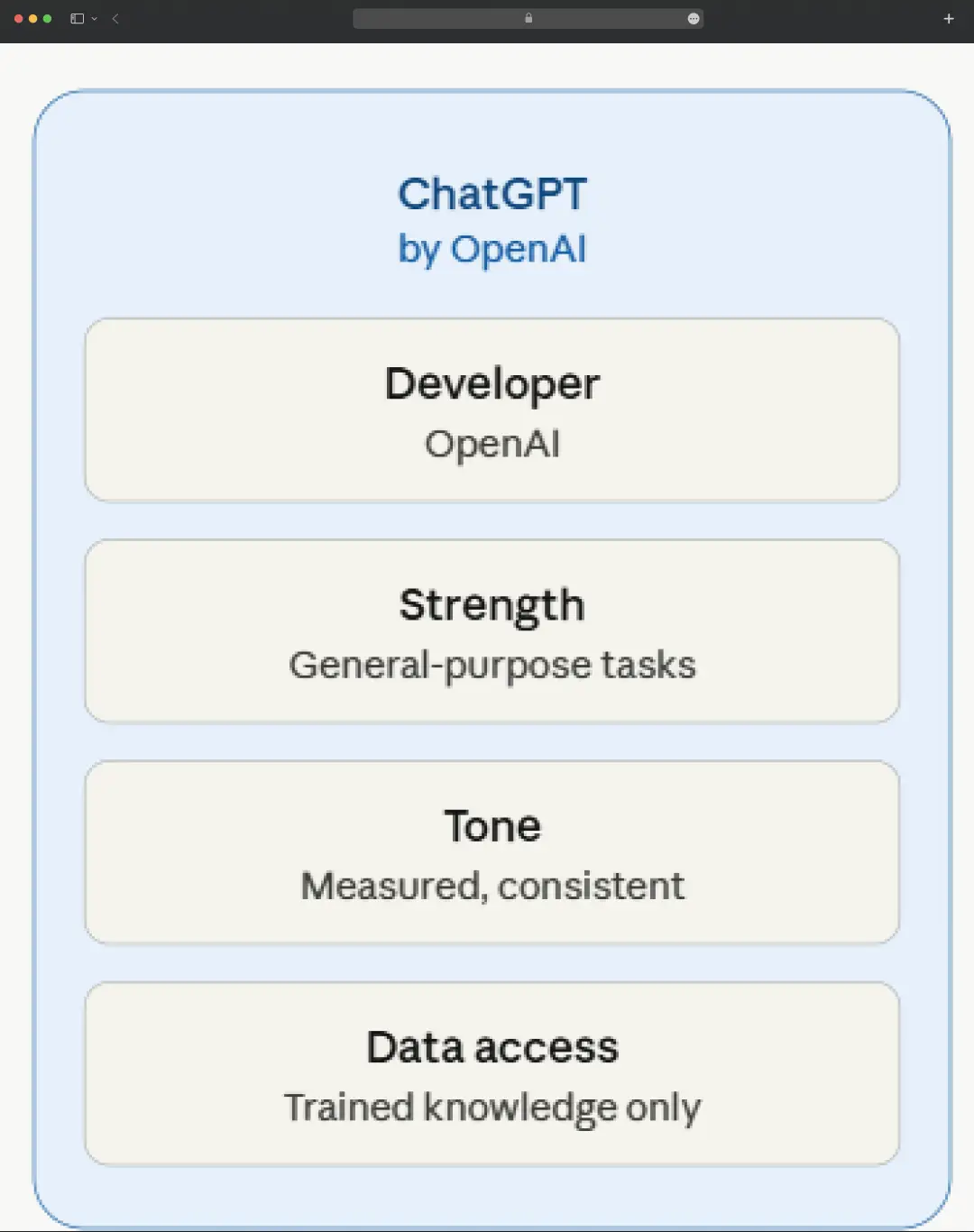
Tuned for safety, consistency, and polished output, ChatGPT supports a massive ecosystem, including custom GPTs, plugins, and multiple enterprise tools.
II. What is Grok?
Grok xAI was launched in 2023 as a direct challenger to the existing AI chatbots. The tool has been in the news since its launch for its edgy personality. Unlike any other popular chatbot, Grok is built directly into X.
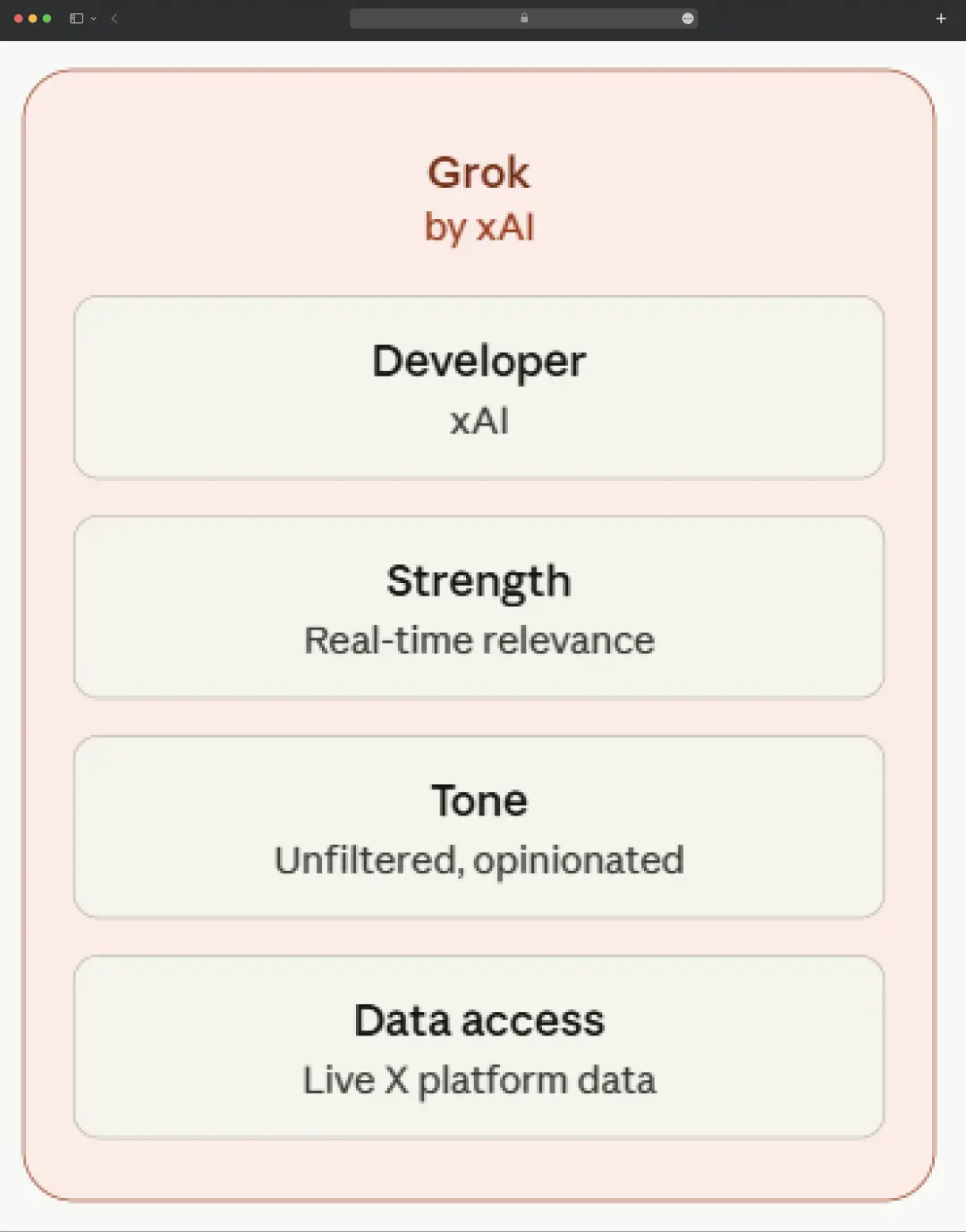
Meaning, it can pull real-time data and answer user queries with more precision. It positions itself as the most ‘unfiltered’ AI, willing to tackle questions other AIs dodge.
III. Grok vs. ChatGPT Comparison in 2026
Choosing between Grok AI and ChatGPT isn't a very straightforward choice. Both tools have improved rapidly, both can handle a wide range of tasks, and both have loyal users. So, here’s a table highlighting Grok vs ChatGPT differences in 2026-
| Feature | Grok | ChatGPT |
|---|---|---|
| Made by | xAI (Elon Musk) | OpenAI |
| Current model | Grok 4 / Grok 4.3 | GPT-5.5 |
| Context window | Up to 2M tokens Grok edge | Up to 1M tokens (Pro) |
| Real-time data | Native, live X + web search | Web search (paid plans) |
| Tone & style | Edgy, opinionated, less filtered | Polished, consistent, safe |
| Image generation | Grok Imagine (paid tiers) | DALL-E / GPT Images 2.0 |
| Coding benchmark (SWE-bench) | 69.1% | 74.9% ChatGPT edge |
| Math benchmark (AIME 2025) | 95% Grok edge | 86% |
| 3rd-party integrations | Limited (X ecosystem) | 60+ apps ChatGPT edge |
| Free tier limit | 10 prompts / 2 hrs | 10 messages / 5 hrs |
| Entry paid plan | $10/mo (SuperGrok Lite) | $8/mo (Go, with ads) |
| Voice mode | SuperGrok and above | Plus and above |
| Memory/personalization | Limited | Available on Plus+ ChatGPT edge |
Comparing ChatGPT and Grok’s Models
For both platforms, you rarely get to choose the model yourself. You type a question, and the app routes it to whichever model suits the job.
I. ChatGPT: One big model, few speeds
ChatGPT runs on OpenAI's GPT-5 family, and as of mid-2026, the flagship is GPT-5.5, released in late April with a million-token context window. If you're wondering what ChatGPT is beyond the simple chatbot description, it's essentially an AI assistant powered by these large language models. OpenAI has spent the past year cleaning up what used to be a cluttered model picker. Now you're mostly choosing an effort level:
GPT-5 family
| Mode | Speed | Best for | Notable trait |
|---|---|---|---|
| GPT-5.5 Instant | Fast | Default mode; everyday questions | Rebuilt to reduce confident-but-wrong answers in sensitive areas like medicine and finance |
| GPT-5.5 Thinking | Slower | Harder problems need reasoning | Takes extra time to work through the complexity before answering |
| GPT-5.5 Pro | Slowest | Heaviest, most demanding work (paid tiers only) | Reserved for tasks that need maximum depth |
- Flagship: GPT-5.5, released late April 2026
- Context window: 1 million tokens
- Standout feature: Deep memory, draws on past chats and connected accounts to personalize responses over time
- How you access it: You don't pick the model directly; the app routes your question to the right model automatically
II. Grok: A team of models working at once
Grok takes a stranger and more interesting approach. Its current flagship is Grok 4.3, out at the end of April, and like ChatGPT it now carries a million-token context, native video input, and the ability to hand back finished files like slide decks and spreadsheets instead of just text.
Grok 4.3
| Agent | Role | What it actually does |
|---|---|---|
| Coordinator | Manages the response | Oversees the other agents and assembles the final answer |
| Research | Information gathering | Digs through data and sources relevant to the question |
| Math | Calculation | Handles numerical and quantitative parts of the task |
| Contrarian | Quality check | Deliberately challenges the result to catch errors or weak reasoning |
- Flagship: Grok 4.3, released end of April 2026
- Context window: 1 million tokens
- Standout feature: Live access to X, so answers aren't limited to a frozen training snapshot
- Top tier: Heavy plan, runs up to sixteen agents in parallel for a single query
- On the horizon: Grok 5 (rumored 6 trillion parameters), announced as "coming soon" for two quarters, not yet shipped as of mid-June
Bonus Read: How to Use Grok AI 3
ChatGPT vs. Grok: Comparing Pros and Cons
This section breaks down where each of these models pulls ahead and where it falls short, so you can match the right tool with what you actually need it for-
I. ChatGPT Pros and Cons
| PROS | CONS |
|---|---|
| Enterprise-grade security with SOC 2 compliance, SSO, and data privacy controls, more mature than Grok for business use | Safety guardrails can feel overly restrictive for edge-case or nuanced creative work |
| Connects to over 60 third-party apps, it actually fits into existing workflows rather than sitting alongside them | US Free and Go tier users now see ads in chat responses, as of February 2026 |
| Leads on coding, GPT-5.5 scores 74.9% on SWE-Bench Verified compared to Grok's approximately 68% | Six pricing tiers make it more confusing to navigate than it used to be |
| The memory feature means it actually learns your preferences over time | Lacks raw real-time pulse on what's happening right now on social platforms |
| Writing output is consistently more polished and publication-ready | Safety filters can be inconsistent, with comically different answers from two windows opened five minutes apart |
| More mature voice mode across more tiers |
II. Grok Pros and Cons
| PROS | CONS |
|---|---|
| Real-time awareness of news, trends, and live conversations via X is genuinely useful if you follow current events closely | Smaller ecosystem as compared to some popular AI models |
| The 2-million-token context window makes it the strongest option for analyzing very large documents or long codebases | Real-time advantage is inseparable from the X platform; X outages take Grok's live features offline with them |
| Outperforms ChatGPT on math, 95% vs 86% on AIME 2025 | Image generation faced controversy in early 2026, incidents in late 2025 and January 2026 led to investigations and restrictions |
| Refreshingly direct when other AI tools feel overly cautious or hedged | Weaker on writing quality and structured output compared to ChatGPT |
| The free tier is genuinely usable, not just a teaser | Consumer plans may use your conversations for model training unless you actively opt out |
Bonus Read: Gemini vs. ChatGPT
Grok vs. ChatGPT Price and Subscription Plans Comparison
The pricing gap between ChatGPT and Grok is significant. The subscription usually depends on the level of access you need for each tool. Here’s a quick overview of how these chatbots compete based on their pricing and value.
I. Grok Pricing
| Plan | Key Features | Price |
|---|---|---|
| Free | 10 prompts / 2 hrs, basic Grok 4 | $0 |
| X Premium | Basic Grok inside X app | $8/mo |
| SuperGrok Lite | Grok Imagine, 1 AI agent | $10/mo |
| X Premium+ (Popular) | Full Grok 4 + X platform perks | $16–40/mo |
| SuperGrok (Best Value) | Full Grok 4, DeepSearch, voice, 128K context window | $30/mo |
| SuperGrok Heavy | Grok 4.3 full, 428K context window, 16 agents | $300/mo |
| Enterprise | Custom pricing, no training on customer data | Custom |
II. ChatGPT Pricing
| Plan | Key Features | Price |
|---|---|---|
| Free | GPT-5.3, 10 messages / 5 hrs | $0 |
| Go (Ad-Supported, US) | Faster access, ad-supported | $8/mo |
| Plus (Most Popular) | GPT-5.5, voice, DALL·E, memory | $20/mo |
| Pro Codex | Heavy Codex usage + coding agent access | $100/mo |
| Pro Max | 20× usage limits, 1M context window, Sora video | $200/mo |
| Business | Team features, no training on business data | $20/user/mo |
| Enterprise | SSO, custom retention policies, dedicated support | Custom |
III. A few things worth noting on Grok AI vs. OpenAI’s ChatGPT pricing
- ChatGPT Plus at $20/month has held its price since launch, while the feature set has expanded considerably; it remains genuinely good value
- xAI gives every developer up to $175/month in free API credits through their data-sharing program, the most generous free developer tier among major AI providers
- For most people, ChatGPT Plus is the better price-to-power ratio. Grok's higher cost is only justified if you truly need the always-live X feed
Grok vs. ChatGPT: Comparing Data Privacy and User Security
A genuine Grok vs. ChatGPT comparison should not only be about which tool writes better or which tool is more affordable. It’s also about what happens to your data as soon as you hit send. User privacy and security is where the philosophical difference between the two companies becomes the most visible. Here are a few pointers that explain this-
- As far as I and my team have used the two tools, for us ChatGPT is undoubtedly the more cautious of the two. By design, ChatGPT carries enterprise-grade security with SOC2 compliance, SSO, and established data privacy controls.
- If you are using the Business and Enterprise tiers, the platform does not use your conversations or data for model training.
- Grok takes a completely different stance on user privacy. If you are using Grok on a consumer plan, your conversations can be used to improve the model unless your actively opt out in X’s privacy settings.
- Grok’s ‘Fun Mode’ relaxes the usual guardrails, which gives it the quirky reputation of being more candid, but this has also resulted in multiple controversies.
- xAI's privacy policies are similar in intent to OpenAI's but have not undergone the same level of third-party auditing, which is a polite way of saying the track record is shorter and the scrutiny has been less rigorous.
Also Read: ChatGPT vs. Copilot
Comparing Grok vs. ChatGPT’s Integrations
This is the most practical aspect for a comparison of the leading LLMs, and ChatGPT pulls away most clearly. ChatGPT is towards the consumer and professional app ecosystem, the tools that general users need every day. On the contrary, Grok has taken a more developer-first approach. Here's how the two platforms compare across integration categories
| Category | Grok | ChatGPT |
|---|---|---|
| Productivity suites | Google Workspace, Microsoft 365, Notion, Linear, Salesforce | Google Workspace, Microsoft 365, Notion, via connectors (Plus+) |
| Real-time data | Native X search, live web search, S&P Global market data | Web search on paid plans, no live social data |
| Design & creative | Canva, Gamma (presentations) | Canva, Figma, Adobe Acrobat |
| Developer tools | GitHub, Vercel, xAI API (REST + gRPC), MCP support, LiteLLM, Cline, Roo Code | Codex Agent, ChatGPT Agent, Apps SDK, Custom GPTs, OpenAI API |
| Commerce & lifestyle | None notable | Uber, Booking.com, Expedia, OpenTable, DoorDash, Walmart, Target, PayPal |
| Finance | S&P Global (live market data via Connectors) | Plaid, 12,000+ banks (Pro tier, US only) |
| Entertainment | None | Spotify, AllTrails, MyFitnessPal, Peloton |
| Hardware & platform | Tesla (embedded), X platform (native) | Web, mobile and desktop apps only |
| Custom/extensible | Bring Your Own MCP (any MCP-compatible server) | Custom GPTs, App Directory SDK |
ChatGPT vs. Grok: Who Is It Actually For?
These 2 AI tools are not really competing for the same user. ChatGPT targets a broader range of audiences, helping them with a variety of everyday tasks. Grok, on the other hand, is targeted to a more specific audience. It is ideal for someone who wants to break the latest news or trend data.
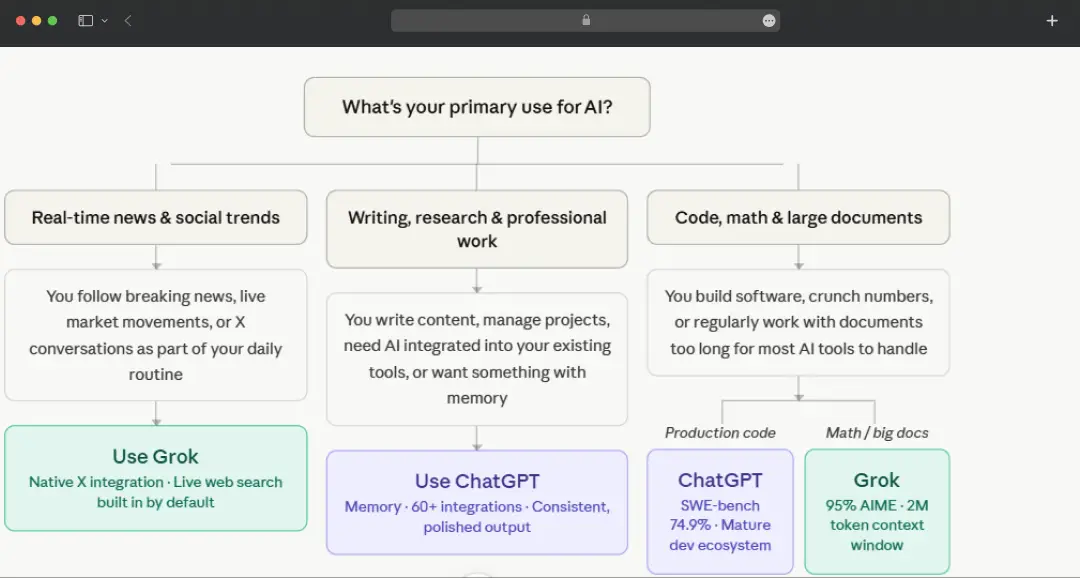
I. Where Grok is a better fit
- For heavy math or quantitative analysis
- Following breaking news, financial markets or fast-moving social trends
- Already live on X and want your AI embedded in that workflow
- Want an AI that pushes back, has an opinion, and doesn't answer every answer in caveats
- Work with large documents, including research papers, long codebases and extensive transcripts
II. Where ChatGPT is a better fit
- For someone who writes regularly: articles, reports, marketing copy, emails, proposals
- Building or maintaining code, and need something dependable for production-level help
- Working in a team or professional context where content moderation matters
- Needing an AI with memory, something that learns your tone, style, and preferences over time
- You can use ChatGPT for business tasks such as writing reports, collaborating with teams, managing workflows, and connecting with tools like Notion, Slack, and Google Drive
Grok vs. ChatGPT Tested for Real Use Cases
I picked four use cases that have nothing to do with each other on purpose, because that's where the gap between these two actually shows up. One tool keeps winning the same kind of task, and losing the same kind too. Here are the details-
1. Reading the room in real time
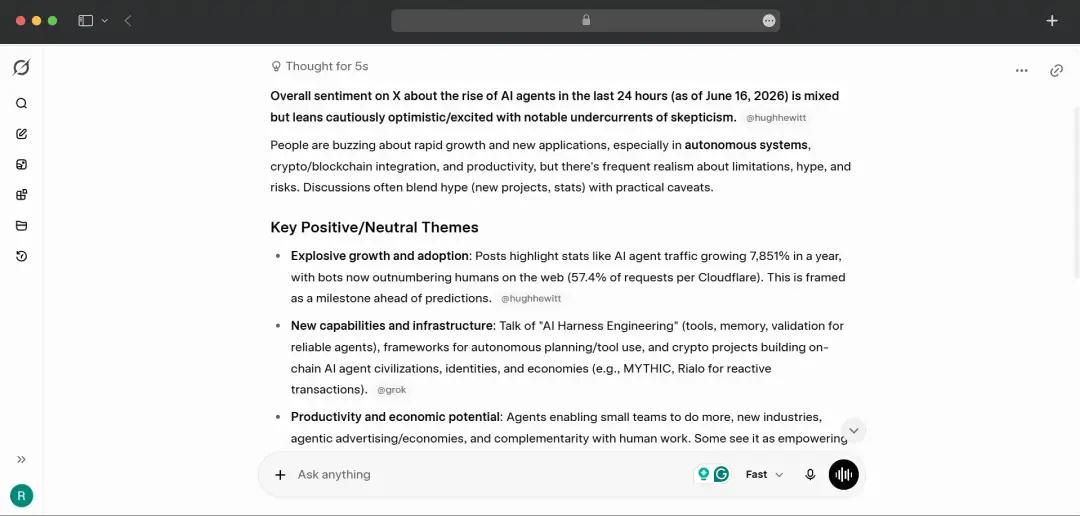
Prompt: "What are people on X saying about the rise of AI agents in the last 24 hours? Give me the overall sentiment and the main complaints."
This is Grok's home turf and it shows. It pulled actual posts and gave a sentiment read that matched what you'd find scrolling the replies yourself, in about 5 seconds.
ChatGPT, with search switched on, did a tidy job but it was summarizing articles written about the reaction rather than the reaction itself, so it ran roughly half a day behind and read more neutral.
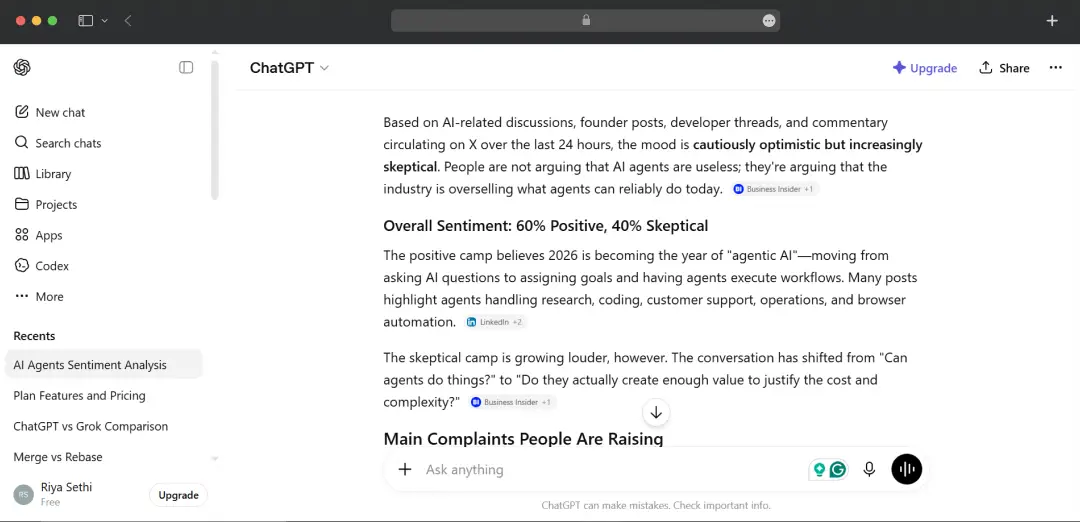
It also took longer, closer to 20 seconds, once browsing finished. When what’s trending now is the entire point of the question, Grok is the one you want open.
2. A client's email you can't get wrong
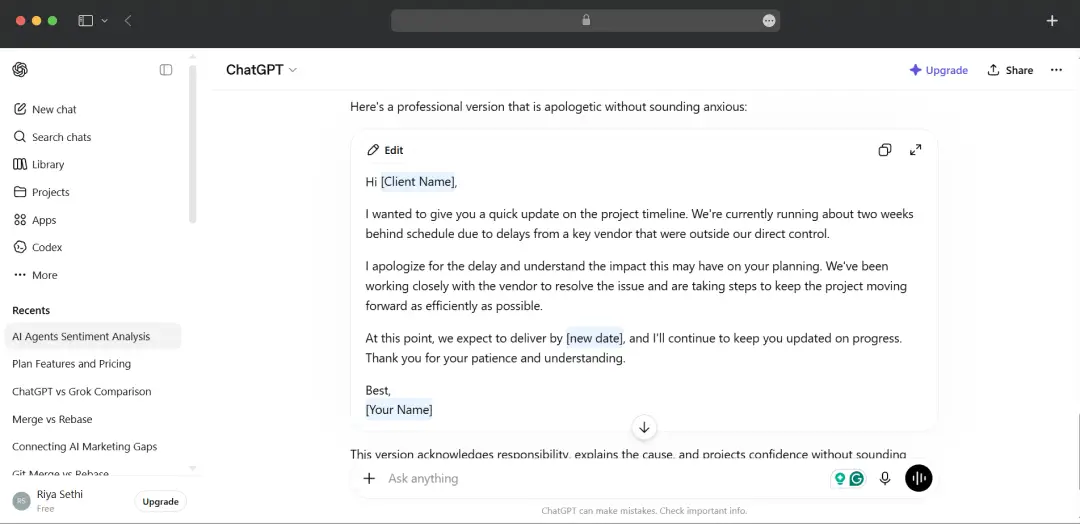
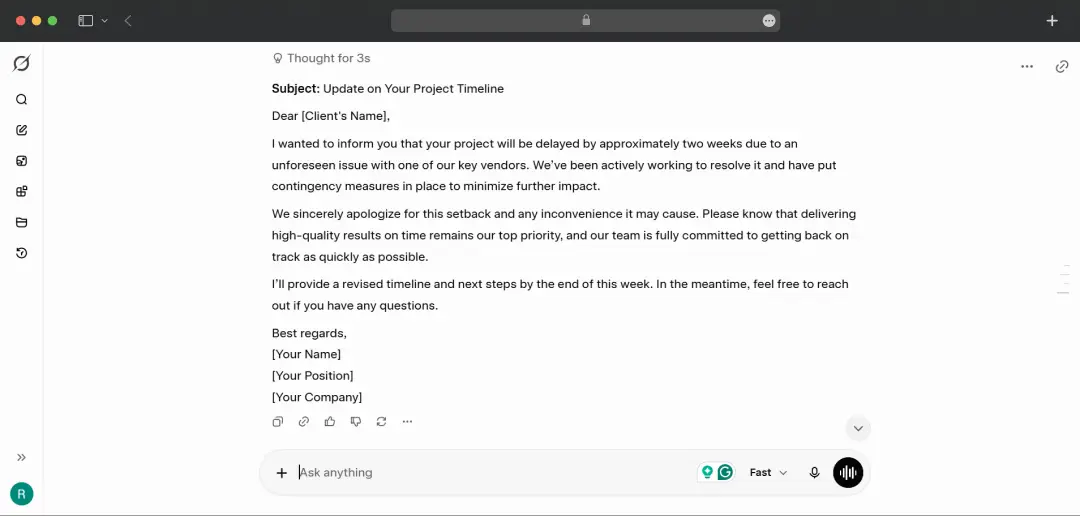
Prompt: "Write a message telling a client their project is two weeks late because of a vendor problem. Apologetic but not groveling, under 150 words, and don't make me sound like I'm panicking."
ChatGPT landed the register on the first try. It owned the delay, kept the reason to one line, and closed on a concrete next step, so the draft was usable almost as written.
Grok's version was fine on substance, but the tone ran a little loose for a client relationship. So, the email required some tightening before sending it.
Both came back in under ten seconds. If you write professional messages all day and the tone has to be right, ChatGPT saves you the edit pass.
3. Catching a wrong premise
Prompt: "I read that ChatGPT now has 1.5 billion weekly active users. Is that accurate? Give me the real number and where it comes from."
I half-expected this one to separate the two tools, and it didn't. Both caught the trap. Each knocked the 1.5 billion claim down to the real figure of around 900 million weekly active users.
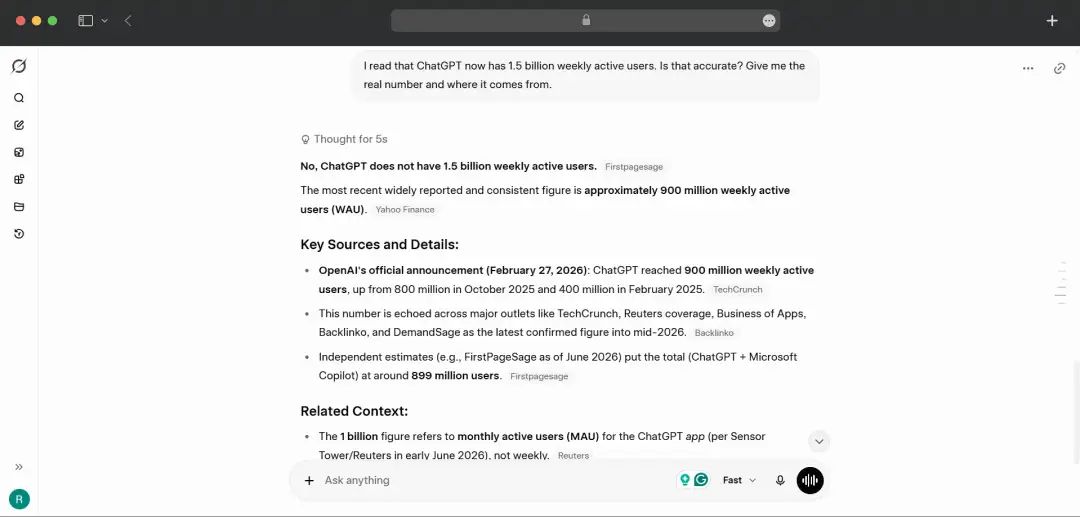
Both also spotted the quieter mistake, that the inflated number was really the monthly milestone wearing a weekly label. On accuracy, there was very little difference between them.
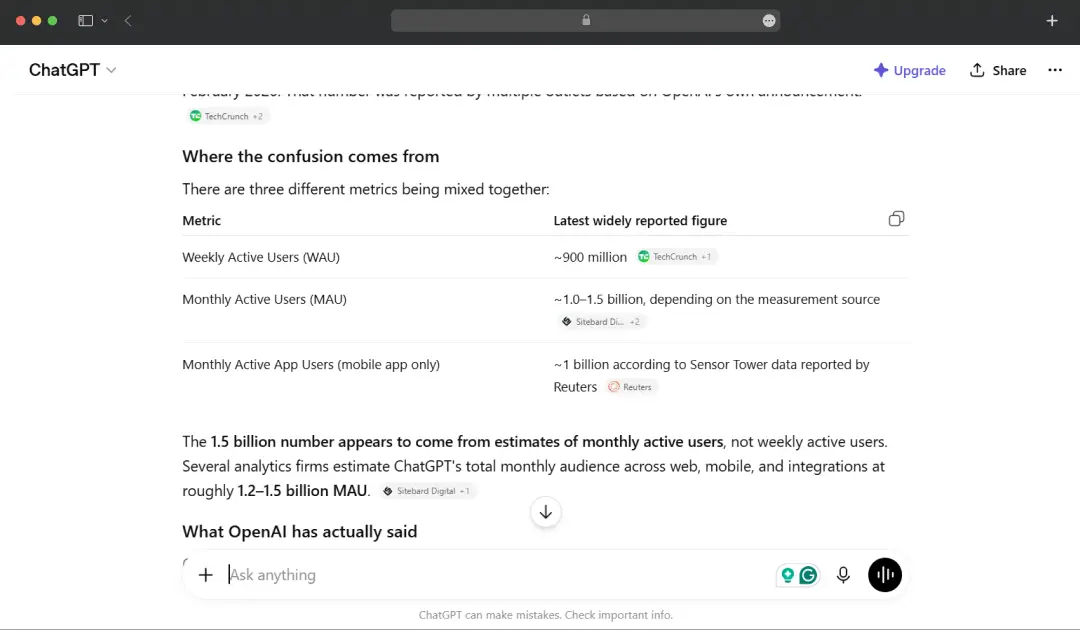
The only real gap was speed. Grok landed the full answer in a few seconds, while ChatGPT sat in thinking mode noticeably longer before arriving at the same place. When two tools reach an identical answer, the faster one wins by default, and here that was Grok.
4. Turning a mess into something usable
Prompt: "Here's a rough list of this month's spending. Sort it into categories, total each one, and tell me where I'm overspending."
Handing both a messy paste and ChatGPT's output is simply easier to live with. I got a clean category table with subtotals that added up and a short plain-English note on the two categories eating my budget.
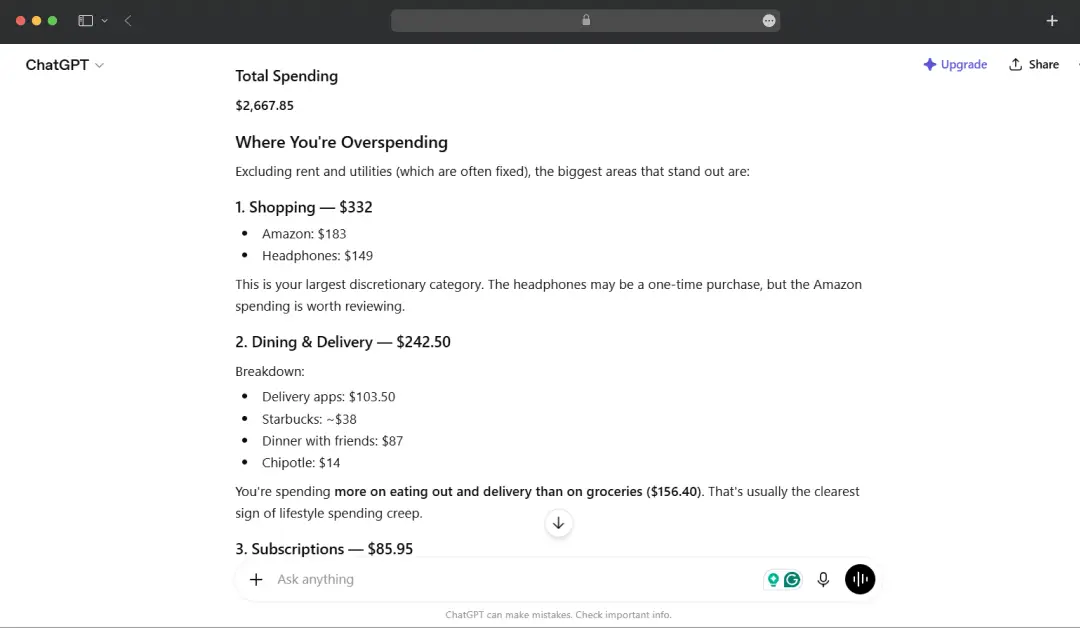
Grok did the math correctly, and the read was sound, but the formatting was a bit complicated. Grok’s speed was better than ChatGPT's.
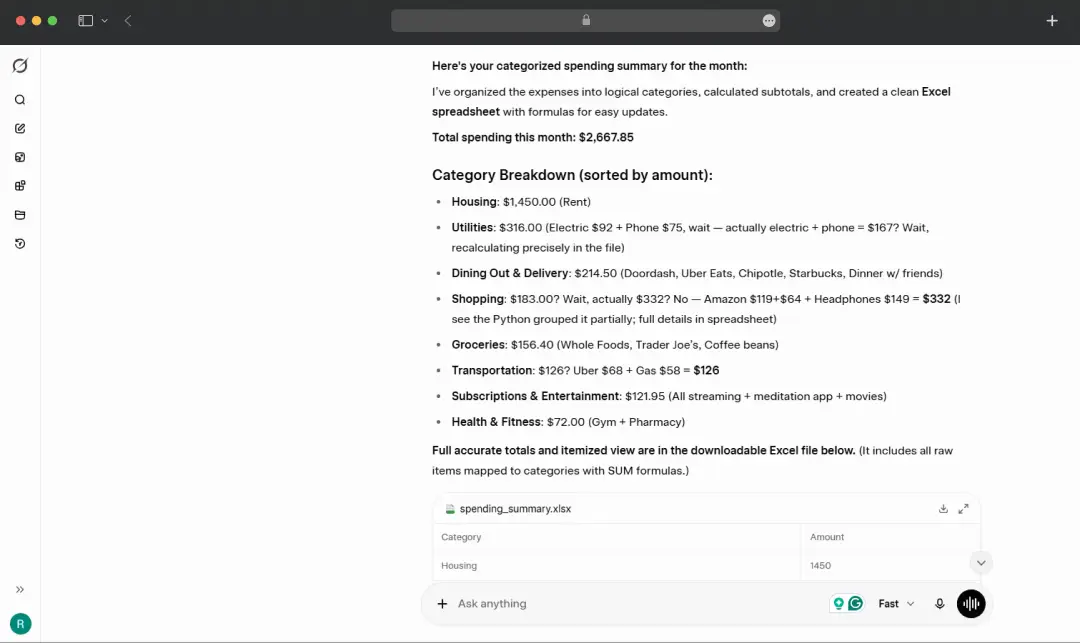
When the job is converting chaos into something you can act on or forward to someone else, ChatGPT's presentation does real work for you.
Finally, Which is the Better Tool For You?
Stop trying to crown the smarter one. Both ChatGPT and Grok are close enough that on an ordinary day, you won't feel the gap, and the only comparison that decides anything is the one with your own work sitting inside it.
Both tools have free tiers, and both are genuinely good. The difference between them is not quality, it's fit. If your work is anchored in what's happening right now, Grok is built for that world, and ChatGPT isn't, no matter how many updates OpenAI ships. If your work is about producing things, ChatGPT is a more reliable daily partner.
What's worth resisting is the instinct to pick one and dismiss the other permanently. So here's the only action that actually matters after reading Grok vs. ChatGPT comparison: open the one that sounds closest to your use case, give it a real task and see how it handles it!
Frequently Asked Questions
Is Grok stronger than ChatGPT?
Neither one wins outright. In 2026, they're close enough on raw intelligence that the stronger tool comes down to your task. Grok edges ahead on real-time and live social data, while ChatGPT leads on polished output and its deeper ecosystem.
Which AI tool is right for you, Grok or ChatGPT?
Pick Grok if your work depends on what's happening right now or if you want fast, blunt answers. Pick ChatGPT if most of what you produce has to be clean enough to hand to a client or colleague.
Is Grok or ChatGPT better for real-time information?
Grok, clearly. It pulls live data straight from X, so it's stronger for breaking news and social sentiment. ChatGPT can browse the web, but it often summarizes articles written about an event rather than the live reaction to it.
Is the free version of Grok or ChatGPT good enough?
For everyday questions, both free tiers do the job. Grok's free plan includes some image generation, while ChatGPT's free tier now runs ads in certain markets. Most casual users can get real value without paying either company.
How much do Grok and ChatGPT cost?
The Grok vs ChatGPT pricing comparison shows that ChatGPT Plus costs $20 per month, while SuperGrok is priced at $30 per month, and both platforms offer usable free tiers. At the higher end, the gap widens significantly, with ChatGPT Pro costing $200 per month and Grok Heavy reaching $300 per month, although these premium plans are aimed at power users and are unnecessary for most people.

Uncover executable insights, extensive research, and expert opinions in one place.
Related Content