Share It On:
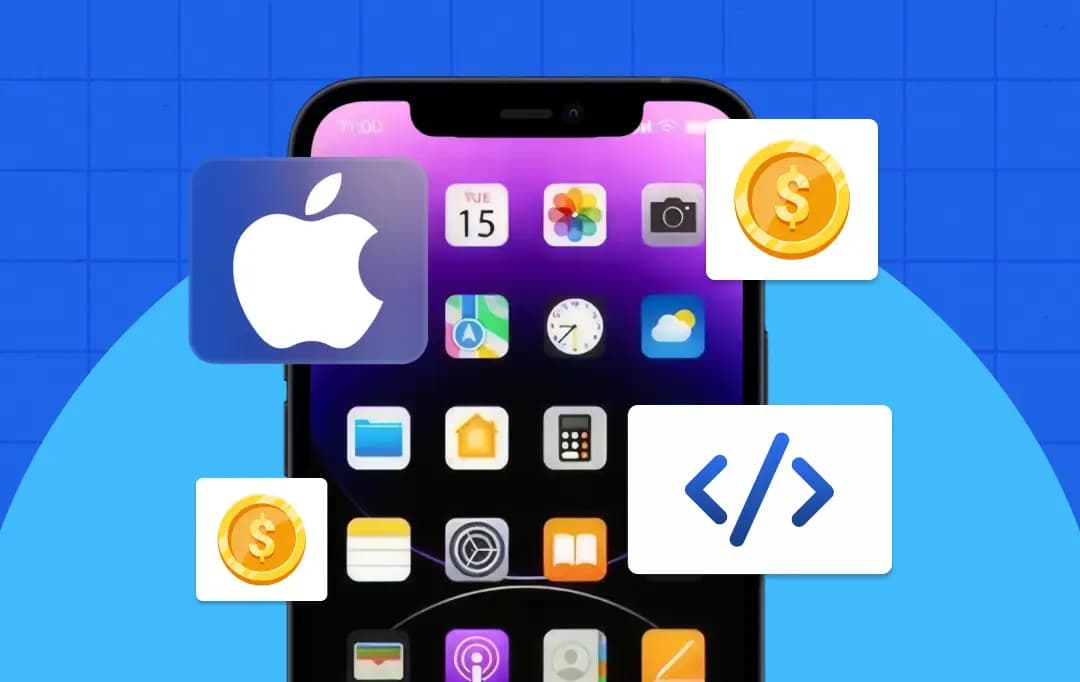 The iOS app development cost in 2026 sits anywhere between $25,000 for a functional utility and $250,000+ for a secure, scalable ecosystem.
In the current tech climate, asking "how much does iOS app development cost?" is like asking "how long is a piece of string?" The answer depends entirely on who is holding the scissors. You aren't just paying for Swift code anymore. You are funding architectural defense, compliance with increasingly aggressive digital laws, and the kind of seamless "intelligence" users now demand as a basic right. And for a short answer, the iOS app development cost can start from as low as $25,000 and can go beyond $250,000. The range is high, so the answer entirely depends on what you’re planning to build.
A clean, simple interface often hides a messy, expensive backend of API calls and data syncing that drives the budget from a manageable five figures to a daunting six.
Everything you’re going to read ahead isn’t a sales pitch. It’s a breakdown of the financial machinery behind iOS development in 2026—tracking the money from the high-rent design studios of San Francisco to the code foundries of Bangalore and the emerging tech boutiques of Vietnam.
Factors Affecting the Cost of Building an iOS App
To get a real number, you have to dissect the anatomy of the project. The final bill is always a collision of three things:
- the density of the logic,
- the pedigree of the engineers,
- and where those engineers sleep at night.
iOS app development trends have swung hard toward modular, component-based builds. It saves you technical debt later, sure, but it demands you pay for smarter architects upfront.
1. The Execution Model: Who is Building It?
The how matters as much as the where. Choosing between an agency and a freelancer isn't just a price choice; it's a risk-management choice. While iOS app development agency pricing can be higher, you get backup developers here. With freelancing, the person you hire decides when you will get your project.
| Model | Avg. Hourly (US) | Pros | Cons |
|---|---|---|---|
| Freelancer | $50 - $120 | Low overhead, direct access. | High "bus factor" (if they disappear, you're stuck). |
| In-House | $75 - $150 (CTC) | Total cultural alignment. | Massive fixed burn; benefits/equity costs. |
| Agency | $150 - $250 | Baked-in PM, QA, and DevOps. | Most expensive; less direct control. |
2. Geography & The "DMA Tax"

Experts like Matt Tubergen of Digital Turbine always advocate for compliance, such as DMA. It’s not about just meeting market requirements, but also about keeping your app fair.
But here’s the truth: Building in-house is a control freak’s game. When you hire iOS app developers directly, you are entering a global bidding war. In 2026, the Digital Markets Act (DMA) in the EU introduced new complexities.
If you're targeting European markets, budget an extra 40-60 hours for implementing alternative payment reporting and compliance audits.
3. Country-Wise Breakdown (2026 Estimates)
| Country | Hourly Rate (Local) | Hourly (USD) | Hourly CTC (USD) | Annual Salary (USD) | Est. CTC (USD) | Notes |
|---|---|---|---|---|---|---|
| USA | $56.56 | $56.56 | ~$73.56 | ~$117,645 | ~$153,000 | National average; coastal cities push higher |
| UK | £41.46 | ~$52.65 | ~$65.87 | ~$109,521 | ~$137,000 | London skews high; heavy GDPR/DMA compliance |
| India | ₹830 | ~$10.00 | ~$12.00 | ~$20,800 | ~$24,960 | Typical for mid-level developers outside Tier-1 agencies |
Note: The hourly CTC includes benefits, taxes, tools, and more such costs.
4. Complexity of the Project
Complexity isn't just about how many screens you have. It's about "logic density"—how hard the app has to think. Mobile app developers don't bill you for the button; they bill you for what happens after the button is clicked.
Identifying the types of app development early saves you from the "feature creep" that kills budgets. If you don't need a proprietary chat system, don't build one. Rent it.
- Simple Apps: Digital brochures are simple to build. They read data, maybe write a little local file. Low risk, low cost.
- Medium Apps: The commercial standard is covered here. User logins, real-time fetching, and payment gateways. This is where the bulk of the market lives.
- High Complexity: Ecosystems that require dynamic actions. Real-time media streaming, heavy encryption for health data, and onboard AI processing. These iOS apps are beasts.
5. The Backend Decision Matrix
Your choice of architecture, while influencing the complexity, can also swing costs by $20,000–$80,000:
- BaaS (Firebase/Amplify): Fast and cheap upfront, but "scaling tax" hits hard later.
- Serverless (AWS Lambda): Pay-per-use logic. Great for unpredictable traffic.
- Microservices: The gold standard for ecosystems. Expensive to build, but won't break when you hit 1M users.
| Complexity | Features | Est. Hours | Team Cost (US Blended ~$74/hr) |
|---|---|---|---|
| Simple | Standard UI, Login, Local Data | 300 – 600 | ~$45,000 |
| Medium | Custom UI, Payments, Microservices | 600 – 1,200 | ~$135,000 |
| High | AI/ML, visionOS, HIPAA Compliance | 1,200+ | $250,000+ |
A Note on Numbers: You will see a jump between individual developer rates and team budgets. Earlier cost ranges assume individual developer modeling. The team-based estimates below reflect real-world multi-role execution (PM, QA, Design).
6. UI/UX Design
Apple’s ecosystem is allergic to ugly software. In 2026, friction is the enemy. The app development process now allocates nearly 20% of the timeline just to design. Why? Because fixing a usability flaw in a Figma file costs $100. Fixing it in code costs $10,000.
| Design Tier | Hours | Cost (US Rates) | Notes |
|---|---|---|---|
| Basic | 40 - 80 | $4,000 - $8,000 | Stock Apple kits. Functional, boring. |
| Polished | 100 - 200 | $10,000 - $20,000 | Custom branding, dark mode, unique identity. |
| Premium | 250+ | $25,000+ | Motion design, haptics, obsession with detail. |
Note: While it’s more of a design-focused budget, we are including this in the overall total to ensure your "Day 1" budget is realistic and covers the full visual polish users expect.
7. Extra Costs
Beyond the talent, you have to pay the toll to cross the bridge. These are fixed app development costs. They don't care about your budget.
| Cost Item | Exact Name | Amount |
|---|---|---|
| Developer Program | Apple Developer Program | $99/year |
| Enterprise Program | Apple Developer Enterprise | $299/year (optional) |
| App Store Fees | Apple commission | 15–30% per sale |
| CloudKit | CloudKit Database/Storage | Usage-based |
| Hardware | Mac Hardware for Dev | ~$599+ approx |
| Publishing | App Store submission | Included in the program |
If you plan on adding in-app purchases to the app, remember that Apple's 15-30% cut isn't a dev cost—it's a revenue tax. But it changes the ROI math fundamentally.
|
Already Getting Tired Of Huge Numbers? Connect with app development experts in India to optimize budgets better! |
Ongoing Costs to Consider in Your iOS App Development Budget
Launch day isn't the finish line. It’s the start of the bleeding. The "Day 2" reality of software is that it needs fuel to keep moving.

1.Maintenance Costs
Code rots. It’s organic. New iOS updates break old layouts. Third-party APIs change their handshakes. The industry rule of thumb for app maintenance cost for iOS is 15% to 25% of the initial build price, every single year.
- Bug Fixes: You will find them. Or your users will.
- OS Updates: Apple keeps releasing newer iOS versions. Your app needs to be ready.
- Security: Patching holes before they become headlines.
2. App Store Commission Fees
The "Apple Tax" is the cost of doing business on the world's most lucrative shelf.
- Small Business: 15% on the first $1 million.
- Standard: 30% once you cross that line.
3. APIs
Modern apps stand on the shoulders of giants. You don't build a map; you rent it.
- Intelligence: Gemini or GPT integration ($0.01 - $0.10 per 1k tokens).
- Payments: Stripe (2.9% + 30¢ per transaction).
- Location: Mapbox or Google Maps (Usage-based).
4. Analytics & Monitoring Tools
- Mixpanel / Amplitude: $25 - $200+/month.
- Sentry: Essential for knowing why your app crashed before the user tweets about it.
5. CI/CD Pipeline & Dev Tools
Automation separates the pros from the hobbyists.
- Bitrise / CircleCI: ~$90/month.
- GitHub Enterprise: ~$21/user/month.
6. Business & Marketing Costs
Well, certain expenses that are all about promoting your app should be considered from the development stage itself. For example:
- ASO Tools: AppTweak or Sensor Tower ($69 - $500 monthly).
- Paid Ads: Apple Search Ads are now the primary way to get high-intent users. The cost-per-tap in competitive niches is brutal.
7. Additional Costs involved in iOS app development services:
Launching an app can invite trouble if not prepared beforehand. Here are some additional costs that can ensure your app’s survival in the market:
- Legal & Compliance: Data privacy isn't optional. Tools for GDPR, CCPA (like OneTrust), and PCI DSS audits are just part of operating expenses now.
- Support & Community Tools: Intercom or Zendesk ($50+/agent). Someone has to answer the emails.
- Content / CMS: Headless CMS solutions like Contentful ($100+/month) let marketing update the app without nagging a developer.
8. The Hidden Budget Killers (Risk Costs)
Software is unpredictable. If you don't budget for these, your project will stall at 90% completion.
- Timeline Compression: If you need a 6-month build done in 3, expect a 30-50% price premium. You aren't just paying for more hands; you're paying for the communication overhead of those hands.
- The "Privacy Manifest" Hurdle: Apple now requires explicit declarations for "Required Reason" APIs. Auditing third-party SDKs for compliance can add $3,000 - $5,000 in specialized QA.
- App Store Rejection Loops: If your app is in a regulated space (Finance/Health), one rejection can delay launch by 3 weeks, burning "holding" payroll for the whole team.
9. The AI Factor: Intelligence is a Moving Target
AI in apps is no longer a gimmick; it’s infrastructure. However, it introduces Token Volatility.
- Narrow AI: Fixed costs for specific tasks (OCR, Image tagging).
- Generative Agents: Running persistent open-source AI agents can blow up your server bill. In 2026, GPU cloud costs are inflating due to high demand. Budget for a 15% buffer in infrastructure for AI-heavy apps.
Calculating the Total Cost of a Medium-Complexity iOS App
Let’s pressure-test the numbers properly. Assume a 4-month roadmap for a commercial-grade iOS product—a logistics tracker, marketplace, or niche commerce app. Nothing experimental. Just solid, revenue-ready software.
This time, the math aligns with the US fully loaded CTC rate (~$73.56/hour) referenced earlier.
The Squad
- 1 Project Manager — scope control and stakeholder alignment
- 2 iOS Developers — architecture, features, integrations
- 1 UI/UX Designer — flows, interaction polish
- 1 QA Engineer — regression, device matrix, edge cases
- 1 DevOps Engineer — CI/CD, cloud stability, deployment
No vanity roles. No bloat. Just what the project realistically needs.
The Tab (Based on US CTC ~$74/hr Blended)
To simplify modeling, we use a blended team rate of ~$74/hour, consistent with earlier CTC calculations. Assume a 4-month roadmap for a commercial-grade iOS product. This reflects a fully loaded team (Squad) model:
| Category | Estimated Hours | Rate | Cost |
|---|---|---|---|
| Development (2 Devs) | 960 hrs | ~$74/hr | ~$71,040 |
| UI/UX Design | 120 hrs | ~$74/hr | ~$8,880 |
| Project Management | 160 hrs | ~$74/hr | ~$11,840 |
| QA & Testing | 200 hrs | ~$74/hr | ~$14,800 |
| DevOps & Deployment | 120 hrs | ~$74/hr | ~$8,880 |
| Infrastructure & Tools | — | — | ~$3,000 |
| Contingency (15%) | — | — | ~$17,100 |
Total Estimated Budget: ~$135,500
That’s the realistic midpoint for a professionally executed, medium-complexity iOS application built by a US-based team under a full employment cost structure.
Could this number shrink? Possibly.
Using cross-platform app development frameworks like Flutter or React Native might reduce engineering hours by 15–25%. But savings rarely arrive without trade-offs. Performance tuning becomes harder. Native animations feel less precise. Deep Apple ecosystem integrations demand more workarounds.
Budget optimization is a strategic choice. Luxury fintech brands rarely compromise on native polish. Internal enterprise tools often do.
The real decision isn’t whether to save money. It’s whether the performance difference matters to your users.
Case Studies: Where the Money Actually Goes
Budget sheets lie. To get the truth, you have to tear the engine apart. Here is the forensic reality of three app archetypes in the 2026 market—and why they cost what they cost.
1. The "Deceptively Simple" Utility (e.g., WaterMinder)

The Concept: Hydration tracker.
The Trap: It looks like a weekend project. It isn't. In 2026, a utility app lives or dies on retention, and retention is expensive. If the interface feels even slightly clunky, users delete it in four seconds flat. You aren't paying for features; you are paying for polish.
- The Tech: SwiftData handles the local storage, but the real work is HealthKit. It’s not just reading data; it’s normalizing it against the noise of Apple Fitness and Oura rings.
- The 2026 Requirement: Interactive Widgets. If a user has to unlock their phone to log a glass of water, you’ve already failed. They expect to tap the Lock Screen and be done.
- Where the Budget Bleeds:
- WatchOS Companion: A hydration app without an Apple Watch extension is basically dead inventory. That’s an immediate 20% hike in dev time.
- Physics: See that water "sloshing" inside the virtual glass? That micro-animation takes a senior dev $2,000 worth of hours to perfect.
- Real Timeline: 8 – 10 Weeks.
- The Check: $25,000 – $40,000 (Design-heavy).
2. The "Logistics Beast" Marketplace (e.g., DoorDash Clone)

The Concept: Hyperlocal on-demand delivery.
The Trap: You aren't building an app. You are building a three-headed monster: Consumer, Driver, and Merchant. All three have to talk to each other in milliseconds, or you lose money.
- The Tech: Node.js or Go on the backend to handle the traffic. Socket.IO keeps the bi-directional connection alive.
- The 2026 Requirement: Dynamic Island support. "Where is my food?" is a question the UI must answer without the user ever opening the app.
- Where the Budget Bleeds:
- The "State" Nightmare: Driver loses signal in an elevator. Customer cancels after pickup. The restaurant runs out of ingredients. Handling these edge cases is 40% of the engineering effort.
- The Math: Calculating delivery fees based on real-time traffic isn't a plugin. It’s a custom algorithm.
- Money Movement: You need Stripe Connect to split a $20 order three ways (Restaurant, Driver, Platform) instantly. One mistake here triggers a compliance audit.
- Real Timeline: 5 – 7 Months.
- The Check: $90,000 – $150,000 (Backend-heavy).
3. The "Digital Fortress" (e.g., Teladoc / Fintech)

The Concept: Telemedicine or High-Security Banking.
The Trap: The code is the easy part. The liability is the hard part. You are handling PII (Personally Identifiable Information) and PHI (Protected Health Information). One leak doesn't just crash the app; it ends the company.
- The Tech: WebRTC for secure video. HL7/FHIR standards if you want to talk to hospital records. AES-256 encryption everywhere.
- The 2026 Requirement: On-Device AI. Symptom checkers or document scanners must run locally on the user's Neural Engine. Sending that data to the cloud is a privacy risk you can't afford.
- Where the Budget Bleeds:
- Compliance is Architecture: You don't "add" HIPAA later. You build the database around it. Every query is logged.
- Video Stability: Building a Zoom clone is trivial. Building a video module that works on spotty 4G in rural areas without dropping the doctor? That is hard engineering.
- The Audit Tax: Before you launch, you pay a third-party for a Pen-Test (Penetration Test). That single security audit costs as much as a new Honda Civic.
- Real Timeline: 8 – 12 Months.
- The Check: $250,000 – $500,000+ (Security-heavy).
Smart Cost-Saving Strategies for iOS App Development

Cutting costs should never mean cutting capability. Smart optimization is about shifting investment toward leverage points that compound over time. Teams that understand evolving iOS app development trends know this well: cost discipline is strategic positioning, not penny-pinching.
The right moves can reduce burn without diluting product quality, while the wrong ones quietly introduce technical debt that explodes later. Below are practical, field-tested ways experienced product leaders reduce costs to create an iPhone app without sacrificing long-term value.
1. Rethink Geography Before You Rethink Scope
Talent arbitrage is still the most powerful lever.
The ecosystem of app development companies in India has matured into an industrial-scale engine. Depth is its advantage. Scaling from five engineers to fifty within weeks is realistic, especially for large roadmap builds. That kind of elasticity would strain hiring pipelines in the U.S. or Europe.
Meanwhile, app development experts in the UK tend to operate at a higher per-hour cost but offer strong regulatory familiarity for fintech and health products targeting European markets.
On the other side of the Atlantic, USA app development experts remain unmatched for high-stakes architecture and compliance-heavy ecosystems. The trade-off is cost density, not capability.
The decision isn’t about cheap versus expensive. It’s about alignment between budget tolerance and product ambition.
2. Choose the Right Hiring Model
When companies decide to hire iOS app developers, they often default to full-time in-house roles. That model offers control but locks capital into fixed overhead.
Hybrid structures are increasingly common. A lean internal core supported by remote mobile app developers can reduce fixed burn while keeping architectural ownership internal.
Outsourcing selectively—design in one region, backend in another—also creates cost flexibility without sacrificing delivery speed.
3. Define the Build Category Early
Misclassification kills budgets.
Understanding the true types of app development at the planning stage prevents feature creep. A transactional commerce app does not require the same infrastructure as a streaming ecosystem.
A disciplined app development process forces prioritization. Feature restraint early in planning prevents budget escalation later in execution.
Even the choice of app development languages impacts cost. Native Swift builds typically deliver superior performance for iOS, but certain stacks can increase ramp-up time depending on talent availability.
4. Be Strategic About Platform Choices
Yes, cross-platform app development frameworks like Flutter or React Native can reduce engineering hours. Sometimes by 15–25%.
But savings are context-driven. Deep Apple integrations, heavy animations, or hardware-level optimizations may require additional effort in hybrid stacks. For internal dashboards, cross-platform works well. For premium consumer-facing products, native still dominates.
Reducing cost should not introduce friction that damages retention metrics.
5. Automate Testing Intelligently
Manual QA is expensive. Repetitive QA is even more expensive.
Modern AI testing tools for apps can automate regression cycles, reducing human testing hours by as much as 30%. That doesn’t eliminate QA engineers—it elevates them into strategic oversight roles.
This is where AI in app development shifts economics quietly. Automation trims operational drag without sacrificing coverage.
The same principle applies to infrastructure monitoring and performance optimization, where targeted AI in apps handles anomaly detection more efficiently than human teams reviewing logs.
Importantly, AI won't replace developers, but it is already reducing time spent on boilerplate code and repetitive tasks. The distinction matters. Tools enhance leverage; they do not eliminate craftsmanship.
6. Control Revenue Model Complexity
Revenue architecture affects engineering hours.
For example, adding in-app purchases to the app introduces receipt validation logic, server-side checks, and App Store compliance considerations. That increases build time and ongoing maintenance.
Monetization decisions should be evaluated not just for revenue upside, but for development cost impact.
7. Avoid Overbuilding Intelligence
There’s a temptation to embed heavy machine learning features everywhere.
In reality, most products benefit from targeted Narrow AI, not sprawling experimental systems. Deploying lightweight models for recommendations or personalization often achieves 80% of the impact at a fraction of the infrastructure cost.
Similarly, running large-scale open-source AI agents without clear monitoring can inflate cloud bills dramatically. Precision beats ambition when budgets matter.
The broader future of AI in product development favors modular integration, not monolithic AI-first builds. Smart CTOs integrate intelligence where it compounds value—not where it inflates cost.
8. Keep the MVP Sacred
Every additional feature extends timelines. Every extended timeline increases payroll burn.
A disciplined minimum viable product avoids speculative features. The goal is validated traction, not architectural perfection.
The teams that manage costs best are rarely the ones with the smallest budgets. They’re the ones with the clearest priorities.
Reducing the average cost to develop an iPhone app is not about squeezing vendors or slashing features blindly. It’s about strategic distribution of effort. Spend heavily where differentiation lives. Optimize ruthlessly where it doesn’t.

Conclusion: Reframing Cost as ROI
The iOS landscape in 2026 is mature. Success requires precision. A functional app might cost $30,000, but a business asset is a six-figure commitment.
Stop looking at development as a "drain" and start seeing it as a Revenue Multiplier. A well-built, native iOS app isn't just software; it's a customer acquisition tool that works while you sleep.
The future of AI and spatial computing isn't about bringing iOS app development costs to zero—it's about the value ceiling being higher than ever before. Understand the levers—location, architecture, and compliance—and you turn development into your most powerful strategic engine.
Frequently Asked Questions
How much does it cost to develop an iOS app?
In 2026, a standard business app lands between $75,000 and $150,000. Simple tools? Under $40,000. Enterprise platforms? $300,000+.
Why are iPhone app developers' costs higher in the USA?
- Cost of living. Competition from Apple and Google. And the premium for having someone in your time zone who speaks your cultural shorthand.
What is enterprise iOS app development pricing?
Starts at $150,000. You are paying for "invisible" features—SSO, legacy integration, SOC2 compliance.
Can AI reduce iPhone app development costs?
Yes, by speeding up boilerplate code and testing. But you need seniors to review it. The savings are in speed, not just the iOS app development hourly rates you pay. Total bill, however, might get reduced.
How to get a tentative using an iOS app development cost estimation formula?
(Design Hours + Dev Hours + QA Hours) × Hourly Rate × 1.2. Never skip the 1.2 multiplier. Software is unpredictable.
What increases iOS app design cost?
Deviating from Apple's standards. Custom gestures, 3D animations, and complex motion design cost real money.
Is outsourcing cheaper?
Yes. You can cut labor costs by 50-70%. But you pay a "management tax"—you need better documentation and tighter project management.
What is the cost of maintaining an app yearly?
Budget 15-20% of the build cost. If you spent $100k building it, put $20k aside to keep it alive.
Does adding payments increase the budget?
Yes. Testing financial transactions is rigorous. You deal with refunds, failed cards, and taxes. It’s a headache that costs money to solve.
How long does iOS app development take?
Simple v1.0? 3-4 months. A real, robust business app? 6-9 months. But the timeline can go beyond based on the complexity of your project.

Uncover executable insights, extensive research, and expert opinions in one place.
Related Content