Share It On:
 Gartner predicts a 25% drop in traditional search by 2026. AEO is how your content survives the shift by getting cited inside AI answers. Here's how to do it.
The way people search has changed. Buyers ask ChatGPT which CRM to shortlist, founders ask Perplexity which agency to hire, shoppers ask Google's AI Overviews which product to buy, driving the broader shift to zero-click searches, where the user gets their answer without leaving the results page.
Over 400 million people now use ChatGPT every week, and the question for marketers has flipped: it's no longer about ranking on page one, it's about being the source the AI quotes. Answer Engine Optimization is the discipline that gets you there.
This guide breaks down what AEO actually is in 2026, why it matters, and how to optimize for it, across ChatGPT, Perplexity, Gemini, Copilot, and Google AI Overviews.
What is Answer Engine Optimization?
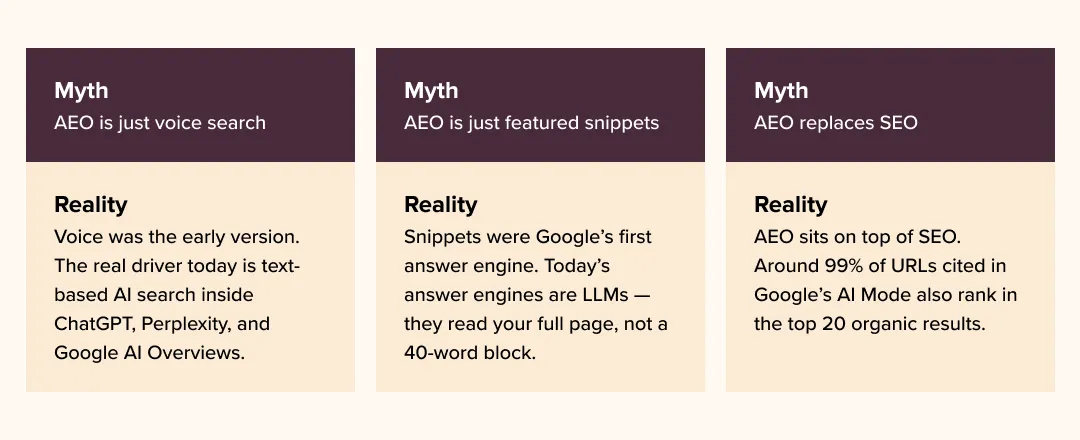
Answer Engine Optimization (AEO) is the practice of structuring content so that AI-powered answer engines, ChatGPT, Perplexity, Google AI Overviews, Gemini, and Copilot can read it, trust it, and cite it as a direct response to a user's question.
Where traditional SEO competes for a ranking position in a list of links, AEO competes for the answer itself. The shift matters because the surface has changed.
An answer engine doesn't return multiple links and let the user pick. It reads dozens of sources, synthesizes them into a single response, and credits a handful with citations. Your content is either part of that answer, or it isn't. There is no page two.
So, when someone asks what is AEO in practical terms, the honest answer is that it's the natural endpoint of AI in SEO, the broader shift of AI moving from a tool that supports search to a system that replaces the search results page.
You still need crawlable pages, a clean structure, and topical authority. But on top of that, AEO asks a different question: Can a language model extract a clear, accurate, citation-worthy answer from this page in under a second? If yes, you get quoted. If not, a competitor does.
Why AEO Matters Now: The Shift in How Buyers Actually Search
The headline numbers tell you search is changing. The deeper story is how it's changing. and why marketers who only watch organic traffic are missing it.
Buyer behavior now looks different at every stage of the funnel:
1. Discovery has moved into conversation
A founder evaluating CRMs no longer types "best CRM for SaaS" into Google and clicks through 10 links. They ask ChatGPT, get three names, and start their shortlist.
The same pattern holds for app development companies, marketing tools, fintech vendors, healthcare platforms and anything with a research-heavy purchase.
2. Comparison happens inside the AI
Instead of opening different tabs, buyers ask follow-up questions. "Which of those three is best for a Series A fintech?" The AI re-synthesizes from the same sources it cited the first time. If your brand wasn't in round one, it's not in round two either.
3. Validation still happens on the web, but quickly
Once the AI gives them three names, buyers do click through. They're verifying, not discovering. The visit is shorter, more decisive, and far closer to a conversion event.
- This last point is the one most marketers are sleeping on. Semrush's 2025 research found that visitors arriving via AI search convert at 4.4 times the rate of visitors from traditional organic search.
- The volume is smaller, but the intent is dramatically deeper. A buyer who arrives from a ChatGPT answer has already done the discovery and comparison work; they're showing up to verify, not to browse.
- For app and SaaS brands especially, this changes what ‘winning a search’ even means. Ranking number one for a comparison query doesn't help if you weren't named in the answer that started the buyer's journey. AEO is how you get named.
AEO vs SEO vs GEO
Three acronyms are now circling the same problem, and the industry hasn't fully agreed on what each one means. Here's the cleanest way to think about them.
1. SEO
Search Engine Optimization is the older discipline, optimizing pages to rank in a list of links on a search engine results page. The output is a position; the goal is a click. SEO has been around since the late 1990s and still does most of the heavy lifting, because traditional search hasn't disappeared.
2. AEO
Answer Engine Optimization is the practice of structuring content so that AI-powered answer engines, such as ChatGPT, Perplexity, Google AI Overviews, Gemini and Copilot cite it as a direct response to a user's question. The output is a citation inside an answer; the goal is to be quoted, not clicked. AEO is the umbrella term most marketers use today for visibility in AI search.
3. GEO
Generative Engine Optimization is the newer, narrower term that emerged from academic and technical SEO circles. It refers specifically to optimizing for generative AI systems, the LLMs that synthesize answers from multiple sources.
In practice, most of what teams call GEO falls under what AEO already covers. The two terms are used interchangeably in many agencies, with GEO leaning more technical (schema, embeddings, retrieval) and AEO leaning more editorial (clarity, structure, citation-worthiness).
A clean way to hold all three:
| SEO | AEO | GEO | |
|---|---|---|---|
| Goal | Rank in a list of links | Get cited inside an AI-generated answer | Get retrieved by a generative AI system |
| Output | Position on a SERP | Citation in an answer | Source material in a synthesized response |
| Optimizes for | Crawlers, ranking algorithms | Answer engines, LLMs | Generative LLMs specifically |
| Primary platforms | Google, Bing | ChatGPT, Perplexity, AI Overviews, Gemini, Copilot | Same as AEO, with technical overlap |
| Success metric | Rankings, clicks, organic traffic | Brand mentions, citations and AI referral traffic | Citation frequency, retrieval rate |
| Maturity | 25+ years | 2 years | <1 year as a named discipline |
How AI Answer Engines Decide What to Cite?
Every AI answer engine does roughly the same things when a user asks a question, and understanding that flow is what separates content that gets cited from content that gets ignored.
Step 1: Retrieval
The engine runs a search against its index and pulls a shortlist of candidate pages. If your page can't be retrieved, it can't be cited! This is why traditional organic visibility is still the cost of entry to AI search.
Step 2: Ranking
Each candidate gets scored on how cleanly it answers the question. Pages that lead with the answer beat pages that bury it. Clear headings, schema markup, and visible last updated dates all add weight here.
Step 3: Citation
The engine doesn't cite the highest-ranked page; it cites the most useful one. That means sources that add something specific (a stat, a framework, a named example) usually beat sources that just restate the consensus.
A few patterns hold across every major answer engine:
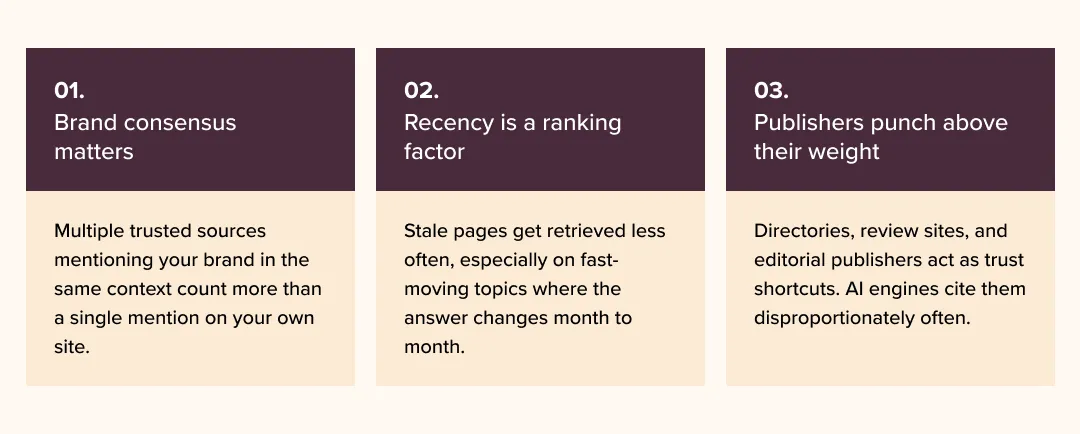
The practical takeaway: AEO isn't one optimization. It's three, be retrievable, be extractable, be citation-worthy, stacked on top of each other.
So, How Do You Optimize Your Content for AEO?
The previous sections built the case; here are the actual moves that get your content cited inside AI answers. Most of these are small, structural changes. The work isn't hard, but it has to be deliberate.
1. Build a trust block at the top of every page
The single fastest AEO win is putting a ‘trust block’ near the top of your page. That means the author's name and credentials, a ‘last updated’ date, one or two cited sources, and a 40–50 word answer summary that defines the topic in plain language.
This structure does two things at once, gives AI engines a clean, extractable answer to quote and signals to the same engines that the page is maintained, attributed, and credible.
2. Lead with the answer, then add nuance
Most blog posts bury the answer under a preamble, three paragraphs of setup before the reader (or the AI) gets what they came for. Reverse this. The first paragraph after your H1 should answer the question directly, in 40–60 words. Add context, examples, and depth after.
Inverted pyramid structure is how journalists have always written, and it's now one of the strongest answer engine optimization strategies you can adopt. AI engines extract the first clean answer block they find on a page. If yours is in paragraph one, you get the citation. If it's in paragraph six, someone else does.
3. Use schema markup; AI engines actually read
Schema is no longer just an SEO nice-to-have. AI answer engines lean on structured data to disambiguate content quickly. The schema types that matter most in 2026:
- Article schema — establishes the page as editorial content, attributes it to an author, and timestamps it.
- FAQPage schema — gets your Q&A blocks pulled into AI Overviews and "People Also Ask" panels.
- HowTo schema — surfaces step-by-step content in voice and AI search results.
- Author and Organization schema — links the content to a real person and entity, building the E-E-A-T signal that AI engines weigh heavily.
- Speakable schema — flags content optimized for voice answers.
The mistake most teams make is implementing one schema type and stopping. Stack three or four where they're genuinely relevant.
4. Structure content for extraction
AI engines extract better from well-structured pages than from prose-heavy ones. The patterns that work consistently across major engines, and rank among the most cited best practices for answer engine optimization:
- Question-led headings: H2s and H3s framed as questions ("How does X work?", "What is Y?") get pulled directly into AI answers.
- Short paragraphs: Two to four sentences. Long blocks get skipped.
- Comparison tables: AI engines love tables for comparative queries — they extract entire rows as citations.
- Bulleted lists for parallel content: Three to six items, each one self-contained.
- Bolded key terms sparingly, never mid-sentence as filler.
The principle behind all of these: make every claim independently extractable. If a single paragraph, bullet, or row can be lifted out and still make sense, an AI engine can cite it cleanly.
5. Build off-site brand consensus
AI engines don't just read your site; they triangulate across the web. When multiple credible sources mention your brand in the same context, the engine treats that as a signal. A single mention on your own blog is weak. Five mentions across a directory listing, a review site, an industry publication, and a Reddit thread are strong.
The practical moves:
- Get listed on category-relevant directories that AI engines already trust.
- Earn coverage in editorial publications in your space.
- Maintain active, well-reviewed profiles on review sites.
- Show up in industry forums, podcasts, and expert roundups.
For app and SaaS brands, directories and review platforms like MobileAppDaily do more heavy lifting than ever; they're exactly the kind of trusted third-party sources AI engines reach for when answering "best X for Y" queries.
6. Integrate AEO with your existing SEO foundation
The biggest AEO mistake is treating it as a replacement for SEO. It isn't. The honest answer to how to integrate AEO using traditional SEO strategies starts here: AEO is a layer on top, not a substitute.
Roughly 99% of URLs cited in Google's AI Mode also rank in the top 20 organic results, which means your foundational SEO work (crawlability, internal linking, Core Web Vitals, backlink profile, topical authority) is the cost of entry to AI search.
The integration model that works:
- Keep doing technical SEO. AI engines retrieve from existing search indexes.
- Layer AEO-specific moves on top: trust blocks, schema, lead-with-answer structure, brand consensus.
- Don't choose. Run them together.
Teams that try to "switch from SEO to AEO" lose ranking first, then lose AI citations along with it. Teams that integrate keep both.
7. Refresh, don't rebuild
The fastest AEO wins come from refreshing content you already have. Audit your top-traffic pages, add trust blocks, restructure to lead with the answer, layer in schema and update the dates. Don't overestimate the cost of starting fresh and underestimate the cost of leaving good pages broken. Refresh first; new content second.
List of the Best Answer Engine Optimization Platforms in 2026
A new category of answer engine optimization tools has emerged in the last 18 months, built specifically to track AI visibility and improve content for citation. The space is young, the field is changing fast, and no single platform covers everything yet.
The best answer engine optimization tools fall into two clear groups: visibility tracking (how often AI engines mention your brand) and content optimization (making your pages more citation-worthy as you write them).
| Tool | Category | What it does | Best for |
|---|---|---|---|
| Profound | Visibility tracking | Tracks brand citations across ChatGPT, Perplexity, Gemini, and Copilot. Shows which prompts surface your brand and which surface competitors. | Enterprise teams running multi-platform AI visibility audits |
| HubSpot AEO | Visibility tracking | Brand visibility scoring across major answer engines, with prioritized recommendations. Bundled with Marketing Hub. | Mid-market teams already inside the HubSpot stack |
| Otterly | Visibility tracking | Tracks brand mentions in AI answers across ChatGPT, Perplexity, and Google AI Overviews. Lighter-weight and self-serve. | Smaller teams, individual marketers, agencies running multiple clients |
| Semrush Enterprise AIO | Hybrid (SEO + AEO) | Combines traditional SEO data with AI visibility audits inside one workflow. | Teams already using Semrush who want one tool covering both |
| Surfer SEO | Content optimization | Scores draft content on extractability, structure, and answer-readiness. Best used during writing. | Content teams optimizing pages before publishing |
| Frase | Content optimization | AI-powered content briefs and answer-engine readiness scoring. | Editorial teams researching and structuring new pieces |
How to Measure AEO Success?
Most teams trying to measure AEO start by looking at the wrong dashboard. Traditional SEO metrics, keyword rankings, organic clicks and click-through rate don't translate cleanly to a world where the answer happens before the click.
The best AI platforms for answer engine optimization track a different set of signals entirely.
Some traditional metrics still matter as supporting indicators. None tell you whether AI engines are citing you. Here are the four metrics that actually track AEO performance:
- Brand mentions in AI answers - how often you're named in answers across ChatGPT, Perplexity, Gemini, AI Overviews, and Copilot.
- Citation count and source URLs - which of your pages are getting cited, and how often.
- AI referral traffic - visitors arriving from AI sources, tracked separately in GA4.
- Sentiment of mentions - whether AI engines describe your brand favorably, neutrally, or critically.
Common AEO Mistakes And How to Avoid Them
Most teams that struggle with AEO aren't doing anything exotic; they're making the same handful of avoidable mistakes. The pattern is consistent across the industry, and so is the fix.
| The mistake | The fix |
|---|---|
| Treating AEO as a replacement for SEO | Around 99% of URLs cited in AI Mode also rank in the top 20 organic results. Run AEO as a layer on top of SEO, not in place of it. |
| Burying the answer under preamble | Lead with a 40–60 word direct answer in the first paragraph after the H1. Add nuance and examples below. |
| Stopping at the FAQPage schema | Stack three or four where they're genuinely relevant. Among the leading answer engine optimization tactics for AI-driven search, schema is also one of the most overlooked. |
| Stuffing pages with question-based H2s | Three to five genuine question-led headings per page. Forced questions get detected by AI engines as easily as by readers. |
| Optimizing only your own site | Earn third-party mentions on directories, review sites, and editorial publications. Brand consensus across the web matters more than any single page. |
| Ignoring content freshness | Update top pages quarterly. Visible “last updated” dates are read by AI engines as a recency signal. |
The Future of AEO: Where This Is Heading?
Three shifts are already reshaping AEO and will define the discipline through 2027.
1. Agentic search is going to be the default
AI agents are starting to browse, compare, and transact on users' behalf. The brands that agents recommend will be the ones whose data is machine-readable, consistent, and current.
2. Multi-modal search is mainstream
Voice queries, image-to-answer search, and visual prompts are now everyday inputs. Image alt text, video transcripts, and product imagery become AEO surfaces in their own right.
3. Brand consensus becomes the moat
AI engines are getting better at filtering self-referential content and weighting third-party signals more heavily. Distributed authority across directories, review sites, and editorial coverage is the part that's hardest to fake and hardest to copy.
*The work isn't to predict where AI search lands. It's to build content and brand presence that holds up regardless of which platform eats the traffic next.
Bottom Line
It's tempting to read a guide like this and walk away with a checklist. The checklist matters, schema, trust blocks, lead-with-answer structure, and third-party mentions. None of it is optional.
But the teams pulling ahead in AEO aren't the ones with the cleanest schema. They're the ones whose content is genuinely worth citing, specific, current, attributed, and useful in ways most published content isn't. AI engines have gotten good at telling the difference, and they're getting better.
Do the tactics. Then make the underlying work strong enough that the tactics have something to point at.
Frequently Asked Questions
What does AEO stand for?
AEO stands for Answer Engine Optimization. The term refers to the practice of structuring content so that AI-powered tools like ChatGPT, Perplexity, Google AI Overviews, Gemini, and Copilot can read it, trust it, and cite it as a direct answer to user queries. AEO sits alongside SEO as a parallel discipline, not a replacement.
What is answer engine optimization used for?
AEO is used to make a brand visible inside AI-generated answers, the synthesized responses that increasingly replace traditional search results. It applies to any business whose buyers research, compare, or shortlist options through AI tools. The most common use cases are B2B service discovery, SaaS and app evaluation, product comparisons, and high-consideration consumer purchases.
Is AEO replacing SEO?
No. AEO is a layer on top of SEO. Around 99% of URLs cited in Google's AI Mode also rank in the top 20 organic search results, which means strong technical SEO is the cost of entry to AI search. Teams that abandon SEO to chase AEO usually lose ground in both. The right approach is to integrate them.
How long does AEO take to show results?
Plan for a 90-day baseline before measuring impact, and 6–12 months for meaningful citation share gains. AI engines re-crawl, re-process, and re-weight signals on their own schedules. Optimization done today might surface in answers six weeks later, six months later, or in waves; the lag is real and well-documented across the industry.
Do small businesses benefit from AEO?
Yes, and often disproportionately. AI engines don't rank by ad spend or domain age. They cite sources that are clear, credible, and consistent. A focused brand with deep expertise in a specific niche can outperform a household name that hasn't optimized. The smaller the niche and sharper the positioning, the better the AEO leverage.
How does answer engine optimization differ from traditional SEO?
Traditional SEO competes for a position in a list of links, the goal is a click. AEO competes for a citation inside an AI-generated answer; the goal is to be quoted. SEO optimizes for crawlers and ranking algorithms; AEO optimizes for answer engines and LLMs. The two work together. Strong SEO is the cost of entry to AI search, but it doesn't guarantee citations on its own.

Uncover executable insights, extensive research, and expert opinions in one place.
Related Content