Share It On:
 Stop letting manual ad buys throttle your growth. Programmatic advertising for apps is the AI-powered engine that identifies and captures high-LTV users in milliseconds, before your competitors even see the signal.
Do you realize billions of ad auctions take place across mobile apps globally? A user opens a gaming app, and before the first frame loads, an automated system already evaluates the user's data, tracks app analytics and metrics, runs an auction, selects the winning ad, and delivers it, all in under 100 milliseconds.
For the people who make decisions, programmatic advertising has three benefits: it saves time, it can be used for lots of people, and it is very transparent. The information here is like a map to help people navigate the world of programmatic mobile advertising, which is worth billions of dollars.
What Is Programmatic Advertising for Apps?
It is when computers buy and sell ad space automatically. This happens with the help of programs and a lot of data that is available right now. It is different from the way of doing things where people would talk on the phone to agree on prices.
Now computers do all the work. They do it very fast. They can do millions of things in one second. Each time they do something, it's special for the person seeing the ad, and it is based on what they are doing at that moment.
When we talk about programmatic mobile advertising on devices, it is more than just using computers to do things automatically. It is also about using computer programs to look at things, decide what to do and then do it all in real-time. Programmatic advertising has to deal with some problems that do not happen on computers. For example, programmatic advertising for apps has to figure out who people are when they are using apps. It also has to work with kinds of apps, like games, tools and social apps. It has to keep up with people who are moving around and doing things very fast on their mobile devices.
Programmatic Advertising vs. Traditional Ad Buying
| Dimension | Traditional (Direct / IO-Based) | Programmatic |
|---|---|---|
| Transaction speed | Days to weeks of negotiation | Milliseconds (real-time auction) |
| Pricing model | Fixed, negotiated CPM | Dynamic, auction-based bidding |
| Targeting | Broad, demographic-level | Granular: behavioral, contextual, geo |
| Optimization | Manual, post-campaign review | Real-time, automated mid-campaign |
| Minimum scale | High (requires minimum spend commitments) | Flexible (scalable from small budgets) |
| Transparency | Limited (publisher-reported metrics) | Full impression-level reporting |
| Creative flexibility | Static placements | Dynamic Creative Optimization (DCO) |
Key Players in the Programmatic Ecosystem
Before diving into app-specific mechanics, it helps to understand the four infrastructure components that make programmatic work:
- Demand-Side Platform (DSP): This is the main base for the person buying the ad. This is where brands put their money. They set rules for pricing, choose the ad's look, and pick the specific groups of people they want to reach with the message. This means the DSP looks at what space is open. It makes a bid for the advertiser.
- Supply-Side Platform (SSP): App owners use a Supply Side Platform or SSP to handle the spots they have for ads. They list open spots. In practice, the SSP handles the logic for the sale and tries to get the most money for the person who built the app.
- Ad Exchange: It is the middle ground where the buyer and seller meet. This marketplace is where the sale happens. It takes the bids from the buyers and the spots from the sellers and picks who wins the auction in the end.
- Data Management Platform (DMP) / Customer Data Platform (CDP): This is the data layer. DMPs and CDPs act as the layer of the system that keeps track of what people do, who they are and what they like to buy. It uses facts from things people do online or from the brand files to help the buyer decide which ads to pick. This tells the DSP where to spend the money. This helps the buyer know they are bidding on the right person.
How Does Programmatic Advertising Work for Apps?
The process that delivers an ad to a user inside a mobile app happens faster and completes in under 100 milliseconds. Here is what occurs between a user opening an app and seeing an ad.
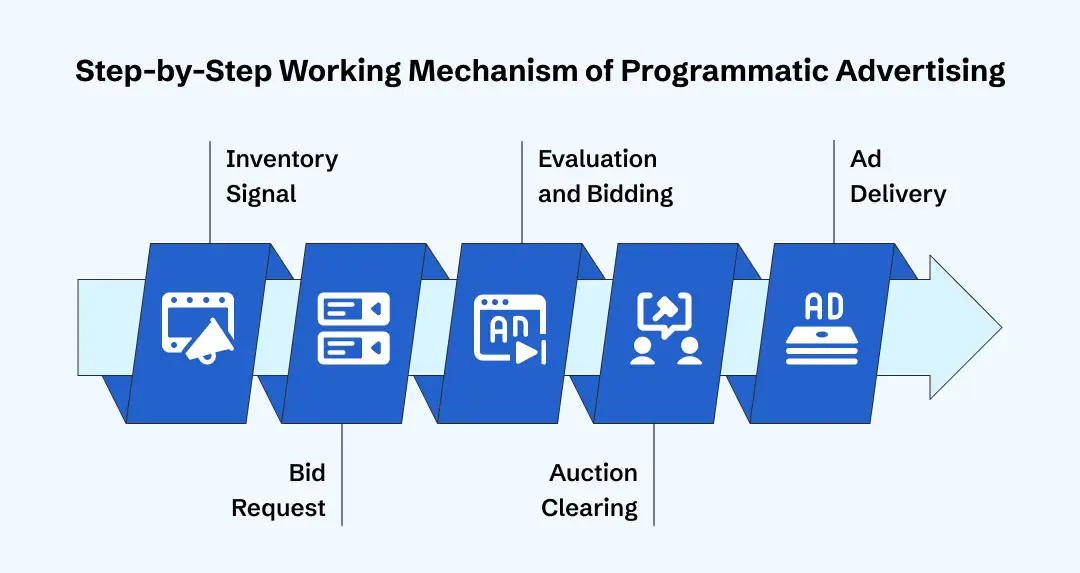
Step 1: Inventory Signal
An individual starts a mobile application that immediately identifies an available ad slot for potential advertisers. By using a software development kit or a header bidding wrapper, the app communicates directly with a supply-side platform to verify that the current inventory is open for a digital placement.
Step 2: Bid Request
The SSP sends a request to many demand-side platforms at once. This digital data packet includes the operating system, device type, app category, and geographical location, along with user information where the individual has provided explicit permission for tracking. Detailed specifications regarding the ad slot size and format are also included within this digital request to help platforms make informed decisions.
Step 3: Evaluation and Bidding
Every demand-side platform analyzes the specific impression against the active campaign goals set by various brands and businesses. The platform calculates a specific bid price if the user matches targeting criteria. The digital systems usually complete the entire calculation and submit the final bid response within a window of approximately one hundred milliseconds to maintain system speed.
Step 4: Auction Clearing
The ad exchange gathers every bid and selects a single winner. This means that the exchange typically awards the placement to the highest bidder, provided the total amount stays above the minimum floor price that the app publisher requires for the slot. In a second-price auction model, the winning advertiser pays exactly one cent more than the amount of the second-highest bid.
Step 5: Ad Delivery
The winning ad creative appears on the screen of the user immediately. Systems log the impression data and fire attribution signals while the platform updates all performance metrics in real time. This continuous feedback loop allows marketers to see the precise outcome of their media spend and adjust their internal settings for future auctions based on live results.
The Strategic Benefits of Programmatic Advertising
The value proposition of programmatic is measurable and multifaceted. Here is a breakdown of why it is the primary source for modern app growth.
| Benefit | What It Means in Practice |
|---|---|
| Precision Targeting at Scale | Reach specific user segments by behavior, device, location, or lookalike, across thousands of apps through a single DSP interface, without managing individual publisher relationships. |
| Real-Time Optimization | Campaigns self-adjust mid-flight based on live performance signals. Underperforming creatives are deprioritized; high-performing placements automatically receive increased budget allocation. |
| Cost Efficiency vs. Direct Buys | Programmatic CPMs typically run 25–45% lower than direct-buy display CPMs, according to DSP performance benchmarks. |
| Transparent, Impression-Level Reporting | Every impression is trackable, including viewability rate, fraud filter status, attribution path, creative performance, and audience segment breakdown. |
| Global Scale Through a Single Entry Point | App programmatic ads allow multi-network reach across geographies without negotiating with individual publishers in each market. One campaign, one DSP, global inventory access. |
| Dynamic Creative Optimization (DCO) | AI-driven systems assemble and serve ad variations personalized to individual users, adjusting imagery, copy, and CTAs in real time. |
| Retargeting Precision | Re-engage users who installed but churned, or who reached a specific in-app event without converting. Retargeting through programmatic can increase ROAS by 2 to 4x on average. |
| First-Party Data Activation | Upload CRM data, in-app event data, or purchase histories to DSPs or CDPs and activate them as audience segments or exclusion lists. |
Building a Programmatic Advertising Strategy for Apps
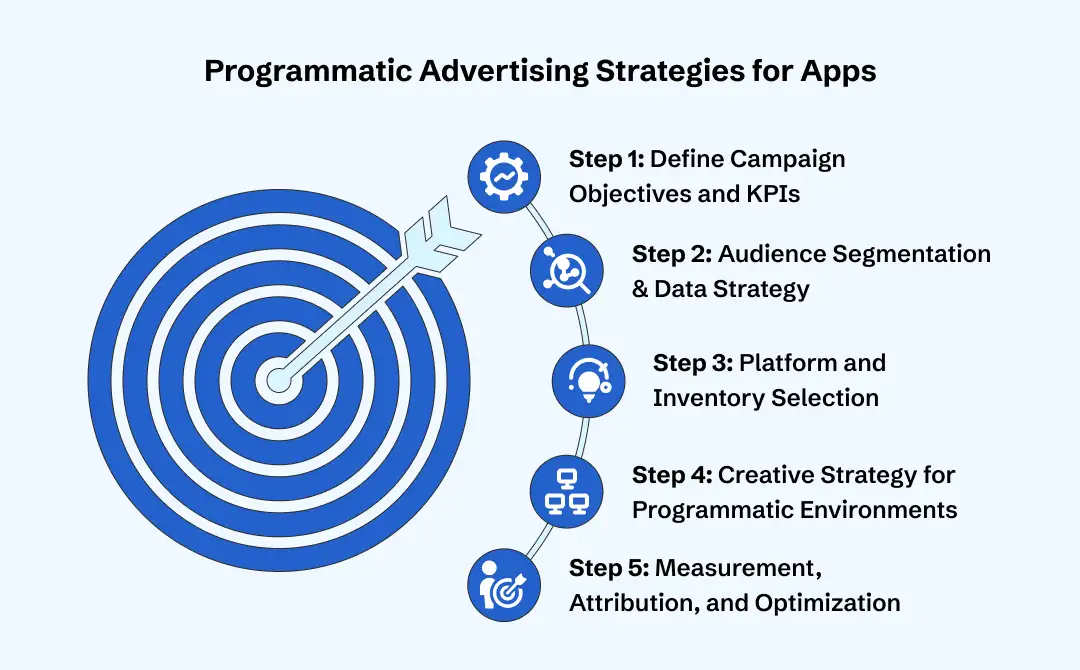
Most programmatic campaigns fail not because of technology limitations, but because of strategic gaps: undefined KPIs, weak audience segmentation, and poor attribution infrastructure. A structured approach eliminates these programmatic advertising strategy gaps before they become wasted.
Step 1: Define Campaign Goals and KPIs
You have to decide on your goals before you spend a single dollar. This choice is the only way to get a good return on your money. Are you trying to make people aware of your app, or do you want them to make a purchase? The way the software bids for ads depends on what you pick. New tools can now find users who will stay active and spend money over a long time. In other words, finding these high-value users is much better than just getting a cheap download from a person who will delete your app tomorrow.
Step 2: Audience Segmentation and Data Strategy
Most marketers in the US have moved toward using their own data because privacy rules have changed so much lately. You should use your own customer records in safe digital spaces to find the right people to target. This makes sure you are following the law. From this angle, you are also making sure your ads reach real humans. You do not want to waste your money on fake accounts or bots that have no interest in your app.
Step 3: Platform and Inventory Selection
Not all inventory is created equal, and not all buying models suit every objective. The choice between open exchange RTB, Private Marketplace (PMP), and programmatic direct should be driven by budget, brand safety requirements, and scale priorities, not default settings. Most successful app marketers find that using a mix of different buying methods gets better results than just sticking to one single way of doing things.
Step 4: Creative Strategy for Programmatic Environments
The way your ads look is a big part of your success. In 2026 and for the years following, the standard is to build ads right when a person is looking at them. This is called Dynamic Creative Optimization. The system picks the best parts, like the headline and the image, for each specific user. Right now, ads that people can play with get much more interest than old banners. This is very true for games or utility apps where a simple picture just gets ignored by most users.
Step 5: Measurement, Attribution, and Optimization
You must work with a tracking partner to see the real results of your work. This partner is usually called an MMP. This creates a way to see your return on spend instead of just counting how many people clicked a link. Clicks do not always turn into money. The real profit is found in the work you do after the ads go live. You have to keep testing new ideas and changing your bids to find the best margins for your business.
App Programmatic Ads Formats
Format selection is one of the highest-leverage decisions in a programmatic strategy. Each format carries distinct CPM ranges, engagement benchmarks, and audience suitability profiles:
| Ad Format | Description | Avg. Engagement | Best Use Case |
|---|---|---|---|
| Banner Ads | Static or animated banners placed within the app UI | Low CTR (0.05–0.12%) | Brand awareness, retargeting at scale |
| Interstitial Ads | Full-screen ads between content transitions | High — 3.2% engagement rate | App installs, mid-funnel conversion |
| Rewarded Video | Opt-in video for in-app reward (currency, lives) | Very high — voluntary interaction | Gaming UA, high-LTV user acquisition |
| Native Ads | Ads styled to match app UI and content feed | 8.8x higher CTR than display | Content apps, social-style feeds |
| Playable Ads | Interactive preview of the advertised app | Highest for gaming UA | Mobile game user acquisition |
| Rich Media / MRAID | Expandable, interactive ad experiences | Medium-high | Brand campaigns requiring engagement |
Cost of Programmatic Advertising for Apps
The cost of programmatic advertising for apps is a layered structure of media costs, platform fees, and operational overhead. Understanding each layer separately is the only way to evaluate actual campaign efficiency.
| Ad Format | CPM Range (USD) | CPC Range (USD) | Notes |
|---|---|---|---|
| Banner Ads | $0.50 – $3.00 | $0.10 – $0.40 | High volume, lower engagement. Best for retargeting at scale. |
| Interstitial Ads | $3.00 – $10.00 | $0.40 – $1.20 | Full-screen, high visibility. Premium pricing reflects format impact. |
| Rewarded Video | $10.00 – $25.00 | N/A (CPV model) | Highest CPM — justified by opt-in engagement and LTV quality. |
| Native Ads | $2.00 – $8.00 | $0.20 – $0.80 | Strong engagement-to-cost ratio. Blends with app UI. |
| Playable Ads | $15.00 – $30.00 | N/A | Premium UA format for gaming. High creative production cost. |
| US Programmatic Display Avg. | $3.12 – $3.50 | $0.15 – $0.25 | High-impact storytelling, non-skippable, premium audiences. |
| PMP / Private Marketplace | 20–40% premium over open RTB | Varies | Brand safety and quality justify the premium for most advertisers. |
Note: Costs vary by vertical. For instance, Financial Services or B2B SaaS apps often see CPMs 2-3x higher due to extreme competition for high-value users.
The Future of Programmatic Advertising in Apps
We are entering a phase where programmatic architecture becomes invisible, embedded, and highly predictive. For you, looking to stay ahead, the following shifts represent the new baseline for performance. These trends are not mere experimental theories but are currently being integrated into the best mobile app marketing tools used by industry leaders.
1. Predictive Modeling and the End of Reactive Tactics
Currently, most campaigns react to data. If a user clicks, the system bids more. If they do not, it stops. The future lies in predictive user acquisition. Advanced models now analyze early session behavior to forecast long-term value. Systems identify signals of dissatisfaction in real time and trigger automated retention ads.
2. Harmonizing CTV with Mobile Workflows
We are moving toward a unified auction environment where a brand can sequence a story across multiple devices. A person sees a high-impact ad on the Smart TV, and the programmatic engine prioritizes a follow-up ad on that same person's mobile device minutes later. This level of orchestration ensures the narrative remains consistent. As mobile and in-app advertising trends continue to favor video content, this cross-device synergy will be the primary driver of brand recall.
3. The Rise of Green Programmatic and Infrastructure Efficiency
As global corporations face stricter environmental reporting, the ad tech stack is coming under scrutiny. High-frequency auctions consume massive amounts of energy. The industry is responding with green bidding paths. These routes prioritize supply partners that use renewable energy or more efficient server configurations.
4. Contextual Intelligence 2.0
As we move away from user-level tracking, contextual targeting is having a resurgence. Modern contextual intelligence uses machine learning to understand the sentiment, mood, and specific intent of the app environment. The system can distinguish between a user reading a casual news story and a user researching a high-ticket purchase. This allows for much higher precision in ad placement without needing to know the specific identity of the individual.
Conclusion: Why is Programmatic Non-Negotiable for App Growth?
Programmatic advertising for apps is now the primary framework for mobile commerce. It has moved far beyond being a simple technical tool used by niche teams. If you are not using these automated systems effectively, you are essentially leaving your growth to chance. Business leaders generally fall into the trap of treating these programmatic app platforms as passive tools. This is a mistake that leads to wasted budgets and poor results.
Success requires more than just turning on a campaign. You must build a strategy that prioritizes your own first-party data and removes unnecessary middlemen from the buying process. The companies that dominate their sectors are those that constantly refine their bidding logic and their creative assets.
Frequently Asked Questions
What is programmatic advertising?
Think of this system as a high-speed digital auction house where software manages the buying and selling of ad space. Computers replace manual negotiations between people to trade inventory. This approach allows you to bid on individual ad impressions in real time based on specific user value instead of purchasing bulk inventory that might fail to deliver results.
How is programmatic mobile advertising different from the web?
Apps use device signals or code built into the app to identify users, while websites mostly use cookies in browsers. Because people spend most of their time in apps, the data is often much better for targeting than what you get on the web. It also enables much higher-quality ad formats that interrupt the user less than web banners.
What is the minimum budget to start with programmatic advertising for apps?
You should plan to spend at least $5,000 to $10,000 for your first month. If you spend less, the software will not have enough information to learn who your best customers are. A larger starting budget ensures that the machine learning models have enough data to move past the initial testing phase and into actual profit.
Is programmatic advertising a good choice for small or mid-sized app publishers?
Choosing this path represents a smart strategic move for smaller publishers. This setup allows a small application to sell its inventory to major global brands without the need to build and manage an expensive internal sales department to find those deals.
How does AI help in programmatic advertising?
The technology calculates the ideal price for every bid, identifies which ads earn the most clicks, and blocks fraudulent activity before you lose any portion of your marketing budget. The system analyzes millions of signals simultaneously to ensure that you spend your money only on users with the highest potential value.
What is the impact of Google Privacy Sandbox on app programmatic ads?
It is a major shift that stops you from tracking one specific person. Instead, you have to target groups of people based on what they are doing in an app at that moment. This move forces the industry to rely more on the quality and context of the app content itself rather than the personal history of the user.

Uncover executable insights, extensive research, and expert opinions in one place.
Related Content