Share It On:
 CAASM turns scattered asset data into one trusted view, helping security teams find hidden risks, close gaps, and respond faster.
Ask a security team how many assets they actually have, and watch what happens. There's a pause. That pause is where a lot of breaches begin. You can't patch a server you don't know exists, and you can't shut down an account nobody ever wrote down. Cyber asset attack surface management, usually shortened to CAASM, was built to fix exactly this.
In this guide, we'll go through what CAASM is, how a CAASM solution turns a messy estate into one trustworthy view, and why the business case has only gotten stronger in 2026.
We'll also look at where AI fits in (both as a helper and as a brand new kind of asset to track), how CAASM differs from ITAM, CMDB, EASM and CTEM, and what to look for when you start comparing vendors. It's a long read, but it's laid out so you can jump straight to the part you need.
What is Cyber Asset Attack Surface Management (Caasm)?
Cyber asset attack surface management (CAASM) is a security practice and a category of cybersecurity tools, built around one stubborn question: what do we actually have, and which parts of it can an attacker reach?
A CAASM solution connects to the systems you already run, pulls their asset data in through APIs, cleans it up, and stitches it into a single inventory your security team can search.
The "attack surface" half of the name matters. An attack surface is everything an attacker could touch: laptops, servers, cloud workloads, SaaS accounts, a forgotten test environment, an API key sitting in a repo, even the smart display in the boardroom.
CAASM looks at that surface from the inside out. It starts with the assets you control (or believe you control) and checks how well each one is covered.
What a cybersecurity asset management platform should tell you
A good platform answers questions like these in seconds, not days:
- Which assets exist, including the ones nobody registered?
- Who owns each one?
- What is it connected to, and what can it reach?
- Which security controls are missing, such as an endpoint agent, patching or logging?
- Do those gaps sit on assets that matter to the business?
How CAASM differs from a traditional inventory
Plenty of companies already have an asset list, so it's fair to ask what's new. The short answer is that an inventory records things, while CAASM records things and judges them.
| Feature | Traditional Inventory | CAASM |
|---|---|---|
| How Data Arrives | Manual entry or periodic imports | API connections, refreshed continuously |
| Scope | Mostly devices and licenses | Devices, cloud, SaaS, OT and IoT, identities |
| Context | Location, owner, purchase date | Relationships, vulnerabilities, control coverage |
| Main Audience | IT operations, finance | Security teams, with IT alongside |
| Question It Answers | What do we own? | What do we own, and what's exposed? |
Also Read: Top Cybersecurity Companies
Why Asset Visibility Keeps Falling Apart, Even with Good Tools
Most companies have spent real money on security tooling over the past decade, and visibility has still slipped. One 2026 survey of 512 ITAM professionals found that complete IT visibility fell to 36%, down from 43% the year before. Blaming lazy teams misses the point. The estate just grows faster than anyone can document it.
1. Every tool sees a slice
Your endpoint tool knows about endpoints. The vulnerability scanner knows about whatever it was pointed at. The cloud console knows about cloud resources, the identity provider knows about accounts, and the CMDB knows about whatever somebody remembered to type in. Each one is accurate about its own slice and silent about the rest.
Put their reports side by side, and they'll disagree on how many devices you have, which ones are protected, and who's responsible for them. That fragmentation is the real villain here, not any single tool.
2. Shadow IT never needed your permission
People rarely go around IT to be difficult. They do it because the approved route is slow. A team signs up for a SaaS tool with a corporate card, a developer spins up a test environment and forgets about it, a contractor plugs in a personal laptop. Research from one vendor found that 31.4% of vendor interactions bypass identity logs, which means the inventory you trust may be missing a good chunk of what people really use.
3. The AI blind spot showed up fast
The newest gap is AI. In that same ITAM survey, only 31% of organizations had visibility into AI software, and 59% reported more wasted spend on it over the past year. On the breach side, the 2025 cost of a data breach study found that one in five organizations had a breach tied to shadow AI.
Those breaches added about $670,000 to the average cost, and only 37% of organizations had policies to manage or detect shadow AI in the first place.
4. Attackers don't wait for your backlog
Exploiting a vulnerability became the most common way breaches start, at 31% of cases. That's the first time it has passed stolen credentials and phishing.
Organizations took a median of 43 days to fix a known-exploited vulnerability, and only 26% of those affecting them were fully remediated. Open vulnerability instances in the dataset jumped from roughly 68.7 million to 527 million in three years.
Now add the uncomfortable bit. If an asset isn't in your inventory, it's not in your patch queue either. It just sits there, exposed, waiting. That's the gap CAASM is designed to close.
How a CAASM solution works
Under the hood, a CAASM solution does something simple to describe and hard to do well. It asks every system you own what it knows, then reconciles the answers. Here's the flow, one stage at a time.
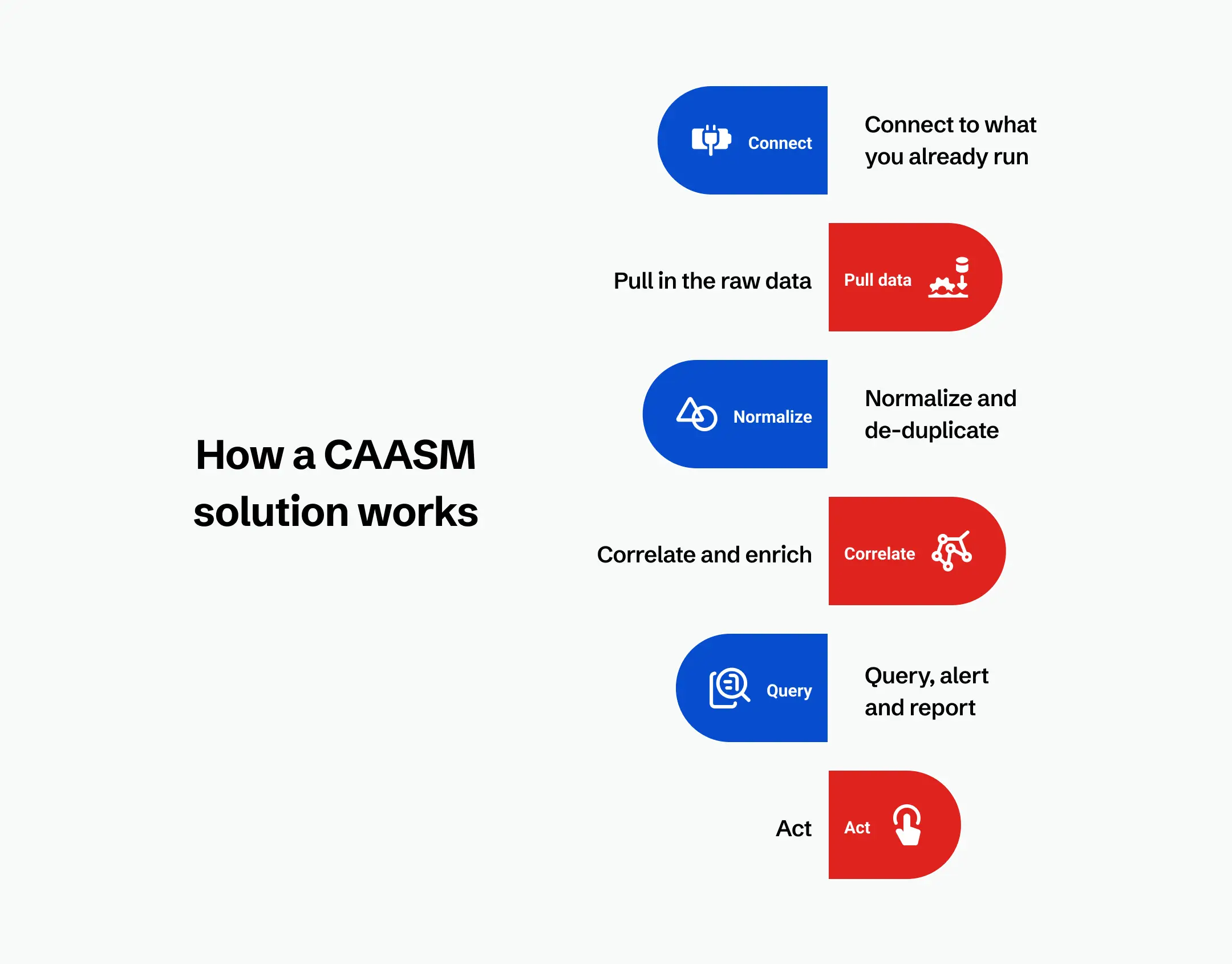
1. Connect to what you already run
Integration comes first. The platform plugs into your endpoint protection, vulnerability scanners, cloud accounts, identity provider, device management, network tools, ITAM and CMDB, mostly through APIs and often without installing anything new on devices. Typical sources include CMDBs, EDR tools and cloud providers, plus network discovery and vulnerability assessment data. Breadth matters here, because a source you can't connect is a blind spot you've chosen to keep.
2. Pull in the raw data
Each source hands back its own version of every asset, with its own field names, formats and timestamps. At this point your inventory looks worse than before, because it's stuffed with duplicates and conflicts. That's normal, and it's the reason the next stage exists.
3. Normalize and de-duplicate
This is where the heavy lifting happens. One laptop can show up as a hostname in the endpoint tool, a serial number in the ITAM system and a MAC address in the network scanner. The platform matches on those identifiers and merges them into a single record, so a big record count doesn't hide a much smaller number of real devices. Matching quality is the thing to test hardest in any demo.
4. Correlate and enrich
Once records are merged, the platform adds context: who owns the asset, which business service leans on it, what software it runs, which vulnerabilities it carries, what controls cover it, and what it connects to. Relationships are where the value lives. A vulnerable server is a medium-sized problem. A vulnerable server that sits next to your customer database and has no endpoint agent is a very different conversation.
5. Query, alert and report
Now you can ask real questions. Show me every internet-facing server missing an endpoint agent. List the cloud workloads with no owner. Which devices run the library version we just heard about on the news? Good platforms let you save those questions as rules that keep running, so a new gap triggers an alert instead of waiting for next quarter's audit.
6. Act
The last stage is the one that separates a dashboard from a program. Findings should trigger something: a ticket for the asset owner, an agent install, a tag that flags a device for isolation, a handoff to the vulnerability team. Findings nobody acts on are just a pricier spreadsheet.
What Kinds of Assets Does CAASM Cover?
A decent way to judge any tool is by how much of your estate it can actually see. Coverage usually falls into four buckets, and the relationships between them matter as much as the buckets themselves.
| Asset Type | What's in It | Why It Tends to Hide |
|---|---|---|
| IT Assets | Laptops, desktops, servers, virtual machines, network gear, mobile devices | Devices leave the office, get re-imaged, or never enroll in management |
| Cloud and SaaS | Instances, containers, storage buckets, SaaS apps and accounts | Spun up in minutes by teams outside IT, and sometimes gone just as fast |
| OT and IoT | Industrial controllers, cameras, medical devices, sensors, smart building systems | Often can't run agents, rarely get patched, and may sit on flat networks |
| Identities, Human and Non-Human | User accounts, service accounts, API keys, tokens, machine certificates | They outnumber people and rarely get rotated once the project ends |
| Software and Dependencies | Installed apps, libraries, browser extensions | They change constantly and live in separate tools |
That identity row deserves a second look. Service accounts, tokens and certificates carry real privilege, yet most inventories ignore them. Practitioners now argue that these should be treated as governed assets with an owner and a lifecycle, the same as any server. Cloud adds another twist. Containers and functions can live for minutes, so a point-in-time scan will miss them completely, which is why continuous discovery is a core requirement for cloud-heavy shops.
Why do businesses need CAASM?
Picture the moment that sells most CAASM programs. A nasty vulnerability hits the news on a Monday morning. The CISO asks which systems are affected, and the honest answer is "give us a few days."
Meanwhile, everyone knows attackers are already scanning for it, and the clock's ticking. That gap between the question and the answer is what you're paying CAASM to shrink. Here's where it earns its keep.
1. Faster, calmer incident response
When something goes wrong, the first stretch of the response is spent on scoping: what is this machine, who owns it, what does it touch? The 2025 breach cost study put the average time to identify and contain a breach at 241 days, and one summary of the same study notes that breaches spanning multiple environments were both the costliest, at $5.05 million on average, and the slowest, at 276 days. A single searchable inventory won't fix all of that, but it takes a lot of the guesswork out of the early hours.
2. Smarter vulnerability prioritization
Severity scores only tell you how bad a flaw could be in theory. They say nothing about whether the affected asset is internet-facing, holds sensitive data or has no endpoint agent. CAASM supplies that missing context, so the same vulnerability can rank very differently on two different servers. Considering that exploitation is now the leading way breaches begin, ranking by real exposure beats ranking by score alone.
3. Finding control gaps hiding in plain sight
Most attacks don't need anything exotic. They need a gap: a device with no endpoint protection, an account without multifactor, a server nobody patches. CAASM compares what exists against what your policy requires and flags the mismatch. Tools can, for example, show that a particular device has no EDR agent, which tells you whether an exposure is actually exploitable.
4. Audit and compliance without the scramble
Almost every major framework starts with an inventory. The NIST Cybersecurity Framework 2.0 puts asset management (ID.AM) at the front of its Identify function, covering hardware, software and services, network data flows, supplier services, data and lifecycle management.
ISO/IEC 27001:2022 expects an inventory of information and associated assets under control A.5.9, and NIST SP 800-53 covers the same ground in CM-8.
Governments have started to put numbers on it, too. CISA's Binding Operational Directive 23-01 tells federal civilian agencies to run asset discovery every seven days and to be able to launch on-demand discovery and vulnerability enumeration within 72 hours.
It only binds those agencies, but CISA recommends every organization review the standard, and it makes a handy benchmark for your own cadence.
5. Cutting waste and shadow spend
Bad inventory costs money, not just safety. Think of it as a tax you pay without ever seeing the invoice. Duplicate tools, unused licenses and unsanctioned apps pile up when nobody can see them. In the ITAM survey mentioned earlier, 44% of organizations had spent more than $1 million on software vendor audits over three years, and 78% of teams said keeping an accurate inventory was their top responsibility. Visibility is a security win and a budget win at once.
6. Zero trust and AI adoption both depend on it
Zero trust sounds great on a slide, but policy can't be enforced on assets you haven't identified. The same logic applies to AI. You can't govern the agents, models and API keys your teams are spinning up if you never knew they existed.
7. It's not only an enterprise problem
A 60-person company with 40 SaaS tools, a cloud account and a handful of contractors has the same problem in miniature. The estate is smaller, but so is the team that has to watch it. Smaller businesses often feel visibility gaps more sharply, because there's nobody whose full-time job is to keep the list straight.
CAASM vs ITAM vs CMDB vs EASM vs CTEM
If your head is spinning from the acronyms, you're in good company. Vendors toss these around as if everyone learned them in school. They overlap a bit, but each one answers a different question.
| Practice | Main Question | Point of View | Usually Owned By | How It Relates to CAASM |
|---|---|---|---|---|
| ITAM | What do we own, what does it cost, is it licensed? | Financial and lifecycle | IT operations | Feeds CAASM with ownership, purchase and lifecycle data |
| CMDB | Which configuration items exist and how do they relate? | Service and change management | IT operations | A data source, often stale or incomplete, that CAASM helps reconcile |
| CAASM | Which assets exist, and which are exposed or uncovered? | Inside out | Security, with IT | The consolidated, security-focused inventory |
| EASM | What can an attacker see from the internet? | Outside in | Security | Finds external assets the inventory may be missing |
| CTEM | Are we continuously reducing real exposure? | Operating model | Security leadership | The program that CAASM and EASM feed |
Where ITAM ends, and cybersecurity asset management begins
ITAM tells you what you bought. Security needs a different set of answers: what's running, what's exposed, and who can reach it. The bridge between the two is what practitioners increasingly call cybersecurity asset management.
One white paper on the topic argues that a centralized asset register is the operational foundation for security. It points out that 46% of compromised systems with corporate logins aren't tracked in centralized management, and it lays out a 90-day plan for building a security-focused register.
It also includes a four-level maturity model that runs from fragmented spreadsheets with no clear ownership up to fully integrated management. Whether or not you ever use that vendor's product, the maturity model is a handy gut check on where your own program sits today.
How CAASM and CTEM fit together
CTEM, short for continuous threat exposure management, is less a product than an operating model that runs in five repeating stages:
- Scoping: decide what matters to the business.
- Discovery: find the assets and exposures within that scope, including the unknown ones.
- Prioritization: rank exposures by exploitability and impact, not severity alone.
- Validation: prove which exposures an attacker could really use.
- Mobilization: get fixes to the right owners and confirm they landed.
CAASM and EASM sit in the first two stages, supplying the asset data that everything downstream depends on. Without them, a CTEM program prioritises exposure against an inventory it can't fully trust. With them but without the process, you get a long, accurate list and no clear way to decide what to fix first. You need both halves.
AI and cybersecurity: what changes for asset visibility
AI shows up in this conversation in two very different ways. It's a tool that can help run your program, and it's a new kind of asset your program has to find. Keep the two apart in your head, because they raise different questions.
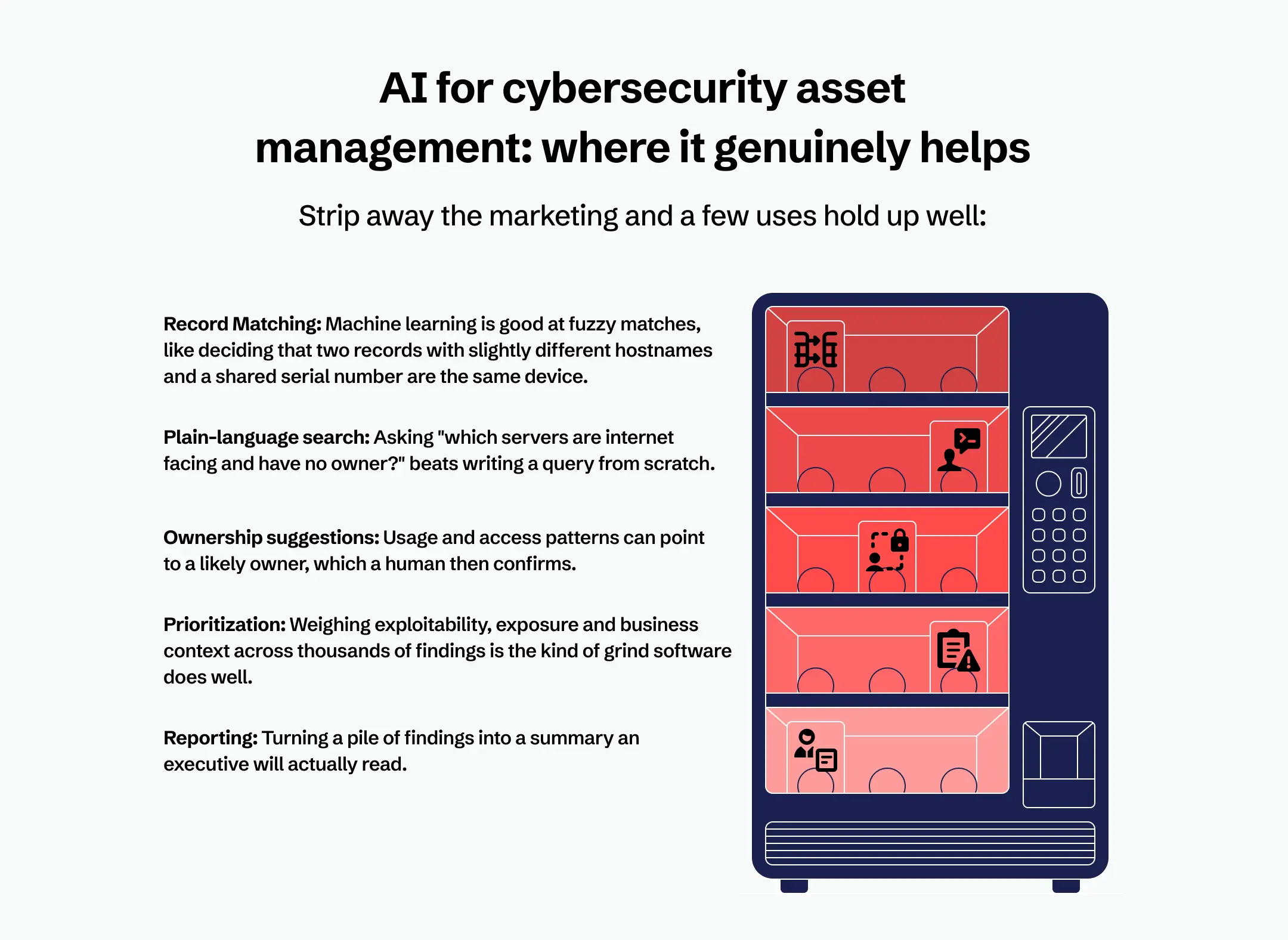
1. AI for cybersecurity asset management: where it genuinely helps
Strip away the marketing and a few uses hold up well:
2. AI tools and agents are assets too
Every AI tool, model and agent your teams adopt is an asset with access to data and systems, and most of them never pass through procurement. Governance guidance for this space suggests recording four things for each one: what it is, who owns it, which identities it can use, and what systems it can reach.
The identity piece trips up a lot of teams. One AI security framework describes the pattern plainly: a coding agent runs under a developer's personal SSH key and cloud credentials instead of a scoped workload identity, with no record in the identity inventory.
Nobody did anything malicious. The agent simply inherited access nobody was tracking. A CAASM solution that treats agents and their credentials as first-class assets can surface that kind of drift before it becomes an incident.
3. Attackers are using AI as well
Attackers are using AI mostly to scale phishing and deepfake campaigns. Faster attackers shrink the window between a new asset appearing on your network and somebody probing it. That's the strongest argument for continuous discovery over quarterly scans. When AI and cybersecurity collide, speed of awareness is half the battle.
Frequently Asked Questions
Is CAASM the same as IT asset management?
No. ITAM focuses on ownership, cost, licensing and lifecycle. CAASM pulls in ITAM data but adds security context, such as exposure, control coverage and relationships between assets, so security teams can act on it.
Does a small or mid-sized business need CAASM?
If you run cloud services, a pile of SaaS apps and a mix of company and personal devices, you already have the visibility problem, just on a smaller scale. Smaller teams don't always need a dedicated platform on day one, but they do need a single, current list of assets with owners. Start there and grow into tooling.
What's the difference between CAASM and EASM?
CAASM looks at your environment from the inside, using data from the tools you run. EASM looks from the outside, discovering what an attacker can see on the internet. They answer different questions and work best together.
Does CAASM replace my vulnerability scanner, CMDB or EDR?
No, it sits on top of them. CAASM consolidates what those tools know and highlights where they disagree or don't cover an asset. You keep the tools and get a more honest view of them.
Is CAASM agent-based?
Mostly it's API-driven, pulling data from tools you already have. Some products add network discovery or lightweight sensors to catch devices no other tool reports, so ask each vendor how it finds unmanaged assets.
How is CAASM priced?
Vendors price in different ways, often tied to the number of assets, integrations or users. Ask for the model early and see how the cost behaves as your estate grows.
Where does AI fit in?
AI can speed up record matching, searching and prioritization. It also adds a new category of assets, such as models, agents and their credentials, that a CAASM solution should track. Either way, it needs clean underlying data to be useful.

Uncover executable insights, extensive research, and expert opinions in one place.
Related Content