- 1. Start with one repetitive task, not one department
- 2. Give every team direct access to AI tools, not just a shared license
- 3. Track time saved, not just tasks automated
- 4. Build a simple feedback loop for AI output
- 5. Review AI-assisted work like you would a junior hire's
- 6. Revisit your tool stack every quarter, not every year
 Share It On:
 Being AI-native isn't about using ChatGPT. Learn the habits, mindset, and operating models that define AI-native businesses in 2026.
Almost every company today calls itself AI-native, but they can never really justify what all did they changed inside their business. This gap between the claim and actual evidence is what we will uncover in our blog ahead.
We've already written about what AI-native means as a concept; what we're covering here is more practical: what these companies look like in practice this year, how their teams are structured, how decisions get made, where AI sits in the actual workflow rather than the marketing copy.
These are patterns we've observed across the companies and products we cover regularly. So, read on further to find out what AI-native companies actually look like.
Characteristics of Leading AI-Native Companies
AI-native private or public companies do not just claim the badge; rather, they show clear traits of being one. These traits show up consistently across the companies that have actually restructured around AI, rather than layered it on top of existing workflows.
1. AI sits in the workflow, not beside it
In these companies, AI isn't a separate tool employees open when they remember to. It's embedded directly into the systems people already use: CRMs, codebases, support queues. So using AI is the default, not an extra step.
2. Smaller teams, wider scope
Headcount per function tends to be lower, but the scope each person owns is larger. A single engineer or marketer often manages work that would have required a team two years ago, because AI handles the repetitive layer underneath.
3. Decisions are made faster, with data in the loop
Planning cycles shrink because models can surface analysis, forecasts, or options in real time. Teams still make the call, but they're not waiting days for a report to be built before they can act on it.
4. Hiring shifts toward judgment, not execution
Job descriptions increasingly favor people who can direct, evaluate, and correct AI output over people hired purely to produce it manually. Execution skills still matter, but they're no longer the primary hiring filter.
5. Products ship and iterate continuously
Release cycles compress because testing, QA, and even parts of design get AI-assisted. Instead of quarterly roadmaps, many AI-native companies operate on rolling updates shaped by real usage data.
6. Cost structures look different
Spending shifts away from headcount-heavy operations toward compute, tooling, and data infrastructure. This changes how these companies scale, growth doesn't require proportional hiring the way it used to.
How Can You Become AI-Native
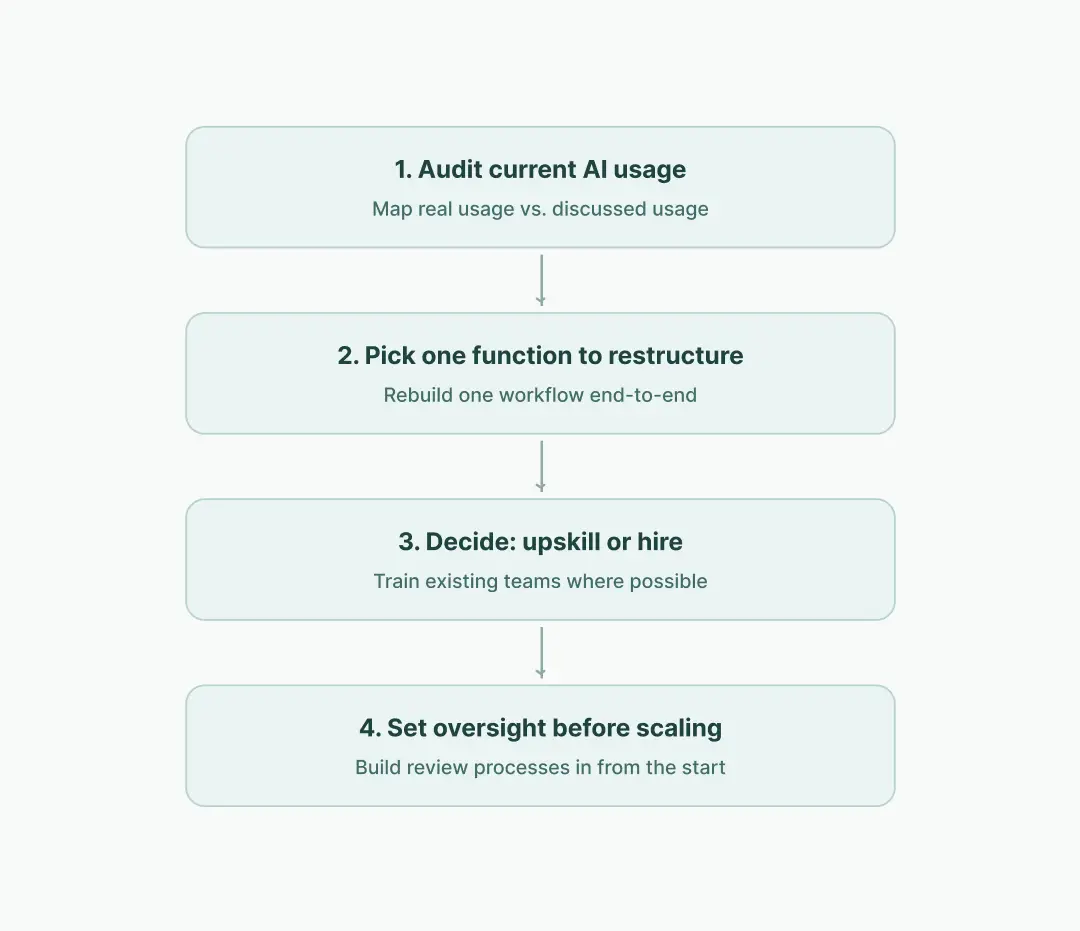
Most companies don't need to rebuild from scratch to move in this direction, they need a clear starting point. These are the steps that tend to separate leading AI-native companies that make real progress from those that stall.
1. Audit where AI is actually being used, not just discussed
Start by mapping which workflows genuinely involve AI versus which ones just get mentioned in meetings. This gap is usually larger than leadership expects.
2. Pick one function to restructure first
Instead of attempting a company-wide shift, choose a single function, support, engineering, or content, and rebuild its workflow around AI end-to-end. This creates a working model to expand from.
3. Decide where to upskill versus where to hire
Existing teams can often be trained to direct and evaluate AI tools rather than replaced outright. Reserve new hiring for roles that require judgment AI can't yet replicate.
4. Set oversight before scaling, not after
Build review and correction processes into the workflow from the beginning. Retrofitting oversight after AI is already embedded across the business is significantly harder.
AI-Native Companies vs. Traditional Companies
Placing the two models side by side makes the differences easier to see than any description on its own.
The comparison below isn't about which approach is better in every case, it's about how differently the top AI-native companies actually operate, day to day.
| Aspect | AI-Native Companies | Traditional Companies |
|---|---|---|
| Team structure | Small, cross-functional teams with wide ownership | Larger teams with narrow, specialized roles |
| Role of AI | Embedded into core workflows and decision-making | Used as a supplementary tool for select tasks |
| Hiring focus | Judgment, oversight, and prompt/output evaluation | Manual execution and domain-specific expertise |
| Product cycles | Continuous shipping, shaped by real-time usage data | Scheduled releases, often quarterly or biannual |
| Decision-making speed | Fast, supported by real-time model output | Slower, dependent on manual reporting and review |
| Cost structure | Weighted toward compute, tooling, and infrastructure | Weighted toward headcount and operational overhead |
| Scaling approach | Growth decoupled from proportional hiring | Growth typically requires proportional headcount increases |
| Data usage | Continuous, feeds directly into operations | Periodic, often reviewed in retrospective cycles |
Real-World Examples of AI-Native Companies in 2026
Only a few companies have moved past the self-claimed AI-native label as marketing and actually built their operations around it.
This AI native companies list is packed with the most visible examples of what the shift looks like in practice.
1. OpenAI
As the company behind ChatGPT, OpenAI's own internal operations reflect the AI-native model it helped popularize: lean teams, rapid iteration cycles, and products that ship and evolve continuously rather than on fixed release schedules. Its influence has also shaped how competitors and enterprise customers structure their own AI adoption.
2. Anthropic
Anthropic has built its products and internal workflows around Claude, using it across coding, research, and operations rather than treating it as a separate customer-facing feature. The company's own engineering and support functions reportedly lean heavily on Claude for day-to-day execution, reflecting the AI-native principle of using your own product to run the business.
3. Perplexity
Perplexity built its core product, an AI-powered search and answer engine — around large language models from the ground up, rather than adding AI to an existing search stack. Its lean team size relative to its user base reflects how AI-native companies scale without proportional headcount growth.
4. Waymo
Waymo's autonomous vehicle operations run on AI at every layer, from perception and route planning to real-time decision-making, with human oversight limited to monitoring rather than direct control. Its inclusion among Nvidia's list of leading AI-native companies in 2026 reflects institutional recognition of it as an established business operating on AI-native infrastructure.
5. Snowflake
Originally a cloud data warehouse company, Snowflake has restructured its platform around AI through Cortex AI, embedding model-driven analytics directly into how customers query and act on their data. It's recognized as one of the top enterprise AI-native platform providers in 2026, alongside Microsoft, Google, and AWS.
6. Salesforce
Salesforce's Agentforce platform reflects a shift from AI as an add-on feature to AI as an autonomous layer capable of executing tasks, handling customer queries, updating records, and triggering workflows without manual input. It's counted among the leading enterprise AI-native platforms in 2026, marking a structural shift for a company built originally on traditional CRM software.
Here’s what you can learn from each company -
| Company | What Businesses Can Learn |
|---|---|
| OpenAI | How to structure lean teams around continuous product iteration instead of fixed release cycles |
| Anthropic | The value of using your own AI product internally before scaling it externally |
| Perplexity | How to scale a user base without scaling headcount proportionally |
| Waymo | How to build systems where AI handles execution and humans handle oversight |
| Snowflake | How to retrofit an existing platform around AI without abandoning your core business |
| Salesforce | How to shift from AI as a feature to AI as an autonomous, task-executing layer |
Challenges of Going AI-Native
Restructuring a company around AI isn't without risk, and most businesses underestimate this part. These are the challenges that show up most often once companies move past the pilot stage
1. Infrastructure and compute costs add up fast
Running AI at the core of your operations means ongoing compute costs that scale with usage, not a one-time software purchase. For companies used to fixed IT budgets, this shift in cost structure can be harder to plan for than expected.
2. Over-reliance on models creates blind spots
When AI handles a large share of decision-making, errors or biases in the model can propagate through the business before anyone notices. Companies need review processes in place, not just trust in the system.
3. Regulatory and compliance requirements are tightening
With frameworks like the EU AI Act now in force, companies operating in high-risk domains — healthcare, finance, hiring- need to account for risk classification and human oversight obligations from the start, not retrofit them later.
4. Talent gaps slow the transition
Restructuring around AI requires people who can direct and evaluate AI output, not just use it. Many companies find this skill set harder to hire for than expected, and internal upskilling takes time
Quick, Actionable Tips for Becoming AI-Native
Beyond the larger structural steps, there are smaller, immediate actions companies can take to start building AI-native habits without waiting for a full strategy rollout
1. Start with one repetitive task, not one department
Pick a single recurring task- meeting notes, first-draft replies, data entry- and automate it fully before expanding. Small, complete wins build trust faster than partial rollouts across many teams.
2. Give every team direct access to AI tools, not just a shared license
Tools sitting behind approval requests or shared logins rarely get used consistently. Direct access removes friction and makes adoption a daily habit rather than an occasional workaround.
3. Track time saved, not just tasks automated
Measuring hours saved per week gives leadership a clearer business case than a list of automated tasks. It also helps identify which use cases are worth scaling first.
4. Build a simple feedback loop for AI output
Even a basic system, flagging errors, correcting outputs and noting what worked, improves results over time and catches issues before they scale. Skipping this step is one of the most common early mistakes.
5. Review AI-assisted work like you would a junior hire's
Treat AI output as a first draft that needs checking, not a finished product. This keeps quality high while the team builds trust in what the tool can and can't be relied on for.
6. Revisit your tool stack every quarter, not every year
AI tools evolve fast, and a stack that made sense six months ago may already be outdated. Short, regular reviews prevent companies from getting locked into tools that no longer fit.
Conclusion
Most companies calling themselves AI-native in 2026 still haven't changed the way they operate, only the way they describe themselves. The companies actually earning the label look different by design: smaller teams doing more, AI embedded in the workflow rather than bolted onto it, and decisions made at a speed traditional structures can't match.
The distinction matters because it's no longer just a branding exercise. As the gap between companies that restructured and companies that didn't continues to widen, the label will stop being something businesses claim and start being something the market simply confirms.
Frequently Asked Questions
What are AI-native companies?
AI-native companies are businesses built from the ground up around AI, rather than adding it to existing systems. AI is embedded in their core workflows, decision-making, and product development, not treated as a separate feature.
How do AI-native companies make money?
Most follow familiar revenue models, subscriptions, usage-based pricing, or enterprise licensing, but their AI-native structure often lets them operate at lower cost per output. This usually means better margins at scale compared to traditional competitors offering similar products.
How to identify AI-native companies?
Look past the marketing language and check for structural signals: lean teams with wide ownership, continuous product releases instead of scheduled ones, and AI embedded directly into day-to-day workflows rather than used as an add-on tool.
Is every AI startup automatically AI-native?
No. Being founded recently or using AI tools doesn't make a company AI-native, the label depends on whether AI is structurally embedded in operations, not just present in the product.
Can a traditional company become AI-native, or only startups?
Traditional companies can become AI-native, though it usually requires restructuring specific functions rather than a single company-wide switch. Several examples in this piece, like Snowflake and Salesforce, show this transition happening at scale.
Do AI-native companies need fewer employees overall?
Not necessarily fewer overall, but headcount tends to shift, smaller execution teams paired with more roles focused on directing, reviewing, and improving AI output.

Uncover executable insights, extensive research, and expert opinions in one place.
Related Content