Share It On:
 This guide to the AI development cost is cheaper than a blindfold and a dartboard (and far more accurate).
Statista says the AI market is going to be $1.01 trillion by 2031 in volume. This means one of the two things: either you sell your soul in an attempt to build something that dominates every other AI solution out there. Or, you stick to your plan, frame a realistic budget, and hire the right kind of folks.
While we can’t introduce you to Lucifer to help you with the first method, we can definitely guide you through the latter one. We will help you figure out AI development costs so you can plan the right kind of space on your P&L sheet.
Now, the quick answer is, your AI product or integration can cost anywhere between — and —. Yes, that’s a massive gap, but predicting the exact cost of building an AI solution is also no different than shooting darts in the dark.
It just gets too risky. So, explore this guide ahead. As you progress, you will be introduced to every parameter that can help figure out the tentative cost of AI development.
Let’s have a look!
Factors That Drive Up Your AI Development Cost
To get a grip on the artificial intelligence development cost estimation, you have to know where the money goes. It's not just code. It's a few key decisions that will define your budget from day one. Your first attempt at an AI development cost estimation starts here.
1. Building AI: In-house vs Outsourcing?
This is your first, and biggest, fork in the road. Do you build an in-house team from scratch or hire an outside shop? The financial difference is staggering. While you’re weighing your options, you should definitely dive deeper into the list of top-tier artificial intelligence development companies to see what the market offers.
A. The In-House Payroll Problem
Hiring your own team gives you total control. It also gives you a massive payroll. We're talking about a war for talent where engineers with the right skills can practically name their price. You're paying for salaries, recruitment bounties, top-tier benefits, and the high-end gear they need to do their jobs.
Meta, for instance, is hiring some of the brightest minds to upgrade its position in the AI race. Reports say some AI engineers are even getting hundreds of millions as their packages.
So, do you need to pay the same amount too?
Not at all, that was just an example of how big a bet this AI race is and what kind of stakes giant companies are investing in it.
You, however, can start with a lower threshold, something that you can easily afford. We have some data from sources like Glassdoor to give you a glimpse of the salaries paid to AI engineers on average. Remember, each number mentioned here is for one developer.
| Country | Junior AI Developer (per annum) |
Mid-Level AI Developer (per annum) |
Senior AI Developer (per annum) |
|||
|---|---|---|---|---|---|---|
| USA | $100,000+ | $200,000+ | $300,000+ | |||
| UK | £84,000+ | $113,000+ | £87,000+ | $117,000+ | £108,000+ | $146,000+ |
| India | ₹6,00,000+ | $6,800+ | ₹10,00,000+ | $11,400+ | ₹25,00,000+ | $28,600+ |
Note: These are tentative figures. In tech hubs like San Francisco or London, costs can even go higher. Also, don’t forget taxes, employee benefits, and more such factors that you become responsible for once you hire a team.

B. The Cost of Outsourcing Your AI Project
Outsourcing can be a savvier move, especially for your first few projects. You plug into a ready-made team of experts without the long-term burden of salaries and benefits. As we explored artificial intelligence development companies, we identified that hourly rates swing from $50 to $250+.
Thankfully, firms are supposed to give you predictable pricing models for AI development. That keeps your budget in control and foreseeable. In short, you pay for the work, without having to manage it on your own.
2. The Gear: GPUs, Cloud Credits, and Data Storage
Great AI needs great hardware. Training a sophisticated model requires a ton of processing power, which means access to expensive GPUs. You either buy them yourself (a huge capital expense) or rent them from cloud providers like AWS or Google Cloud.
Those hourly cloud bills can climb shockingly fast. This is the cost of AI software development that often gets forgotten in the initial pitch.
3. Complexity of the AI Project
The single biggest cost driver is the complexity of AI solutions. A simple FAQ chatbot is one thing. A system that predicts customer behavior using a dozen variables is another universe of complexity and cost.
The harder the problem, the more senior the talent, the longer the timeline, and the bigger the bill. The development costs of AI are a direct reflection of ambition.
| Complex AI Projects | Estimated Hours (MVP to Advanced) | Estimated Costs (at $99 per hour) |
|---|---|---|
| Chatbot | 150–600 hours | $14,850 – $59,400 |
| Recommendation System | 200–800 hours | $19,800 – $79,200 |
| Computer Vision (Image Classification / Object Detection) | 250–1200 hours | $24,750 – $118,800 |
| Natural Language Processing (Text Analysis) | 200–700 hours | $19,800 – $69,300 |
| Generative AI (Text / Content Generation) | 300–1200 hours | $29,700 – $118,800 |
| Voice Recognition & Speech-to-Text | 250–700 hours | $24,750 – $69,300 |
| Predictive Analytics (ML Forecasting) | 200–900 hours | $19,800 – $89,100 |
| Fraud Detection System | 300–1400 hours | $29,700 – $138,600 |
| AI-Powered Search / Semantic Search | 250–1100 hours | $24,750 – $108,900 |
| Healthcare AI (Diagnostics / Risk Models) | 400–2000 hours | $39,600 – $198,000 |
| Finance AI (Trading / Credit Scoring Models) | 350–1600 hours | $34,650 – $158,400 |
| AI-Powered SaaS Platform (End-to-End Product) | 600–3000 hours | $59,400 – $297,000 |
Note: These costs mentioned above are tentatively calculated based on industry standards and can be very dynamic.
Types of AI
AI isn’t limited to chatbots or automation. Some of these types of AIs are already available, while others are yet just concepts. Here’s an overview:
- Narrow AI is mostly designed to execute one purpose. For instance, Netflix uses Narrow AI to leverage AI-powered personalization.
- Reactive AI, which uses sensors to gather information and reacts accordingly. For example, AI is used in games like Chess.
- Memory AI keeps previous experiences stored in memory and shapes its responses accordingly.
- Self-aware AI isn’t a reality, at least for now. As the name suggests, it will display almost consciousness.
- Artificial General Intelligence is not too far from self-aware AI. The difference is, it will be a fully independent AI system with the ability to do more than just know about its existence.
- Artificial Superintelligence is something that exceeds the cognitive ability of humans.
So, How Much Does AI Development Cost: Here’s a Breakdown
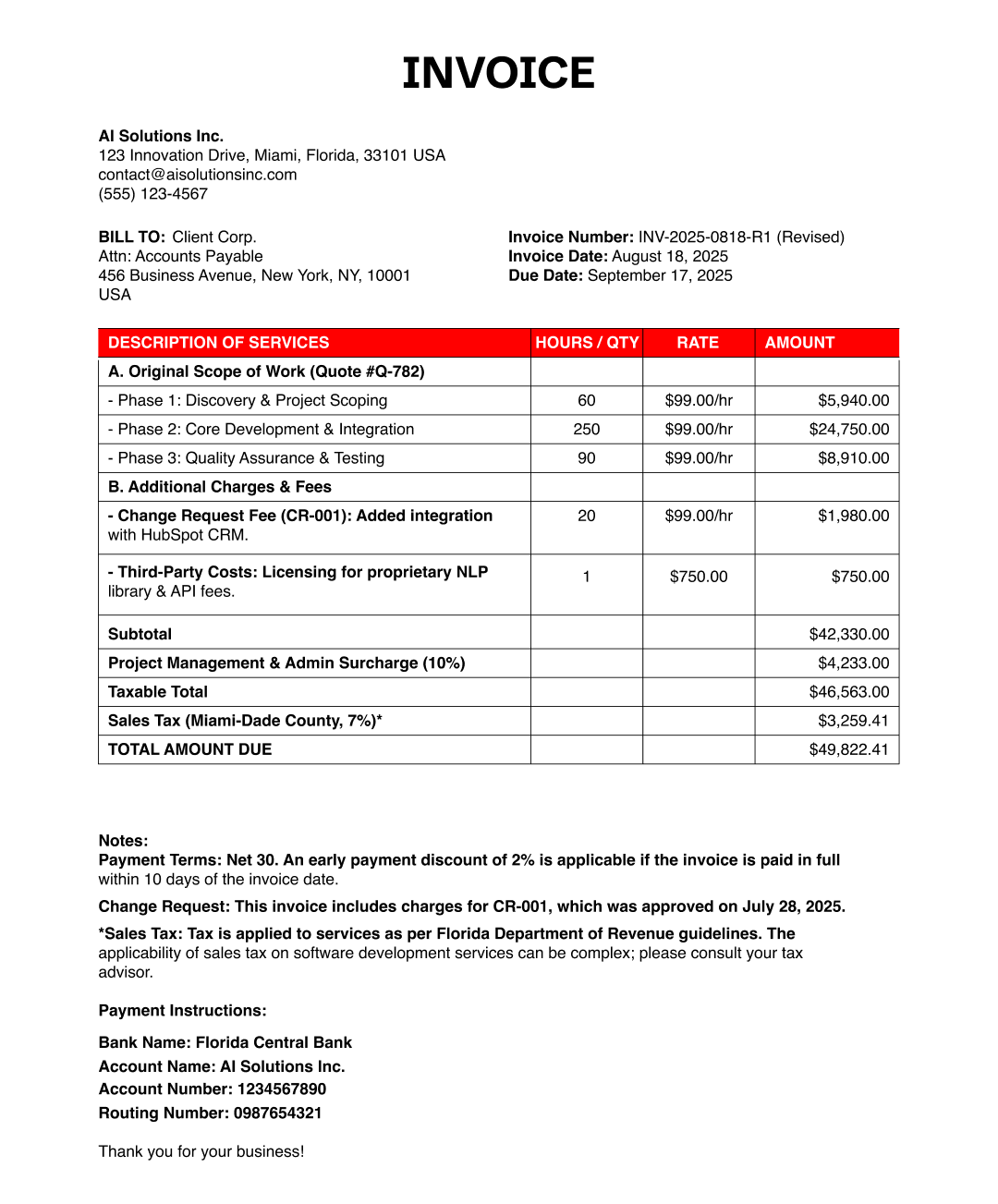
Well, now that we have critical figures on our tips, let’s do a tentative calculation. We will calculate the cost of building an AI chatbot that takes almost 400 hours. The cost we are taking into consideration is $99 per hour, and the developers are from Florida, USA.
The cost also includes:
- A Change Request Fee: Accounting for work added beyond the original scope.
- Third-Party Costs: Pass-through costs for software or APIs needed for the project.
- A Project Management Surcharge: A common fee (often 10-15%) to cover administrative and management overhead.
- Specific Local Taxes: Reflecting the combined state and county tax rate for Miami-Dade, Florida (6% state + 1% local surtax).
The formula for a project-based cost is straightforward:
|
(Total Project Hours × Hourly Rate) + Additional Costs like Taxes, Surcharges, Tech Fees, etc. = Total Estimated Cost |
Here’s how the invoice can look:
How to Plan Your Artificial Intelligence Development Cost Estimations
You can tame the overall cost of artificial intelligence development. You just need a plan. Breaking it down into three phases, check it out!
1. The Discovery Phase
Stop. And plan. Before a single line of code gets written, you need to define the exact problem you're solving. You need to know if your data is even usable. This is your roadmap. Skimp on this phase, and you'll pay for it ten times over down the line. Budget 10-15% of your total project cost for a proper discovery.
2. The Build Phase
This is the main event. Most of your budget gets spent here. But you have options that can radically change the price, which is critical when it comes to leveraging AI. Here’s everything that can be done:
- Go Custom: Building a model from the ground up. It’s expensive, slow, and powerful. Only do this if you have a truly unique problem that off-the-shelf AI can't solve.
- Use Pre-trained Models: The smarter move for most companies. Stand on the shoulders of giants by taking a powerful open-source model and fine-tuning it with your data. This can cut your AI app development cost in half.
- Plug into an API: The fastest and cheapest route is using AI APIs. Use a service from Google, OpenAI, or Microsoft. You pay for what you use. This turns a giant capital investment into a manageable monthly bill. It's a key reason why we see so much innovation in AI in Marketing. After all, building a product isn’t enough; you need to market it well to get some real return.
3. The "Keep-It-Running" Phase
AI isn't a one-and-done deal. Models get stale. Their performance degrades over time as they encounter new data. You have to budget for a team to monitor, retrain, and optimize the system. A safe bet is to budget 15-20% of the initial development cost per year, just to keep it running smoothly.

Popular AIs and the Cost to Build Them
Theory is one thing. Let's look at real-world examples.
1. Cost of Building ChatGPT (High-Level Estimate)
Want to know what the bleeding edge costs? Look at OpenAI's GPT models. Building GPT models costs millions in electricity and cloud computing alone. That figure doesn't even touch the salaries of the PhDs who built it. This is the financial stratosphere, a game for giants.
As for the cost, the breakdown can look like this
| Cost Component | Estimate Range |
|---|---|
| Compute (GPU + Cloud) | $20M – $30M |
| Talent (Researchers & Eng.) | $15M – $30M annually |
| Data Acquisition & Prep | $5M – $10M |
| Infrastructure & Serving | $10M+ per year |
| Total (GPT-3 scale) | $50M – $100M+ |
| Total (GPT-4 scale) | $100M – $250M+ |
2. Cost of Building an App like Janitor AI
A platform like Janitor AI (a character-based chatbot) is a different beast. It’s clever, not colossally expensive. It doesn’t train a new mega-model; it builds a cool application on top of existing ones.
The cost here is in the app development—the user interface, the databases, the API calls. The budget to build Janitor AI looks more like a high-end app build. It can fall somewhere around $92,000 plus ongoing API fees.
3. Cost of Building Midjourney
One of the most popular AI image generators, Midjourney, represents a fascinating middle ground. Unlike apps like Janitor AI that are built on top of other companies' models, Midjourney developed its own powerful, proprietary image generation model from scratch. However, unlike OpenAI, it was reportedly built by a very small, self-funded team.
The cost structure here is completely different from a simple app. The real story is the astronomical and continuous cost of computing. This can be broken into two parts:
A. Training Cost: A massive, upfront cost to train the initial model on billions of images. This requires renting thousands of high-end GPUs for weeks or months. This cost is repeated for every new version (V2, V3, V4, V5, V6, etc.).
B. Inference Cost: The ongoing operational cost every time a user generates an image. With millions of users, this becomes a massive, multi-million dollar monthly bill just to keep the service running.
Here’s a high-level estimate of what it would take to build a service like Midjourney:
| Cost Component | Estimate Range |
|---|---|
| Compute (Initial Model Training) | $5M – $15M |
| Talent (Small, Elite R&D Team) | $5M – $10M annually |
| Data Acquisition & Curation | $2M – $5M |
| Ongoing Inference & Serving Costs | $10M – $50M+ annually (scales with usage) |
| Total Initial Investment | $12M – $30M+ |
The key takeaway is that Midjourney's subscription model isn't just for profit; it's a necessity to cover the enormous and perpetual server costs required to generate millions of images every single day.
How to Save on Your Cost to Develop an AI Solution?
You can keep costs from spiraling out of control. It just takes discipline. Here are some tips!
- Launch an MVP. Don't try to build your grand vision on day one. Build a small, focused Minimum Viable Product that solves one problem perfectly. Prove it works, then expand.
- Use free tools. The AI world is built on open-source artificial intelligence frameworks like TensorFlow and PyTorch. Use them. They are the industry standard and cost nothing.
- Fix your data first. "Garbage in, garbage out." AI is only as good as the data it's trained on. Clean and label your data before you hire a team of expensive engineers.
- Rent, don't buy. Use the cloud. Pay-as-you-go services give you access to supercomputing power without the insane upfront cost. Keeping an eye on evolving AI trends shows this is how modern tech is built.
- Outsource to cost-efficient markets. AI development companies in India, Ukraine, etc., are often considered cost-efficient compared to their counterparts in locations like the UK, the USA, etc. Outsourcing to such countries can be good for your pockets.
Final Word
The bottom line is that the AI development cost isn't a fixed price but a strategic number that you control. It's dictated by major decisions: the talent you hire, the complexity of the problem you solve, and the infrastructure you choose to power it.
While building a foundational model like ChatGPT costs hundreds of millions, a business can enter the AI space for a fraction of that by planning meticulously. The key is to start with a focused MVP, leverage pre-trained models instead of building from scratch, and never forget to budget for the significant, ongoing costs of maintenance and operation.
The price of admission to the AI revolution is steep, but with a disciplined strategy, it’s a manageable investment.
Frequently Asked Questions
Just give me a number. How much does AI cost?
There isn't one. A simple AI tool can be had for $15,000. A complex system can run into the millions. The cost is tied directly to the complexity of the problem you're trying to solve.
What's the biggest budget killer in AI development?
Complexity. Hands down. The more complex the task, the more data, time, and senior-level talent you need. That's what sends the budget skyward.
Can I do AI on a small budget?
Yes. Use third-party APIs, build on top of open-source models, and launch a hyper-focused MVP. Solve one small problem incredibly well. That's how you get in the game without deep pockets.
What about costs after launch?
Budget 15-20% of the initial build cost, per year, for maintenance. All AI models need to be monitored, retrained, and updated, or they stop working correctly. It's a permanent line item.
How much does it cost to build an AI app?
An AI app's cost depends on its complexity, ranging from $15,000 to over $300,000. Here's a quick breakdown:
- Simple MVP: ~$15,000 - $60,000
- Complex App (like Janitor AI): ~$92,000
- Full AI-Powered Platform: ~$300,000+
Will I own my AI product even if I use open-source AI frameworks?
Yes. The most popular open-source AI frameworks (like TensorFlow and PyTorch) use permissive licenses. This allows you to build and sell a commercial product where you own your unique code, trained models, and final intellectual property. The primary requirement is typically to provide attribution to the framework you used.

Uncover executable insights, extensive research, and expert opinions in one place.
Related Content