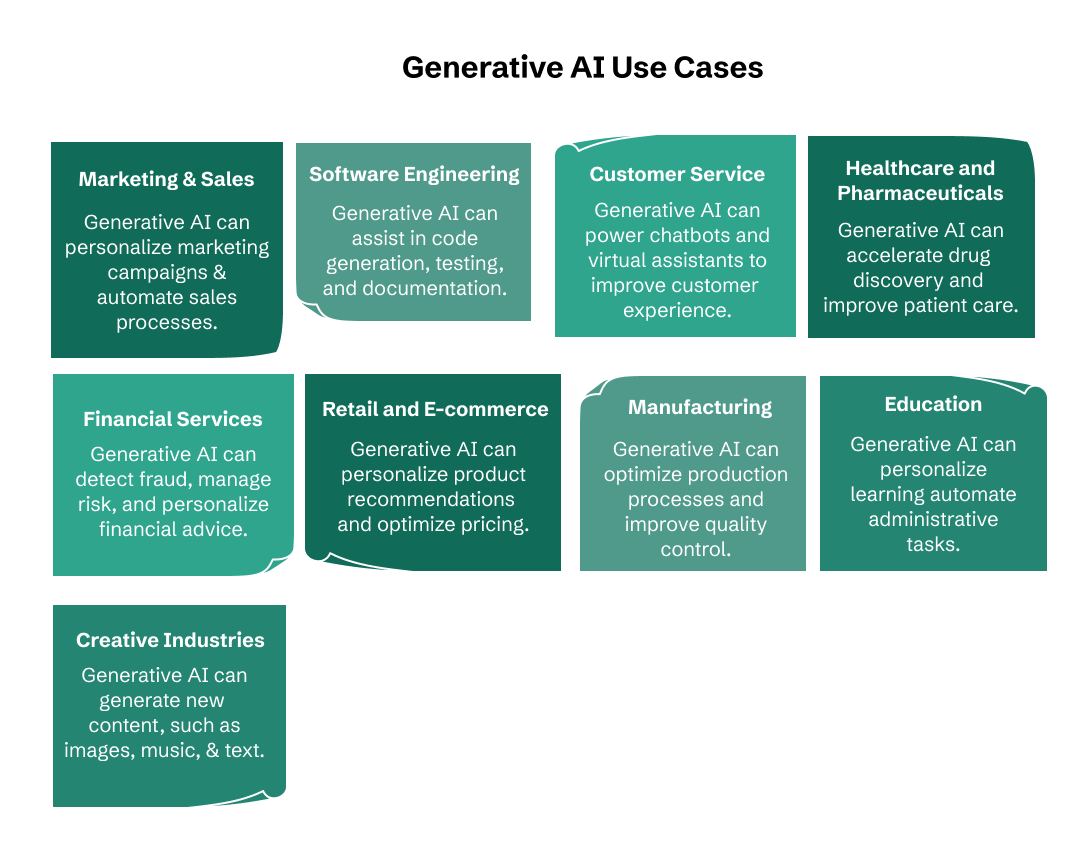
- 1. Marketing and Sales: Where ROI Meets Revolution
- 2. Software Engineering: The Productivity Multiplier
- 3. Customer Service: The Experience Revolution
- 4. Healthcare and Pharmaceuticals: Accelerating Innovation
- 5. Financial Services: The Intelligence Revolution
- 6. Retail and E-commerce: The Experience Economy
- 7. Manufacturing: The Smart Factory Revolution
- 8. Education: Scaling Excellence
- 9. Creative Industries: The Amplification Effect
 Share It On:
 From marketing to manufacturing, explore proven generative AI business use cases transforming industries and creating trillions in value for forward-thinking businesses.
Remember when "digital transformation" was the buzzword every consultant threw around? Well, buckle up—because generative AI just made that look like child's play. We're not talking about marginal improvements or fancy dashboards anymore. We're witnessing a fundamental rewiring of how businesses create, compete, and deliver value.
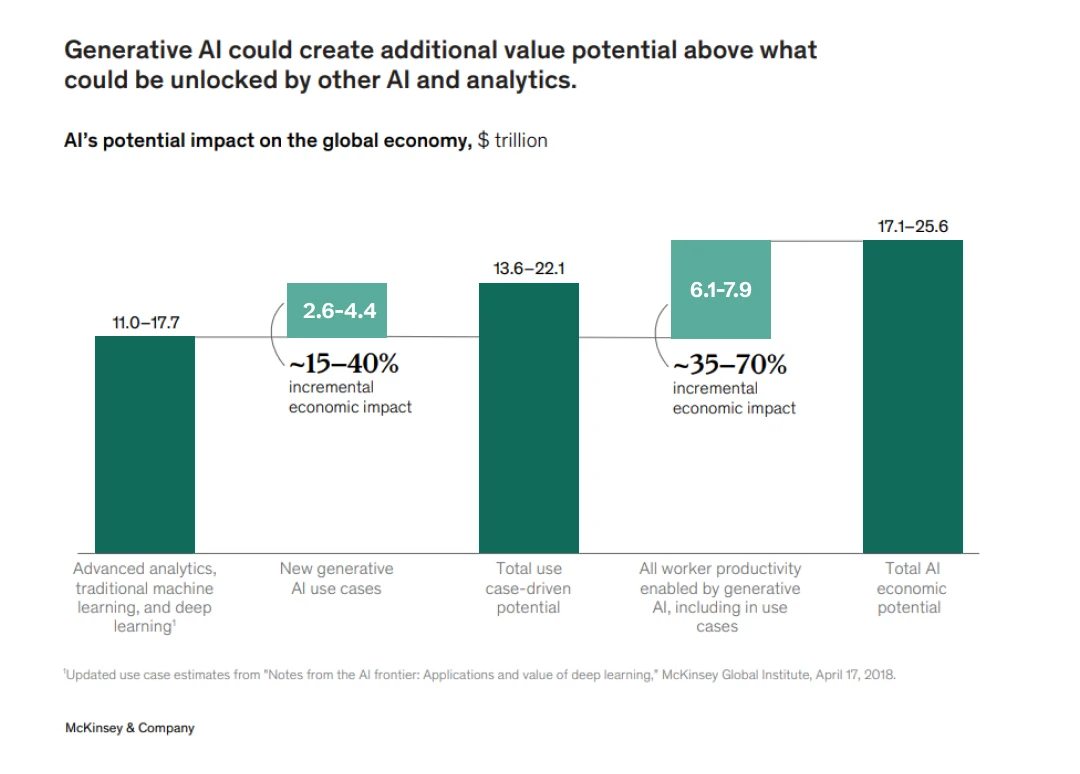
The numbers are staggering enough to make any CFO's head spin: McKinsey projects that generative AI could inject between $2.6 trillion to $4.4 trillion annually into the global economy. That's not a typo. And here's the kicker—75% of that value concentration hits just four areas: customer operations, marketing and sales, software engineering, and R&D. If your strategic planning doesn't account for this shift, you're essentially planning for obsolescence.
But let's cut through the hype for a second. This isn't about jumping on the latest tech bandwagon because everyone else is doing it. This is about understanding that generative AI business applications are already reshaping entire industries while we're still sitting in boardrooms debating whether to "explore" it. Your competitors? They're not exploring—they're implementing, scaling, and capturing market share.
Generative AI Business Use Cases By Industry
1. Marketing and Sales: Where ROI Meets Revolution
Let's talk brass tacks. Marketing departments have always been caught between creativity and metrics, between brand building and lead generation. Now, Generative AI is seemingly giving a solution to this equation. That too in ways that were previously “unorthodox.”
According to McKinsey's research, generative AI could boost marketing productivity by 5-15% of total marketing spending. But those percentages don't tell the whole story. What we're seeing in the trenches is nothing short of transformative.
- Content Velocity That Changes Everything: Teams are revolutionizing their content production workflows. What used to take your marketing team a week now takes a day and a half. Companies like Jasper AI and Copy.ai aren't just helping businesses write faster; they're enabling them to test, iterate, and optimize at speeds that make traditional marketing cycles look prehistoric. Gartner identifies content generation as one of the most mature generative AI use cases, with organizations reporting dramatic increases in output without adding headcount.
- Personalization That Actually Scales: We've all been sold the "personalization" dream before. Although it usually meant adding {{FirstName}} to email templates. But generative AI has cracked the code on true personalization at scale. Companies are using AI to create unique customer journeys for millions of users simultaneously—something that would have required armies of marketers just two years ago.
- Dynamic Email Campaign Optimization: Forget A/B testing two subject lines. Marketing teams are now generating hundreds of email variations. It helps optimize everything from subject lines to call-to-action buttons based on recipient behavior patterns. Each email becomes a personalized conversation starter, not a mass broadcast.
- SEO and Digital Marketing Revolution: Businesses implementing AI for SEO optimization and digital marketing are seeing substantial improvements in organic traffic and engagement. These systems optimize everything from meta descriptions to content structure, adapting in real-time to algorithm changes.
2. Software Engineering: The Productivity Multiplier
If you're a tech leader who hasn't looked at generative AI for development, you're leaving money on the table—lots of it. The potential for transformation here is massive.
GitHub reports that developers using Copilot complete tasks significantly faster. But here's what the statistics don't capture: it's not just about speed. These Generative AI tools are democratizing expertise, allowing junior developers to code at mid-level quality and mid-level developers to perform like seniors.
- Automated Code Review and Optimization: AI systems now review pull requests with superhuman consistency. It can identify security vulnerabilities, performance issues, and maintainability problems that even senior developers fail to point out. Code reviews that took hours now happen in minutes with higher accuracy.
- Testing and Quality Assurance: AI doesn't just run tests—it generates test cases, identifies edge cases that humans consistently miss, and suggests fixes. Google Cloud's collection of real-world AI implementations showcases how companies are reducing bug rates and improving software quality across the board.
- Legacy Code Modernization: Every CIO has that one legacy system—the one running on ancient code that nobody wants to touch. Banks and insurance companies are now using generative AI to translate these systems into modern languages. Ultimately, compressing multi-year migration projects into months.
- Bug Reproduction and Resolution: When users report bugs, AI analyzes logs, reproduces issues automatically, and often suggests fixes before human developers even start investigating. Mean time to resolution drops dramatically.
3. Customer Service: The Experience Revolution
Here's a dirty little secret about customer service: most companies treat it as a cost center to be minimized. Generative AI flips that script entirely, with ai development companies helping businesses deploy advanced chatbots and intelligent support systems that enhance customer experience. We're talking about potential productivity improvements that transform service into a competitive advantage.
- Chatbots That Actually Work: Modern generative AI-powered assistants handle complex, multi-turn conversations with context awareness that feels genuinely helpful. We're seeing companies report significant increases in customer satisfaction scores—not just cost savings, but actual satisfaction improvements.
- Intelligent Call Routing: AI analyzes customer sentiment, issue complexity, and agent expertise to route calls in the most efficient way. For instance, angry customers reach conflict resolution specialists in the shortest TAT. Moreover, technical issues can go to subject matter experts. While sales opportunities get directed to top performers.
- Agent Augmentation That Delivers: The smartest implementations we're seeing don't replace human agents—they turn them into super-agents. AI provides real-time support, suggested responses, and instant access to relevant information, allowing even junior agents to perform at senior levels.
- Real-time Language Translation: Global companies now provide native-language support without hiring multilingual agents. How? With Generative AI. These models translate conversations in real-time while preserving emotional context and cultural nuances.

4. Healthcare and Pharmaceuticals: Accelerating Innovation
The pharmaceutical industry spends enormous amounts on R&D, with new drugs taking 10-15 years to develop on average. Generative AI use cases in healthcare are compressing these timelines in ways that seemed impossible just five years ago.
- Drug Discovery at Silicon Valley Speed: Lead identification that used to take months in the olden days now happens in mere weeks. Companies like Insilico Medicine and Atomwise are using AI to explore chemical spaces that human researchers might never have considered. This helps identify promising drug candidates at unprecedented speeds.
- Precision Medicine That Scales: AI analyzes patient data to create truly individualized treatment plans, considering genetic markers, medication histories, and outcomes from millions of similar cases. What used to be "precision medicine for the wealthy" is becoming "precision medicine for everyone."
- Medical Imaging Analysis: Radiologists receive AI assistance that identifies subtle abnormalities in X-rays, MRIs, and CT scans. Early-stage cancer detection rates improve while reducing false positives and reading times. In fact, just recently, AI was able to detect subtle signs of breast cancer in a patient 10 years before it could’ve been detected.
5. Financial Services: The Intelligence Revolution
Banking might have a reputation for being conservative, but when it comes to generative AI use cases in financial services, they're surprisingly aggressive.
- Risk Assessment and Fraud Detection: Banks using AI for loan processing and fraud detection are seeing dramatic improvements. Real-time analysis of transaction patterns, automated risk scoring, and intelligent alert systems are becoming table stakes in the industry.
- Wealth Management Democratization: Major firms are equipping financial advisors with AI assistants that can instantly synthesize information from vast document libraries. Advisors can now provide insights that would have taken teams of analysts days to compile.
- Algorithmic Trading Enhancement: AI generates trading strategies based on market sentiment analysis, news interpretation, and pattern recognition across global markets. High-frequency trading becomes more sophisticated and profitable.
- Credit Underwriting Revolution: With AI, now loan applications get processed in minutes instead of days. These models analyze hundreds of data points (traditional credit scores, income sources, social media activity) and create more accurate risk profiles and expand credit access.
6. Retail and E-commerce: The Experience Economy
Retail's transformation through generative AI isn't just about efficiency—it's about completely reimagining the shopping experience.
- Conversational Commerce: Customers describe what they want in natural language, and AI doesn't just find products—it curates experiences. "I need something professional but approachable for a client dinner in Miami"—and AI delivers options considering weather, cultural context, and personal style.
- Dynamic Operations: From pricing to inventory management, AI systems optimize in real-time based on countless variables. Supply chain resilience has become a major differentiator, with AI-powered systems predicting disruptions before they impact operations.
- Inventory Forecasting Revolution: AI predicts demand with unprecedented accuracy by analyzing weather patterns, social media trends, economic indicators, and historical data. Stockouts and overstock situations become rare.
- Supply Chain Transparency: AI allows customers to receive detailed information about things like product origins, sustainability metrics, and delivery estimates. As higher computational power clubbed big data exists now, complex supply chains have become a lot more transparent and trustworthy.
- Virtual Try-On Experiences: AI-infused try-on experiences are great, as customers can now visualize products in their environment or on their bodies before purchasing. This can even lead to a big drop in return rates while customer confidence increases.
7. Manufacturing: The Smart Factory Revolution
Manufacturing might seem like an odd fit for generative AI, but the applications are transformative. Here are some of them:
- Generative Design: Engineers are using AI to create designs that human minds wouldn't conceive—parts that look organic but perform better than traditional designs. Components that are lighter, stronger, and use less material.
- Predictive Excellence: Factories using AI-powered predictive maintenance are seeing massive reductions in unplanned downtime. Quality control systems now detect defects invisible to human inspectors, preventing costly recalls and protecting brand reputation.
- Production Schedule Optimization: AI optimizes manufacturing schedules across multiple facilities, considering machine capacity, material availability, energy costs, and delivery deadlines. Production efficiency improves while costs decrease.
- Quality Control Enhancement: AI-powered vision systems are now able to detect invisible defects and detect them so well that was previously not possible with a human workforce. This means that product quality improves while inspection costs drop dramatically.
Also Read: Generative AI vs Predictive AI
8. Education: Scaling Excellence
The education sector's transformation might not grab headlines, but the implications are profound.
- Truly Adaptive Learning: Coursera highlights how AI platforms create customized learning paths based on individual pace, style, and knowledge gaps. We're not talking about multiple choice quizzes—we're talking about AI tutors that adapt their teaching style to each student.
- Teacher Empowerment: AI handles the administrative burden—grading, lesson planning, progress tracking—freeing teachers to do what they do best: inspire, mentor, and connect with students.
- Automated Assessment and Feedback: Paper assessment and feedback have gotten a lot easier with Generative AI. Models can grade complex assignments, provide detailed feedback, and identify learning gaps automatically. Teachers spend less time on administrative tasks and more time on actual teaching.
- Curriculum Development: With the help of predictive analytics, AI can now analyze job market trends and skill demands to suggest curriculum updates. This means that educational programs stay relevant to industry needs automatically.
9. Creative Industries: The Amplification Effect
Here's where things get interesting for any business that depends on creative output. Generative AI business applications in creative fields aren't replacing creativity—they're amplifying it exponentially.
- Content Production at Scale: News organizations use AI to simply cover more stories as they can generate pieces in mass. Furthermore, marketing agencies generate concepts in minutes instead of days with AI. Whereas, content creators produce more while maintaining quality.
- Design Democratization: Tools that once required years of training are now accessible to anyone. AI assists non-designers in creating professional materials. This means that creativity becomes limited only by imagination, not technical skill.
- Video Production Acceleration: Only a few years back, video production required a very specific set of skills that took time to learn and even execute. Now, AI generates video scripts, creates storyboards, and even produces rough cuts. Because of this, video content creation becomes accessible to small businesses and individual creators.
- Music Composition and Production: Musicians receive AI assistance with melody generation, arrangement suggestions, and even full instrumental tracks. This helps uplift creative exploration while artistic vision remains human-driven.
The Implementation Reality Check
To be real for a moment. Not every generative AI project succeeds. Every generative AI case study we've discussed comes with challenges. Successful implementations require careful planning and realistic expectations. But here's the difference with generative AI: the barrier to entry is lower, the time to value is faster, and the generative AI business use cases are clearer than ever before.
The companies winning with generative AI share three characteristics:
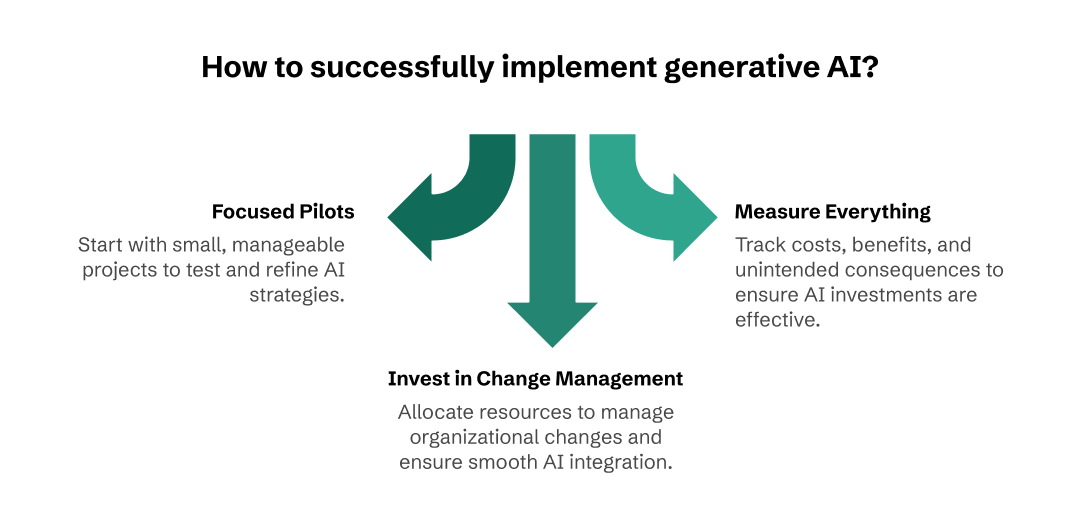
- They start with focused pilots, not enterprise-wide transformations
- They measure everything—costs, benefits, and unintended consequences
- They invest in change management as much as technology
Leaving With a Thought
We're at an inflection point. Gartner predicts that by 2026, over 80% of enterprises will have deployed generative AI applications, up from less than 5% in 2023.
Every week of delay is a week your competitors are learning, iterating, and capturing value. The McKinsey estimate of $4.4 trillion? Goldman Sachs suggests it could reach $7 trillion by 2030.
The generative AI revolution isn't coming—it's here, it's real, and it's rewriting the rules of business. The companies that embrace this reality will survive AND define the next decade of their industries. Adoption is just a matter of time.
Frequently Asked Questions
Which industry benefits the most from generative AI?
While every sector's getting disrupted, banking and high-tech are absolutely crushing it with generative AI. McKinsey's data shows banking could capture up to 4.7% of industry revenues—we're talking $340 billion annually. Tech companies? They're seeing 20-45% productivity gains in software development. But here's the real story: the industry that moves fastest wins, regardless of sector.
What are some examples of generative AI being used?
The applications are everywhere once you start looking. GitHub Copilot helps developers code 50% faster. Morgan Stanley's 16,000 advisors use GPT-4 to synthesize massive document libraries instantly. Retailers use AI for hyper-personalized shopping experiences. Pharma companies compress drug discovery from months to weeks. Even newsrooms deploy AI to cover more stories.
How are government agencies using generative AI?
The government's moving faster than you'd think. Agencies are deploying AI for citizen services—think intelligent chatbots that actually understand complex queries. Document processing that took weeks now happens in hours. Fraud detection in benefits programs. Policy analysis at unprecedented scale. Some agencies report 40% productivity gains in administrative tasks. The public sector's digital transformation just hit hyperdrive.

Uncover executable insights, extensive research, and expert opinions in one place.
Related Content