Share It On:
 Looking to outsource web development services without risking delays or poor results? Here are proven tips and expert strategies to choose the right development partner.
Outsourcing web development means hiring an external team, onshore, nearshore, or offshore, to build, maintain, or scale your website or web app. Done right, it cuts costs by 40–70%, ships faster than an in-house build, and gives you access to skills that are hard to hire full-time. Done wrong, it quietly burns six months of runway.
The decision isn't whether to outsource. Most companies already do, 76% of enterprises outsource at least part of their IT work. The decision is who to hire, what model to use, and what to pay.
Get those three right and outsourcing becomes a real lever for growth. This outsource web development guide walks through all three.
How to Outsource Web Development: A Step-by-Step Guide
There are multiple advantages of hiring web development companies and you’ve decided to outsource. But what’s next? Before you start sending emails, walk through the six step guide below-
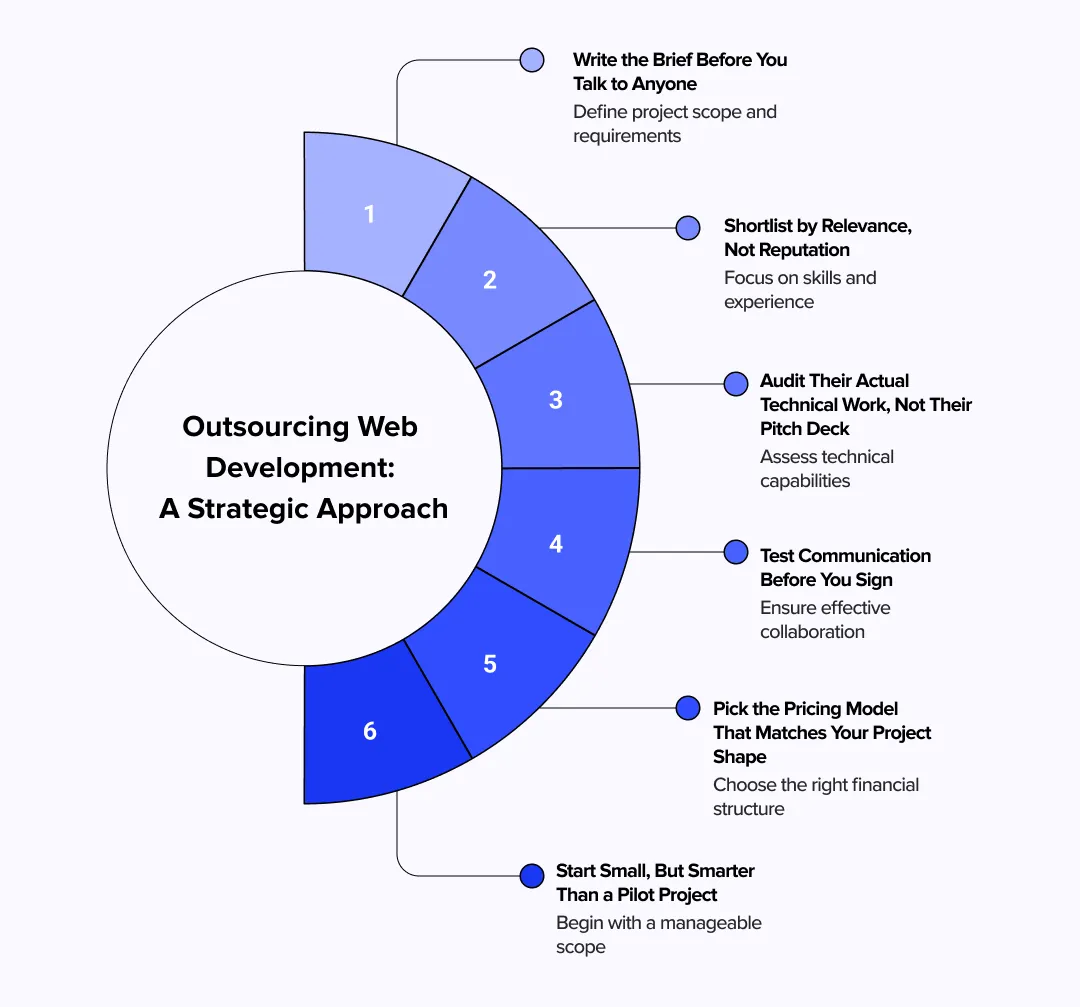
1. Write the Brief Before You Talk to Anyone
The single biggest predictor of outsourcing success is how clearly you can describe what you want before the first vendor call. A good brief covers project goals, target users, must-have features, technical constraints, integrations, success metrics, and timeline. It doesn't need to be long; three to five pages is plenty, but it needs to be specific.
2. Shortlist by Relevance, Not Reputation
The best vendor for your project isn't the most famous one; it's the one that's built something close to what you need. A 50-person agency that's shipped 15 e-commerce sites will outperform a 500-person firm that's mostly done enterprise dashboards, even if the bigger firm has better PR. Filter your shortlist by three things: industry experience, project type (marketing site vs. SaaS vs. internal tool), and technology stack.
3. Audit Their Actual Technical Work, Not Their Pitch Deck
Every agency has a polished sales process. The differentiator is what's underneath. Ask for three things: a live demo of a recent build, access to a code sample (sanitized is fine), and a 15-minute call with a developer who actually worked on the project, not the salesperson, not the founder.

4. Test Communication Before You Sign
Schedule a 30-minute working session, not a pitch, with the team you'd actually work with. Bring a real problem from your project and watch how they engage. Do they ask clarifying questions? Do they push back on assumptions? Do they speak in specifics or abstractions?
Communication quality compounds. The importance of web development is undeniable for your business, so make sure to choose a partner who is clear with ideas and communication.
5. Pick the Pricing Model That Matches Your Project Shape
The three main pricing structures for outsourced web development services are fixed-price (best for tightly scoped projects), time and materials (best for evolving scope), and dedicated team (best for long-term product work). Match the structure to the project, not the other way around.
The mistake most companies make is choosing a fixed price for an evolving project to "control costs." It backfires, every change becomes a billable line item, and the vendor's incentive shifts from solving your problem to staying inside the original contract.
6. Start Small, But Smarter Than a Pilot Project
The conventional advice is to start with a small pilot before committing to a larger engagement. The updated version: start with a paid discovery sprint or a single sprint of real work, two to four weeks, scoped narrowly, with a defined deliverable.
This is different from a pilot in one important way. A pilot is a separate project; a discovery sprint is the first phase of the actual project. You're not buying a test, you're buying a structured first step that tells you whether to keep going.
Why Most Businesses Prefer to Outsource Website Development?
The decision to outsource web development services is not based on a single factor. Six different factors get bundled together to allow businesses to reach this decision. Based on the patterns we've seen across hundreds of vendor-client engagements, here's what actually drives the call:
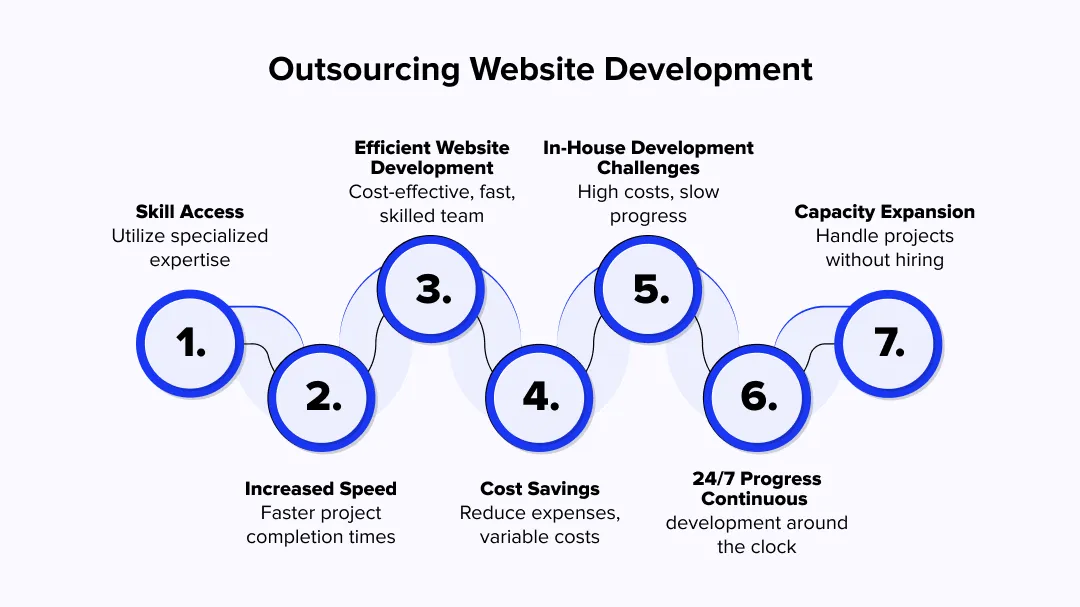
1. Cost
Hiring a senior developer in the US runs roughly $165,000 a year before benefits. Hiring web developers in India or the Philippines with the same skill level runs $40,000–$55,000. For most non-engineering companies, that gap is the entire business case.
2. Speed
In-house hiring takes 4–8 weeks before a developer writes a line of code. Conversely, a vendor with bench capacity starts in days. For founders with 90 days of runway or marketing teams chasing a campaign window, speed is the whole point.
3. Access to skills you can't hire full-time
AI integration, accessibility compliance and headless CMS architecture, these are specialist skills you need for one project, not one role. Outsourcing buys them by the hour.
4. Variable cost instead of fixed cost
Hiring an in-house team costs the same in slow months as in busy ones. A vendor scales up and down with the work. For seasonal businesses or product teams between launches, that flexibility is worth more than the hourly savings.
5. Capacity without hiring overhead
Recruiting, onboarding, equipment, benefits, and management time add roughly 30% to the loaded cost of an in-house hire. A vendor absorbs all of that.
6. Around-the-clock progress
Distributed teams across time zones mean code gets written while your office sleeps. Useful for tight launch windows; less useful if your project doesn't need 24-hour velocity.
Most outsourcing decisions involve three or four of these at once. The mistake most businesses make is leading with cost when speed or skill access is the real driver; that's how you end up with the most affordable vendor instead of the right one.
Types of Outsourcing Models: Where to Hire, and How
Before you shortlist a single vendor to outsource your web development project, you need to answer two questions: where do you want your team to sit, and how do you want to pay them?
So, how to choose the right outsourcing provider? Geography shapes your daily workflow, while the engagement model directly impacts the cost of building a website and your overall financial exposure. Confuse the two, and you'll end up with a contract that doesn't fit how your business actually operates.
I. Geographic Models
1. Onshore
Onshore simply means hiring developers in your own country. You'll pay the most, US rates run $100–$250 an hour, but you'll also get the smoothest workflow: no time zone gaps, no cultural translation, no contract structures designed for cross-border work.
2. Nearshore
Nearshore can be defined as choosing web developers in a country close to yours, with overlapping working hours. For instance, as a US-based company, you can nearshore to Mexico, Costa Rica, or Colombia. UK and EU companies can hire outsource web developers to Poland, Ukraine, or Romania.
3. Offshore
Offshore is hiring across continents, usually India, the Philippines, or Vietnam, for North American and European companies. This is where the cost savings are largest, often 60–70% below onshore rates. The trade-off is logistical: you're working across an 8–12 hour gap, which makes async-friendly projects.
II. Cost Comparison by Region
| Region | Hourly Rate | Time Zone Overlap (US) | Best Fit |
|---|---|---|---|
| North America (US, Canada) | $100–$250 | Full | Regulated industries, complex stakeholder coordination |
| Western Europe (UK, Germany) | $70–$200 | 5–9 hours | EU compliance, premium engineering culture |
| Eastern Europe (Poland, Ukraine, Romania) | $30–$70 | 6–8 hours | Senior technical work, strong English |
| Latin America (Mexico, Colombia, Argentina) | $25–$60 | 0–3 hours | Daily-collab product work for US clients |
| Asia (India, Philippines, Vietnam) | $15–$50 | 9–12 hours | Async-friendly builds, tight budgets |
| Africa (Egypt, Nigeria, South Africa) | $20–$50 | 4–8 hours | Emerging tech hubs, English proficiency |
*The high end of every range usually buys senior engineers and tighter project management. The low end buys raw hours. Most companies budget for outsourcing land in the middle of whichever region they pick.
III. Engagement Models
1. Full-Cycle (Project-Based)
The vendor takes the brief, builds the thing, and hands it over. You're paying for an outcome, not hours. Scope is locked at the start; change requests are billed separately. Best for well-defined projects with a clear endpoint, a marketing site, an MVP or a redesign.
2. Dedicated Team
A cross-functional web development freelancer’s team works on your product as an extension of your in-house staff. They have their own project manager but report into your roadmap. You don't own them, but you direct them. Best for long-term product work where you need consistency, accumulated context, and the ability to pivot scope without renegotiating contracts.
3. Staff Augmentation
You hire individual specialists who slot into your existing team and follow your processes. They're plugged in, not partnered with. Best for filling specific skill gaps, a senior React developer for three months, a DevOps engineer to set up your CI pipeline, and a QA lead for a launch.
IV. Engagement Model Comparison
| Model | Pricing Structure | Best For | Risk to Watch |
|---|---|---|---|
| Full-Cycle (Project-Based) | Fixed price for defined scope | Well-scoped builds with a clear endpoint, MVPs, marketing sites and redesigns | Scope creep: every change becomes a billable line item |
| Dedicated Team | Monthly retainer per team member | Long-term product work needing consistency and roadmap flexibility | Underutilization of your roadmap slows down |
| Staff Augmentation | Hourly or monthly per specialist | Filling specific skill gaps within an existing team | Coordination overhead if your in-house team isn't ready to manage them |
Bonus Read: In-House vs. Outsource Web Development
What Outsourced Web Development Actually Costs
The first question every buyer asks is "How much will this cost?" The honest answer is somewhere between $1,000 and $250,000+, and which end you land on isn't random; it's a function of your project type, geography, scope clarity, and timeline.
Below is the actual breakdown by project type, what moves the number, and the outsource web development cost that almost never show up in the initial proposal.
| Project Type | Cost Range | Typical Timeline |
|---|---|---|
| Simple marketing site (1–10 pages, no custom backend) | $1,000–$8,000 | 2–6 weeks |
| Custom WordPress / CMS site with integrations | $5,000–$25,000 | 4–10 weeks |
| MVP web application (defined scope, single user role) | $15,000–$60,000 | 8–16 weeks |
| Full SaaS product (multi-tenant, integrations, dashboards) | $40,000–$150,000 | 4–9 months |
| Enterprise platform (custom architecture, compliance, scale) | $150,000–$500,000+ | 6–18 months |
KEY POINTERS
- These ranges assume mid-tier vendor pricing, Eastern European or Latin American teams, or senior offshore.
- Onshore US development typically lands at the high end of each range or above. Bargain-basement offshore can land below the low end, but the quality variance is significant.
- Most companies budget too tightly because they price the build and forget that the build is half the cost. Real total cost includes design, content, testing, deployment, and the first 6–12 months of post-launch fixes. Understanding the complete web design cost structure helps businesses budget more accurately and avoid unexpected expenses. Plan for the build to be 60–70% of your total spend.
What Drives the Cost Up or Down
Here are the four factors that move the outsourced web development costs -
- A well-defined brief reduces development cost by 20–40% because the vendor isn't billing you to figure out what you want. Vague briefs are the most expensive thing in outsourcing.
- A senior full-stack developer costs $150 an hour in the US, $50 in Eastern Europe, and $25 in South Asia. The same skill, different markets. The full regional breakdown is in the comparison table above.
- Fixed-price contracts include a risk premium because the vendor is absorbing scope uncertainty. Time and materials is cheaper if the scope is genuinely flexible, but more expensive if you don't manage it actively.
- Compressed timelines run 20–50% above standard rates because the vendor has to staff up or pull people off other accounts. If your launch date is fixed, build the premium into your budget upfront.
Hidden Costs Most Businesses Miss
The sticker price of outsourcing web development services is usually 60–70% of the real total cost. Budget the other 30–40% upfront and you'll avoid the surprise that derails most outsourcing engagements.
- Post-launch maintenance and fixes: 15–20% of the build cost annually. Budget for it from day one; most companies don't, and end up funding it from emergency reserves.
- QA and testing buffer: 10–15% of the development cost. Affordable-looking quotes often include only basic functional testing, not cross-browser, performance, or security testing, which you'll pay for separately.
- Project management overhead: 10–15% of total cost. Most vendors charge for PM time as a separate line item.
- Discovery and design phases: $2,000–$15,000. This is real work and should be budgeted for separately, not negotiated as a freebie.
- Knowledge transfer at handoff: 1–2 weeks of dedicated time. When the project ends, you need documentation, code walkthroughs, and access transfers.
- Contract change orders: 15–30% of the original scope, on average. Across most projects, the scope expands. Build a 20% contingency into your budget specifically for change orders.
Which Development Roles Can Be Outsourced (and which not)?
One of the most effective web development strategies is to know that not everything needs to be outsourced. The mistake most businesses make isn't outsourcing too little; it's outsourcing the wrong things. Here's the working split, based on what consistently works and what consistently goes wrong.
I. What to Outsource and How Much Control to Keep
| Work Type | Outsource Fully? | Why | What You Keep In-House |
|---|---|---|---|
| Marketing and brochure sites | Yes | Defined scope, low strategic risk, easy to verify quality | Brand guidelines, content approvals |
| MVPs with a clear feature list | Yes | Vendors ship faster than in-house ramp-up | Product vision, user research |
| Internal tools and admin dashboards | Yes | Useful for the business, not customer-facing | Access control, security review |
| Standalone integrations (Stripe, HubSpot, Salesforce, APIs) | Yes | Vendors who've done it 50 times do it faster than your team learning it | API keys, vendor relationships |
| Maintenance and bug fixes | Yes | Retainers are more affordable than a full-time hire if the load is under 20 hrs/week | Triage and prioritization |
| QA and testing | Yes | Specialized, scopable, verifiable | Acceptance criteria, release decisions |
| Core product features | Partial | Vendors build, but the architecture and roadmap need an owner | Product manager, lead engineer |
| Custom SaaS development | Partial | The platform can be built; the technical direction can't be outsourced | Architecture decisions, technical debt strategy |
| AI and ML integrations | Partial | Vendors can build the pipeline; judgment on output quality stays internal | Model selection, evaluation and prompt design |
| Work tied to your competitive moat | Partial | The differentiator stays; adjacent work can move | The core algorithm, system, or workflow itself |
II What Not to Outsource
Some work either depends on institutional knowledge that's expensive to transfer, or carries risk that's hard to recover from if it goes wrong.
- Security architecture for regulated data - Healthcare, financial, or government data. Compliance overhead makes outsourcing more expensive than hiring, and the liability exposure is significant.
- Live business operations - The systems your business runs on every day — payment processing, customer data pipelines and real-time analytics. Build, monitor, and own these in-house.
- Strategic technical decisions - Which database to use, which framework to commit to, when to refactor versus rebuild. These are five-year decisions; vendors are six-month engagements.
- Work you can't write a clear brief for - If you can't describe what success looks like, no vendor can deliver it. Either pay for a paid discovery phase first or do the thinking in-house before signing.
Challenges in Outsourcing Web Development and How to Overcome Them
Web application development outsourcing fails for predictable reasons. Knowing what they are before you sign is the difference between solving them in advance and discovering them in month four.
| Challenge | How to Overcome It |
|---|---|
| Time zone gaps that slow decisions | Insist on a 3–4 hour live overlap and a daily 15-minute standup |
| Vague briefs leading to scope creep | Write the brief with explicit non-goals, not just must-haves |
| Quality variance across vendor teams | Get the actual team names and seniority in writing before signing |
| Junior staff swapped in after the contract was signed | Require weekly code reviews with an in-house or independent lead |
| Communication breakdowns that compound | Document every decision in a shared spec doc within 24 hours |
| IP ownership ambiguity | Specify code, design, and data assignment on payment in the master contract |
| Data security in regulated industries | Require SOC 2 or ISO 27001 and confirm where data is processed |
| Scope expansion past the original contract | Build a 20% contingency into the budget and define a change-order process |
| Vendor disappears at handoff | Add a paid 1–2 week handoff phase and withhold 10% of payment until verified |
| Maintenance falls between contracts | Lock post-launch support terms before the build kicks off, not after |
Conclusion
Outsourcing web development works when you treat it as a structured decision, not a vendor-shopping exercise. The companies that get a real return on it know what they're outsourcing, why they're outsourcing it, and what they're keeping on their side.
The mechanics in this guide, the engagement models, the cost ranges and the in-house anchors aren't complicated. What makes them work is using them in order. Get the brief right, pick the model that fits the project shape, evaluate vendors on actual work instead of pitch decks, and write the contract with handoff already in mind.
Done well, outsourcing is the fastest way to ship a product without building a permanent engineering team. Done poorly, it's an expensive lesson in why the brief matters. So plan wisely!
Frequently Asked Questions
How much does it cost to outsource web development in 2026?
Costs range from $1,000 for a simple marketing site to $250,000+ for an enterprise platform. The biggest variables are project type, region, and scope clarity. Eastern European and Latin American teams typically charge $25–$70 per hour, while US-based vendors charge $100–$250 per hour for comparable work.
Where should I outsource web development to?
It depends on your time zone tolerance and budget. US clients who need daily collaboration usually go nearshore to Mexico, Costa Rica, or Colombia. Companies prioritizing cost over real-time communication go offshore to India, the Philippines, or Vietnam. Eastern Europe (Poland, Ukraine, Romania) is the most common middle ground for both US and European clients.
Is it affordable to use AI tools or outsource to a developer?
For small, well-scoped projects, including landing pages, simple dashboards, internal tools, AI tools like Cursor or Claude Code can replace a developer for under $200 a month. For anything requiring architecture decisions, integrations, or ongoing maintenance, outsourcing is still more affordable than the time it takes a non-developer to direct AI tools well.
What's the difference between offshore and nearshore web development?
Offshore means hiring across continents and time zones, typically India, the Philippines, or Vietnam for North American clients, with 8–12 hour gaps. Nearshore means hiring in a neighboring country with overlapping working hours, such as Mexico, Costa Rica, or Colombia, for US clients. Nearshore costs more but eliminates the coordination overhead that comes with async-only work.
How do I make sure I can trust an outsourced developer with my code and data?
Sign an NDA before sharing project details. Specify IP assignment and data ownership in the master contract; code becomes yours on payment, with no exceptions. For regulated data, require SOC 2 or ISO 27001 attestation and confirm where data is processed and stored.

Uncover executable insights, extensive research, and expert opinions in one place.
Related Content