Share It On:
 Every codebase tells a story — make sure yours is worth reading. Learn how to choose a web development company that writes your future.
Choosing a web development partner is a high-stakes gamble. According to a Business Research Insights report, the global web development market is exploding—projected to swell by over $165.13 billion by 2035—but this boom has created a chaotic landscape littered with landmines.
Businesses are no longer just asking for websites; they're commissioning intricate digital ecosystems. This makes the question of how to find a good web development company one of the most financially critical decisions you'll make all year. Get it wrong, and you're not just out of a budget.
You're bleeding market share, haemorrhaging credibility, and stuck with a digital anchor that drags your business down. This guide isn't about finding the cheapest vendor. It's a strategic framework for how to choose a web development company that functions as a genuine partner, one squarely focused on delivering measurable, bottom-line results.
So, without ado, let’s begin!
1. What's the Point? (Define Your Architectural Blueprint)
Never, ever approach a custom website development company with a vague "we need a new website" request. It's a recipe for disaster. You are the architect; they are the builder. You must hand them a detailed blueprint, not a cocktail napkin sketch. Before you send a single email to hire a web development company, you must have concrete answers to these questions.
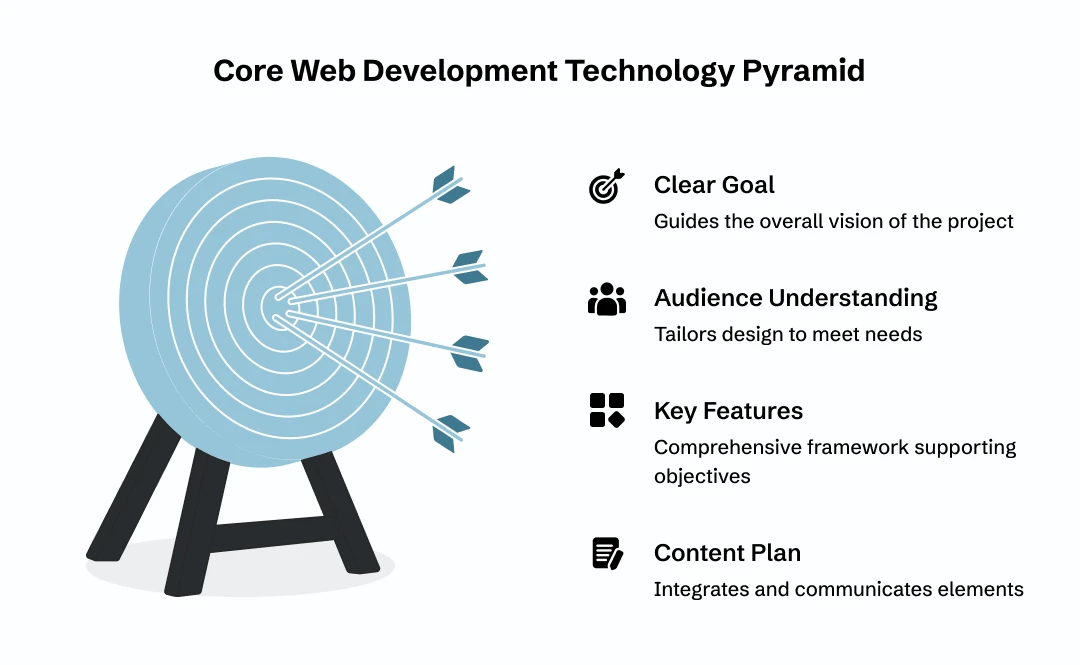
- What is the Primary Business Goal? Is this a lead-generation machine? A direct-to-consumer sales engine? A high-authority content hub? If you can't articulate the primary commercial purpose in a single sentence, honestly, you aren't yet ready to hire anyone.
- Who Is This For? (And Who Is It Not For?) "Everyone" is not an audience. A platform targeting enterprise CIOs requires a vastly different UX, tone, and security posture than one targeting Gen-Z shoppers. Be precise while drafting the user persona. This will overall decide your user acquisition and retention rates.
- The "Must-Have" vs. "Nice-to-Have" Matrix: This is your core functional spec. List every single feature—CMS integration, e-commerce cart, booking API, multi-language support—and ruthlessly categorize it. This document becomes the north star for your entire web development plan.
- The Content Hurdle: A beautiful site with no content is a $50,000 empty picture frame. Who is writing the copy? Shooting the photos? Producing the videos? A weak content strategy is the number one reason projects miss their launch date.

2. The Evidence Locker (Evaluating Portfolio and Experience)
A company's portfolio isn't a creative gallery; it's an evidence locker. It’s your job to interrogate it. Looking at pretty homepages is the rookie mistake. A veteran looks for proof of results.
- Look for Versatility, Not a "One-Trick Pony": Does every site in their portfolio look suspiciously similar? That's a red flag. You want a web development firm that demonstrates a wide-ranging design aesthetic and the technical chops to build for different industries, not one that just re-skins the same template.
- Have They Solved Your Problem Before? This is crucial. If you're a retail web development company prospect, you need to see complex e-commerce builds, not just static brochures for dentists. If you're in real estate, you need to see MLS integrations. For e-commerce specifically, you must seek out specialized ecommerce web development companies that live and breathe conversion funnels, payment gateways, and inventory management.
- Demand Case Studies That Talk Metrics: A case study that only talks about "a beautiful design" and "a happy client" is useless marketing fluff. The importance of web development is its impact. Look for case studies with headlines like, "How we reduced cart abandonment by 22%" or "Redesign led to a 150% increase in qualified leads."
3. The Interview Room (Ask Before You Trust)
Before you fall for pitch decks or polished portfolios, talk to the people who’ll actually build your product. A web development company is only as good as its core team — not its presentation.
Ask for a brief interview with the project manager, lead developer, and UI/UX designer. You’re not testing coding syntax; you’re assessing how they communicate, solve problems, and take responsibility. This step turns a faceless vendor into a real partnership opportunity.
Here are a few ready-to-use interview questions that instantly reveal competence and attitude:
- “What’s one project that went off-track, and how did your team handle it?”
- “How do you manage scope changes without derailing deadlines?”
- “If a post-launch issue hits, what’s your immediate triage process?”
- “Which collaboration and tracking tools do you rely on daily?”
- “How do you keep design and development aligned across sprints?”
- “What happens once the project goes live — how does support work?”
Listen carefully to how they answer. Strong teams explain how they think, not just what they’ve done. They’ll talk in specifics — tools, frameworks, decisions — while weak teams stay vague.
By interviewing at the right level during your research phase, you shift from shopping for a service to choosing a partner who’s invested in your long-term success. In fact, this evaluation process is one of the most important steps when you choose a web design company for a long-term digital project.
4. Under the Hood (Assessing Technical Expertise)
A stunning chassis with a sputtering, mismatched engine is worthless. Many businesses get seduced by a slick design proposal and forget to ask what's powering it. The types of web development services offered are your first clue.
- The Right Tech Stack for Your Job: Don't let a company sell you on their favorite tech stack. The project's goals should dictate the tools. Do you need the lightning speed of a React front-end? The raw power of Python/Django for data-heavy operations? The enterprise support of .NET? The chosen stack has 10-year consequences for scalability and security. That's why experienced development teams carefully evaluate the best web app development frameworks before recommending a solution that aligns with your business goals. Your tech stack decides your strategy to hire web developers meeting the project’s tech requirements.
- The In-House vs. Offshore Bench: Ask them point-blank: "Who is actually writing the code?" Are they using their own salaried front-end developers and back-end developers? Or are they subcontracting the core build to the lowest bidder? A deep, in-house bench of full-stack developers means more accountability and less "lost in translation." This is a key factor when considering outsourcing web development services.
- UX/UI Isn't a Feature, It's the Whole Game: This is not a "nice-to-have." This is the thing. Data overwhelmingly shows that a well-architected UI/UX design in web development can boost conversions by up to 400%. This discipline is the science of translating your business goals into a seamless user journey. A team that treats it as just "making it look good" will fail you.
- SEO from Day One: A site that isn't built with SEO optimization from the very first line of code is a site that's launching with a massive handicap. SEO isn't a post-launch "add-on"; it's in the site architecture, the heading structure, the page speed, and the mobile-first indexing.
5. The Unbiased Truth (Client Reviews and References)
The portfolio is what the company wants you to see. The reviews are what their past clients need you to know. Spend as much time on this step as you did on the portfolio.
- Read the Bad Reviews: Every company has them. The key is how they respond. Do they get defensive and argumentative? Or do they take ownership and offer a professional resolution? That response tells you everything about their character.
- Call Their References. Ask Hard Questions. Any decent firm will provide references. Don't ask softball questions like "Were you happy?" Ask veteran-level questions that reveal their true process:
- "What was the biggest unexpected crisis during the project, and how exactly did they handle it?"
- "How did they handle scope creep or a change request from your team?"
- "Tell me about their communication. When things went wrong, who called you, and what did they say?"
- "How clean was the project handoff and documentation?"
6. The Crisis-Flow (Communication and Collaboration)
Projects go wrong. It's a fact. A feature will break. A deadline will be missed. A third-party API will go down. The web development process you should be evaluating isn't the "happy path" workflow; it's the crisis-flow.
- Who Is Your Point of Contact? You need a single, dedicated project manager who has real authority, not just a sales-focused "account manager."
- What's the Communication Rhythm? Demand a plan. Will there be standing weekly check-ins? A shared Slack channel? A real-time dashboard? Vague promises of "we'll keep in touch" are a massive red flag.
- How Do They Handle Feedback? "We'll send you a link when it's ready" is amateur hour. A professional process involves structured walk-throughs of wireframes, clear revision cycles, and a ticketing system for feedback. You are a partner, not a spectator. This entire collaborative effort defines the partnership.
7. Building a Fortress (Security and Compliance)
A data breach can be an extinction-level event, destroying decades of brand trust and inviting catastrophic fines. In 2026, web development firms that don't lead with security are committing malpractice.
- Privacy by Design: The firm must build for compliance from the ground up. This means a deep, practical, and non-negotiable understanding of the GDPR (General Data Protection Regulation) if you have any European traffic.
- Handling Sensitive Data: If you're in healthcare, the service providers you’re looking for must be HIPAA-compliant. No excuses. If you process a single credit card, the vendors you pick must be fluent in PCI DSS (Payment Card Industry Data Security Standard). This isn't optional; it's the law.
- Security Protocols: Ask for their security checklist. It should include SSL implementation, data encryption at rest and in transit, protection against SQL injection and XSS, and a plan for regular security audits.
8. The AI Augment (Future-Proofing Your Platform)
Don't get dazzled by AI hype. A company that sprinkles "AI" all over its proposal is often just using buzzwords. But don't ignore it, either. The most significant of all web development trends is the practical application of AI as a tool for efficiency and personalization. It’s not about AGI; it’s about augmentation.
- **Practical AI Use Cases: How, specifically, is the firm using AI in web development? Are they just using Generative AI to write blog posts (like this one)? Or are they using it for intelligent code completion, automated debugging, and running thousands of A/B tests? Those are the Generative AI use cases that deliver real value.
- Smarter Tooling: Top-tier AI web development companies are not building from scratch. They are masters of integration. They leverage existing AI APIs to plug in sophisticated features—like recommendation engines or advanced semantic search—at a fraction of the cost of building them. They use AI website builders for rapid prototyping, not as a crutch for the final product.
- The Future of AI: Ask about their experience with more advanced concepts. Are they using open source AI agents to automate complex back-end workflows? Are they exploring tools that use Automatic Lexicon Inductions to help AI understand your company's specific, niche-filled jargon? This shows they're not just users of AI, but students of it. This is how you spot the benefits of AI.
9. The Real Cost of "Cheap" (Budget Planning)
Let's talk money. And let's be clear: the cheapest bid is almost always the most expensive mistake you will ever make. It's the bid that leads to six months of missed deadlines, a final product that doesn't work, and a total-loss "rescue project" with a real developer. You are not shopping for a commodity; you are looking for the best value and lowest risk. The most successful businesses view this as investing in custom web development rather than simply purchasing a website.
- Pricing Models: The web development cost is structured in a few key ways. A fixed-price project estimate is great for a clearly defined project, but it’s inflexible. Hourly rates (or "Time & Materials") are far more flexible and common for complex projects where the scope is likely to evolve.
- Line-Item Invoices: Never accept a vague proposal. Demand an itemised cost breakdown. How many hours/dollars are allocated to discovery, to UI/UX, to front-end, to back-end, to QA? This transparency is the hallmark of a professional firm.
- Total Cost of Ownership (TCO): The project fee is just the down payment. What are the ongoing costs? You must budget for website maintenance, hosting, licensing, and a support retainer. This is the real long-term investment, and it's especially critical for web development companies for startups that need predictable OPEX.
Cost Comparison: Choosing Your Pricing Model
The choice of your pricing model depends on the priorities of your vendor. Some like long-term commitments, some prefer the flexibility of the project scope. Either way, these can be one of the three options you will get to explore in the market.
| Model | Best For... | Pros | Cons |
|---|---|---|---|
| Fixed Price | Clearly defined projects with zero scope creep (e.g., marketing sites). | Budget Predictability: You know the exact cost upfront. | Zero Flexibility: Any change requires a painful and costly "change order." Can incentivise the agency to cut corners. |
| Time & Materials (T&M) | Complex, evolving projects (e.g., custom apps, MVPs, iterative builds). | Maximum Flexibility: You can pivot, add features, and refine as you go. | Budget Uncertainty: The final cost is unknown. Demands extremely high trust and weekly oversight. |
| Retainer | Long-term, ongoing maintenance, optimisation, and new features. | Dedicated Team: You have guaranteed access to developers who already know your code. | "Use It or Lose It": You're paying for access to the team, not just the hours. Inefficient for one-off projects. |
10. The Long View (Global Sourcing and Partnership)
A website isn’t a painting you hang once and forget. It’s more like a living garden — it changes, sometimes wildly, and needs care that never quite ends. You don’t just hire web developers for a project; you look for a team that grows with you, one that sees your brand as something still unfolding.
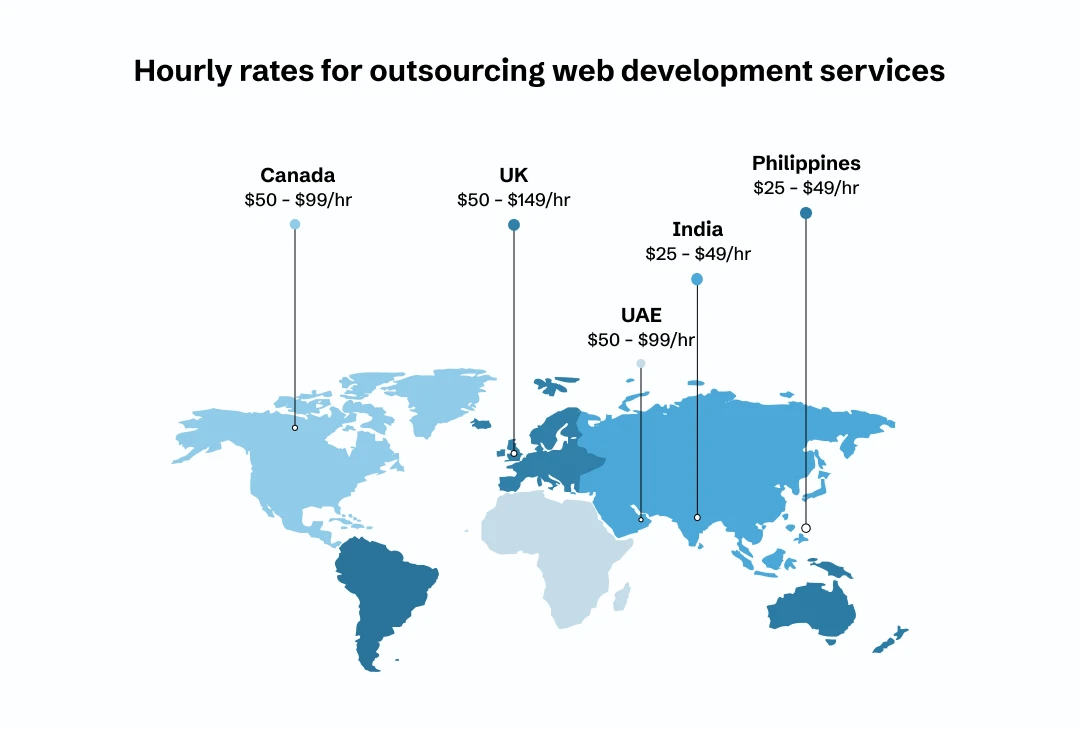
The average hourly cost can look something like this!
- Architecture for Growth: Think of your site like a city blueprint. Can it handle a sudden crowd — say, ten times your current traffic — without breaking? And if you want to plug in a new product line or business unit, will it need a total rebuild, or can it stretch to fit? That’s what scalability really means: building with tomorrow already in mind.
- A Smarter Global Sourcing Strategy: The idea of hiring the agency down the street feels almost nostalgic now. The best talent is global, scattered across time zones, each cluster with its own flavor and strength. It’s less about geography and more about matching energy, cost, and creativity.
- Many businesses now lean on some of the best web development companies in India, known for their deep engineering pools and ability to handle large-scale, layered builds. You’ll find teams there who can move fast, ship often, and still keep budgets in check — a rare combination when you’re scaling aggressively.
- A growing number are also turning toward web development companies in the Philippines, where developers are known for strong communication and flexibility. They thrive on collaboration — ideal if your product evolves fast or you’re running multiple sprints at once.
- For brands that prefer time-zone harmony and closer touchpoints, web development companies in Canada often make an excellent fit. These teams combine North American standards with hands-on project management, bridging creative work and strategic alignment without friction.
- Across the Atlantic, web development companies in the UK bring their own blend of creativity and structure — design that’s clean and code that’s disciplined. It’s a great balance for enterprise clients who want reliability without losing character.
- Then there are the new digital hubs reshaping the landscape. Web development companies in the UAE, for instance, are rising fast in sectors like luxury, finance, and logistics. They blend Western design sensibility with an understanding of high-stakes, fast-growth markets — making them an interesting partner for companies across manufacturing and commerce.
11. The Agreement Table (Contracts, Clarity & Conversations)
A handshake may start the deal, but a clear contract sustains it. Before you lock in your web development partner, pause for a serious discussion — not about design or timelines, but about expectations. Every successful project begins with a transparent agreement that lays out deliverables, milestones, revision limits, payment schedules, and maintenance clauses.
Discuss ownership rights openly. Who controls the codebase? Who manages hosting credentials? What happens to your data if you switch vendors later? These questions aren’t about mistrust — they’re about long-term stability and control.
A good web development company will welcome these conversations. They’ll explain their change-request process, help define what counts as “out of scope,” and ensure you know how communication will work post-launch. This is also the time to clarify warranties — bug fixes, minor revisions, and support windows.
Finally, ensure both sides agree on how success is measured. It’s not just about going live; it’s about uptime, performance benchmarks, and user satisfaction metrics. A well-written agreement doesn’t just protect your investment — it builds mutual respect and accountability before a single line of code is written.

The Final Call: Turning Selection into Strategy
A great website doesn’t come from luck — it comes from intent. Smart web development strategies begin with asking sharper questions, not chasing trends. What role should your site play in your business engine? What does success actually look like? Those answers guide every build that lasts.
When figuring out how to hire web developers, skip the shiny decks. Talk to the people who’ll actually touch the code. Notice how they think, not just what they say. The best ones push back gently, suggest better tools, and plan for scale before you even ask. That’s who you want on your side.
And if you’re considering a custom website development company, treat the first project like a rehearsal, not a wedding. Run a small sprint. Watch how they communicate, how fast they adapt, and whether they fix problems without drama. That tells you more than any proposal ever could.
The real win isn’t in launching a site — it’s in building a partnership that outlives the project. Because the web isn’t built once, it’s built every single day you choose the right people to grow it with you.

Uncover executable insights, extensive research, and expert opinions in one place.
Related Content