Share It On:
 Here’s an expert analysis of SaaS versus custom web development costs, benefits, and implementation strategies for modern business leaders.
Every business leader faces this decision eventually. Your company needs new software, and you're weighing two fundamentally different approaches. On one side, there's Software as a Service - monthly subscriptions, instant access, zero maintenance headaches. On the other hand, you have custom web applications that you own completely (but require significant upfront investment).
The stakes aren't small. The global SaaS market reached $250 billion in 2024, while countless businesses continue building custom web applications to gain competitive advantages. Both paths can lead to success, but choosing the wrong one can cost your company months of productivity and hundreds of thousands of dollars.
We've seen companies thrive with SaaS application development solutions that perfectly matched their needs. We've also seen businesses transform their industries with custom applications that couldn't exist any other way. The difference always comes down to understanding what your business actually requires versus what seems appealing on paper.
Choosing Between SaaS And Web App: Key Differences That Actually Matter
Understanding the practical differences helps clarify which approach suits your situation:
| Aspect | SaaS Applications | Web Applications |
|---|---|---|
| Ownership & Control | Provider owns and manages everything; you're a subscriber | You own the application and have complete control |
| Deployment Speed | Immediate – sign up and start using | Takes weeks to months for development and deployment |
| Customization | Limited to the provider's configuration options | Unlimited customization possibilities |
| Pricing Model | Monthly/annual subscription fees | Upfront development cost, then hosting and maintenance |
| Maintenance | The provider handles all updates, security, and maintenance | Your responsibility (or your development partner's) |
| Scalability | The provider manages scaling automatically | Requires planning and potentially significant infrastructure changes |
| Integration | Limited to available APIs and connectors | Can integrate with virtually any system or database |
| Data Control | Data is stored on the provider's servers | Complete control over data location and security measures |
| Exit Strategy | Can cancel the subscription, but may face data export challenges | Own the code and data completely |
SaaS vs Web App: Understanding the Meaning
The debate between SaaS vs Web Application can be better understood when we know the basics of it. Here is a detailed breakdown of the two.
1. What SaaS Really Means for Your Business
Software as a Service eliminates most technical complications from your software decisions. You pay monthly fees, access applications through web browsers, and the provider handles everything else. No servers to buy, no updates to install, no security patches to worry about.
The appeal is obvious. Companies like Salesforce built billion-dollar businesses by removing technical barriers between businesses and powerful software. When you need project management, customer relationship management, or accounting software, you can literally start using professional-grade applications within hours of making the decision.
This model works because Saas development services have matured dramatically over the past decade. Providers invest millions in infrastructure, security, and feature development that individual companies could never justify. You get enterprise-level capabilities at predictable monthly costs.
The trade-off is straightforward: convenience costs control. You can configure SaaS applications within their allowed parameters, but you cannot fundamentally change how they work. If your business processes differ significantly from what the software assumes, you'll need to adapt your workflows or look elsewhere.
When SaaS Makes Perfect Business Sense?
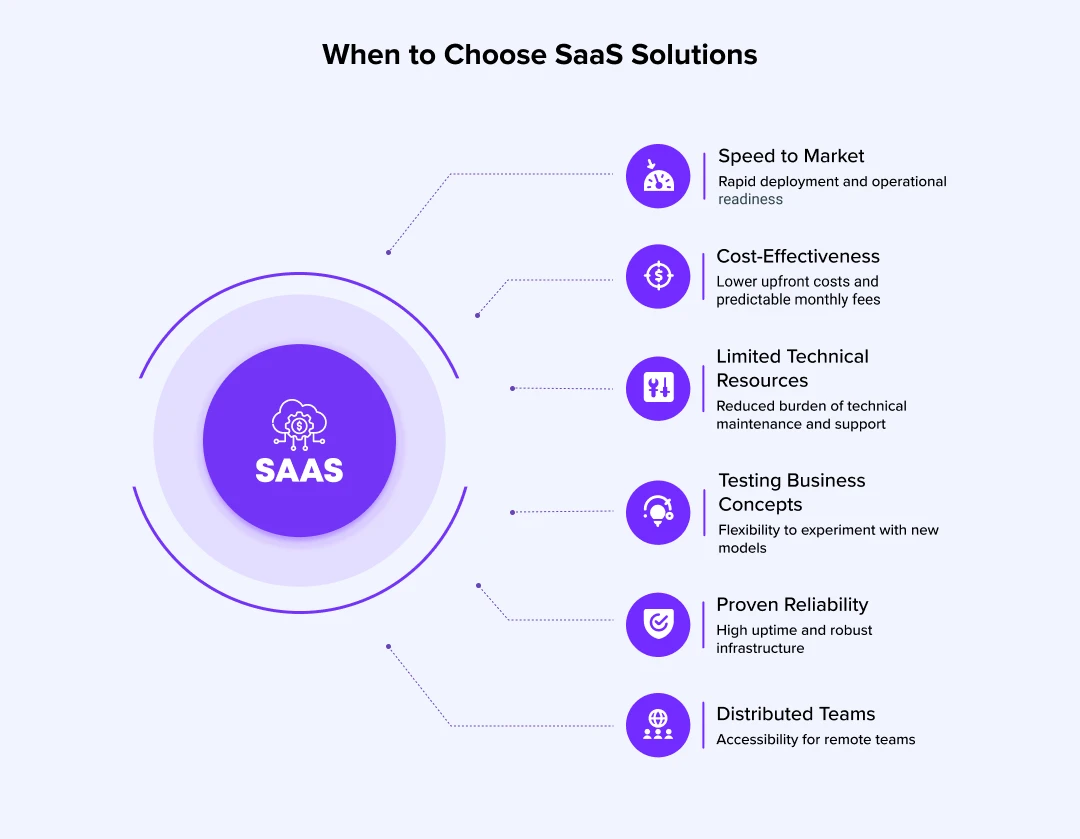
SaaS applications shine when:
- You Need Speed to Market: If you need a solution yesterday, SaaS wins hands down. Most SaaS platforms can have you operational within hours, not months.
- Your Budget is Tight: The upfront costs of SaaS are typically much lower than custom development. Instead of a $50,000 development project, you might pay $100-500 per month.
- You Have Limited Technical Resources: SaaS can help big time if you don't have a dedicated IT team or development staff. It removes the burden of technical maintenance and support.
- You're Testing Business Concepts: If you're not sure exactly what you need (or you're experimenting with new business models), SaaS offers the flexibility to try different approaches without massive commitments.
- You Need Proven Reliability: Established SaaS providers have invested millions in infrastructure, security, and reliability. They often provide better uptime than many businesses could achieve on their own.
- Your Team is distributed: SaaS applications are built for the cloud-first world. Remote teams can access the same powerful tools from anywhere with an internet connection.
2. Custom Web Applications: Building for Your Exact Needs
Web applications represent the opposite philosophy. Instead of adapting your business to fit available software, you build software that fits your business exactly. These applications run on web servers, accessible through browsers like SaaS, but you control every aspect of their functionality.
Companies choose custom development when their competitive advantage depends on doing things differently. A logistics company might need specialized routing algorithms. A manufacturing business might require integration with proprietary machinery. A financial services firm might have compliance requirements that standard software cannot meet.
The investment is substantial. Development services for custom applications typically start at $50,000 and can exceed $500,000 for complex enterprise systems. Development takes months, not hours. You'll need ongoing maintenance, security updates, and feature enhancements.
However, the result is software that becomes a business asset. You own the code, control the data, and can modify functionality whenever business requirements change. For companies with unique needs or long-term growth plans, this ownership model often proves more valuable than subscription savings.
When Custom Web Applications Are Worth the Investment?
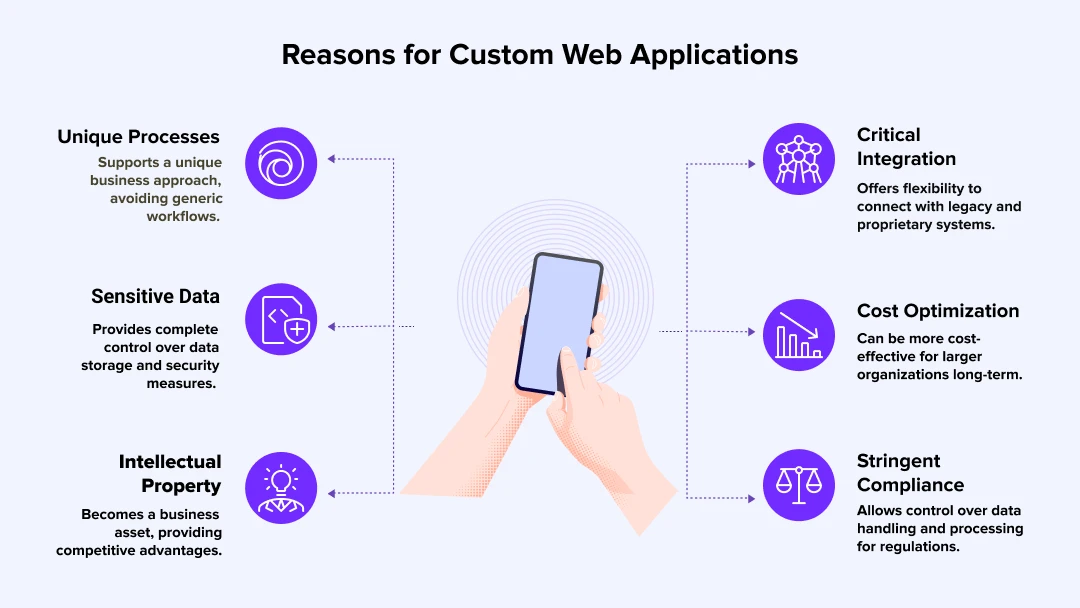
Custom web applications make sense when:
- Your Business Processes are Unique: If your competitive advantage comes from doing things differently, then a software that supports your unique approach is non-negotiable. This is because an off-the-shelf solution might force you into someone else's workflow.
- Integration is Critical: Custom web applications work wonders when you need deep integration with existing systems. It offers unlimited flexibility to connect with legacy databases, specialized equipment, or proprietary systems.
- You Handle Sensitive Data: While SaaS providers take security seriously, some businesses require complete control over their data storage, processing, and security measures.
- Long-term Cost Optimization Matters: Even though the upfront costs are higher, Custom applications can be more cost-effective in the long run. This is especially true for larger organizations with thousands of users.
- You want to Create Intellectual Property: A custom application becomes a business asset that you own. It potentially provides competitive advantages and even revenue opportunities.
- Compliance Requirements are Stringent: Certain industries have rigid regulatory requirements. To move around that bureaucratic red tape, these solutions are a better choice as you can control every aspect of data handling and processing.

The Hybrid Approach: Best of Both Worlds
Here's something that many businesses don't consider initially: You don't have to choose just one approach. Some of the most successful digital strategies I've seen combine both SaaS and custom web applications strategically.
Example: You might use SaaS solutions for standard business functions (email marketing, accounting, or customer support). Simultaneously, you can build custom web applications for your core business processes or customer-facing platforms. This approach lets you move quickly in areas where standardization works while maintaining control over your differentiating capabilities.
This means that maybe it's not SaaS or Web Apps, but maybe it's the combination of SaaS and Web Apps that will do the job for your business needs.
Financial Reality Check
The cost comparison isn't as straightforward as it seems to be. A 50-person company using a comprehensive SaaS platform might pay $150 per user monthly (totaling $90,000 annually). Over the span of five years, that's $450,000 with no assets to show for it.
Custom application development platform solutions for the same company might cost $250,000 initially, then $20,000 annually for hosting and maintenance. Total five-year cost: $330,000, plus you own the software completely.
However, it would be wise to note that this calculation ignores hidden costs.
Custom applications require:
- Project management
- Quality assurance
- Ongoing development support, etc.
Whereas, SaaS solutions include:
- Customer support
- Automatic updates
- Infrastructure management, etc.
Here's a tip: The true cost comparison depends on your internal capabilities and long-term needs.
Making the Strategic Decision
Getting this software choice right requires stepping beyond immediate pressures and sales pitches to examine your actual business needs. The companies that succeed match their technology decisions to their specific circumstances, timeline, and long-term strategy.
1. Start with Your Business Goals
The choice between SaaS and custom web applications depends on your specific circumstances (not industry trends or competitor actions). Hence, the wise thing would be to start by documenting your actual requirements. This includes integration needs, customization requirements, and long-term growth plans etc.
2. Assess Your Technical Capabilities Honestly
Evaluate your internal capabilities realistically. Can your team manage custom software, or do you need solutions that work without technical expertise? Consider your financial position and whether you prefer predictable monthly expenses or larger upfront investments.
3. Consider Your Timeline Realistically
It’s important to remember that you must not rush this decision. Bad software choices can hamper business operations for years. So, the right thing to do is to take time to understand your options. You must speak with potential vendors beforehand and consider how each approach aligns with your business strategy.
4. Evaluate Your Growth Trajectory
SaaS applications excel when you need proven functionality quickly and cost-effectively. Custom web applications make sense when your business requirements are unique or when you need complete control over functionality and data.
The best choice is the one that helps your business achieve its goals efficiently while positioning you for future growth. Whether that means embracing SaaS convenience or investing in custom development flexibility, make sure your software strategy supports your broader business objectives.
Tip: Remember that this decision isn't permanent. Many businesses start with SaaS solutions to establish operations quickly, then transition to custom applications as they grow and their needs become more sophisticated. Others find that SaaS continues to meet their needs as they scale.
Final Thoughts
The right software decision can accelerate your business for years. The wrong one creates headaches that distract from what really matters - serving customers and growing revenue.
SaaS delivers speed and simplicity when you need proven solutions fast. Custom applications provide control and differentiation when your business demands something unique. Both approaches have built successful companies, but only when they matched the business reality.
Your choice doesn't need to be permanent. Many thriving businesses evolve their software strategy as they grow. Start where it makes sense today, then adapt as your needs become clearer.
The companies winning in their markets aren't necessarily using the most advanced technology. They're using the right technology for their situation. Make that your goal, and your software will become a competitive advantage rather than a constraint.
Frequently Asked Questions
What's the main difference between SaaS and web applications?
SaaS companies host and maintain everything while you pay subscription fees. Web applications are custom-built software you own outright. It's like renting versus buying - different ownership models with distinct trade-offs between convenience and control over your technology investment.
How much does each option typically cost?
SaaS runs $75-600 per user monthly, escalating quickly for larger teams. Custom development requires $75,000-750,000 upfront but minimal ongoing expenses. SaaS seems cheaper initially, though custom applications often cost less over 4-6 years for established businesses with stable user counts.
Which option works better for small businesses?
Small businesses typically benefit from SaaS initially. Lower upfront costs, immediate deployment, and zero technical maintenance make SaaS attractive for companies that are resource-constrained. But! Businesses with unique processes or specialized industry requirements might need custom development despite higher initial investments.
Can I switch from a SaaS application development platform to custom applications later?
Absolutely, but transitions require extensive planning. Moving from SaaS means rebuilding functionality and migrating years of data. This means consuming significant time and money. Many businesses start with SaaS for immediate needs. They later develop custom applications for core processes while maintaining SaaS for standard functions.
How do I determine which option fits my business?
Examine your timeline, budget, technical capabilities, and customization requirements honestly. If you really need something operational next month? Choose SaaS. And, if you have unique business processes requiring specialized functionality? Go for custom development. Decide whether you want to focus on core business or managing software infrastructure.

Uncover executable insights, extensive research, and expert opinions in one place.
Related Content