Share It On:
 Your competitors who invested in custom web development are converting more leads than those still running on basic templates. The question isn't whether custom is expensive. It is whether investing in it is right for your business.
Many leaders mistakenly view a website as a simple line-item expense rather than a high-performance engine for growth. This perspective is a fundamental error in judgment. Whether you are a founder pushing a startup or an executive managing an enterprise, the choice between a generic theme and custom code defines your conversion limits and your ability to compete in 2026.
This editorial breaks down the importance of custom web development across four dimensions: budget, return on investment, business position, and the technical trends of 2026's market. If you are evaluating whether investing in custom web development makes sense for your business, this is the guide you need before writing a single check.
To understand the foundational scope of what's involved, start by understanding what web development is before diving into the investment calculus.
Understanding Custom Web Development
Custom web development is the process of building a website or web application from scratch or with highly tailored frameworks, designed entirely around your specific business logic, unique workflows, technical requirements, and user personas. Unlike off-the-shelf platforms, there are no pre-packaged constraints. Every component from the database architecture to the front-end UI is engineered to your specifications.
How Custom Web Development Differs From Template-Based Solutions?
Template-based platforms, such as WordPress, Wix, Squarespace, and Shopify, offer speed-to-market through drag-and-drop interfaces and pre-built modules. They are extremely effective for MVP launches, simple brochure sites, or micro-businesses. However, the structures of these platforms are structurally restricted. The moment your product complexity, traffic volume, or compliance requirements grow, the template-based web development goes against your goals and not with you.
In such a scenario, custom web development is the go-to solution. Custom development is the digital ownership. It allows the integration of specific web development technologies, such as React, Vue, or Python-based backends, optimized for your data processing needs, rather than relying on heavy, generic plugins.

The Great Debate: Template vs. Custom Website
To make an informed decision, business owners must look beyond the initial invoice. The following table breaks down the critical friction points between these two approaches.
| Factor | Template Website | Custom Website |
|---|---|---|
| Initial Cost | $10–$500/month (SaaS) | $10,000–$150,000+ (one-time build) |
| Time to Launch | Days to 2 weeks | 8–24 weeks (full build) |
| Design Flexibility | Limited to theme constraints | Unlimited — pixel-perfect to brand specifications |
| Scalability | Platform-dependent ceiling | Architecturally scalable on demand |
| SEO Performance | Generic code, bloated plugins | Lean, semantic, structured data-ready |
| Security | Shared attack surface (known CVEs) | Custom stack and narrower exposure surface |
| Ownership | Platform-locked (no source code) | Full source code ownership |
| Integrations | Plugin/middleware dependencies | Native API integrations, no middleware lag |
| Licensing Fees | Ongoing monthly/annual fees | Eliminated after build |
| Best For | MVPs, micro-businesses, blogs | Growth-stage, enterprise, data-driven products |
The template vs. custom website debate tends to resolve itself the moment a business hits its first real growth phase. What looked like a cost-effective decision at launch starts looking different when you're three plugin subscriptions deep, patching a security vulnerability your platform introduced, and realizing the checkout flow you need simply can't be built on what you're running.
The Importance of Custom Web Development in Today’s Market
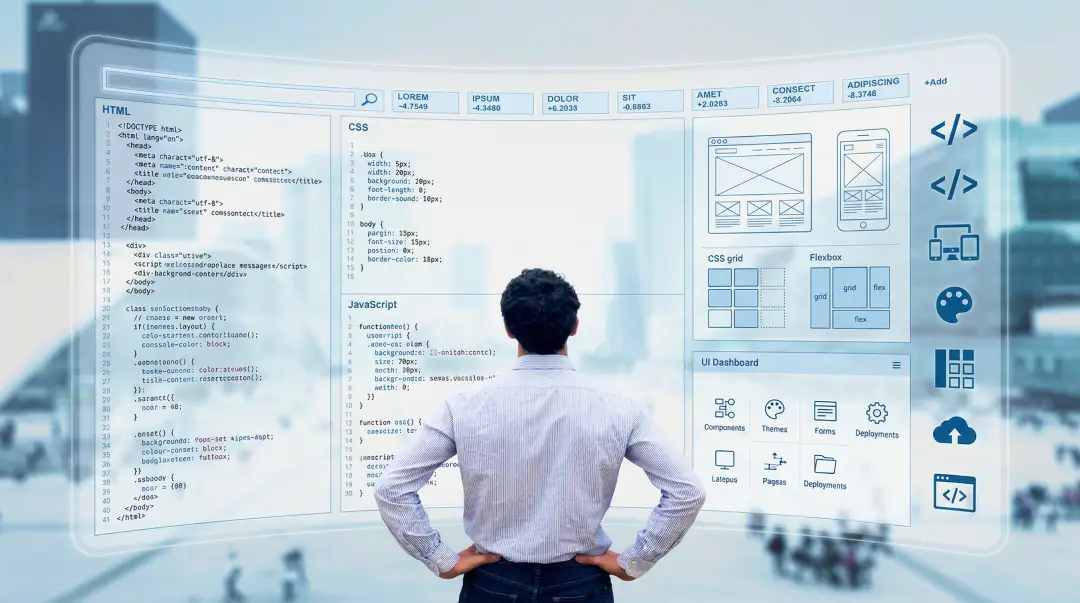
Customer expectations have quietly raised the bar for what a business website needs to do. It's no longer enough to have a clean design and a contact form. Buyers, especially in B2B, arrive at your website already midway through their decision-making process. They have done their research, compared options, and by the time they land on your page, they're evaluating whether your digital presence reflects the quality of what you're actually selling.
That's where a lot of businesses quietly lose deals they never knew they were in. A slow, generic, template-constrained website doesn't just underperform; it also fails to deliver on its promise. It actively signals the wrong things to the wrong people at the worst possible moment. Confusing navigation, non-personalised content, broken integrations, slow load times; these are website problems, not product problems. And they're almost always fixable through custom development.
At its core, these are the reasons why you choose custom web development and how it is gaining traction and is becoming important for business growth.
Web Development Trends Shaping Business Success
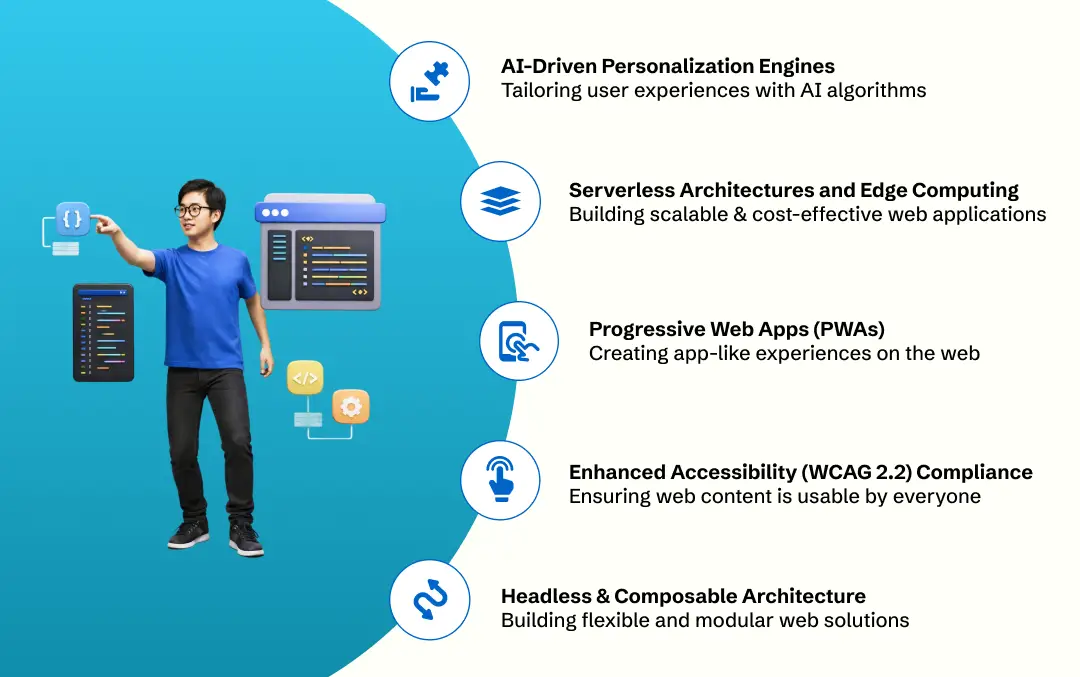
The key to high-performing platforms in 2026 is about the underlying intelligence of the build. When you look at the web development trends separating market leaders from the rest, it becomes clear that off-the-shelf templates simply can’t keep up with the technical demands of a modern enterprise.
Here is how custom architecture is currently redefining the digital playing field:
1. AI-Driven Personalization Engines
In 2026, B2B buyers expect a segment-of-one experience. Static messaging is a conversion dropper. By integrating artificial intelligence in web development, businesses can now deploy real-time engines that adjust CTAs, pricing models, and content based on a visitor's specific firmographics and intent signals. Trying to bolt this on to a template usually results in broken scripts and slow load times; custom builds are the only way to make this seamless.
2. Serverless Architectures and Edge Computing
For a global brand, every millisecond of latency is lost revenue. Leading web development technologies are moving toward the edge, where site logic is processed closer to the user rather than a central server. This isn't just a technical flex; it’s a commercial necessity for high-volume platforms. Custom architecture allows your developers to skip the middleman server, cutting latency at the source in a way standard stacks just can't handle.
3. Progressive Web Apps (PWAs)
Why spend thousands of dollars on a native app when a PWA can offer offline access, push notifications, and near-native speeds through a browser? As AI web development trends evolve, PWAs are becoming the gold standard for mobile engagement. However, getting a PWA to run smoothly requires a level of service worker configuration that traditional themes simply don't support.
4. Enhanced Accessibility (WCAG 2.2) Compliance
In the last few years, accessibility lawsuits in the US and privacy regulations like GDPR in the UK have reached record highs, with settlements costing businesses millions. You can’t just install a plugin on a website and call it compliant. True accessibility, engineered to meet ADA and WCAG 2.2 standards, must be baked into semantic HTML from day one. This is one of the most overlooked benefits of a custom website.
5. Headless & Composable Architecture
The biggest mistake I see businesses make is locking into a single platform. Composable architecture allows you to decouple your front-end from your back-end. This means you can swap out your CRM or update your UI without destroying the entire site. It’s the ultimate future-proof move, and it’s structurally impossible to achieve with a standard template platform.

Evaluating the Investment: Full Cost Structure for Custom Web Development
Before investing in custom web development, you need full cost visibility and not just the development quote. Here's a comprehensive breakdown of every cost category relevant to a custom web build:
Pricing Estimate Based on Different Categories
| Cost Category | Price Range (USD) | What It Covers | Notes |
|---|---|---|---|
| Discovery & Strategy | $2,000–$15,000 | Business analysis, wireframes, tech stack planning | Often waived by agencies for large projects |
| UI/UX Design | $5,000–$40,000 | User research, prototyping, design systems, accessibility audit | Critical investment directly impacts conversion |
| Frontend Development | $10,000–$60,000 | HTML/CSS/JS, React/Vue/Angular build, responsive design | Scale with component complexity |
| Backend Development | $15,000–$80,000 | APIs, databases, business logic, and authentication | Higher for complex workflows or microservices |
| CMS Integration | $3,000–$20,000 | Headless CMS (Contentful, Sanity) or custom admin panel | Reduces long-term content ops costs |
| Third-Party Integrations | $2,000–$25,000 | CRM (Salesforce, HubSpot), ERP, payment gateways | Per-integration cost varies by API complexity |
| QA & Testing | $3,000–$15,000 | Automated testing, manual QA, performance & security audits | Non-negotiable for production-grade apps |
| Cloud Infrastructure Setup | $2,000–$10,000 | AWS/GCP/Azure configuration, CDN, SSL, load balancing | Ongoing hosting: $200–$2,000/month |
| SEO Technical Foundation | $2,000–$8,000 | Schema markup, Core Web Vitals optimisation, sitemap | Built in during development, cheaper than retrofitting |
| Security Hardening | $2,500–$12,000 | Pen testing, WAF setup, GDPR/HIPAA compliance modules | Required for fintech, healthtech, and ecommerce |
| Maintenance & Support (Annual) | $5,000–$36,000/yr | Bug fixes, updates, and performance monitoring | Typically, 15–20% of the build cost per year |
Pricing Estimates Based on Project
| Project Category | Price Range (USD) | Best For | Key Offerings |
|---|---|---|---|
| Standard B2B Site | $15,000 - $40,000 | Mid-sized Firms | Custom UX, CRM integration, SEO setup |
| E-commerce Platform | $40,000 - $120,000 | High-volume retailers | Custom checkout, AI product engines, ERP sync |
| SaaS/Web Application | $75,000 - $250,000+ | Tech startups | Proprietary algorithms, high-security tiers |
| Enterprise Portal | $150,000+ | Large corporations | Legacy system integration, global scaling |
Quantifying the Web Development ROI for Business Success
Investing in digital infrastructure isn’t about checking a box; it’s about capital allocation. When we talk about the web development ROI for the business, we are looking at how a tailored system acts as a force multiplier for your existing operations. A template is a static expense that depreciates the moment it’s launched, but a custom build is a dynamic asset designed to appreciate in value as you scale.

By understanding the web development process, stakeholders can see that every dollar spent on custom code is a dollar spent on removing friction from the customer journey.
Conversion Rate Optimization (CRO) Through Custom UX
Standard templates are built for everyone, which means they are optimized for no one in particular. Custom development allows you to remove friction from the specific path your B2B clients take. This level of web development strategies for business can result in a 200-400% increase in conversion rates compared to generic themes.
SEO Superiority and Technical Dominance
Google’s algorithms give importance to Experience, Expertise, Authoritativeness, and Trustworthiness (E-E-A-T). Custom websites allow for cleaner semantic markup and faster load times, which are important in web development. You can use the best SEO tools for auditing and monitoring a website to benchmark your current technical health and identify where a custom build would move the needle most.
Operational Efficiency and Third-Party Integrations
A custom website acts as the central hub for your business operations. By understanding the web development process, you can build automated bridges between your website and your inventory or accounting software. This reduces manual labor and human error, providing a clear ROI for web development.
How to Maximize Your Digital Investment?

Spending your investment on a custom build is only half the battle. The actual value is unlocked by how you manage the lifecycle of the project. To ensure your website remains a high-yielding asset rather than a depreciating asset, you need a roadmap that balances technical rigor with business objectives. Here is what you need to do before investing in the development:
How to Hire Web Developers for Multiple Projects?
The cheapest quote is almost always the most expensive in the long run. When you hire web developers, you aren't just buying code; you are buying their architectural judgment. To maximize your return on investment, look for partners who challenge your assumptions rather than just taking orders. Follow these steps:
- Portfolio Logic over Aesthetics: Don’t just look at how the sites look. Ask about the 'why' behind the navigation and the performance benchmarks they achieved.
- Full-Stack Maturity: Ensure the team understands both the front-end user experience and the back-end scalability. A beautiful site that crashes under high traffic is a failed investment.
- Post-Launch Support: A developer who disappears after the site goes live is a major red flag. Maximizing your investment requires a partner who provides long-term maintenance and iterative updates.
Key Questions to Ask Before Investing in Hiring a Developer
Before a code is written, you need to clear the air on technical ownership and future-proofing. This phase is where most business owners leave money on the table by not being specific enough. Here are some questions that you need to ask:
1. Who owns the IP and source code?
You must have 100% ownership. Never let a vendor keep your digital assets "hostage" on their proprietary servers.
2. How will the site handle a 5x spike in traffic?
If they don’t mention web hosting checklist items like load balancing or CDNs, they aren't thinking about your growth.
3. What is the documentation process?
If another developer can't read the code six months from now, you’ve just built a "black box" that will be expensive to fix.
4. How are you integrating AI?
Ask for specifics on AI in web development to ensure you aren't just getting a generic chatbot, but a functional tool that aids your bottom line.
5. If we decide to move our site to a different hosting provider or internal team tomorrow, what specific technical barriers will we face?
Ask for a clean web hosting checklist and prove that the site is built on open, well-documented standards. Ensure that your digital property is a portable, independent asset that can grow wherever you choose to take it.

The Final Verdict: Is Your Website an Asset or an Expense?
Ask yourself the following three practical questions:
- Is your web platform directly tied to revenue generation or lead qualification?
- Are you operating in a sector where performance, compliance, or personalisation are the primary necessities?
- Has your business reached a stage where long-term asset ownership is more promising and valuable than short-term cash flow preservation?
If you answered yes to any two of the three, custom development is your path.
The initial capital expenditure of custom web development is higher. That's true. But the Total Cost of Ownership (TCO) over a 4–5 year horizon, combined with the compounding returns from conversion optimisation, SEO technical superiority, and operational efficiency, makes it the only viable choice for scaling enterprises. Businesses that treat their website as a long-term strategic asset rather than a recurring operational expense are the ones systematically outperforming their template-dependent competitors.
Frequently Asked Questions
Is custom web development for small businesses worth it?
Yes. Investing early prevents massive technical debt that destroys future profits. Most startups fail because their tech stack cannot scale. A custom build offers a unique competitive edge. It ensures your site is a revenue engine rather than a static, disposable expense.
How long does the custom web development process take?
Quality engineering requires roughly three to six months. This covers everything from architecture to deployment. Rushed builds lead to expensive errors. A patient approach ensures every feature serves a business goal. You get a robust tool built for high performance instead of a compromise.
What is the typical web development ROI for business?
Returns typically manifest within twenty-four months. This profit stems from superior conversion rates and zero platform fees. Maintenance costs drop when you own the code. Secure, clean architecture also prevents data breaches. You trade high upfront costs for long-term financial stability.
How do I hire web developers who understand my specific industry?
Ignore flashy demos. Ask candidates to explain how their code supports specific business revenue goals. Look for developers who challenge your ideas with better logic. You need a partner who values technical debt reduction. Their past work should prove they build for results.
What are the top web development trends for 2026?
High speed and edge computing dominate the current market. AI systems now adjust content based on visitor intent in real-time. Legal compliance regarding accessibility is a major priority. These shifts demand deep, custom code. Off-the-shelf builders cannot support these high-level technical requirements.
Can I integrate AI into a custom website?
Custom builds allow for deep AI integration that predicts client needs. You can automate complex service tasks easily. This requires a clean backend that templates cannot provide. Proprietary data becomes a weapon. It is why leaders choose custom code over generic, rigid themes.

Uncover executable insights, extensive research, and expert opinions in one place.
Related Content