- 1. OpenAI
- 2. NVIDIA
- 3. Google (Alphabet)
- 4. Microsoft
- 5. Amazon Web Services (AWS)
- 6. Meta
- 7. Anthropic
- 8. Databricks
- 9. Mistral AI
- 10. MiniMax
- 11. Apple
- 12. Snowflake
- 13. Scae AI
- 14. Adobe
- 15. Anduril
- 16. Figure AI
- 17. Midjourney
- 18. Perplexity AI
- 19. Cohere
- 20. Salesforce
- 21. Recursion Pharmaceuticals
- 22. Runway
- 23. Harvey
- 24. EliseAI
- 25. Gong
- 26. Insitro
- 27. Character.ai
- 28. Upstart
- 29. Grammarly
- 30. DeepL
- 31. Tempus
- 32. Cerebras Systems
- 33. Glean
- 34. Nexthink
- 35. SoundHoundAI
- 36. Viz.ai
- 37. Notion
- 38. Kodiak Robotics
- 39. Flatfile
- 40. Synthesia
- 41. Moveworks
- 42. DataRobot
- 43. InsuredMine
- 44. SambaNova System
- 45. AMD (Advanced Micro Devices)
- 46. IBM
- 47. InspiringApps
- 48. Smartly
- 49. Domino Data Lab
- 50. Clari
 Share It On:
 Get an in-depth market analysis about the top AI companies transforming industries and creating fortunes.
The AI market is on a blistering pace to reach a multi-trillion-dollar valuation by 2030, signaling a historic economic shift. Yet most people struggle to name the AI companies driving this explosive growth beyond the obvious players like OpenAI and Google.
According to Grand View Research, the AI market jumped from $279.22 billion in 2024 and is projected to hit over $1,811.75 billion at a CAGR of 35.9% by 2030. Honestly, the AI market has exploded—growing sixfold in just six years.
Yet, if you try to read about it, you'll find most articles are either bogged down in tech-speak or just chasing the latest shiny object. And none of them are actually telling you which companies are building these sustainable businesses.
We found ourselves asking the same questions our readers face: Which Artificial Intelligence companies will actually matter when the hype settles? We've spent months analyzing the AI ecosystem to identify which organizations are genuinely transforming industries in this rapidly evolving market. Let’s check the list of AI companies.
50 Most Talked About and Top Artificial Intelligence Companies
Artificial Intelligence is the powerful engine actively rewiring every industry on the planet. This list throws much-needed spotlight on the 50 biggest AI companies that are building the future.
| Company Name | Overview | |
|---|---|---|
| 1 | OpenAI | Leading in generative AI with models like ChatGPT and Claude. |
| 2 | NVIDIA | Dominates AI hardware with GPUs essential for AI model training. |
| 3 | Google (Alphabet) | A pioneer in AI research, specializing in LLMs and AI-driven search. |
| 4 | Microsoft | Integrates AI across products like Azure AI and Microsoft Copilot. |
| 5 | Amazon Web Services (AWS) | Leading cloud provider with AI tools like SageMaker and custom silicon chips. |
| 6 | Meta | Develops open-source AI models like LLaMA and focuses on AI-driven ads. |
| 7 | Anthropic | Focuses on AI safety and alignment with models like Claude. |
| 8 | Databricks | Provides a unified data and AI platform for collaborative data science. |
| 9 | Mistral AI | French AI startup specializing in open-weight models. |
| 10 | MiniMax | Chinese AI company focusing on foundational models and AI applications. |
1. OpenAI
- Location: San Francisco, California
- Company size: 1,001 - 5,000 employees
- Focus: Foundational Model Research & Deployment
Artificial intelligence development companies like OpenAI are one of the most popular names amongst the top AI companies in the world. It’s known as a research and deployment company whose mission is to bring in smart concepts like artificial general intelligence (AGI) in the future.
It’s a generative AI platform that has attained the limelight for a long time because of its AI power to create, generate text, images, videos, and more. OpenAI is also backed by Microsoft, continues to push the frontier of AI capabilities with its GPT family of models, while also focusing on safety research and creating platforms for developers to build on its technology.
2. NVIDIA
- Location: Santa Clara, California
- Company size: 10,000+ employees
- Focus: AI Hardware & Software
NVIDIA is the undisputed leader in accelerated computing and the primary hardware provider for the AI revolution. Its powerful GPUs, based on architectures like Hopper, Blackwell, and its CUDA software platform, are the industry standard for training and deploying large-scale AI models. NVIDIA has also positioned itself as the foundational engine for nearly every major tech company and startup in the space.
3. Google (Alphabet)
- Location: Mountain View, California
- Company size: 10,000+ employees
- Focus: Foundational Models & Cloud AI
Google is one of the largest AI companies that stands at the forefront of AI research and application. DeepMind and Google Research Labs have developed foundational models like Gemini. Today, Gemini empowers Android OS, answers questions by pulling information from the web, and even holds value-driven conversations with you. Additionally, Gemini also uses immense data resources and custom Tensor Processing Unit (TPU) hardware, which aims to make AI helpful for everyone, from individual consumers to large enterprises.
4. Microsoft
- Location: Redmond, Washington
- Company size: 10,000+ employees
- Focus: Enterprise AI & Cloud Platforms
Microsoft’s Copilot AI, built with the partnership of OpenAI, helps make conversations and assist in generating texts, emails, images, and more. Copilot has also been implemented across different Microsoft 365 apps, and GitHub has positioned itself as the leader in enterprise AI. This has led to the automation of various tasks like customer service, software development, security, and more. Microsoft’s mission is to empower organizations of all sizes to adopt AI, transforming productivity for businesses worldwide.
5. Amazon Web Services (AWS)
- Location: Seattle, Washington
- Company size: 10,000+ employees
- Focus: Cloud Infrastructure & E-commerce AI
Amazon Web Services is a prominent name in cloud computing, providing the scalable infrastructure that powers a significant portion of the AI industry. Its top services, like Amazon SageMaker, have made AI accessible to millions of developers and businesses. Moreover, Amazon’s significant market investment in Anthropic, along with its development of custom AI chips such as Trainium and Inferentia, demonstrates AWS's commitment to remaining a central pillar of AI development.
6. Meta
- Location: Menlo Park, California
- Company size: 10,000+ employees
- Focus: Open-Source AI & Social Media
Meta is one of the top AI firms that has championed the open-source movement with its FAIR (Fundamental AI Research) lab. It develops and releases powerful LLMs, like the Llama family, for free academic and commercial use. Meta’s strategy fosters innovation globally and powers AI-driven features in its products, including Instagram, Facebook, and its metaverse ambitions.
7. Anthropic
- Location: San Francisco, California
- Company size: 501 - 1,000 employees
- Focus: AI Safety & Foundational Models
Anthropic, a powerful AI research company, was founded with a core mission of safety. It builds reliable, interpretable, and steerable AI systems, like Claude, a conversational AI model. Anthropic AI is also backed by major investments from Google and Amazon. Most importantly, it also serves as a competitor to AI giants like OpenAI. This also emphasizes a constitutional AI approach to ensure its models align with human values.

8. Databricks
- Location: San Francisco, California
- Company size: 5,001 - 10,000 employees
- Focus: Enterprise Data & AI Platform
Databricks makes it to the list of AI companies because of its AI-powered capabilities that help you organize, clean, and prepare the massive datasets that make AI possible. Their lakehouse platform essentially acts as mission control for enterprise data, letting companies store everything in one place and then run analytics, machine learning, and now generative AI on top of it. Databricks acquired MosaicML in 2023 for $1.3 billion, and it became clear they're serious about moving beyond just data infrastructure into full-stack AI solutions that enterprises can actually deploy and trust.
9. Mistral AI
- Location: Paris, France
- Company size: 51 - 200 employees
- Focus: Open-Source Foundational Models
Mistral AI represents Europe's ambitious attempt to break America's stranglehold on cutting-edge AI development. This French startup made waves by releasing surprisingly capable open-source models that rival GPT-4 in many tasks.
They're building powerful yet efficient models that companies can actually run on their own infrastructure rather than being forced into expensive API dependencies. With $415 million in funding and partnerships across Europe, Mistral is positioning itself as the regional champion that understands European data privacy concerns while delivering the AI capabilities businesses actually need.
10. MiniMax
- Location: Paris, France
- Founded: April 2023
- Focus: Open-source foundational models and enterprise AI solutions
Minimax emerged from China's competitive AI scene as the company that cracked one of AI's most challenging tasks: generating realistic videos from simple text prompts. While Western companies struggled with clunky, expensive video AI that barely worked, Minimax shipped models that actually produce usable content at reasonable costs. Now they're expanding beyond video into multimodal AI that combines text, images, and video seamlessly, positioning themselves as China's answer to OpenAI's dominance in creative AI applications.
11. Apple
- Location: Cupertino, California
- Company size: 10,000+ employees
- Focus: Consumer Electronics & On-Device AI
Apple Intelligence platform, launched in 2024, integrates AI capabilities across iOS, macOS, and iPadOS while keeping personal data secure on users' devices. Rather than chasing flashy generative AI demos, Apple focuses on practical AI features embedded throughout its ecosystem— from Photo organization and Health insights to enhanced Siri capabilities.
Their custom silicon, including the M-series and A-series chips with dedicated Neural Engines, enables powerful AI processing without compromising user privacy, positioning Apple as the privacy-conscious alternative in an increasingly data-hungry AI landscape.
12. Snowflake
- Location: San Francisco, California
- Company size: 10,001+ employees
- Focus: Cloud Data Platform
Snowflake operates a cloud data platform that serves as the foundation for the AI strategies of thousands of enterprises. Its platform allows companies to store, process, and analyze massive amounts of data, which can then be used to power business intelligence tools, analytics applications, and machine learning models.
13. Scae AI
- Location: San Francisco, California
- Company size: 501 - 1,000 employees
- Focus: Data for AI
Scale AI is a data platform that provides the high-quality training data needed to build and validate AI applications. The company utilizes a combination of machine learning and human-in-the-loop annotation to process and label massive datasets, ranging from images for autonomous vehicles to text for large language models, serving as a critical partner for companies such as OpenAI and the US Department of Defense.
14. Adobe
- Location: San Jose, California
- Company size: 10,000+ employees
- Focus: Creative & Marketing AI
While other companies were building AI to write essays, Adobe focused on the one world it has always owned: the creative professional. They built their Firefly AI to act as a powerful assistant right inside Photoshop and Illustrator. It's the magic behind features like Generative Fill, and because it was trained on their own stock library, businesses can actually use it without worrying about copyright lawsuits.
15. Anduril
- Location: Costa Mesa, California
- Company size: 1,001 - 5,000 employees
- Focus: Defense Technology
Anduril is a defense technology company that builds AI-powered hardware and software for military and national security applications. Andruil is also known for its popular collaboration with military bodies, such as the US defense. Its products include autonomous drones, advanced surveillance towers, and an AI-native command and control platform called Lattice, all designed to modernize military capabilities.
16. Figure AI
- Location: Sunnyvale, California
- Company size: 51 - 200 employees
- Focus: Humanoid Robotics
Figure AI is popularly known for its collaboration with OpenAI and BMW. Moreover, it focuses on creating a general-purpose humanoid robot. It's a robot, mostly designed to perform manual labor in industries like logistics, warehousing, and manufacturing, aiming to address labor shortages and automate dangerous tasks.
17. Midjourney
- Location: San Francisco, California
- Company size: 1 - 50 employees
- Focus: Generative Art & Image Creation
Midjourney is one of the most powerful AI image generator tools. It’s run by a tiny independent lab, and the entire experience famously lives inside a Discord server. For many artists and creators, it remains the gold standard for pure aesthetic quality. Midjourney is also accessible through the Discord chat platform. Also, its tool is renowned for creating highly artistic, detailed, and aesthetically pleasing images from text prompts, setting a high bar for creative AI.
18. Perplexity AI
- Location: San Francisco, California
- Company size: 51 - 200 employees
- Focus: AI-Powered Search & Answer Engine
Perplexity AI is a popular conversational or generative AI platform. It’s mostly designed to challenge traditional search engines like Google. Perplexity AI has some prominent features that help it understand user queries and deliver direct, comprehensive answers, with cited source links. Most recently, it has also been in the news for attempting to collaborate with smartphone companies to become the in-built default browser.

19. Cohere
- Location: Toronto, Canada
- Company size: 501 - 1,000 employees
- Focus: Enterprise Language Models
Cohere has been laser-focused on one thing: building serious AI for actual businesses. They offer powerful large language models with a crucial twist—letting companies run them on their own private cloud so sensitive data never has to leave their sight. This focus on privacy and control has made them a go-to partner for the enterprise world.
20. Salesforce
- Location: San Francisco, California
- Company size: 10,000+ employees
- Focus: Business & CRM AI
Salesforce is one of the first giants that optimized the world of sales. Instead of building flashy demos, they embedded their Einstein AI directly into the tools that millions of salespeople use every single day. It helps predict which deals are likely to close, write follow-up emails, and handle customer service chats automatically. Their entire game is about enhancing the human seller or service agent, not replacing them.
21. Recursion Pharmaceuticals
- Location: Salt Lake City, Utah
- Company size: 501 - 1,000 employees
- Focus: AI for Drug Discovery
Recursion Pharmaceuticals and its AI act as the supervisor for the whole operation. It sifts through an ocean of visual data from these experiments, looking for any sign that a potential drug is having a positive effect on diseased cells. They're not just practicing science; they're trying to industrialize the process of discovery itself.
22. Runway
- Location: New York, New York
- Company size: 51 - 200 employees
- Focus: Generative AI for Video
For years, creating a decent-looking video or special effect required a studio and a massive budget. Runway basically puts Hollywood visual effects into a web browser for everyone to use. With their tools, you can type a sentence to create a video clip from scratch or magically erase a person walking through your shot. They're giving a new generation of creators a powerful toolkit that was pure science fiction just a few years ago.
23. Harvey
- Location: New York, New York & San Francisco, California
- Company size: 51 - 200 employees
- Focus: Legal AI
Harvey is an AI company that's acting as a super-smart paralegal for some of the world's biggest law firms. It can analyze a thousand-page contract for risks in minutes or draft a legal memo that would have taken a junior associate all night. It's one of the best examples out there of AI being trained for a single, high-stakes job—and doing it incredibly well.
24. EliseAI
- Location: New York
- Company size: 200-500 employees
- Focus: For property management
Anyone who's ever tried to rent an apartment knows the frustration of waiting for a leasing agent to call back. EliseAI built a smart assistant specifically to fix that problem for property managers. Their AI, Elise, works around the clock to answer questions about floor plans, schedule tours, and follow up on leads so no potential renter is ever ignored.
25. Gong
- Location: San Francisco, California
- Company size: 1,001 - 5,000 employees
- Focus: Sales & Revenue Intelligence
Gong's AI turned it into a science by listening to every single sales call, meeting, and email. It doesn't just record the words; it understands them, pointing out when competitors get mentioned, what pricing actually works, and what your top reps do differently. It's like having a game tape for every sales call, giving teams a brutally honest look at what it takes to win.
26. Insitro
- Location: South San Francisco, California
- Company size: 201 - 500 employees
- Focus: AI for Medicine Development
Insitro's entire strategy is built around solving that problem first. Instead of just finding data, their automated labs create massive, clean datasets specifically designed to teach their AI what a disease looks like at a cellular level. It treats drug discovery less like biology and more like data engineering.
Also read: AI in Healthcare
27. Character.ai
- Location: Menlo Park, California
- Company size: 51 - 200 employees
- Focus: Conversational AI & Entertainment
What if you could have a conversation with anyone you could imagine, from Socrates to your favorite anime hero? That's the incredibly popular world of Character.AI. It’s less of a single assistant and more of a massive playground where millions of users build and share their own AI personalities to chat with. They’ve proven that for a lot of people, the future of AI isn't about productivity; it's about companionship and fun.
28. Upstart
- Location: San Mateo, California
- Company size: 1,001 - 5,000 employees
- Focus: AI for Lending (Fintech)
For banks, the old way of judging credit often meant saying 'no' to a lot of potentially great customers. Upstart provides an AI-driven platform that acts as a much smarter lens for looking at risk. Instead of just a credit score, the model considers a person's education and career path to find creditworthy people who were previously overlooked. This allows lenders to approve more loans while simultaneously lowering their risk, a win-win that traditional models couldn't offer.
29. Grammarly
- Location: San Francisco, California
- Company size: 1,001 - 5,000 employees
- Focus: AI Writing Assistance
Long before everyone was talking about ChatGPT, Grammarly was the quiet AI working behind the scenes on millions of emails and essays. It’s so much more than just a spellcheck; it’s the little editor on your shoulder that questions if your tone sounds confident enough or if your sentences are getting too wordy. At its core, it’s a tool designed to close the gap between what you mean to say and what you actually write.
30. DeepL
- Location: Cologne, Germany
- Company size: 501 - 1,000 employees
- Focus: AI Translation
DeepL is the company that has built its entire reputation on fixing that, consistently delivering translations that sound like they were written by a human. Their AI seems to have a much better ear for the nuances and idioms of a language, not just swapping words one-for-one. It’s why so many professionals and multilingual users swear by it when a translation absolutely has to be right.
31. Tempus
- Location: Chicago, Illinois
- Company size: 1,001 - 5,000 employees
- Focus: AI for Personalized Medicine
Tempus is a health technology company using AI to advance precision medicine. It has built one of the world's largest libraries of clinical and molecular data, which it analyzes to provide doctors with personalized insights for patient treatment, particularly in the field of oncology.
32. Cerebras Systems
- Location: Los Altos, California
- Company size: 201 - 500 employees
- Focus: AI Hardware Systems
Most companies train huge AI models by linking together thousands of individual GPU chips, which can get incredibly complex. Cerebras looked at that problem and went in the complete opposite direction. They build one single, dinner-plate-sized chip that holds the power of a whole rack of servers.
33. Glean
- Location: Palo Alto, California
- Company size: 201 - 500 employees
- Focus: Enterprise Search
The modern office runs on a dozen different apps, creating a digital chaos where finding anything specific is difficult. Glean works by plugging into everything—Slack, Drive, Jira, you name it—to create a single, unified memory. With Glean, you get one single, smart search bar that can actually give you the answer you need, not just another link to hunt through.
34. Nexthink
- Location: Boston, Massachusetts
- Company size: 500-1,001 employees
- Focus: Software solutions
We’ve all had those days where our work laptop just grinds to a halt for no apparent reason, and the IT help desk has no idea why. Nexthink built its entire platform to stop that from happening. Their software acts like a smart detective for a company's entire fleet of devices, using AI to spot problems like a bad software update and fix them automatically, often before employees even notice anything was wrong. It's a proactive approach that stops blaming the user and starts fixing the actual problem.
35. SoundHoundAI
- Location: Santa Clara, California
- Company size: 201 - 500 employees
- Focus: Voice AI & Conversational Intelligence
A lot of people still know SoundHound from their music and lyric-finding app, which felt like magic a decade ago. But behind the scenes, they used that same audio know-how to build a seriously powerful conversational AI. Now, that's the reason a bunch of fast-food chains are using to create their own custom voice assistants. They've become the go-to choice for any brand that wants a voice but doesn't want to hand its customer data over.
36. Viz.ai
- Location: San Francisco, California
- Company size: 501 - 1,000 employees
- Focus: AI for Medical Diagnostics
Viz.ai built an AI that acts like a digital lookout, automatically scanning every brain scan the second it's taken. If it spots trouble, like a major clot, it instantly alerts the entire stroke team on their phones—bypassing the slow, traditional hospital pager system. It’s a simple but brilliant use of AI to shave off precious minutes when it matters most.
37. Notion
- Location: San Francisco, California
- Company size: 500-1,001 employees
- Focus: Workspace tool
Millions of people already use Notion as a second brain to organize everything from their meeting notes to their personal goals. It’s the kind of AI that can instantly summarize a messy page of notes or help you brainstorm five different headlines for a blog post you're stuck on. The whole idea is to fight writer's block and clean up clutter directly where you do your thinking.
38. Kodiak Robotics
- Location: Mountain View, California
- Company size: 201 - 500 employees
- Focus: Autonomous Trucking
Kodiak Robotics is one of the key players focused entirely on teaching big-rig trucks how to drive themselves safely from one depot to another. They’re not trying to solve chaotic city driving; their AI takes over for the long, hypnotic stretches of highway where trucks spend most of their time. It’s a pragmatic approach to automation, meant to make our supply chains more reliable and trucking a whole lot safer.
39. Flatfile
- Location: Fully Remote
- Company size: 51 - 200 employees
- Focus: Data exchange
Every company has faced the nightmare of trying to import a customer's messy spreadsheet into its system. Flatfile builds the smart importer that software companies use to fix customer data issues. Their AI automatically figures out what your messy column names mean and helps you fix typos on the fly, before you even hit 'submit'.
40. Synthesia
- Location: London, United Kingdom
- Company size: 201 - 500 employees
- Focus: AI Video Generation
Synthesia's whole idea was to replace everything with a text box and a realistic AI avatar. You just type up your script, pick an avatar, and the AI generates a surprisingly lifelike video of them presenting it for you. It’s become a go-to tool for businesses that need to create hundreds of instructional videos without booking a single day in a studio.
41. Moveworks
- Location: Mountain View, California
- Company size: 501 - 1,000 employees
- Focus: IT & Employee Support Automation
Moveworks builds the AI chatbot that's designed to be your first and last stop for those kinds of problems. It doesn't just understand your request to "reset a password"—it actually goes and does it for you, right in Slack or Teams. The whole idea is to let the humans on the help desk solve hard problems, not act as password-resetting machines.
42. DataRobot
- Location: Boston, Massachusetts
- Company size: 1,001 - 5,000 employees
- Focus: Automated Machine Learning (AutoML)
Most companies want to use AI but hit a brick wall when they realize they don't have a team to build models from scratch. DataRobot was built to be a "data scientist in a box" to solve exactly that problem. You give it a dataset, tell it what you want to predict, and it automatically builds and tests hundreds of different models to find the best one for the job. It's all about letting regular business folks get their hands on powerful AI without needing to write a single line of code.
43. InsuredMine
- Location: Frisco, Texas
- Company size: 51-200 employees
- Focus: AI for Insurance Tech
Independent insurance agents spend a ton of their time juggling spreadsheets and follow-up reminders instead of actually talking to clients. InsuredMine built an all-in-one toolkit designed to clean up that chaos and act as a smart assistant for them. The AI part is subtle but smart; it will spot things like a client who needs flood insurance or automatically send out a birthday text. It’s all about letting the agent focus on the human relationship, while the software handles the documentation.
44. SambaNova System
- Location: Santa Clara, California
- Company size: 501 - 1,000 employees
- Focus: AI Hardware & Software Systems
Building a world-class AI system from scratch is insanely expensive and complicated, even for huge companies. SambaNova’s approach is to deliver a complete, pre-configured AI system right to your doorstep, often as a subscription. Their secret sauce is a flexible chip design that adapts to different types of AI models, not the other way around. It's a powerful option for big players who want top-tier AI power without becoming hardware experts themselves.
45. AMD (Advanced Micro Devices)
- Location: Santa Clara, California
- Company size: 10,000+ employees
- Focus: High-Performance Computing Hardware
For decades, AMD (Advanced Micro Devices) has built its reputation by being the fierce, high-performance competitor to whoever dominates the chip market. They brought that same fighting spirit from their long CPU battle with Intel directly to NVIDIA's doorstep in the AI space. With their powerful Instinct accelerators, they're not just offering an alternative; they're offering a lifeline to companies desperate to avoid a single-supplier monopoly.
46. IBM
- Location: Armonk, New York
- Company size: 10,000+ employees
- Focus: Enterprise AI & Consulting
IBM deploys its AI strategy not through a single public chatbot, but through a targeted suite of tools built on its venerable Watson platform, widely used by AI web development companies. For example, its Watson Orchestrate product tackles operational drag by automating complex, repetitive workflows, freeing up employees to focus on more critical tasks. Similarly, the Watson Code Assistant acts as a knowledgeable pair programmer, accelerating development cycles by generating code and catching errors. This focus on specific, measurable business outcomes rather than general-purpose creativity is the hallmark of IBM's entire enterprise AI approach.
47. InspiringApps
- Location: Completely Remote
- Company Size: 51-200 employees
- Focus: Software development
InspiringApps are the expert app builders you hire when you have an idea for an app. They’re the team that can take your vision and actually weave in features like a recommendation engine or a natural language chatbot. They're less about inventing new AI and more about putting existing AI to work in a real, tangible product.
48. Smartly
- Location: Helsinki, Finland
- Company Size: 501-1001 employees
- Focus: AI-powered advertising solutions
Trying to manage a huge social media ad campaign across a dozen platforms can feel like an impossible juggling act. Smartly's AI steps in as a tireless campaign manager that never sleeps. It constantly tinkers with your ads—testing thousands of different images and headlines—while automatically pushing money toward what's actually working. The whole point is to let the AI handle the endless number-crunching so human marketers can focus on the big picture.
49. Domino Data Lab
- Location: San Francisco, California
- Company size: 201 - 500 employees
- Focus: Enterprise MLOps and AI platform
Domino Data Lab essentially builds the 'factory floor' for enterprise AI. It gives data science teams a single place to manage all their projects, track experiments, and safely deploy their models without breaking things. They’re not making the flashy AI itself, but they’re building the essential plumbing that keeps it all from falling apart.
50. Clari
- Location: Sunnyvale, California
- Company size: 501 - 1,000 employees
- Focus: Revenue operations
Clari's Revenue Platform introduces operational rigor by applying AI to the entire revenue process, from pipeline inspection to final forecasting. It systematically analyzes the complete history of revenue activity, across emails, calendars, and CRM data to identify at-risk deals and uncover upside opportunities. The result is a new level of revenue precision, enabling leaders to mitigate risk and confidently meet their financial goals.
What Makes an AI Company a Leader?
Leading AI companies are creating the tech wave. Let's break down what separates the real players from the pretenders in this rapidly evolving field.
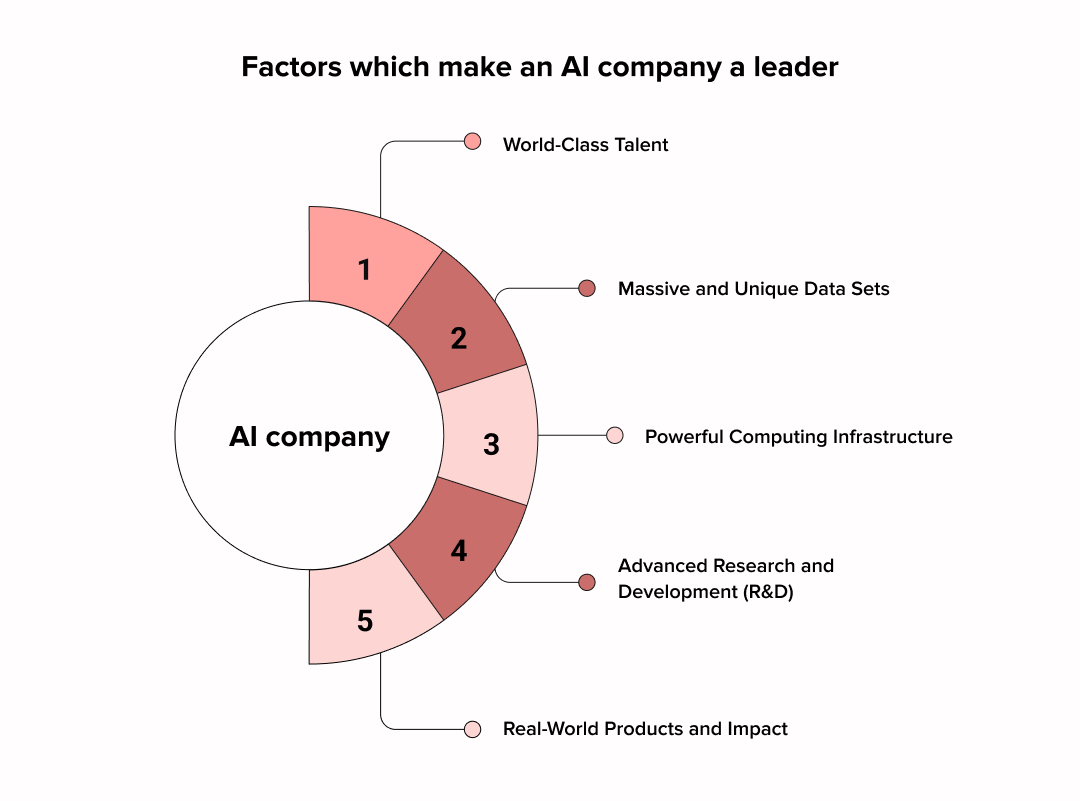
1. World-Class Talent
At its core, AI is driven by people. Honestly, the top AI companies attract and hold the brightest minds in the field. These include the talented researchers, brilliant engineers, and creative data scientists. They’re all collectively shaping the future of AI technology.
They create a culture that not only attracts this talent but also gives them the freedom and resources to experiment and build groundbreaking things. It’s a fierce competition for these experts, and the companies that win this talent war almost always lead the pack.
2. Massive and Unique Data Sets
You can think of data as the fuel that powers the AI engine. While algorithms are the engine's design, they are useless without high-quality data to learn from. Top AI companies have access to vast and, more importantly, proprietary data sets that no one else has.
For example, Google has decades of search queries, and Meta has the intricate social graph. This unique data gives their AI models a massive head start and allows them to generate insights and capabilities that are impossible for others to replicate.
3. Powerful Computing Infrastructure
Training sophisticated AI models, especially large language models (LLMs), requires an astronomical amount of computing power. We're talking about building and maintaining massive data centers filled with thousands of specialized chips, such as GPUs and TPUs.
This kind of infrastructure is incredibly expensive and complex to manage. Top companies invest billions to build their own custom hardware and cloud platforms, giving them a significant competitive edge in speed and scale.
4. Advanced Research and Development (R&D)
The best AI companies don't just use existing technology; they invent it. They have dedicated R&D labs that are constantly pushing the boundaries of what's possible. They publish influential papers in top academic conferences, open-source revolutionary models and tools for the community, and create the foundational models that others build upon. This commitment to pure research demonstrates true leadership and ensures they stay several steps ahead of their competitors.
5. Real-World Products and Impact
Top AI companies successfully integrate their technology into products that millions of people use every day. This is the ultimate test. It’s about translating complex AI from the lab into a seamless, useful feature. Whether it's a smarter search engine, a more helpful virtual assistant, life-saving medical imaging analysis, or a better recommendation system, the ability to ship products with tangible benefits is what separates the true leaders from the purely academic players.

Future Outlook of AI Companies
If you think the AI race has been wild so far, just wait. The next few years aren't going to be about who has the biggest chatbot. The game is changing, and it's shifting in a few key ways. The established giants—your Googles, Microsofts, and Amazons—are focused on digging deeper moats.
They're weaving AI into every single thing they sell, turning it into a utility like electricity for their cloud and software customers. Their goal is to become the all-in-one provider for the entire enterprise world. Moreover, the AI trends show that the future of AI companies seems bright.
- The AI market size projection to reach $1.8 trillion by 2030 represents every industry getting rebuilt.
- The valuation of AI in healthcare is projected to reach $110.61 billion by 2030.
- AI in the automotive industry is also growing at a massive rate. Research shows AI in the automotive industry market will reach $14.92 billion by 2030.
- The usage of AI in manufacturing is also growing, to the extent that it will reach $155.04 billion by 2030.
- Leading and new AI companies like OpenAI have raised a total of $57.9B over 11 funding rounds.
In conclusion, Everyone obsesses over the biggest AI companies in the world, with chatbots giving clever answers, but the real money comes from companies solving not-so-glamorous or talked-about problems. Databricks is organizing messy corporate data. Grammarly is fixing millions of emails. The winners aren't necessarily those with the biggest models or most funding - they're the ones understanding actual customer pain points.
Instead of AI giants controlling everything, we get specialized companies owning their niches. For anyone navigating this space - investing, job hunting, or choosing partners - forget the hype and focus on results.
Frequently Asked Questions
How to select your top artificial intelligence agency?
Look for artificial intelligence agencies and companies with proven innovation, real-world products people love, and a strong ethical framework. Assess their access to unique data and their ability to attract the absolute best engineering talent.
Which AI companies are growing fastest right now?
Best Artificial Intelligence companies like OpenAI, Anthropic, and Nvidia lead in growth, but established players like Microsoft, Google, and Amazon dominate revenue. Emerging companies like Mistral AI and specialized firms in healthcare and finance are also experiencing rapid expansion.
How big is the AI market actually worth?
According to Grand View Research, the global AI market reached approximately $279.22 billion in 2024 and is projected to hit over $1,811.75 billion at a CAGR of 35.9% by 2030.
What are the biggest risks faced by AI companies today?
Regulatory uncertainty, intense competition, and massive infrastructure costs pose major challenges. Many companies face talent shortages, data privacy concerns, and the risk of technological obsolescence. Market corrections could eliminate poorly positioned players despite current valuations.
Should I invest in AI companies or avoid the hype?
Focus on companies with proven business models, not just AI buzzwords. Look for sustainable revenue growth, real customer adoption, and clear competitive moats. Avoid companies burning cash without realistic profitability paths, regardless of their AI capabilities.

Uncover executable insights, extensive research, and expert opinions in one place.
Related Content