So, how do you fix this? You cannot fix call chaos by throwing more people at it; you leave it to AI voice agent services.
AI voice agent services for businesses are not filling this gap in a flashy, “this will change everything overnight” way, but in a very practical sense. They pick up instantly. They handle the repetitive stuff. They make sure no call just… disappears.
But yes, not all of them are good. Some can feel too artificial, some break mid-conversation, and some just create a different kind of frustration.
So based on our research and real-world comparisons, we’re breaking down the AI voice agent services for businesses that actually work and what you should realistically expect before choosing one.
A Quick Glance at the Top-Rated AI Voice Agent Services for Businesses on This List
The following table provides a quick comparison of leading platforms based on their key features, ideal use cases, and technical setup requirements to help you identify the perfect solution for your team's specific needs-
| Service Name | Key Feature | Best For | Platform Type / Setup |
|---|---|---|---|
| Vapi | Low-latency API-first infrastructure, custom LLM integration, and programmable voice interruptions | Developers and startups building highly customized, real-time voice applications | Code-Heavy / Developer API |
| Retell AI | Highly conversational interactions with realistic turn-taking, emotion detection, and natural pauses | Customer service and support teams requiring empathetic, human-like voice interactions | Developer API & Dashboard |
| Bland AI | Rapid deployment for high-volume calling, inbound/outbound automation, and live call transfers | Sales teams and SMBs focused on cold calling, outreach campaigns, and lead qualification | Low-code / Developer API |
| Synthflow AI | No-code environment with hyper-realistic voices, appointment scheduling, and white-labeling capabilities | Marketing agencies and SMBs deploying voice bots quickly without coding | No-code / Drag-and-drop |
| Voiceflow | Collaborative visual flowchart builder, state management, and multi-channel support (voice + text) | Enterprise teams and product managers designing complex conversational UX | Visual Builder / Enterprise SaaS |
| LiveKit Agents | Open-source WebRTC framework for real-time, low-latency audio and video streaming | Engineers embedding real-time voice agents into custom applications | Open-source / Code-Heavy |
| Gnani.ai | Multilingual capabilities (especially Indic languages), speech analytics, and compliance features | Enterprises, BFSI, and large contact centers | Enterprise Platform |
| Ringg.ai | End-to-end sales automation, intelligent scheduling, and automated lead nurturing | Sales development representatives (SDRs) and demand generation teams | Turnkey SaaS Application |
Read Less
List of AI Voice Agent Services for Business

Vapi
Pros & Cons
Pros
- Supports both inbound and outbound calling across web, iOS, Android, and phone
- Full flexibility to mix and match LLMs, STT, and TTS providers
- Works with 100+ languages via supported STT/TTS providers
- Can embed voice agents directly in websites
- Scales to thousands of concurrent calls with enterprise-level infrastructure
Cons
- No persistent free plan, only $10 in trial credits for new users
- No pre-built templates or industry-specific flows out of the box
- HIPAA/SOC 2 compliance costs an additional $1,000/month on the pay-as-you-go plan
Why You'll Love It
Vapi stands out as one of the best AI voice agent services for businesses as it offers a unique developer experience with clean SDKs, well-documented APIs, and the freedom to build completely custom conversation logic. The best part? It lets you do it all without being constrained by a platform's visual builder or preset flows.More about product
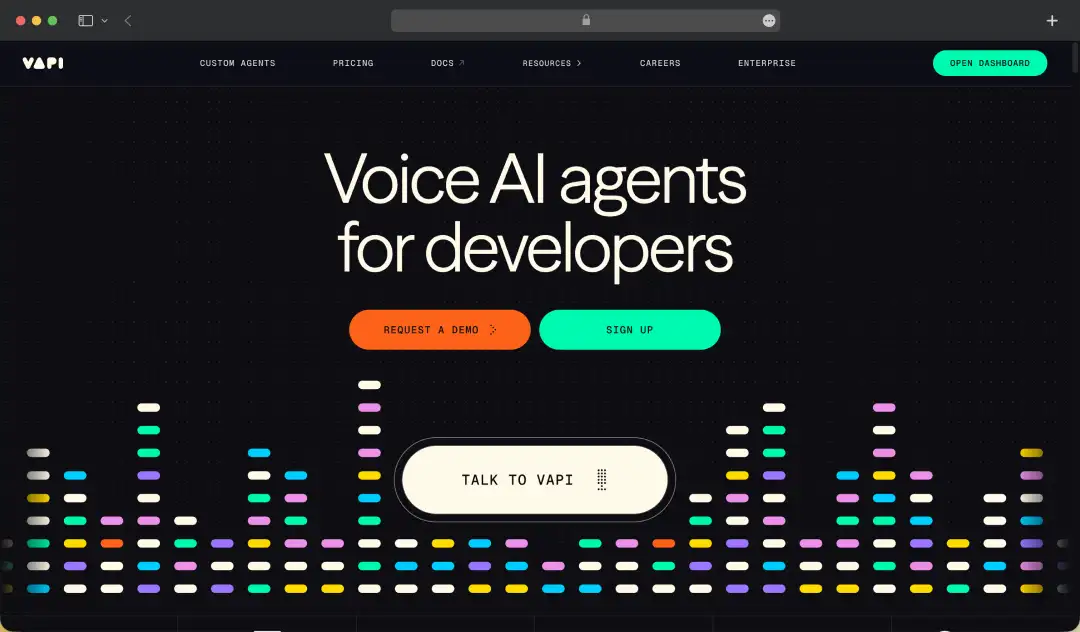
Vapi is a developer-focused voice AI platform that enables technical teams to build, test, and deploy AI voice agents capable of making and receiving phone calls. Beyond phone calls, Vapi allows you to embed voice AI agents directly into websites, expanding conversational AI use cases to web-based customer interactions.
This AI voice agent service for businesses supports more than 100 languages via service providers such as Microsoft Azure, so international companies don't need to create different systems to service clients in different regions.
The platform also includes an analytics dashboard covering call logs, transcripts, success rates, and cost breakdowns. This can be extremely useful for debugging, though basic compared to enterprise-grade analytics platforms.
However, during our research of the platform, the one trade-off that you need to consider before using this platform is that to build a functional voice agent, you need to pay for transcription, LLM processing, text-to-speech, and telephony separately. This multi-part structure means you could receive up to 5 separate invoices each month just to run one voice agent. This can complicate your budget.
Price: $0.05/min base (Vapi hosting only); Enterprise plans available with custom pricing, unlimited concurrency, HIPAA options, and 24/7 support.

Retell AI
Pros & Cons
Pros
- Transparent pay-as-you-go pricing with no platform fees or subscription lock-in
- All-inclusive $0.07/min base rate bundles the voice engine and LLM processing
- Supports 30+ languages with barge-in and interruption handling
- SOC 2 (Type 1 & 2), HIPAA, and GDPR compliant
- 20 free concurrent calls are included in all accounts
Cons
- More technical setup required than fully no-code platforms
- No built-in visual builder for non-technical users
- Support primarily via Discord and email, no live ticketing on lower plans
- Enterprise-grade access requires a minimum spend of $3,000/month
Why You'll Love It
Retell sits at a genuinely useful middle ground in the AI voice agent services space. If you are an engineering-led team running production call operations in regulated industries, the native HIPAA and SOC 2 compliance, and the real-time WebSocket streaming, make this platform a credible production choice without enterprise-level procurement overhead.More about product
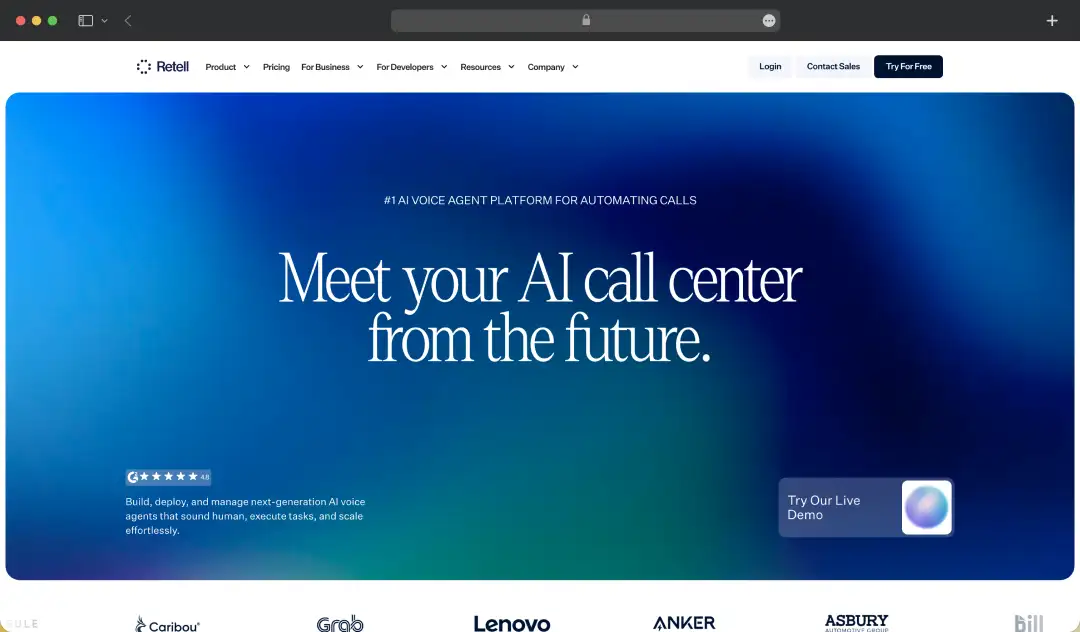
Retell AI provides an end-to-end platform and voice API for designing, testing, deploying, and monitoring production-ready AI voice and chat agents that operate over phone, web, SMS, and chat.
It supports both prompt-based and flow-based agent design, simulation testing, observability (call history, success rates, latency, sentiment), and deep integrations with telephony and CRMs. Retell starts at $0, paying only for what you use. New accounts receive $10 in free credits, 20 concurrent calls, and 10 free Knowledge Bases with full platform access and no commitments.
Developer control is Retell's strongest feature. You can use WebSockets for real-time streaming, route calls via custom webhooks, inject LLM prompts dynamically, and scale to thousands of concurrent sessions.
Plus, the platform supports warm call transfers with full context handoff, so the receiving human agent has complete visibility into what the AI has already discussed.
The best part? You are only charged for connected calls. If a call fails to connect, you won't be billed. And for calls that reach voicemail, billing applies only for the duration the AI agent is active on the line.
Price: $0.07+/min (pay-as-you-go, no platform fee)
Bonus Read: 10 AI Voice Agents in 2026

Bland
Pros & Cons
Pros
- API-first design gives developers precise control over call flows and logic
- Supports voice cloning from short audio samples
- High-volume outbound call automation with batch call support via CSV upload
- The Knowledge Base Gaps feature automatically detects unanswered questions during calls
- Self-hosted enterprise option for data sovereignty
Cons
- Not accessible to non-technical users, no meaningful no-code visual builder
- Additional fees for warm transfers, voicemail drops, and short/failed calls
- Voice quality is basic- less expressive in emotional contexts
- No bundled plans for startups — entry cost relatively high for early-stage use
- No built-in analytics dashboard; call data exported via API only
Why You'll Love It
Bland AI is the best AI voice agent service for your business if you're running high-volume outbound calling campaigns. If you have the engineering resources to build on top of it and prioritize throughput and configurability over speed-to-deploy, Bland delivers.More about product
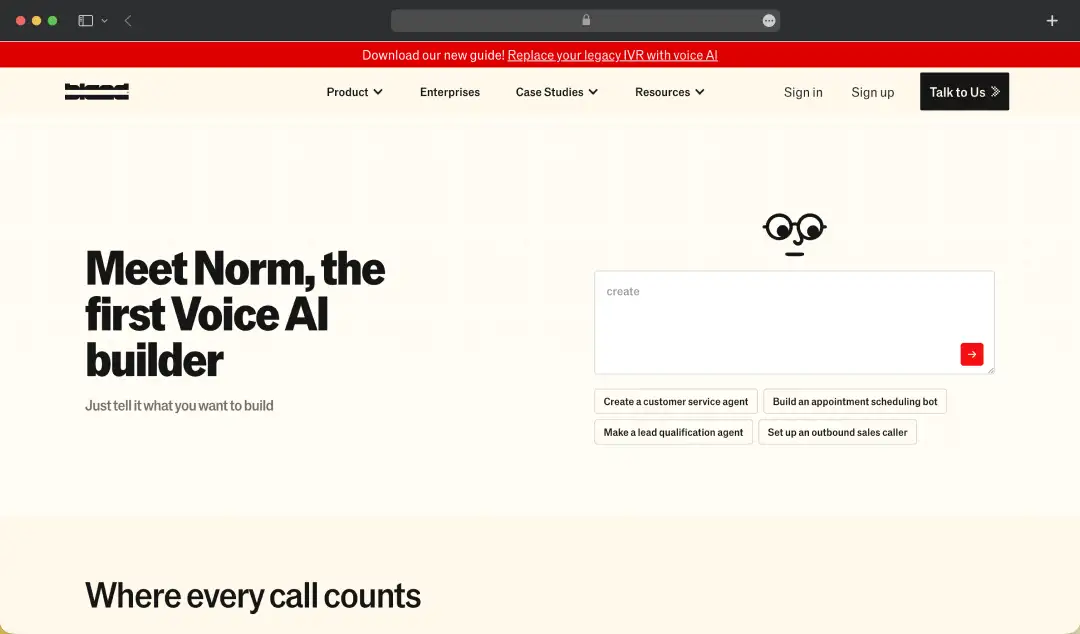
Bland AI's proprietary orchestration framework and edge delivery network power a platform designed around automating inbound and outbound phone calls with customizable AI voices and seamless integrations.
The platform is structured around an API and REST architecture, enabling your team to build call flows programmatically, define agent behaviors, connect external systems via webhooks, and run batch campaigns from uploaded CSV lists.
With its voice cloning feature, businesses can create custom voices from short audio samples. Its knowledge base feature includes automatic detection of questions the agent couldn't answer during live calls, flagging gaps for the team to address.
The platform supports SIP connectivity for enterprise customers who want to connect directly from their own telephony infrastructure or contact center platform.
Bland AI’s self-hosted infrastructure option is particularly relevant for enterprise and regulated industries. This self-hosted solution keeps all conversation logs and transcripts within the company infrastructure, this is an essential feature for regulated sectors. The platform operates at $0.09/minute, eliminating traditional call center staffing costs.
Price: Build at $299/month; Scale at $499/month; Enterprise custom pricing

Synthflow AI
Pros & Cons
Pros
- End-to-end no-code deployment with visual flow builder
- Auto-QA monitors every conversation in real time and feeds performance back for improvement
- Bundled pricing includes voice, LLM, transcription, and analytics in a single rate
- BELL framework (Build, Evaluate, Launch, Learn) structures the full agent lifecycle
- Connects to Cisco, Avaya, Genesys, and RingCentral for enterprise telephony
Cons
- Off-script conversations can expose limitations, and agents may revert to canned responses
- Deep prompt and parameter control are more limited than developer-first platforms
- Less flexibility than code-first platforms for highly custom logic
Why You'll Love It
Synthflow is one of the most trusted AI voice agent services for businesses today. It is best known for its genuine architectural commitment to the enterprise deployment problem rather than just the agent-building problem. For operations leaders who want real voice AI without needing an AI engineering team, this is currently one of the more complete options.More about product
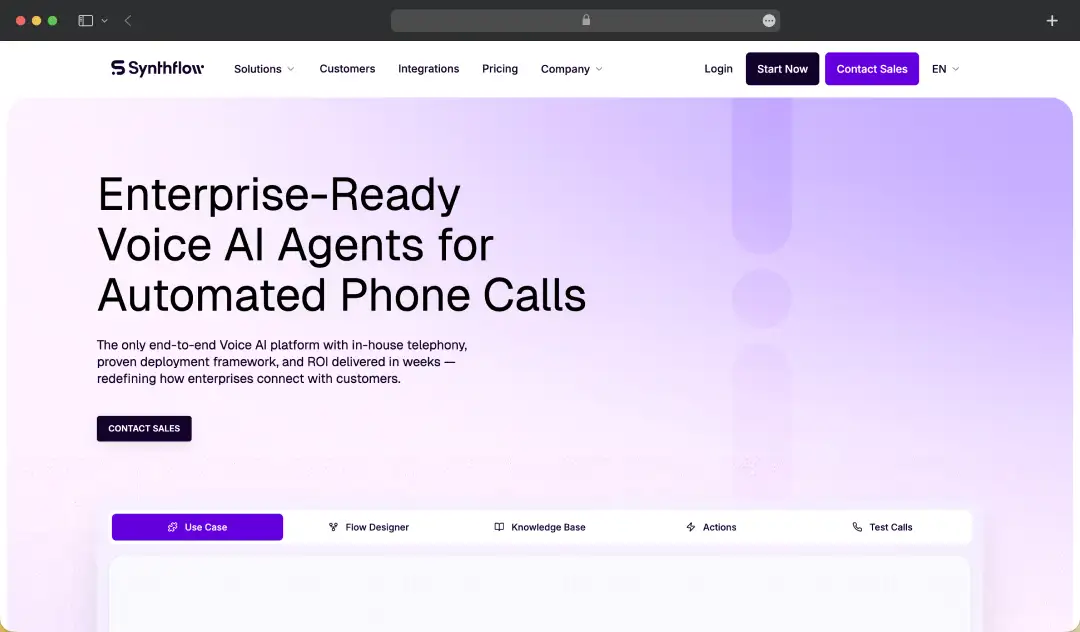
Synthflow is built around a proprietary BELL framework connecting every stage of the agent lifecycle: Build, Evaluate, Launch, and Learn, operating as one repeatable process built directly into the platform.
Unlike many other AI voice agent services for businesses that rely entirely on third-party carriers, Synthflow runs on its own enterprise-grade communications infrastructure, integrating directly with existing telephony or any SIP-based provider. It gives complete control over routing, quality, and compliance.
The visual Flow Designer allows agents to be built with conditional logic, API connections, and subflows that handle specialized tasks independently. Every agent is tested automatically in the Test Center, where simulated calls measure accuracy, response quality, and compliance against defined KPIs before customers ever interact with the agent.
Once live, Auto-QA and monitoring analyze every conversation in real time, feeding insights back to continuously improve performance. Synthflow pricing scales with call minutes, with overages at $0.12–$0.13/min depending on the plan.
All plans bundle voice, LLM, transcription, and CRM integrations at a single rate, eliminating the multi-vendor invoice problem common on developer-first platforms. It is one of the top-rated AI voice agent services for businesses that also supports a white-label mode where agencies can manage client sub-accounts from one dashboard.
Price: $0 to start, and usage-based billing post that

Voiceflow
Pros & Cons
Pros
- Exceptionally strong visual flow builder for designing complex conversational logic
- Genuinely collaborative, supports multi-editor workspaces with comments and shared components
- Supports both chatbot and voice agent design from one platform
- Works with GPT-4, Claude, Gemini, and custom LLMs, no model lock-in
- Strong ecosystem of integrations: Salesforce, Shopify, Zendesk, Snowflake, and more
Cons
- Per-editor seat pricing makes team collaboration expensive fast
- The credit system is complex, and usage costs can be unpredictable during traffic spikes
- No live chat support on lower plans; support is primarily self-service
Why You'll Love It
Voiceflow's real strength is in the design and prototyping experience, building complex, branching conversational flows is genuinely fast and collaborative. It earns a prestigious place when chatbot design quality and team collaboration are the priorities.More about product
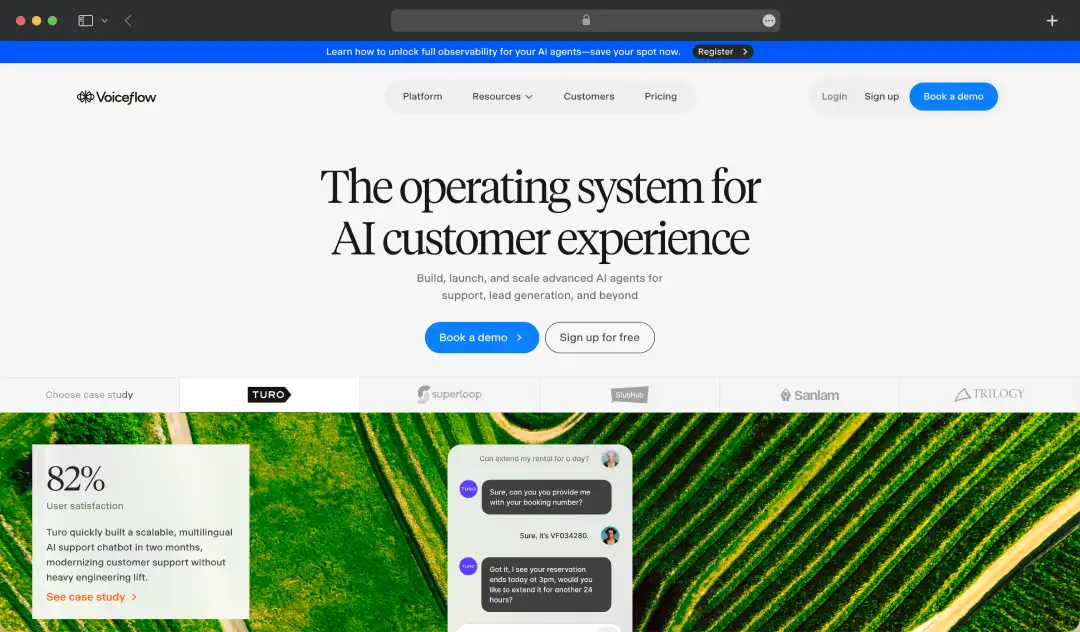
Voiceflow is built to deploy AI agents for every customer channel from one platform, with customers like Turo, StubHub, and Sanlam using it to build scalable multilingual agents without a heavy engineering lift.
The platform originated as a tool for building Alexa skills and has evolved into a broader multi-channel agent builder.
On voice specifically, Voiceflow supports voice agents through telephony APIs like Twilio, but the experience is stitched together. Voice quality depends on your TTS provider, such as Amazon Polly or Google TTS.
Voiceflow's drag-and-drop builder and templates let users design chatbots or IVR agents in under a day, and the platform supports reusable components and pro-code features like custom JavaScript, APIs, modular blocks, and multi-LLM routing.
Price: Free (Starter); custom pricing for paid plans

LiveKit
Pros & Cons
Pros
- Fully open source (Apache 2.0), self-host the entire stack or use LiveKit Cloud
- Mix and match any STT, LLM, or TTS provider without vendor lock-in
- Handles voice, video, and multimodal agents in a single framework
- Built-in semantic turn detection using a custom transformer model reduces interruptions
- Native MCP support for integrating external tools with minimal code
Cons
- Requires coding in Python or Node.js, no visual builder for non-developers
- Self-hosting requires managing your own infrastructure, which adds operational overhead
- Community support via GitHub/Discord, enterprise support requires paid Cloud plans
Why You'll Love It
Trusted by OpenAI, LiveKit provides scalable, open-source voice infrastructure for just $0.01/min. It gives high-volume teams total freedom to choose their own models and customize the pipeline, drastically lowering the total cost of ownership compared to proprietary platforms.More about product
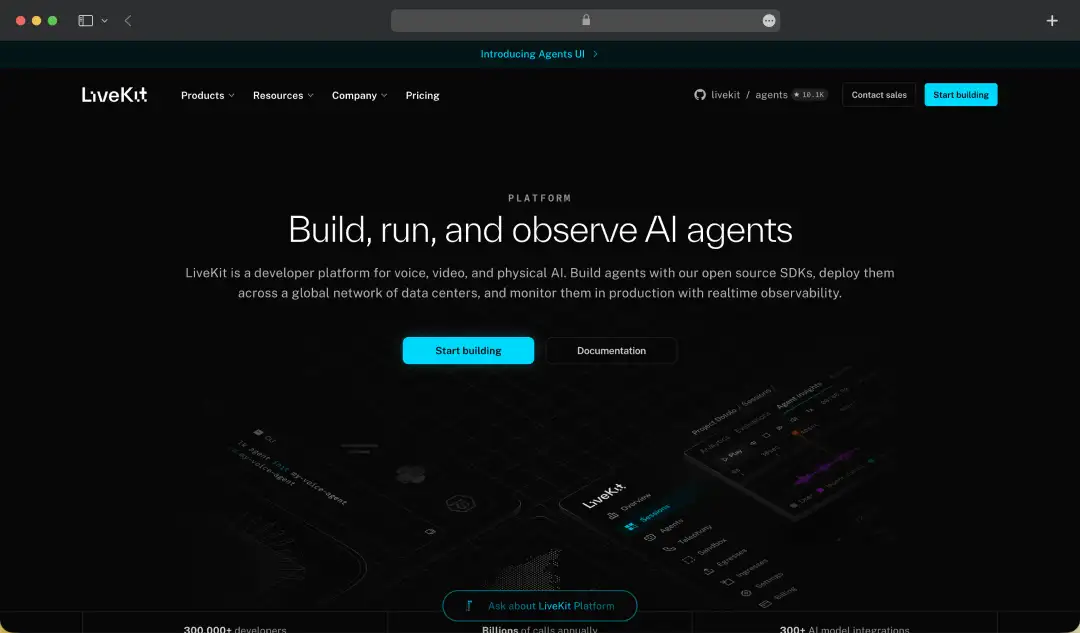
LiveKit is a realtime framework for voice, video, and physical AI agents. The framework provides tools and abstractions for feeding real-time media and data through an AI pipeline that works with any provider, and is fully open source under the Apache 2.0 license.
Developers write agent logic directly in Python or Node.js, which means every decision in the conversation pipeline is transparent and modifiable.
This platform offers a multi-agent handoff for breaking complex workflows into simpler tasks, extensive integrations with nearly every AI provider for Large Language Models (LLMs)
, STT, and TTS. LiveKit also offers state-of-the-art semantic turn detection using a custom model for lifelike conversation flow, built-in MCP support, and a built-in test framework with judges to evaluate agent performance.
For production deployment, LiveKit Cloud handles real-time infrastructure, routing, and scaling with zero infrastructure management, including native SIP support for inbound and outbound phone calling without manual trunk configuration.
Teams get end-to-end visibility into every conversation through turn-by-turn telemetry, session recordings, transcripts, and trace spans. LiveKit Cloud also includes LiveKit Inference for running AI models without managing separate API keys. The open-source framework itself is free to run locally or on your own servers.
Price: Framework is free and open source. LiveKit Cloud agent session minutes are billed at $0.01/min; paid plans include monthly allotments.

Gnani.ai
Pros & Cons
Pros
- Supports 40+ languages, including 12+ Indic languages, rare depth for South Asian and multilingual markets
- Full product suite: voice bots, agent assist, voice biometrics, and omnichannel analytics under one roof
- Processes 30+ million voice interactions daily at production scale
- Real-time agent assist (Assist365) for live human agents during calls
- Low-code/no-code platform alongside API access
Cons
- Enterprise-only positioning means it is not accessible to SMBs or early-stage companies
- Implementation and onboarding timelines are typical of enterprise software, not fast deployment
- Primarily relevant to BFSI, telecom, and healthcare verticals, less general-purpose
Why You'll Love It
Ideal for South Asian enterprises, Gnani.ai stands out by building proprietary Indic language models instead of relying on Western APIs. With secure on-premise deployment options and its Armour365 voice biometrics for authentication, it is a top-tier choice for the BFSI, telecom, and healthcare sectors.More about product
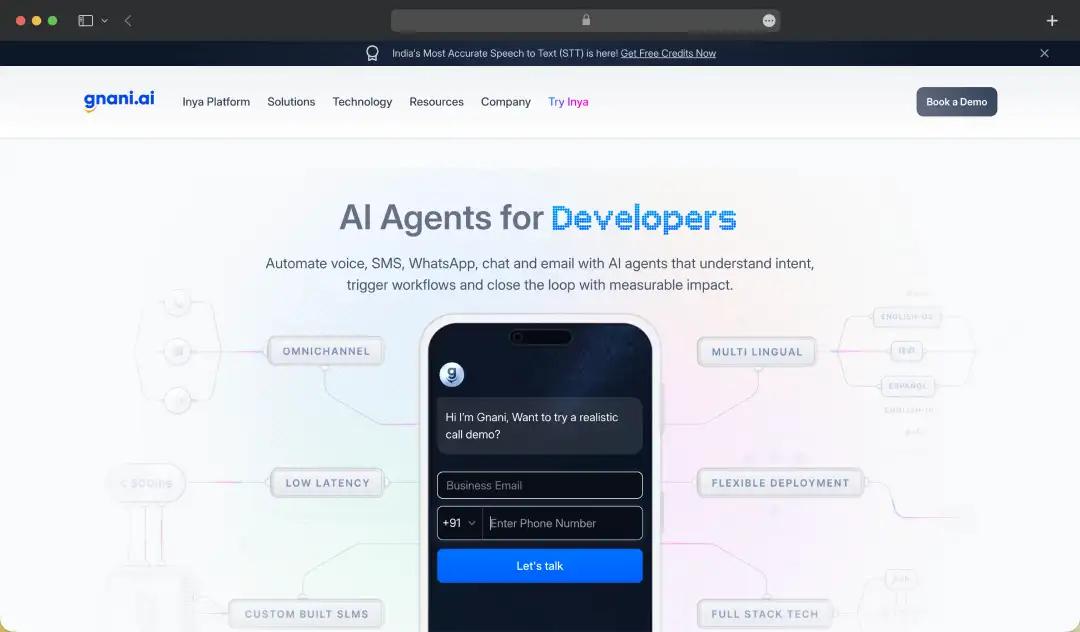
Gnani.ai is a unified voice-first conversational AI platform that integrates generative AI to enhance customer service and automate business processes. This India-based platform offers Automate365 for AI-driven business workflow automation, Assist365 for real-time agent assistance, Armour365 for secure voice biometrics authentication, and Aura365 for omnichannel customer analytics.
The company has developed its platform through a transition from traditional conversational AI to a comprehensive Agentic AI platform, combining speech-to-speech LLMs, industry-specific Small Language Models (SLMs), and agentic workflows. It enables AI agents to understand, reason, and autonomously handle tasks in real-world enterprise environments.
Gnani.ai reports serving over 200 customers, supporting more than 40 languages, and processing over 30 million voice interactions daily.
The platform's low-code/no-code environment and pre-built conversation flows allow deployment teams to configure and launch agents without deep engineering involvement.
It is one of the best AI agents for customer support that offers its proprietary speech recognition APIs and NLP-based solutions to power customer support automation for leading companies in BFSI, e-commerce, and other sectors, with seamless integration into existing enterprise systems.
Price: Custom enterprise pricing only.

Ringg.ai
Pros & Cons
Pros
- Sub-400ms latency via proprietary Flash engine, among the fastest in this category
- No-code builder accessible to non-technical users alongside API access for developers
- Strong multilingual support for Indian languages, including 16+ regional accents and mixed-language (Hinglish) conversations
- Handles 10,000+ concurrent calls with stable voice quality at scale
- Native WhatsApp integration syncs call and messaging data in one workflow
Cons
- Relatively newer platform with a less established enterprise track record than legacy players
- Advanced customization for highly complex logic flows is less mature than developer-first platforms
- International telephony coverage is still maturing outside India and key markets
Why You'll Love It
Ringg.ai simplifies pricing by bundling the entire voice stack into a single, transparent rate. Built specifically for the Indian market, it combines sub-400ms latency with superior Hinglish support, delivering voice automation so natural that customers often mistake the AI for a real human.More about product
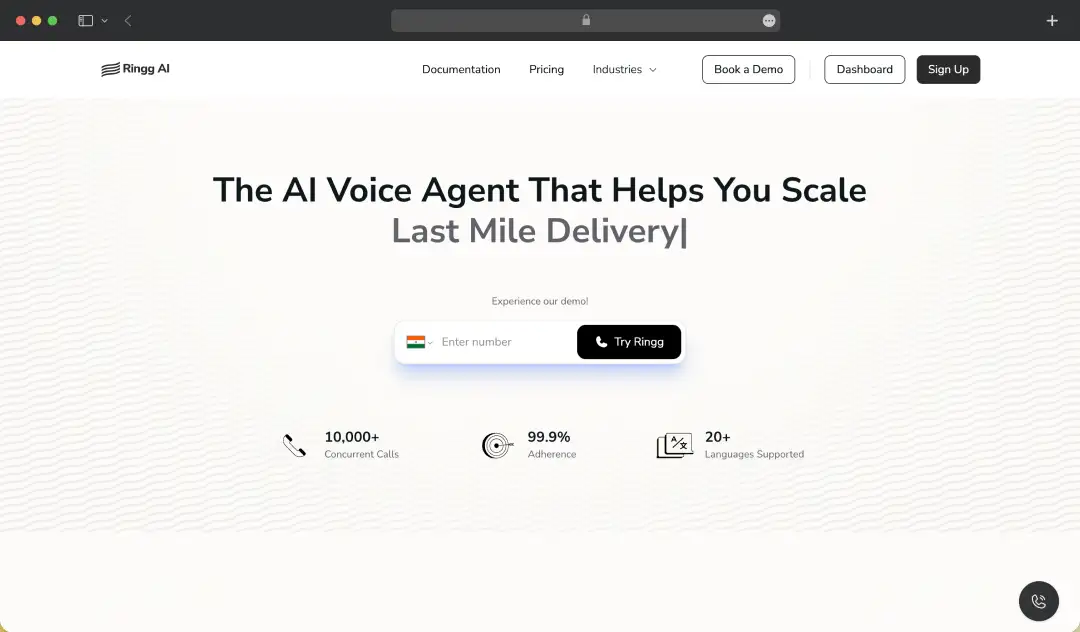
Ringg.ai is a multilingual voice AI platform for businesses handling high-volume phone calls. It automates inbound and outbound conversations, qualifying leads, booking appointments, confirming orders, and answering common questions, with a human handoff that transfers full context to the receiving agent when escalation is needed.
The platform provides sub-400ms latency, supporting 20+ languages, 16+ regional accents across 8+ major Indian languages, including Hindi, Kannada, Bengali, and Marathi. It can also handle complex mixed-language conversations like Hinglish or Marathinglish without dropping context or breaking conversational flow.
Ringg.ai bundles Brain (LLM), Ears (STT), Voice (TTS), and Phone Line (telephony) into one transparent rate, eliminating the unpredictability of component-based billing. The platform also offers pre-trained agents for specific business outcomes, unlike developer-first platforms, where users typically start from a blank prompt.
This makes deployment faster for business teams that need working agents quickly, rather than building from scratch.
Ringg.ai includes a no-code voice agent builder, real-time analytics with call dispositions, CRM and calendar integrations, and an advanced analytics dashboard to monitor call performance and customer satisfaction.
Price: Flexible usage plan at $0.10/minute per connected call; Enterprise plan at $0.06/minute per connected call.
How Did We Evaluate the Best AI Voice Agent Services for Businesses
To ensure we only recommended top-tier platforms, through a structured process, we rigorously tested each service against a strict set of criteria. Here is what we prioritized during our evaluation:
1. Ultra-Low Latency
We checked that platforms consistently deliver sub-500ms response times, ensuring conversations feel natural, responsive, and free of awkward robotic pauses.
2. Robust Language and Dialect Support
We ensured the agents could fluently handle diverse customer bases, specifically testing for localized dialect support (like Hinglish) and the ability to process mixed-language inputs seamlessly.
3. Security and Compliance
We verified that every platform on our list adheres to strict, enterprise-grade data protection standards, including SOC 2 Type II, HIPAA, and GDPR compliance.
4. Ease of Deployment and Integration
We assessed how easily these tools plug into existing workflows, prioritizing platforms that offer low-code deployment and out-of-the-box integrations with major CRM software, EHRs, and scheduling systems.
5. Transparent Pricing Models
We looked closely at cost structures, favoring platforms that offer clear pay-as-you-go rates or bundled pricing for the entire voice stack to ensure businesses aren't hit with hidden vendor fees.
6. Customization and Control
We tested the extent of platform flexibility, ensuring that businesses can dictate their underlying models and easily fine-tune the agent's tone, voice style, and emotional resonance to match their brand.
Also Read: Best AI Agent Platforms
Why Does Your Business Need AI Voice Agent Services?
In today’s fast-paced market, customer expectations for immediate, personalized support are higher than ever. Integrating an AI voice agent is no longer just a technological upgrade—it is a strategic necessity to stay competitive. Here is why your business needs to adopt AI voice automation:
- Customers hate being put on hold. AI voice agents provide instant, round-the-clock support, ensuring that every inbound call is answered immediately, whether it is during peak hours, weekends, or holidays.
- Call volumes can fluctuate wildly due to seasonality or marketing campaigns. Unlike traditional call centers that require weeks to hire and train new staff, AI voice agents can scale up instantly to handle thousands of concurrent calls without breaking a sweat.
- By automating routine queries like order tracking, appointment scheduling, and basic troubleshooting, businesses can drastically lower their cost-per-resolution and reduce the overhead associated with large customer support teams.
- AI does not replace your best human talent; it protects them from burnout. By filtering out repetitive questions, AI agents free up your live representatives to focus on high-value, complex, and emotionally nuanced interactions that require a human touch.
- Human agents can have bad days; AI agents do not. They deliver a perfectly consistent tone, adhere strictly to compliance scripts, and represent your brand flawlessly on every single call.
- Serving a diverse or global customer base traditionally requires hiring specialized bilingual staff. Modern AI voice agents can instantly switch between languages and regional dialects, allowing you to seamlessly serve localized markets without additional hiring.
Wrapping Up!
If your business is dealing with missed calls, slow response times, or teams stuck handling repetitive queries all day, something needs to change. And that’s exactly where AI voice agent services for businesses will help you.
That said, choosing the wrong tool can easily backfire. A bad voice agent doesn’t just fail; it frustrates customers and damages trust. So the goal isn’t to just automate, it’s to automate well.
Based on everything we’ve covered, the smartest move is to focus on what actually matters for your business: conversation quality, reliability, and how naturally the system fits into your existing workflow.
Get that right, and you’re not just saving time or cutting costs, you’re making sure every call actually works in your favor.
We cut through the deafening digital noise to find what truly works. Every product on our list survives a relentless, hands-on analysis—no exceptions. We do the grunt work to deliver verified, trustworthy recommendations, so you can choose the right tools with absolute confidence.
- Products Reviewed - 4,000+
- No. Of Experts - 20+
- Categories - 65+
Frequently Asked Questions
What are AI voice agent services for businesses?
AI voice agent services for businesses are tools that handle incoming and outgoing calls using AI. They can answer queries, qualify leads, and manage support without human intervention.
How do AI voice agent services for businesses improve customer support?
They respond instantly, reduce wait times, and handle repetitive queries at scale. This frees up human agents to focus on more complex or high-value conversations.
Are AI voice agents better than traditional call centers?
Not always better, but more efficient for repetitive tasks. They work best alongside human teams, handling volume while humans manage nuanced conversations.
What should businesses look for in AI voice agent services?
Focus on natural conversation quality, reliability, integrations, and real-time responsiveness. A tool that sounds robotic or breaks the flow will hurt customer experience.
Are AI voice agent services for businesses expensive to implement?
Costs vary, but they’re often more affordable than scaling a full support team. Most businesses see value through reduced hiring needs and improved call handling efficiency.






We've got more answers waiting for you! If your question didn't make the list, don't hesitate to reach out.
More in Artificial Intelligence
Explore More In Artificial IntelligenceThe 10 Best AI Legal Assistant Tools to Supercharge Your Legal Processes in 2026




Choosing the Best AIOps Tools for Modern Chaos