
ManageEngine Review: A Comprehensive Look at Zoho’s IT Management Suite
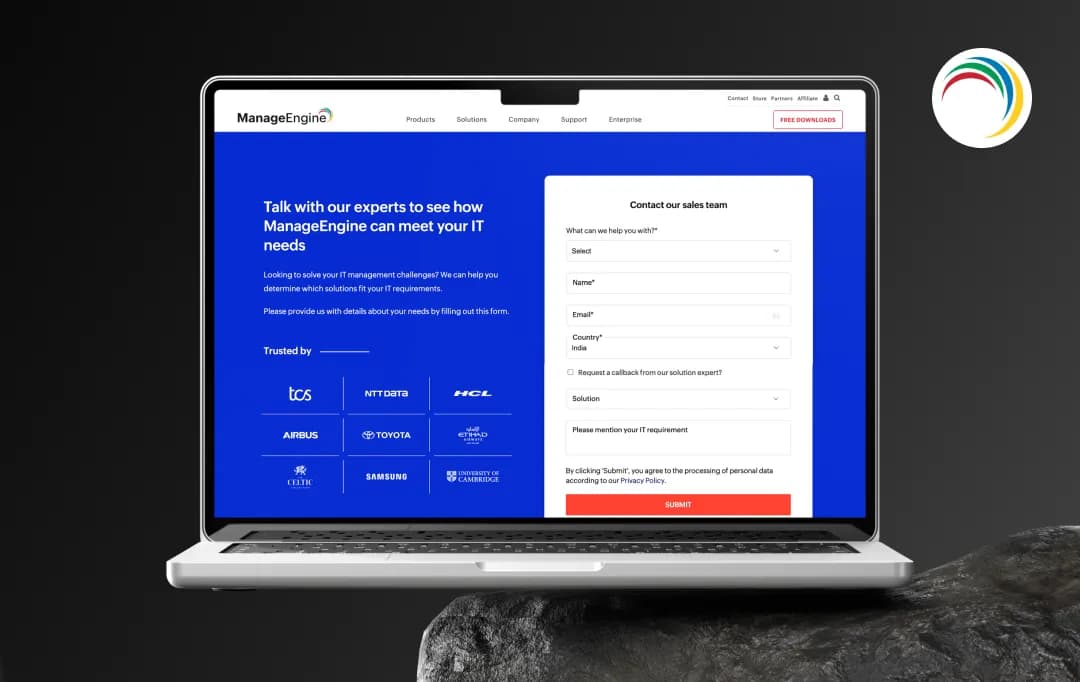
ManageEngine is the enterprise IT management division of Zoho, launched in 2002 and has now expanded its portfolio to include more than 60 products and free tools. These tools span different use cases, from unified endpoint management and IT service management to low-code application development, network and application monitoring, and others.
Rather than a single unified application, you can easily understand ManageEngine as a federation of purpose-built products- Endpoint Central, ServiceDesk Plus, OpManager, ADManager Plus, and dozens of others. All these products are designed to interoperate but are sold, licensed, and often deployed separately.
The platform’s core pitch is affordability and breadth, allowing organizations to assemble a fairly comprehensive IT management stack. Its full-package deal at an affordable price makes it a popular choice among mid-sized IT teams, MSPs, and organizations with data residency or air-gapped requirements.
This ManageEngine review evaluates the platform holistically. We have covered its features, pricing, products, integrations, and everything else to help you decide if it's the right choice for your organization or not.
Pros and Cons of ManageEngine
Pros
- Extremely broad product catalog covering nearly every IT management discipline under one vendor
- Significantly lower cost than comparable enterprise tools (often cited as 50–70% more affordable than alternatives)
- Flexible deployment options: cloud, on-premises, or hybrid, with perpetual licensing available for some products
- Deep native integration between ManageEngine products, such as ServiceDesk Plus, Endpoint Central, ADManager Plus, and OpManager
- Strong compliance credentials, including ISO 27001, ISO 27701, SOC 2 Type II, HIPAA, and GDPR, making it suitable for regulated industries
- Generous free/community editions and 30-day trials across most products
- ITIL-aligned service management and automation capable of supporting complex enterprise workflows
- Strong compliance credentials, including ISO 27001, ISO 27701, SOC 2 Type II, HIPAA, and GDPR, making it suitable for regulated industries
Cons
- Not a true single platform, each product has its own console, database, and licensing, creating a fragmented experience
- Initial setup, workflow customization, and ongoing administration require a skilled IT team and significant time investment
What Does ManageEngine Offer?
ManageEngine’s real strength is not any single flagship product; it's the sheer surface area it covers. Very few vendors at this price point let you patch endpoints, run a service desk, monitor a network, and audit Active Directory without signing four separate enterprise contracts.
Here are ManageEngine features that actually explain why IT teams keep this platform in their stack-
1. Modular, product-based architecture (4.5/5)
ManageEngine isn't one monolithic app; it's a family of specialized products that each solve one problem well (helpdesk, patching, monitoring, AD auditing, etc.). This lets organizations buy only what they need, but it also means there's no single license or console that covers everything, so IT teams need to plan their stack deliberately.
Bonus Read: Best Helpdesk Software
2. Unified Endpoint Management and Security (UEMS) (4.4/5)
Led by Endpoint Central (formerly Desktop Central), UEMS covers patch management, software deployment, OS imaging, remote troubleshooting, and mobile device management across Windows, macOS, Linux, and mobile endpoints. Security-focused add-ons include vulnerability management, ransomware protection, and browser security, extending the platform from pure management into endpoint security.
3. ITIL-aligned IT Service Management (4.5/5)
ServiceDesk Plus provides incident, problem, change, and asset management with customizable workflows, SLA tracking, and a self-service portal. Reviewers consistently highlight strong automation and workflow customization, though several note that configuring advanced workflows takes real effort and training for administrators and non-IT users alike.
4. IT Operations Management and Observability (4.5/5)
OpManager and Applications Manager give real-time visibility into network devices, servers, and application performance, with customizable dashboards, threshold-based alerting, and both agent-based and agentless monitoring. Users generally rate the interface as intuitive for day-to-day monitoring, though large, complex networks can involve a non-trivial setup process.
5. Identity and Access Management (4.3/5)
Products like ADManager Plus, ADAudit Plus, ADSelfService Plus, and Identity360 cover Active Directory administration, real-time auditing, self-service password reset, and adaptive multi-factor authentication, supporting zero-trust access models. This is widely regarded as one of ManageEngine's strongest and most mature categories.
6. Privileged Access Management (4.2/5)
PAM360 and Password Manager Pro handle privileged credential vaulting, session recording, and just-in-time access for administrative accounts, giving organizations enterprise-grade PAM capability without the cost typically associated with dedicated PAM vendors.
7. Security Information and Event Management (4.1/5)
Log360 centralizes log collection, correlation, and threat detection across the IT environment, with user and entity behavior analytics (UEBA) to help security teams detect anomalies and respond to incidents from a single console.
8. Deployment flexibility (4.2/5)
Nearly every product can be deployed as a cloud subscription or an on-premises install, and several still offer perpetual on-premises licensing. This is a genuine differentiator for regulated industries, government, or organizations with data sovereignty requirements that rule out cloud-only competitors.
9. Native cross-product integration (4.0/5)
Because ManageEngine builds most of its products in-house, integrations between them (e.g., ServiceDesk Plus pulling asset data from Endpoint Central, or OpManager feeding alerts into ServiceDesk Plus tickets) tend to be deeper and more reliable than integrations with outside tools.
10. Low-code application development (4.1/5)
Its low-code tooling lets IT teams build custom internal applications on top of the platform, which is useful for organizations that want to extend ManageEngine beyond its out-of-the-box workflows without a full development team.
11. MSP-specific editions (4.0/5)
Many core products (Endpoint Central MSP, ServiceDesk Plus MSP, OpManager MSP) have purpose-built multi-tenant versions, making ManageEngine a common choice for managed service providers who need to manage many client environments from one place.
Understanding ManageEngine Pricing
ManageEngine does not sell a single bundled platform license; pricing is per product, and each product has its own licensing logic (per technician, per endpoint, per server, or per identity), so the total cost depends entirely on which products you combine and how large your environment is.
IMPORTANT NOTE: The platform offers a free trial for 30-days for all users.
I. ServiceDesk Plus (ITSM)- per technician
| Technicians / Assets | Standard | Professional | Enterprise |
|---|---|---|---|
| Free (2 technicians, 250 assets) | Free | $495/year | $1,195/year |
| 5 technicians, 500 assets | Free | $1,195/year | $2,995/year |
| 10 technicians, 500 assets | $1,195/year | $2,295/year | $5,995/year |
| 20 technicians | $2,395/year | $4,545/year | $10,795/year |
| 50 technicians | $4,795/year | $10,795/year | $21,595/year |
| 100 technicians | $8,395/year | $19,195/year | $29,995/year |
| 200 technicians | $11,995/year | $23,995/year | $35,995/year |
*This is the pricing for ‘On-Premises’
II. Endpoint Central (UEM): per endpoint + per server, annual on-prem, 1 technician
| Edition | 50 endpoints | 10 servers |
|---|---|---|
| Professional | $795/yr | $295/yr |
| Enterprise | $945/yr | $345/yr |
| UEM | $1,095/yr | $395/yr |
| Security | $1,695/yr | $495/yr |
Because pricing is fragmented across products, prospective buyers should request a consolidated quote for their full intended stack before committing, rather than budgeting from any single product's advertised starting price. For information on pricing, visit ManageEngine’s official website.
ManageEngine Solution Categories
ManageEngine software groups its 60+ products into a handful of broad solution categories. The table below names the flagship product in each category and what it does in a single line.
| Category | Flagship Products | What It Does |
|---|---|---|
| Unified Endpoint Management & Security (UEMS) | Endpoint Central, Mobile Device Manager Plus, Browser Security Plus | Manages, patches, and secures desktops, servers, and mobile devices across their lifecycle. |
| IT Service Management / Enterprise Service Management | ServiceDesk Plus, SupportCenter Plus | Runs help desk ticketing, ITIL workflows, and service delivery for IT and other business departments. |
| IT Operations Management (ITOM) | OpManager, Applications Manager, NetFlow Analyzer | Monitors network devices, servers, and applications for performance, availability, and outages. |
| Identity & Access Management (IAM) | ADManager Plus, ADAudit Plus, ADSelfService Plus, Identity360 | Manages Active Directory, auditing, self-service password resets, MFA, and SSO. |
| Privileged Access Management (PAM) | PAM360, Password Manager Pro, Key Manager Plus | Secures, vaults, and monitors privileged credentials and administrative sessions. |
| Security Information & Event Management (SIEM) | Log360, EventLog Analyzer | Aggregates and correlates security logs and detects threats across the IT estate. |
| Advanced IT Analytics | Analytics Plus | Turns IT data from across ManageEngine products into unified dashboards and business intelligence. |
| Low-Code Application Development | AppCreator | Let IT teams build custom apps and workflows without heavy coding. |
| MSP Solutions | Endpoint Central MSP, ServiceDesk Plus MSP, OpManager MSP | Multi-tenant editions of core products are purpose-built for managed service providers. |
ManageEngine Integrations and Compliance
No IT management platform survives on its own an island, and this is where ManageEngine's dual identity, a Zoho-built ecosystem player that also has to work inside someone else's Microsoft- and Slack-centric environment, becomes most visible.
Here are the important integrations and compliance you need to know-
I. Integrations
| Integration | Connects To | What It's Useful For |
|---|---|---|
| Native ManageEngine ecosystem | Endpoint Central, OpManager, ADManager Plus, ADSelfService Plus, PAM360, and other ManageEngine products | Share asset, alert, and identity data across products without middleware; this is the deepest and most reliable integration path. |
| Microsoft 365 / Azure AD | Exchange Online, Teams, SharePoint, Azure Active Directory | Provisioning, reporting, and compliance monitoring across Microsoft's cloud stack. |
| Collaboration tools | Microsoft Teams, Slack | Ticket notifications, alerts, and approvals are routed directly into chat channels. |
| Development & ticketing tools | Jira | Cross-links tickets and issues between ITSM and engineering workflows. |
| Business intelligence | Microsoft Power BI | Pulls ManageEngine data into external dashboards and reports. |
| Zoho Business Suite | Zoho CRM, Zoho Desk, Zoho Analytics, and other Zoho apps | Extends ManageEngine data into broader business operations given the shared parent company. |
| REST APIs | Custom and third-party systems | Enables integrations with tools outside the native connector list, though this typically requires in-house development effort. |
II. Compliance
| Certification / Standard | Scope | What It Means for Buyers |
|---|---|---|
| ISO/IEC 27001 | Applications, systems, people, technology, and processes across cloud and on-premises products | Independently verified information security management practices. |
| ISO/IEC 27701 | Extension of ISO 27001 | Formal privacy information management for handling personal data (PII). |
| ISO/IEC 27017 | Cloud services | Security controls specific to cloud computing environments. |
| SOC 2 Type II | ManageEngine and its products | Audited controls across security, availability, processing integrity, confidentiality, and privacy. |
| HIPAA (SOC 2 + HIPAA Type 2) | ServiceDesk Plus, Endpoint Central, ADManager Plus, and their cloud/MSP editions | Acts as a Business Associate, supporting healthcare data handling requirements. |
| GDPR | All cloud and on-premises products handling EU personal data | Periodic audits and a designated Data Protection Officer support EU data protection compliance. |
| CSA STAR (Cloud Security Alliance) | Cloud services | Submitted Consensus Assessments Initiative Questionnaire documenting cloud security practices for procurement review. |
For regulated industries like healthcare, finance, government, and enterprises with strict data residency requirements, this compliance footprint, combined with the option to self-host on-premises, is one of ManageEngine's more compelling differentiators against pure cloud-native competitors that may not offer an on-premises alternative at all.
How Does ManageEngine Help Different Industries
ManageEngine’s product suite (ITSM, UEM, SIEM, IAM, ITOM) is packaged and positioned differently depending on the sector, with each industry page emphasizing the specific compliance, security, or operational pressures that sector faces.
Below is a summary of how ManageEngine frames its value for each of the eight industries it targets-
| Industry | Focus Area | How ManageEngine Positions Itself |
|---|---|---|
| Government | Citizen services & legacy modernization | Helps agencies deliver a citizen-centric digital experience, empower their workforce, modernize legacy systems, and support agile decision-making. |
| Education | Student experience & campus security | Aims to elevate student experience, improve learning outcomes, streamline IT workflows, and secure campus networks and devices. |
| Healthcare | Patient care & data security | Focused on personalizing patient care, securing healthcare ecosystems, and improving operational efficiency (a separate NHS-specific offering targets UK trusts on patient data security and care delivery). |
| Manufacturing | Automation & compliance | Positions around AI-driven automation for IT operations, paired with integrated cybersecurity for threat detection, response, and regulatory compliance. |
| Finance (BFSI) | Regulatory compliance & risk | Targets banking/insurance modernization, meeting customer expectations, and complying with tightening financial regulations while minimizing cyber risk. |
| Retail | Customer experience & resilience | Built around delivering seamless shopping experiences through secure, resilient, and future-ready IT infrastructure. |
| Logistics | Global visibility & data intelligence | Emphasizes bespoke logistics solutions, analytical data intelligence for decision-making, and real-time visibility into worldwide operations. |
| Energy | Infrastructure security & compliance | Centers on managing and securing energy infrastructure with compliant, AI-powered IT solutions. |
Also Read: Best Cybersecurity Tools
Customer Reviews
How was your experience with the product?
Also Reviewed By Us