
Monday.com Review: I Tested It Beyond Its Pretty Interface and Colorful Boards
Think about your team's actual workflow for a second. There's the project management tool everyone signed up for with good intentions. The Slack channel that's basically a graveyard of “circling back on this.” The spreadsheet someone built in 2022 that half the team doesn't even know exists anymore.
And somehow, despite having five different places to track work, nobody can answer a simple question: “How far did we get with the project?”
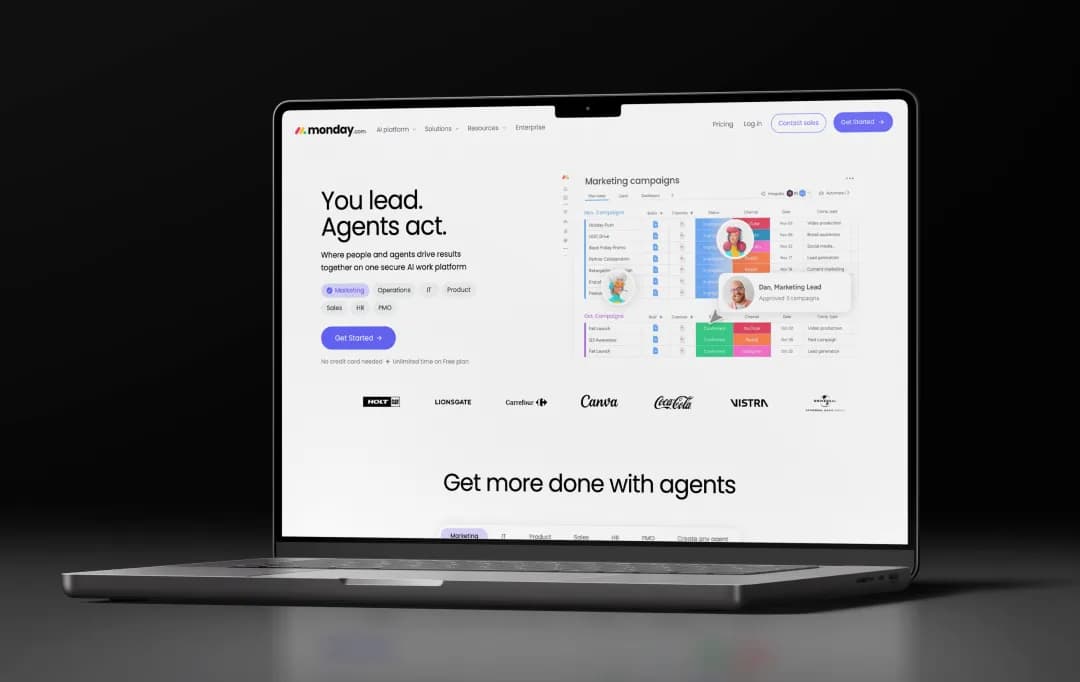
That's the exact chaos Monday.com claims it can fix. One platform, the pitch goes, where your tasks, timelines, and conversations all live together instead of being scattered across a dozen tabs. It's a bold promise, and one you've probably seen a hundred times in ads that are as colorful as they are confident.
So I decided to actually test it. Not just skim the features page, but dig into whether the platform genuinely simplifies how teams work, or if it's just another tool that looks great in a demo and falls apart in daily use. So, here’s my comprehensive Monday.com review, covering all the necessary details about the platform.
Pros and Cons of Monday.com
Pros
- Highly visual, customizable boards that adapt to different workflows without coding
- Strong automation engine for repetitive tasks like status updates and notifications
- 200+ integrations across marketing, communication, collaboration, and development tools
- Multiple views, Kanban, Gantt/Timeline, Calendar, Chart, for the same data
- AI features (AI blocks, Sidekick assistant, AI agents) built into paid plans
- Free plan available for individuals or very small teams
Cons
- Automations and integrations are locked behind paid plans and are not available on Basic
- Paid plans require a minimum of 3 seats, so solo users and pairs pay more than the per-seat price suggests
- Can get expensive as teams and automation needs scale up
- Learning curve for teams unfamiliar with “Work OS”, style platforms
What Does Monday.com Offer?
Monday app’s feature set goes well beyond basic task boards; it now spans workflow automation, native AI agents, and portfolio-level reporting. Here's what stands out.
1. Customizable Boards with Dependencies and Sub-Items (4.5/5)
Boards support column types for status, timelines, formulas, and people, plus task dependencies and sub-items for breaking work into stages. Views range from Kanban and Gantt/Timeline to Calendar, Workload, and Chart, so the same data can be read as a sprint board, a critical path, or a capacity plan.
2. Workflow Builder (4.5/5)
A visual, no-code canvas for mapping multi-step, cross-functional processes (e.g., Sales → Ops → Finance approvals) with branching logic, smart conditions, and SLA-based escalation, going beyond simple single-trigger automations to model entire business processes.
3. AI Blocks (4.3/5)
Modular AI functions that plug into the Workflow Builder, classic Automations, or individual columns to summarize text, classify requests, extract fields from documents, or propose next actions, turning ambiguous, judgment-based steps into repeatable automation.
4. Monday Sidekick (4.2/5)
A context-aware AI assistant that understands your actual boards, statuses, and documentation (not a generic chatbot), used for tasks like generating executive summaries, debugging automation formulas, and suggesting workflows tailored to your setup. It's included in the Standard plan, with a fuller "Plus" tier on Pro and Enterprise.
5. AI Agents (Agent Builder / Agent Factory) (4.2/5)
Monday AI offers autonomous digital workers that run processes end-to-end, monitoring boards, applying judgment based on defined rules, and taking action (routing requests, chasing updates, triggering next steps) even when no one is actively working, within the permission boundaries you set.
6. Automations Engine (4.0/5)
No-code automations for status changes, notifications, and recurring tasks, with monthly action limits that scale sharply by plan, from none on Basic to 25,000/month on Pro and 250,000/month on Enterprise.
7. Dashboards and Portfolio Reporting (4.0/5)
Cross-board dashboards aggregate data from multiple projects into a single real-time view for tracking budgets, timelines, and risk, with true portfolio and resource management reserved for the Enterprise tier.
8. Workload and Resource Management (4.3/5)
Monday software’s visual workload views show who's over- or under-allocated across boards, helping managers rebalance assignments before deadlines slip, rather than just tracking task status in isolation.
9. Monday MCP (Model Context Protocol) (3.9/5)
An official MCP server that lets external AI tools, including Claude, ChatGPT, and Copilot, read and write monday.com data directly, while still enforcing the same row-level permissions users already have.
10. Product Lifecycle Management (Monday dev) (4.0/5)
Through the Monday dev product, allows teams to streamline product lifecycle management. Right from roadmapping, backlog prioritization, sprint planning, bug and incident tracking, to releases.
Visual roadmaps link individual tasks and epics to quarterly goals, while burndown charts, velocity metrics, and two-way GitHub/GitLab integrations give engineering and product teams delivery visibility without needing a separate tool like Jira.
11. Integrations
Monday.com integrations support over 200+ native integrations across marketing, communication, collaboration, and development tools (Slack, Gmail, Microsoft Teams, Outlook, Zoom, Google Drive), letting Monday.com sit at the center of an existing tool stack rather than replacing it.
12. WorkForms, Docs, and Canvas
Custom intake forms feed directly into boards, real-time collaborative docs support planning and write-ups, and Canvas provides a whiteboard for brainstorming, keeping planning and execution in the same platform.
13. Time Tracking and Budgeting
A dedicated time-tracking column (manual or timer-based) ties logged hours to tasks and boards for budget tracking, available from the Pro plan onward.
Understanding Monday.com Pricing
Unlike most project management tools, Monday.com uses seat-based pricing across 5 different tiers billed monthly or annually. Monday.com’s free plan is genuinely useful to test out the tool before committing full time. Here’s an overview of Monday pricing-
| Plan | Price (Billed Annually) | Best For | Key Limitations |
|---|---|---|---|
| Free | $0 (up to 2 seats) | Individuals or pairs testing the platform | No automations, integrations, or Timeline/Gantt view |
| Basic | $9/seat/month | Small teams needing simple task tracking | No automations or integrations |
| Standard | $12/seat/month | Most small-to-mid-sized teams | Automations and integrations are capped at 250 runs/month |
| Pro | $19/seat/month | Teams needing advanced automation and reporting | No portfolio or resource management |
| Enterprise | Custom pricing | Large organizations requiring advanced security and governance | Requires contacting sales for pricing |
- Monday Service pricing starts at $31/seat/month for the standard plan, and it goes up to $45/seat/month for the Pro plan
- Monday Dev pricing starts at $9/seat/month and goes up to $20/seat/month for the Pro plan.
- Monday CRM pricing starts at $12/seat/month and goes up to $28/seat/month for the Pro plan. The ultimate plan comes with custom pricing.
*This is the recent pricing as of July 2026. For further pricing information, visit Monday.com
Bonus Read: Best To-Do List Apps
Monday.com Solutions
Beyond generic project boards, Monday project management tool packages its platform into dedicated solutions for specific teams and functions, each with tailored templates, dashboards, and AI agents. Here's how the core solutions break down.
| Team / Function | What monday.com Offers | How It Helps |
|---|---|---|
| PMO (Projects & Delivery) |
|
|
| Marketing (Campaigns & Creative) |
|
|
| Operations (Processes & Efficiency) |
|
|
| IT (Tickets & Support) |
|
|
| HR (Hiring & Onboarding) |
|
|
| Sales (Pipeline & Deals) |
|
|
Who Is Monday.com For (and not)
Monday.com is one of the most flexible CRM software, and is thus usable across many team types, but it's a stronger fit for some than others. Here are the personas where Monday fits excellently and a few where it does not.
| Team Type | Good Fit? | Why |
|---|---|---|
| Non-technical teams wanting an intuitive, visual tool | Yes | Drag-and-drop boards and 200+ templates need no coding or IT setup |
| Operations teams with recurring workflows | Yes | Strong automation engine cuts down on manual, repetitive process work |
| Small-to-mid marketing or creative teams | Yes | Customizable boards, forms, and docs suit campaign and content workflows |
| PMOs managing complex, multi-project portfolios | Conditionally | Needs the Enterprise plan for portfolio and resource management features |
| Freelancers or solo users | Not ideal | The Free plan is limited, and the 3-seat minimum makes paid plans costlier than solo-focused tools |
| Teams needing strict budget control at scale | Not ideal | Automation limits and per-seat costs can climb quickly as teams and needs grow |
Customer Reviews
How was your experience with the product?