
We are not biased. We test and review every product. Here's our Methodology.

Is MathGPT worth it? My review breaks down its performance, accuracy in solving math problems, key features, and overall user experience.

MobileAppDailyCertified Rating
4.5 out of 5
Product Review CTA
Let Your Product Take the Center Stage with Our Review
Riya

Written By Riya

Riya turns everyday tech into effortless choices! With a knack for breaking down the trends and tips, she brings clarity and confidence to your downloading decisions. Her experience with ShopClues, Great Learning, and IndustryBuying adds depth to her product reviews, making them both trustworthy and refreshingly practical. From social media hacks and lifestyle upgrades to productivity boosts, digital marketing insights, AI trends, and more—Riya’s here to help you stay a step ahead. Always real, always relatable!

Explore More By Author

MathGPT Review: Does This AI Math Solver Actually Teach You Anything?

MathGPT

Most apps designed to help out in Mathematics just spit out an answer and leave you exactly as confused as before. I went into MathGPT expecting more of the same. A few dozen problems later, the picture turned out to be more interesting than that.

MathGPT was built by two Cornell engineering students who got tired of the gap between getting an answer and understanding it. You just need to photograph a problem, get a step-by-step solution, and, the part that sets it apart, generate a narrated video that walks through the work. 

It claims more than 2 million students across 150-plus countries, and it stretches well past math into physics, chemistry, accounting, and statistics.

So I put it through its paces. I gave it clean typed equations, handwritten calculus, a couple of word problems, and a deliberately ugly photo taken at a bad angle. What follows in this MathGPT review is what held up and what didn't.

Pros and Cons of MathGPT

Pros

  • Video explanations with voiceover are genuinely useful for visual learners, not a gimmick
  • Reads photos, typed input, and PDFs without much fuss
  • Covers physics, chemistry, accounting, and statistics, not just math
  • Follow-up questions stay in context, so you can actually interrogate a solution
  • Pricing sits below most named competitors
  • Practice tests, quizzes, flashcards, and an AP exam hub round it out

Cons

  • Notation rendering breaks intermittently; fractions sometimes show as raw text
  • Like any LLM-based tool, it can confidently produce wrong steps
  • Accuracy still needs human double-checking, which the tool admits to

A Closer Look at MathGPT Features

The MathGPT AI math solver goes beyond basic equation solving and offers tools designed to help you understand and work through math problems more effectively. Here's a closer look at the platform's key features and how they perform in real-world learning scenarios.

1. Step-by-step solutions (4.8)

This is the baseline, and it's solid. Drop in a problem, and MathGPT AI breaks it into discrete steps with the reasoning attached, not just the arithmetic. On a second-order differential equation I tested, it named the method before applying it. This is the kind of context a bare calculator skips.

2. AI video explanations (4.5)

This is the feature worth installing the app for. Instead of a static wall of steps, the MathGPT AI tool generates a short narrated video with animated diagrams that talks through your specific problem. If you are someone who learns by watching rather than reading, it closes a real gap.

3. Custom interactive quizzes (4.4)

Once you've solved something, this AI homework assistant will spin up practice questions on the same concept. It's the difference between getting an answer and actually retaining the method. The quizzes adjust to the topic you're working on, so after a round of derivatives, you get more derivatives, not a random grab-bag.

4. Graphing (4.1)

There's a built-in graphing tool for visualizing functions. It does the job for plotting and seeing what an equation actually looks like, though it's the most conventional part of the toolkit and won't surprise anyone who's used Desmos.

5. Multi-subject coverage (4.7)

The interface splits into MathGPT, PhysicsGPT, ChemGPT, and AccountingGPT. Practically, that means the same photo-to-solution flow works whether you're staring at a free-body diagram or a balance sheet. Coverage runs from elementary arithmetic up through college-level material.

6. The extras (4.5)

Beyond solving, there's a practice test library, a video gallery, flashcards, an AP exam hub, and a stack of standalone calculators. Bundled together, these nudge Math GPT from a quick-answer tool toward something closer to a study platform.

Who is MathGPT Suitable For?

The MathGPT AI tool is designed for anyone who regularly works with math, whether they're learning new concepts, completing assignments, or solving complex equations. While this is primarily an app to help solve math problems for students, the platform can also be useful for educators and professionals who need quick mathematical assistance.

User Type How MathGPT Helps
School Students Understand mathematical concepts, solve homework problems, and receive step-by-step explanations.
College Students Work through advanced topics such as calculus, linear algebra, statistics, and differential equations.
Exam Aspirants Practice problem-solving techniques and learn faster methods for competitive examinations.
Teachers & Tutors Create examples, verify solutions, and explain mathematical concepts more effectively.
Parents Assist children with math homework and learning activities without requiring advanced math knowledge.
STEM Learners Explore mathematical principles used across science, engineering, and technology disciplines.
Researchers & Academics Check calculations, validate formulas, and work through complex mathematical expressions.
Working Professionals Solve math-related challenges in fields such as finance, engineering, analytics, and operations.
Self-Learners Study mathematics independently through guided explanations and interactive problem-solving support.
Anyone Needing Quick Answers Get fast solutions for everyday calculations and general mathematical questions.

Understanding MathGPT Pricing and Subscription Plans

MathGPT - AI math solver, runs on a freemium model, and the split between free and paid is quite honest. You get real learning tools without paying, not a crippled demo, and the upgrade exists to lift the daily caps rather than unlock the basics.

Here's how the free tier and MathGPT pro/unlimited plans break down:

Plan Price What You Get Best For
Basic (Free) $0 15 questions per day, 5 video explanations per day, limited practice tests, 3 study guides per day, 3 flashcards per day, and unlimited graphing tools. Trying the platform or handling occasional homework and study needs.
MathGPT Unlimited (Monthly) $14.99/mo Unlimited chats and solutions, video explanations, practice questions, practice tests, study guides, flashcards, and graphing features. Students who need flexibility and intensive support during busy academic periods.
MathGPT Unlimited (Yearly) 50% off monthly pricing (~$7.49/mo, billed annually) Includes all features available in the monthly Unlimited plan at the lowest effective cost. Regular users who plan to use MathGPT throughout a semester or full academic year.

*This is the current pricing as of June 2026

Why Trust MobileAppDaily?

For us, Product Reviews mean diving headfirst into the functionality of each digital product, whether it's an app, software, or website. Our process centers around hands-on testing of each tool we pick. From scrutinizing features to testing vulnerabilities of security standards, the goal remains to help you find products that don't just work but truly elevate your experience. In a nutshell, if we're recommending a product, it's because we believe it'll genuinely make your digital life easier.

  • Products Reviewed - 4,000+
  • No. Of Experts - 20+
  • Categories - 65+
Explore Our Methodology

Customer Reviews

Checking...

Rate the product based on your experience?

How was your experience with the product?

Also Reviewed By Us

MobileAppDaily’s Ratings for MathGPT

Expert Opinion
Feature

FEATURE

4.5

Strong math solver with image input and step-by-step explanations.

Pricing

PRICING

4.3

Affordable for students with a useful free tier.

Performance

PERFORMANCE

4.6

Accurate across most math topics and problem types.

UI/UX

UI/UX

4.4

Simple, beginner-friendly, and easy to navigate.

How to Use MathGPT

The learning curve is basically flat. If you've ever sent a text with a photo attached, you already know the hardest part. Here's the full flow, plus a few things I picked up that the onboarding won't tell you.

1. Open MathGPT

Use the web app at math-gpt.org or install the mobile version, it's listed as MathGPT, AI Math Solver on both the iOS App Store and Google Play. The web and app share the same account, so you can start a problem on your laptop and pick it back up on your phone without losing the thread.

2. Pick your subject

Switch between the MathGPT, PhysicsGPT, ChemGPT, and AccountingGPT tabs depending on what's in front of you. It's a small thing, but choosing the right tab up front noticeably sharpens the response; physics problems get physics framing instead of being treated as raw equations.

3. Input the problem

You've got three options: snap or upload a photo, type it directly, or drop in a PDF. The photo route is fastest, but it's also where things go wrong. When I shot handwritten work in bad light, the AI occasionally misread a variable and confidently solved the wrong equation.

Two extra seconds of good lighting and a flat angle fixed it almost every time. For anything with dense notation, typing it in beats trusting the camera.

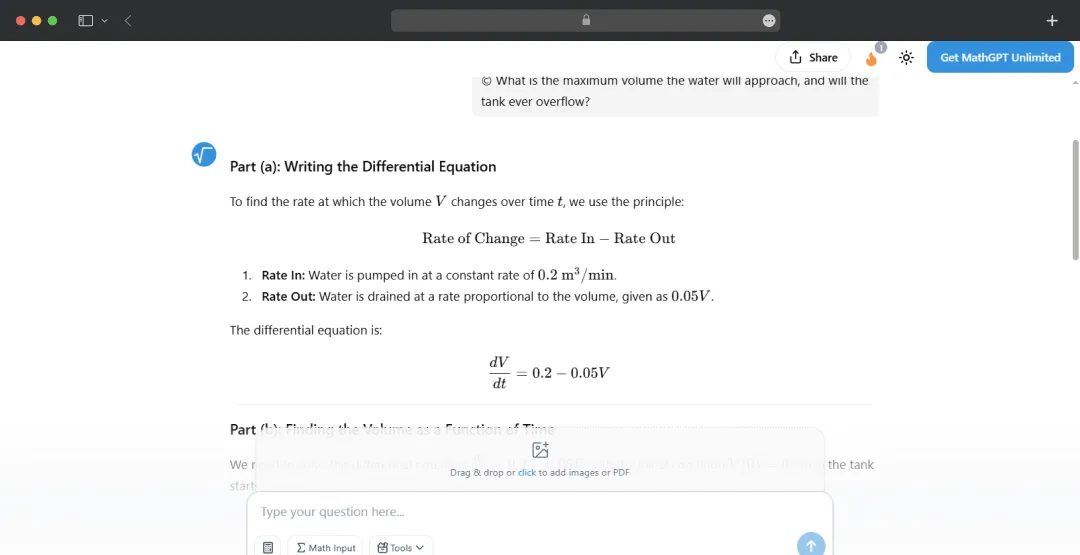
For this testing, I will be writing the problem directly to the MathGPT AI homework assistant. (a) Write the differential equation describing how the volume of water changes over time. (b) If the tank starts empty, find the volume of water as a function of time. (c) What is the maximum volume the water will approach, and will the tank ever overflow?

Question: A cylindrical water tank has a radius of 1.5 meters and a height of 4 meters. Water is being pumped in at a constant rate of 0.2 cubic meters per minute, while a drain at the bottom removes water at a rate proportional to the current volume, equal to 0.05 × V cubic meters per minute (where V is the volume in cubic meters). (a) Write the differential equation describing how the volume of water changes over time. (b) If the tank starts empty, find the volume of water as a function of time. (c) What is the maximum volume the water will approach, and will the tank ever overflow?


4. Read the step-by-step solution

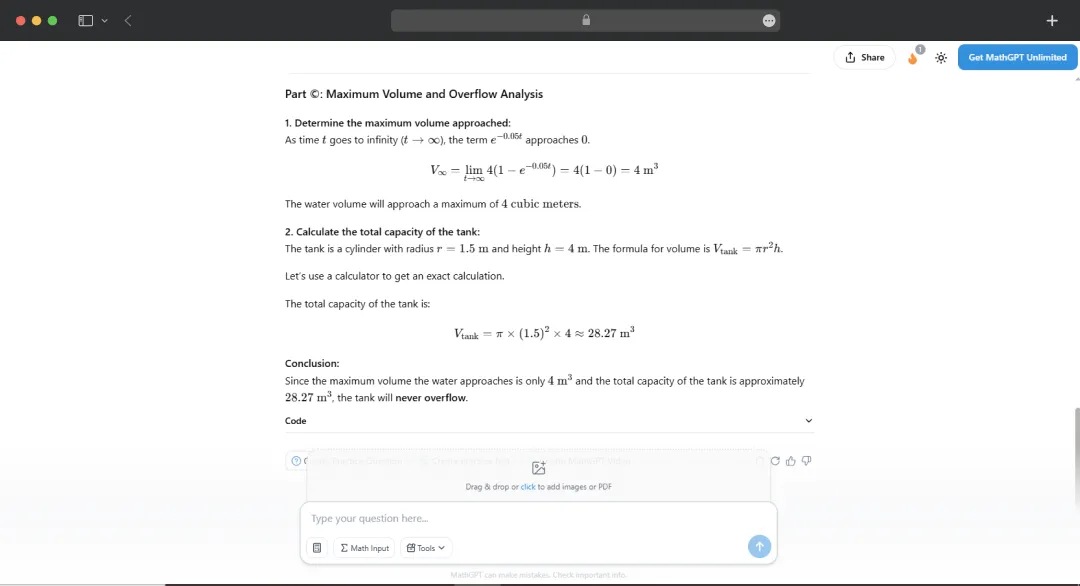
Read the step-by-step solution

This is the core output, the problem broken into discrete steps with the reasoning attached, not just a final number. Read it through once before doing anything else. If a particular step doesn't click, that's your cue for the next move.

Read the step-by-step solution

5. Generate a video explanation

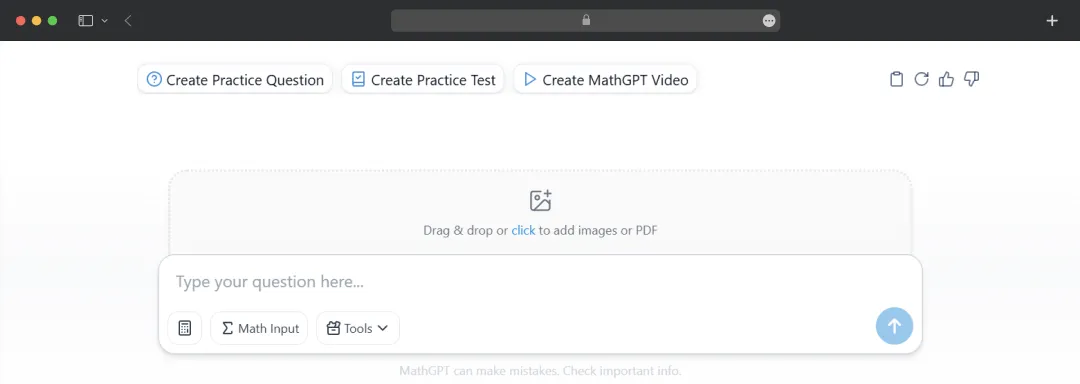
Generate a video explanation

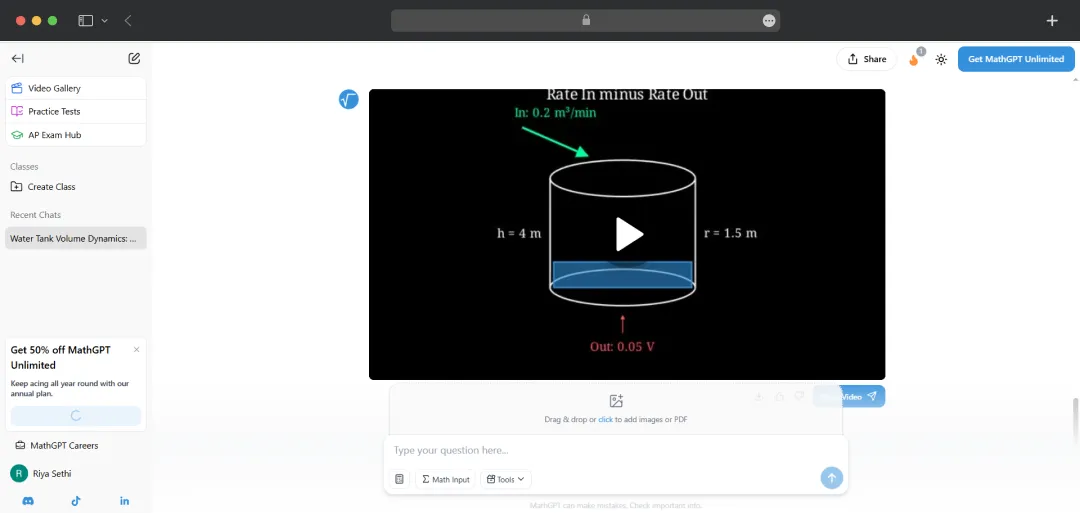
When the written steps don't land, have MathGPT build a short narrated video walking through your exact problem. Simply, click on the ‘Create MathGPT video’.

Generate a video explanation

This is the feature I'd point any stuck student toward first. It's far more useful than hunting for a generic tutorial online, because it's built around the specific question you asked rather than a lookalike.

6. Ask follow-ups

Don't treat the first answer as the end. Push back on a step you don't follow, or ask it to re-explain a concept from a different angle. The conversation stays in context, so each follow-up builds on the last instead of starting cold.

One habit worth building: attempt the problem yourself first, then use MathGPT AI for solving math problems. The tool will help to find your first wrong step rather than to hand you the answer cold.

MathGPT vs. Its Alternatives

MathGPT solver isn't the only name in this space, and it's worth knowing where it sits against its alternatives. The two most common comparisons are Photomath and Gauth AI.

I've used all three. They're built on different philosophies, and the right pick depends entirely on what you actually need from a math tool.

Here's how the best math apps line up against MathGPT

Basis MathGPT Photomath Gauth AI
Free Tier Limited solves, with access to video explanations and flashcards. Unlimited basic step-by-step solutions with no account required. Approximately 11 questions per day, ad-free Wikipedia access, and step-by-step solutions; follow-up questions require a paid plan.
Paid Pricing $14.99/month or approximately $7.49/month when billed annually (50% discount). Photomath Plus costs $9.99/month or $69.99/year. Gauth Plus costs $11.99/month or $99.99/year. A Tutor plan at $19.99/month adds live human tutoring.
Input Methods Photo capture, typed text, and PDF uploads. Camera scan with strong OCR, typed input, and handwriting recognition. Photo scanning, typed input, and handwriting recognition.
Step-by-Step Solutions Yes, with concept explanations attached to solutions. Yes, free for basic explanations; Plus adds animated tutorials. Yes, with detailed reasoning and conversational follow-up support on paid plans.
AI Video Explanations Yes, AI-generated narrated and animated videos for individual problems. Animated tutorials available through Plus, but not AI-generated per question. No AI-generated videos; only animated walkthroughs are available.
Subjects Beyond Math Physics, chemistry, accounting, and statistics. Math only. Physics, chemistry, biology, coding, writing, economics, SAT preparation, and more than 30 additional subjects.
Practice Tools Custom quizzes and flashcards. Limited practice features and no quiz generation. Access to a searchable library of 100M+ solved questions and AI Tutor mode, but no quiz or flashcard creator.
Platforms Web, iOS, and Android. iOS and Android with a mobile-first experience. Web, iOS, and Android.
Owned By / Backing Independent company founded by two Cornell graduates. Owned by Google following its acquisition in 2023. Backed by ByteDance, the parent company of TikTok.

MobileAppDaily’s Final Verdict on MathGPT

I went into MathGPT expecting one of the other AI math solver tools that would hand me answers quickly. Instead, I found a tool that genuinely tries to bridge the gap between solving a problem and understanding it.

The AI-generated video explanations, contextual follow-up conversations, and practice-focused features make it feel much closer to a tutor than a calculator.

What impressed me most was how consistently it turned difficult problems into teachable moments. In fact, after spending time with the platform, I was impressed enough to ask my team to dig deeper, test it across different subjects, and compare it against established names.

MathGPT reviews from the entire team were largely the same: while it's not immune to occasional AI mistakes, it's one of the few tools in this category that actively encourages learning instead of answer-copying.

If you're looking for perfect mathematical accuracy without any need for verification, no AI tool is there yet.

But if you want a study companion that explains concepts, generates personalized video walkthroughs, creates practice material, and keeps the learning process engaging, MathGPT is one of the strongest options available today. For students, exam aspirants, self-learners, and even educators, it's easy to recommend.

MathGPT
Frequently Asked Questions

FAQ
  • Is MathGPT free to use?

    Yes, Math GPT is the best free math AI which offers a limited number of solves, step-by-step solutions, AI video explanations, and flashcards without any additional charges. Users who need unlimited access can upgrade to a paid subscription.

  • Can AI solve math problems accurately?

    Yes, modern AI tools can solve math problems across subjects like algebra, calculus, geometry, and statistics. However, it's always a good idea to verify complex solutions, as AI can occasionally make mistakes.

  • Is MathGPT the best AI tool for solving math problems?

    MathGPT is among the best AI tools for solving math problems, especially for students who want explanations rather than just answers. Its AI-generated video walkthroughs help it stand out from many competitors.

  • What makes MathGPT different from other AI math solver apps?

    Unlike many AI math solver platforms that focus on delivering answers, MathGPT emphasizes learning through step-by-step explanations, personalized video lessons, quizzes, and flashcards. This makes it more useful as a study companion than a simple calculator.

Delve into our comprehensive yet easy-to-consume guides, which provide insights that help scale business faster and prevent unseen pitfalls.

Related Products

Cut through the clutter and explore related digital products that deliver on performance.

MathGPT Review 2026: Features, Pricing, Pros & Cons