
Emergent AI Review: The AI Tool Everyone’s Suddenly Talking About?

When AI tools promise to automate workflows, think independently, and handle complex tasks with minimal input, skepticism is fair. That’s exactly where Emergent AI enters the conversation. Positioned as an AI platform built to help users create, manage, and scale intelligent agents, it promises smarter automation without the usual complexity that comes with advanced AI systems.
But does it actually deliver on those claims, or is it another platform that sounds more impressive than it feels in practice?
In this Emergent AI review, we’ll break down its features, pricing, usability, pros and cons, and real-world value to help you decide whether it’s worth your time. Whether you're exploring AI agents for productivity, automation, development, or business workflows, this guide will give you a clearer picture of what Emergent AI does well, where it falls short, and who it’s best suited for.
Pros and Cons of Emergent AI
Pros
- Transforms prompts into fully functional, production-ready applications in a matter of minutes
- Goes beyond basic UI mockups by autonomously building the frontend, backend, databases, and deployment pipelines
- You have full access to edit, export, and host the generated codebase anywhere you choose
- Employs multiple specialized AI agents (Planning, Coding, Testing) that act as an engineering team
- Democratizes product development by allowing non-technical founders and PMs to execute vibe coding using only natural language
Cons
- The credit-based billing system lacks transparency; AI agents getting stuck in logic loops can rapidly drain your balance
- The platform prioritizes functional logic over aesthetics, often producing generic, templated UI designs that require a human developer to polish
Understanding Key Features of Emergent AI
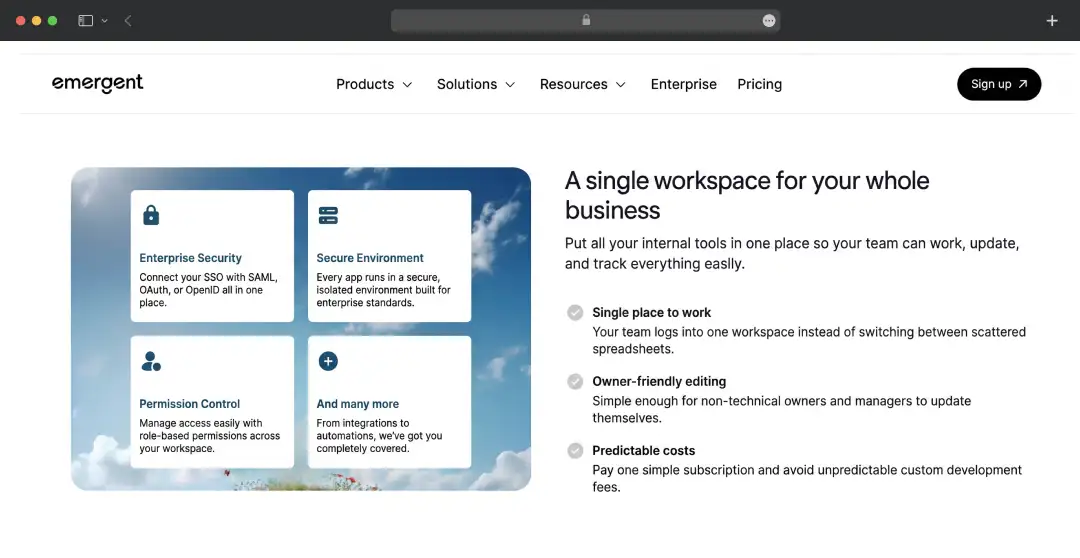
The Emergent AI software stands out in the no-code space by functioning as a true vibe coding platform that transforms natural language into robust, production-ready applications.
It abstracts complex engineering tasks into conversational prompts, enabling you to build scalable software without writing a single line of code.
1. Natural Language to Full-Stack Generation
Unlike standard drag-and-drop website builders that only generate frontend mockups, Emergent AI builds the complete application stack from simple prompts.
It autonomously sets up a React/Next.js frontend, a Python FastAPI backend, and configures flexible MongoDB databases to handle complex logic.
This ensures that the generated output is a fully functional web or mobile application, complete with user authentication and custom business logic, rather than just a visual prototype.
2. Multi-Agent Orchestration System
The platform does not rely on a single, overwhelmed large language model; instead, it utilizes a coordinated team of specialized AI agents.
Your prompt is routed through dedicated Planner, Designer, Developer, Integrator, and Product Manager agents that work in parallel to execute specific tasks.
This architecture mirrors a real-world software engineering team, allowing for higher quality code generation, better structured databases, and an organized progression from initial idea to final deployment.
3. Autonomous Self-Debugging Loop
Emergent AI tools for automation come with a native ability to identify, analyze, and fix their own coding errors. When an issue occurs during the build process, the system doesn't simply crash and wait for the user to troubleshoot the code manually.
The AI agents autonomously read the error logs, determine the root cause of the failure, and apply the necessary patches in real-time, keeping the development process moving forward with minimal human intervention.
4. Full Code Ownership and GitHub Integration
Emergent AI completely eliminates vendor lock-in by treating the generated application as standard, exportable software backed by a real Git repository. It provides bi-directional GitHub syncing, meaning every action the AI takes is recorded as a clean commit with a meaningful description.
You can easily export their entire codebase, make manual edits locally, and host their application anywhere, giving them absolute ownership over their intellectual property.
5. Custom Embedded AI Agents
If you are looking to build advanced software, Emergent allows the embedding of custom, context-aware AI agents directly into the generated applications. These are not basic customer service chatbots, but highly capable sub-agents that can query the app's internal database, trigger backend API endpoints, and execute multi-step automated workflows.
So, Emergent AI’s advanced capabilities even allow non-technical builders to easily launch sophisticated SaaS products, internal tools, and AI-native platforms that can operate autonomously based on user input or schedules.
Bonus Read: Best Vibe Coding Tools
Emergent AI Pricing and Subscription Plans
While the platform offers a free entry point for experimentation, deploying and maintaining live, full-stack applications will require a paid tier to sustain your credit usage. Understanding the emergent AI benefits tied to scalability, automation, and faster app deployment can also help users decide whether upgrading makes sense for their needs.
Here is the current breakdown of Emergent AI's pricing:
| Plan Tier | Price (USD) | Credit Allocation | Key Features Included |
|---|---|---|---|
| Free Plan | $0 / month | 10 credits / month | Access to core platform features, basic web and mobile app generation, and access to standard AI models. Best for platform testing. |
| Standard Plan | $20 / month | 100 credits / month | Everything in Free, plus private project hosting, GitHub integration, task forking, and the ability to purchase extra top-up credits. |
| Pro Plan | $200 / month | 750 credits / month | 1M token context window, custom AI agent creation, system prompt editing, high-performance computing, and priority support. |
Emergent AI Use Cases
Emergent AI isn't just for spinning up basic landing pages; its architecture is specifically designed to handle complex logic, multi-tenant databases, and operational workflows. Whether you're a startup founder looking to validate a product or an enterprise team streamlining operations, the platform caters to several high-value use cases:
| Target Audience | Primary Use Case | Description |
|---|---|---|
| Product Managers & Founders | Rapid Prototyping & MVPs | Turn requirements into functional, production-ready apps in hours to validate market ideas immediately. |
| SMB Owners | Internal Tools & Dashboards | Build custom CRMs, employee directories, and inventory dashboards connected to your databases without a dev team. |
| IT Agencies | Accelerated Client Delivery | Generate full-stack applications rapidly, allowing agencies to deliver high-quality web and mobile apps to clients faster. |
| Operations Teams | Workflow & Automation Systems | Automate daily operations by defining complex, multi-step conditional logic conversationally—no Zapier required. |
| SaaS Builders | Multi-Tenant SaaS Platforms | Autonomously build scalable SaaS products complete with user tiers, role-based access controls, and Stripe billing hooks. |
| Innovators & Tech Teams | AI-Native Embedded Apps | Create applications with sophisticated, native AI agents that can actively query databases and execute scheduled background tasks. |
Also Read: Best AI Coding Agents for Coding
Customer Reviews
How was your experience with the product?