Share It On:
 Entrepreneurs and small businesses are building functional software in days, not months, using AI-powered natural language programming.
A quarter of Y Combinator's latest startup batch just did something unprecedented—they built 95% of their codebase without actually writing code. They simply described what they wanted in plain English, and artificial intelligence handled the rest.
This isn't science fiction or some far-off promise about the future of programming. It's happening right now, and it's called vibe coding. While traditional developers are debating semicolons or no, a new breed of creators is shipping products by having conversations with AI.
But the thing that makes Vibe Coding truly revolutionary is that vibe coding isn't just making development faster. It's fundamentally changing who gets to participate in the digital economy. Let's cut through the hype and get to what vibe coding actually means and how it is already changing the way we approach software development.
What Exactly is Vibe Coding Programming?
When Andrej Karpathy coined the term in early 2026, he was describing something we'd all been feeling but couldn't quite name. This is the new way of building software, where you describe what you want in plain English, and artificial intelligence handles the heavy lifting.
The Core Concept That's Changing Everything
Here's the deal: vibe coding flips traditional programming on its head. Instead of memorizing syntax and debugging semicolons, you're having a conversation with an AI that understands both human intent and code structure. You say "I need a dashboard that tracks inventory and sends alerts when stock runs low," and the AI builds it. Not a template, not a half-baked solution—actual, working software.
What makes this different from previous attempts at "no-code" solutions is the sophistication of the underlying technology. These generative AI systems have been trained on millions of repositories, documentation, and real-world applications. They understand context, maintain state across conversations, and can reason about architectural decisions.
Why This Matters Right Now
The timing isn't coincidental. We're at a perfect storm of AI advancement, developer shortage, and increasing demand for custom software. Vibe coding isn't just convenient—it's becoming necessary for businesses to stay competitive.
Think about it: every business needs custom software, but not every business can afford a development team. Vibe coding bridges that gap, and honestly, it's about time.
How Does Vibe Coding Work in Practice?
Understanding how vibe coding actually works helps separate the reality from the hype. It's not magic—it's a structured process that anyone can learn.
1. The Development Workflow
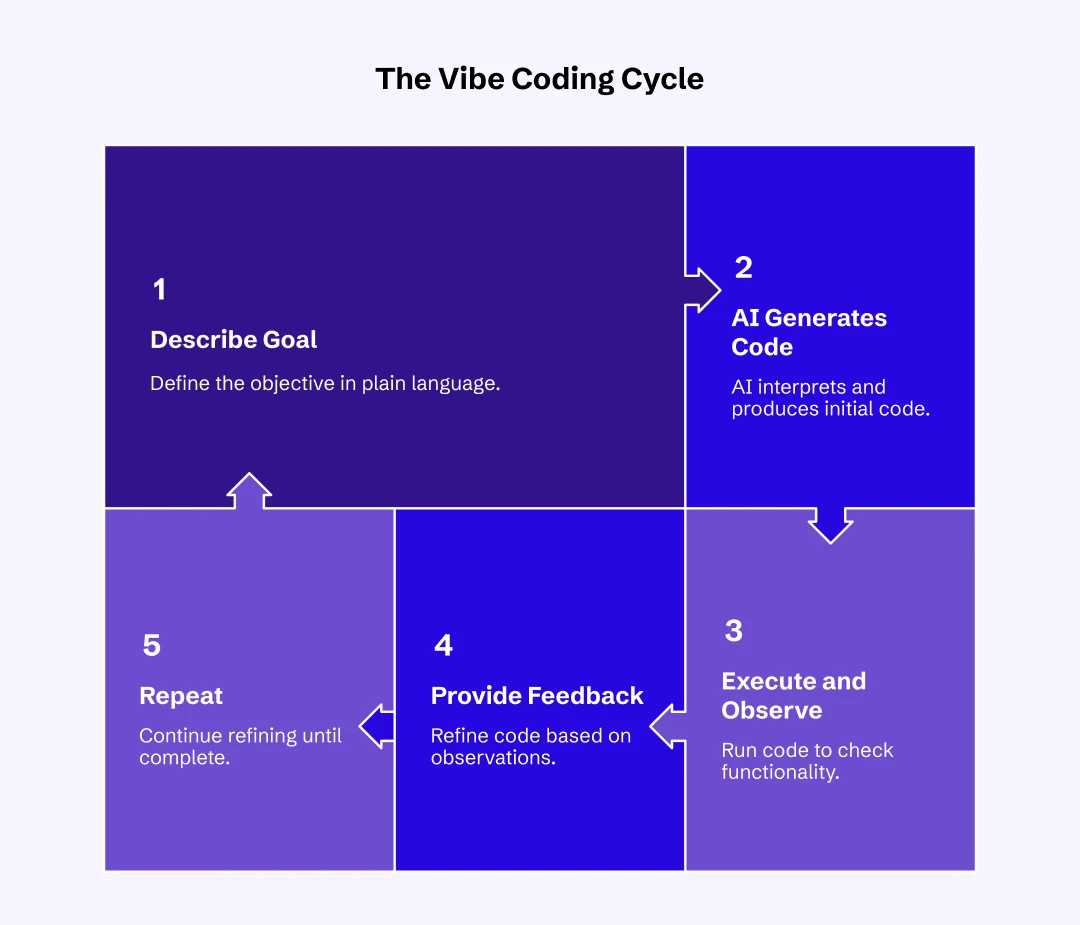
The process starts simple. You begin with a natural language prompt, something like: "Build me a client portal where customers can view invoices, make payments, and download reports." The AI processes this request and generates initial code—often surprisingly complete.
But here's where it gets interesting. This isn't a one-and-done transaction. The AI creates a working version: you test it, and then you refine. Maybe you realize you need email notifications, or the color scheme doesn't match your brand. You tell the AI, it adjusts, and the cycle continues. Each iteration gets you closer to exactly what you need.
What is fascinating is how this mirrors actual development conversations. It's like having a junior developer who works at superhuman speed and never gets tired. The difference? This "junior developer" has seen millions of code examples and can implement solutions instantly.
2. Integration with Real Development Teams
Professional developers aren't sitting on the sidelines here. They're using vibe coding to eliminate the boring parts of their job. Many senior developers spend less time on boilerplate code and can focus on architecture and complex problem-solving.
The smart teams are creating hybrid workflows. They use AI tools for developers to generate initial implementations, then apply their expertise to optimize, secure, and scale the code. It's not about replacement—it's about amplification.
Vibe Coding vs Traditional Coding: The Real Differences
Let's be honest about what changes and what doesn't when you shift from traditional coding to vibe coding.
1. Speed and Learning Curves
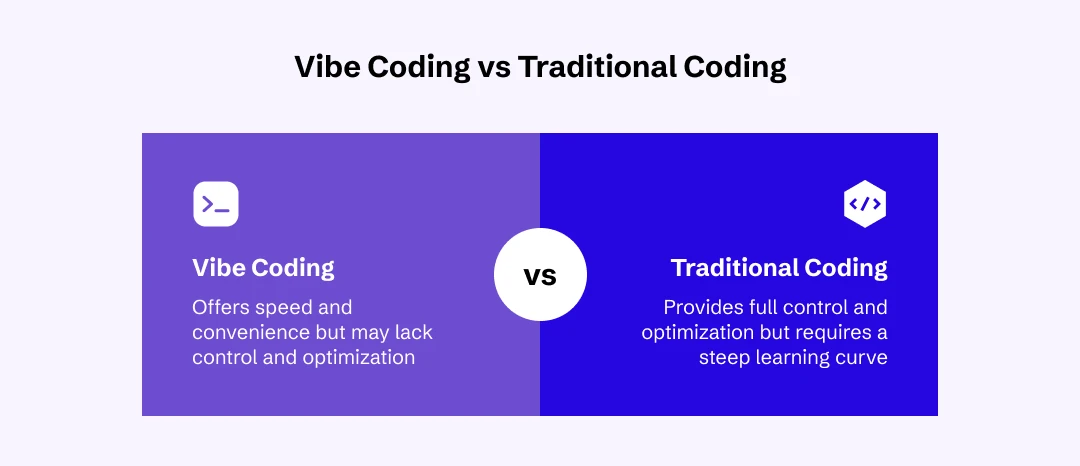
Traditional programming has a brutal learning curve. We're talking months to become productive, years to become proficient. Where developers used to spend weeks just trying to understand object-oriented programming. With vibe coding, that timeline collapses dramatically.
But (and this is important) speed comes with trade-offs. The code might not be optimized for your specific use case. It might use more resources than necessary. For many business applications, these trade-offs are completely acceptable. For others, you'll need traditional expertise.
2. Control vs Convenience
Traditional coding gives you complete control. Every function, every variable, every architectural decision is yours. When performance matters, when you're handling sensitive data, or when you're building something truly novel, this control is irreplaceable.
Vibe coding trades some control for convenience. The AI makes decisions about implementation details, and while they're usually good decisions, they might not align with your specific needs or standards. It's like the difference between cooking from scratch and using a meal kit—both get you fed, but one gives you more control over the ingredients.
Real-World Vibe Coding Use Cases That Actually Matter
Let's look at what's actually happening with vibe coding in the real world—backed by data and real examples.
1. YC Combinator Startups Leading the Charge
The most striking evidence of vibe coding's impact comes from Y Combinator's Winter 2026 batch. According to YC managing partner Jared Friedman, 25% of startups in their current cohort have codebases that are 95% AI-generated. These aren't non-technical founders—every one of them is highly technical, fully capable of building from scratch. They're choosing AI because it's faster.
YC CEO Garry Tan reports these companies are growing 10% week-on-week, something that's "never happened before in early-stage venture." The ability to build with fewer people means they don't need to raise as much capital, and they can reach profitability faster.
2. Real People Building Real Applications
Beyond the YC ecosystem, individual creators are proving vibe coding's potential. Joe Frabotta built Lambo Levels, a crypto visualization tool, using ChatGPT to refine prompts and Lovable to build the interface. No coding background, just clear ideas and the right AI tools.
Gaming startups are using vibe coding to develop prototypes in days instead of months. Companies are creating functional games with minimal manual coding, using free-tier ChatGPT to generate basic game mechanics and test ideas instantly.
3. Business Automation and Internal Tools
Companies across industries are leveraging vibe coding for practical applications. Menlo Park Lab, a generative AI startup, uses vibe coding to develop products like Brainy Docs, which transforms PDFs into explainer videos. They're not just prototyping—they're shipping production features.
Vibe Coding Limitations: What Nobody Talks About
Now for the reality check. Vibe coding has limitations, and ignoring them is a recipe for disaster.
1. When AI Gets It Wrong
AI hallucinations are real. Sometimes the generated code looks perfect but contains subtle bugs that only surface under specific conditions. AI confidently generates database queries that would work 99% of the time but fail catastrophically on edge cases.
Security is another concern, which is why many teams work with artificial intelligence development companies
to review and secure AI-generated code. AI tools might generate code with hardcoded passwords, SQL injection vulnerabilities, or overly permissive access controls. If you're not reviewing the output carefully, you're essentially running untrusted code in production. Not ideal.
2. The Complexity Ceiling
Current AI tools excel at CRUD applications, basic workflows, and standard integrations. Ask them to build a distributed system with complex state management? You're going to have a bad time. They can help with pieces, but you need human expertise for the architecture.
There's also the maintenance question. Six months later, when something breaks, can you fix it if you don't understand the code?
3. The Human Element Still Matters
Here's something the hype articles won't tell you: vibe coding doesn't eliminate the need for problem-solving skills. You still need to understand your business problem, break it down logically, and communicate it clearly. The AI handles implementation, but vision and strategy remain distinctly human responsibilities.
Essential Vibe Coding Tools You Should Know About
Vibe Coding tools are evolving fast. Here are some of the top names that are leading the charge right now.
1. For Professional Developers
GitHub Copilot remains the gold standard for developers who want AI assistance without changing their workflow. It integrates into your IDE, suggests code as you type, and learns from your patterns. It's like autocomplete that actually understands what you're trying to build.
Cursor takes things further. It's built from the ground up for AI-first development. You can describe changes in natural language, and it'll refactor entire codebases. Developers using Cursor report 2-3x productivity gains on routine tasks.
2. For Entrepreneurs and Non-Coders
Replit Agent is probably the most accessible entry point. You literally describe your app idea, and it builds everything—database, backend, frontend, the works. Plus, it handles deployment, so you go from idea to live app without leaving your browser.
Bolt.new and Vercel's V0 are even simpler. They're perfect for building landing pages, simple tools, and prototypes. No code view necessary—just chat your way to a working application.
3. Enterprise Solutions
Google's Vertex AI and Amazon's CodeWhisperer offer enterprise-grade features like compliance checking, security scanning, and integration with existing cloud infrastructure. They're pricier but come with the governance features large organizations need.
Getting Started with Vibe Coding (A Practical Approach)
Ready to jump in? Here's how to start without overwhelming yourself.
1. Start Small and Specific
Don't try to rebuild your entire business system on day one. Pick something small and annoying—maybe a calculator for quotes, a form that emails you responses, or a simple dashboard for tracking metrics. Get comfortable with the process before tackling bigger projects.
2. Learn the Art of Prompting
Good prompts make all the difference. Instead of "make me a website," try "create a landing page with a navigation bar, hero section with our value proposition, three feature cards with icons, customer testimonials carousel, and a contact form that sends emails to support@mycompany.com."
The more specific you are, the better the output you can expect.
Note: Also include details about functionality, design preferences, and technical requirements.
3. Establish Safety Nets
Always use version control, even if you don't fully understand it. Most vibe coding platforms have built-in versioning. Test everything thoroughly before showing it to customers. Have someone technically review the code if you're handling sensitive data.
4. Know When to Call in the Pros
Vibe coding is powerful, but it's not suitable for everything. If you're handling payments, personal data, or building something mission-critical, get professional help, often by partnering with ai development companies in the USA for production-ready systems. Use vibe coding for prototypes and internal tools, then bring in experts when you need to scale or secure things properly.
The Business Impact You Can Expect
It's time for some real numbers and real outcomes. Because that's what matters to your bottom line.
1. Cost and Time Savings
Software development companies using vibe coding report significant reduction in development time for simple applications. A project that would take three months traditionally might take three weeks with AI assistance. For small businesses, this translates to tens of thousands in savings.
But remember—these savings apply mainly to straightforward applications. Complex systems still require traditional development time and expertise.
2. Competitive Advantages
The real advantage isn't just cost savings—it's agility. When you can prototype and test ideas in days instead of months, you can experiment more. You can respond to customer feedback faster. You can outmaneuver competitors stuck in long development cycles.
How Much Does Vibe Coding Actually Cost?
While traditional development can drain your budget fast, vibe coding offers a dramatically different cost structure. Here's what you're actually looking at:
| Project Type | Traditional Development | Vibe Coding Cost | Time to Build |
|---|---|---|---|
| Landing Page | $3,000 - $15,000 | $0 - $50/month | 2-4 hours |
| MVP Web App | $25,000 - $100,000 | $20 - $200/month | 1-2 weeks |
| Internal Business Tool | $10,000 - $50,000 | $30 - $150/month | 3-5 days |
| E-commerce Site | $15,000 - $75,000 | $50 - $300/month | 1-2 weeks |
| Mobile App Prototype | $30,000 - $150,000 | $50 - $500/month | 2-3 weeks |
| SaaS Platform (Basic) | $50,000 - $250,000 | $100 - $1,000/month | 3-4 weeks |
Additional Costs to Consider:
- Hosting and deployment: $5-100/month depending on traffic
- Code review by professionals: $500-5,000 for security audit
- Ongoing maintenance: 10-20% of initial development cost annually
Latest Trends in Vibe Coding: What's Hot Right Now
The vibe coding landscape evolves weekly, but certain trends are defining where the technology is headed.
1. Multi-Agent Workflows
The biggest shift happening right now? Multiple AI agents working together. Instead of one AI handling everything, specialized agents tackle different aspects—one for frontend, another for database design, another for testing. Tools like Microsoft's AutoGen are pioneering this approach, creating AI teams that collaborate like human developers.
2. Voice-to-Code Development
Forget typing prompts—developers are now literally talking their apps into existence. New tools are emerging that let you describe features verbally while sharing your screen, and the AI builds in real-time. It's particularly powerful for mobile development where you can describe gestures and interactions naturally.
3. AI Code Ownership and Legal Frameworks
Companies are establishing new policies around AI-generated code ownership. Major firms are creating "AI attribution" standards where AI contributions are tracked like human commits. Legal teams are scrambling to figure out IP rights when neither human nor company technically "wrote" the code.
Industry-Specific AI Models
Generic coding assistants are giving way to specialized models. We're seeing AI tools trained specifically for fintech compliance, healthcare HIPAA requirements, or e-commerce platforms. These specialized models understand industry jargon and regulatory requirements, making them far more effective than general-purpose tools.
Conclusion
The key for vibe coding is to approach it strategically. Use it where it makes sense—prototypes, internal tools, simple applications. Understand its limitations and plan accordingly. Most importantly, remember that AI is a tool, not a magic solution. Success still requires clear thinking, good judgment, and understanding your users' needs.
Start small, experiment freely, and don't be afraid to fail. The cost of trying has never been lower, and the potential upside has never been higher.
Frequently Asked Questions
Can vibe coding really replace traditional developers?
No, vibe coding complements rather than replaces developers. While AI handles routine tasks and simple applications effectively, complex systems still require human expertise for architecture, security, and optimization. Professional developers are using vibe coding to enhance productivity, not become obsolete.
What's the actual cost of building an app with vibe coding?
Most AI coding tools range from free tiers to $20-100 monthly subscriptions. Building a simple app might cost $50-500 in tool subscriptions versus $10,000-100,000 for traditional development. However, complex applications still require professional oversight, which adds to costs.
Is AI-generated code secure enough for business applications?
AI-generated code often contains security vulnerabilities if not properly reviewed. For business-critical applications handling sensitive data, professional security audits remain essential. Many companies use hybrid approaches—AI for initial development, human experts for security hardening and compliance.
How long does it take to learn vibe coding effectively?
Unlike traditional programming, which takes months or years, basic vibe coding proficiency can develop within weeks. The learning curve focuses on crafting effective prompts and understanding AI limitations rather than memorizing syntax. Most people become productive within 2-4 weeks of regular practice.
Which industries benefit most from vibe coding currently?
Marketing agencies, startups, small businesses, and educational platforms see immediate benefits. These sectors often need rapid prototyping, simple tools, and customizable solutions. Industries requiring high security or complex systems—like healthcare and finance—typically use vibe coding for non-critical applications only.

Uncover executable insights, extensive research, and expert opinions in one place.
Related Content