Share It On:
 Behind every digital chart and AI-driven diagnosis lies the discipline of healthcare software development. This overview highlights the forces shaping the industry. For deeper insight into strategy, compliance, and architecture, continue reading the
 Modern medicine now runs on code. In operating rooms, in billing departments, in remote consultations happening hundreds of miles away, healthcare software development quietly powers the decisions that shape patient outcomes.
In 2026, when a system fails, it isn’t just data that disappears — care stalls, workflows fracture, and trust erodes. With the global digital health market reaching $177.77 billion, the industry has crossed a threshold. This is no longer digitization. It is infrastructure.
But beneath the growth numbers lies a more demanding reality. Interoperability mandates, AI governance, cybersecurity threats, and relentless cost pressure define the terrain. This is a world where software must endure clinical stress, regulatory scrutiny, and life-or-death stakes.
This guide steps inside that world — exploring the strategy, compliance architecture, and engineering discipline required to build healthcare systems that don’t just launch, but survive.
The "War Room": Who You Need Before You Write a Line of Code
Most healthcare projects don't die because the tech stack was weak. They die because the team didn't have the right DNA. You cannot outsource clinical intuition. Before you even think about wireframing, you need to assemble a "War Room." If these seats are empty, you’re just building expensive shelfware.
- The Clinical Liaison (or CMIO): Get a practicing clinician or a Chief Medical Information Officer. You need a designated "bullshit detector." They are the ones who will look at your slick new feature and tell you exactly why a nurse at 3 AM will hate it—and you—for inventing it.
- The Compliance Architect: This isn't a lawyer. This is a technical architect who bleeds HIPAA, GDPR, and IEC 62304. Their job is to design your data governance upfront so you don’t have to tear down your entire backend when the first audit hits.
- The Interoperability Specialist: Your software is useless if it’s an island. You need a translator fluent in FHIR, HL7, and DICOM. Their sole purpose is ensuring your shiny new tool can talk to the clunky, twenty-year-old EHRs that hospitals refuse to replace.
- The Clinical UX Designer: Standard UI maximizes engagement. Clinical UX minimizes cognitive load. The goal isn't "delight"; it’s safety. They know that a red button implies "emergency," not "cancel," and that difference saves lives.
|
Your Healthcare Software Is Only As Strong As Its Security Connect with cybersecurity pros we featured for some guidance. |
The Stakeholder Matrix: Decoding the Hate
Once the team is set, map the battlefield. In healthcare, the person using the software (the doctor) is almost never the person paying for it (the admin), and neither of them sets the rules (the regulator). It’s a mess.
Here is the breakdown of who you are actually building for, and exactly why they will try to kill your project if you get it wrong:
| Stakeholder | The Core Motivation ("The Why") | The Friction Point (Why They Hate New Tech) | Your Non-Negotiable Deliverable |
|---|---|---|---|
| Clinicians (Doctors/Nurses) | Speed & Safety. They just want to finish rounds without killing anyone. | Alert Fatigue. If your app beeps too much or demands 5 clicks for a 1-click task, they will find a workaround — or just boycott you. | Seamless Workflow Integration. If it’s not faster than a sticky note, it fails. |
| Hospital Administrators (The Buyers) | ROI & Efficiency. They care about billable hours, bed turnover, and keeping the lights on. | Integration Nightmares. They dread "rip and replace." If it doesn't plug into their existing Epic/Cerner systems, it’s a non-starter. | Interoperability & Data Reporting. Show them the money (or the savings) on a single dashboard. |
| Patients | Access & Trust. They want results now, and they want to know you aren't selling their secrets. | Confusing Interfaces. If it feels harder than Amazon, they won't use it. If it feels "leaky," they won't trust it. | User-Centric Design & Transparency. Make it simple. Make it secure. Period. |
| Regulators (FDA, ONC, HHS) | Safety & Privacy. Their only job is to prevent harm and stop breaches. | Ambiguity. They hate "black box" algorithms and "we'll fix it in post." | Audit Trails & Compliance. Every action logged. Every click is traceable. No exceptions. |
| Insurers (Payers) | Risk Reduction. They want proof that the treatment was actually necessary. | Data Opacity. They hate vague claims. They need structured data to process payouts. | Structured Data Output. Feed them the codes (ICD-10, CPT) automatically or get denied. |
Brainstorming and Research Phase (Strategic Foundation)
Now that you have the right folks collected, you can kickstart picking their brains. Most projects die here because founders fall in love with a solution before verifying the problem. In healthcare, "move fast and break things" is a lawsuit waiting to happen. You need to be surgical.
- Start with clinical research validation. Does your software actually improve an outcome, or does it just look cool?
- If you are building a diagnostic tool, you need to assess the market gap—not just what is missing, but why it is missing.
- Often, the technology exists, but the reimbursement code doesn't. That is a business model failure, not a technical one.
- Conduct stakeholder interviews that go beyond polite feedback. You want to know what makes a nurse curse at their screen at 3 AM.
- Perform a feasibility analysis that includes a safety classification check.
- If you are signing up for custom healthcare software development solutions that act as a medical device (SaMD), you are entering a regulated minefield.
The Strategic Checklist:
- Discovery: Define the exact clinical workflow you are disrupting.
- Compliance Mapping: Identify every regulator that has a say in your code.
- Data Risk Review: Map the flow of PHI before writing a single line.
- Technical Feasibility: Can this actually integrate with a 20-year-old hospital server?
This is the moment to start looking at options to outsource your software development project. The process of choosing software developers is critical because their mistakes become your liabilities.
You need a team that understands that "minimum viable product" in healthcare cannot mean "minimally safe." Early vendor selection influences your architecture, and if they don't understand IEC 62304, walk away.
Types of Healthcare Software
The market is fragmented, and before you plan what you’re building, are you sure you’re up to date with all the types there? Well, to navigate it, you need to understand where your solution fits in the stack, and here, we have listed down the foundational layers of multiple kinds of healthcare software that dominate the current market.
| Category | Description | Examples | Core Challenges |
|---|---|---|---|
| Electronic Health Record (EHR) Systems | Longitudinal patient records and history. | Epic, Cerner, NextGen | Interoperability, fatigue, UI clutter. |
| Clinical Decision Support Systems (CDSS) Software | Diagnostic guidance and alert systems. | IBM Micromedex, UpToDate | Clinical accuracy, alert fatigue. |
| Telemedicine Platforms | Remote consultation infrastructure. | Teladoc, Amwell | Latency, compliance, reimbursement. |
| Remote Patient Monitoring (RPM) Systems | Chronic care tracking via IoT. | Dexcom, Biobeat | Real-time data collection, connectivity. |
| Healthcare Analytics and Data Management Software | Data aggregation for population health. | Tableau, PowerBI (Health) | Unstructured patient data, silos. |
| Pharmacy Management Software | Drug inventory, billing, and dispensing. | McKesson, ScriptPro | Legacy system integration, regulations. |
| Medical Imaging Software | PACS integration and radiology tools. | GE Healthcare, Philips | Image storage scaling, bandwidth. |
| Medical Practice Management Software | Scheduling, billing, and admin. | Kareo, athenahealth | Scalability demands, workflow fit. |
| Personal Health Record (PHR) Software | Patient-controlled data apps. | Apple Health, MyChart | Security, user engagement. |
| Health Information Exchange (HIE) Software | Cross-provider data exchange networks. | Mirth, Orion Health | Interoperability, data standards. |
Beyond these giants, the ecosystem is teeming with mHealth (mobile health) applications and sophisticated healthcare revenue cycle management (RCM) software designed to claw back revenue in an increasingly tight margin environment.
Regulatory Compliance and Data Security (Non-Negotiable Layer)
Compliance is the oxygen of this industry. If you cut corners here, you suffocate. In the 21st century, HIPAA compliance in software development is the absolute baseline, not the gold standard. It is the minimum viable product for staying out of federal court.
If you are building for the modern web, you are likely navigating a minefield of overlapping and occasionally contradictory frameworks.
You aren't just protecting data; you are engineering trust. A single leak doesn't just result in a fine; it results in a "death by migration" as every hospital system rips your software out of their infrastructure.
The Regulatory Matrix: What Rules You Actually Play By
You need to know exactly which handcuffs you are wearing.
| Regulation / Standard | The "TL;DR" for Developers | The Technical Nightmare |
|---|---|---|
| HIPAA (USA) | Privacy & Portability. You must protect PHI (Protected Health Information). | Audit Trails. You cannot just "delete" a record. You need a permanent, immutable log of who deleted it, when, and why. |
| GDPR (Europe) | Data Sovereignty. The user owns the data, not you. | Right to be Forgotten. Unlike HIPAA, GDPR allows users to demand total erasure. This wreaks havoc on relational databases and immutable backups. |
| IEC 62304 (Global) | Medical Device Lifecycle. If your software diagnoses or treats, it is a medical device (SaMD). | SOUP (Software of Unknown Provenance). You are liable for every 3rd party library (npm, pip) you use. You must document and validate them all. |
| FHIR (Interoperability) | The Modern Tongue. The standard for exchanging healthcare data via RESTful APIs and JSON. | Granularity. You can't just dump a PDF. You must map data to specific "Resources" (e.g., Patient, Observation) with strict validation. |
| EU AI Act (2026) | AI Governance. Classifies medical AI as "High Risk." | Explainability. You cannot use a "black box" model. You must log the model's decision path and ensure human oversight is possible. |
The Security Bible: NIST, OWASP, and The Reality of 2026
You do not "invent" security in healthcare. You follow the scriptures.
- NIST 800-115 is your testing manual. It is not enough to say you are secure; you must prove it through the specific penetration testing and vulnerability assessments outlined here.
- OWASP Top 10 is your backlog. In healthcare, "Broken Access Control" isn't a bug; it's a HIPAA violation. In 2026, API Security (OWASP API Top 10) is just as critical, specifically BOLA (Broken Object Level Authorization), where User A can see User B's X-rays by changing an ID in the URL.
- Encryption is binary. There is no "light" encryption. You use AES-256 for data at rest and TLS 1.3 for data in transit. Anything less is negligence.
- Zero Trust Architecture. The castle-and-moat approach is dead. Assume the hacker is already inside the hospital network. Every microservice must authenticate every request, every time.
The Predator in the Room: Ransomware & Supply Chain Attacks
We are currently in a digital arms race. In 2024, the sector faced a brutal wave of ransomware attacks, with reports highlighting a 30% surge in attacks on healthcare vendors and a record-breaking 275 million patient records exposed.
- The Shift: Attackers have stopped targeting the well-defended hospitals directly and have started targeting software vendors. They know your startup has fewer defenses than the Mayo Clinic.
- The Consequence: These aren't just IT nuisances; they shut down emergency rooms and force ambulances to divert.
- The Defense: You need cybersecurity experts involved from day zero, not as a patch-up crew before launch. You need an SBOM (Software Bill of Materials) to track every library you use, because that is where the next attack will come from.
Do not treat compliance as a "check-the-box" exercise at the end of the project. If you try to bolt on HIPAA compliance after you’ve built the architecture, you will have to rewrite 60% of your code. Build it in.
The Healthcare Software Development Process
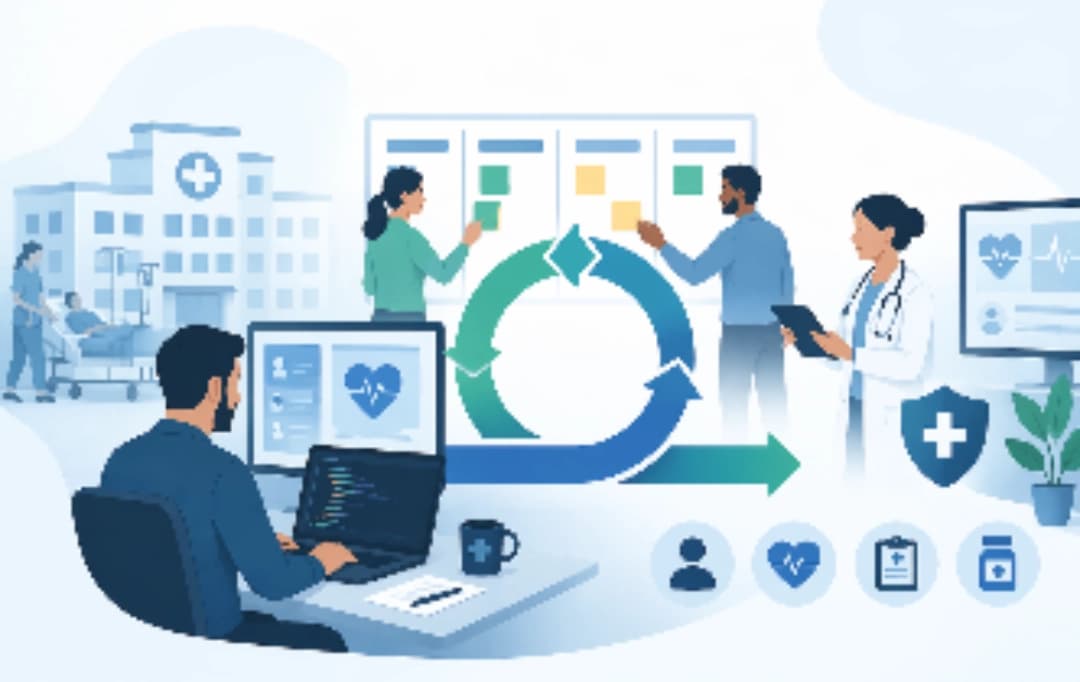
The medical software development process is a rigid adaptation of the standard software development life cycle (SDLC). You cannot simply agile-sprint your way through patient safety protocols.
It starts with requirements analysis that treats clinical constraints as hard boundaries. Architectural design must account for high availability—systems cannot go down during surgery. The UI prototype phase is critical; bad UX in a hospital leads to medical errors.
Testing is exhaustive. You need cloud-based testing environments that simulate the chaotic data loads of a real hospital. Cloud-native approaches and microservices allow for modular updates, but every module needs security by design. Your overall cost of healthcare software testing will rise, but save you from millions of dollars in penalties.
Process Flow & Regulatory Overlay
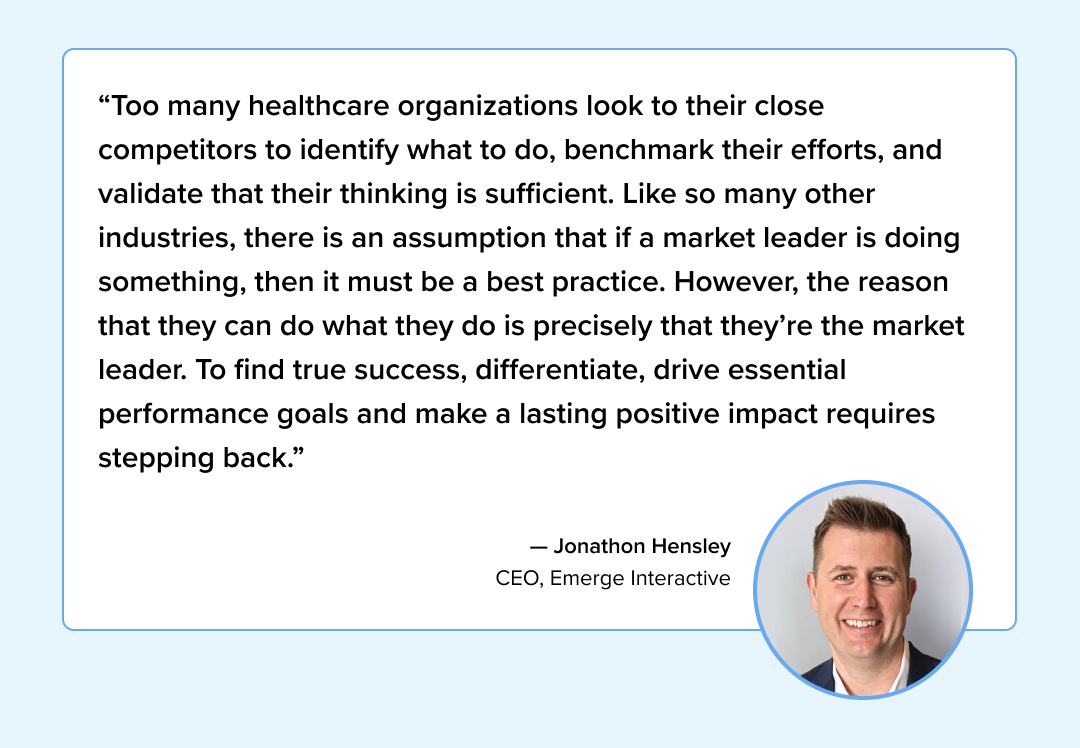
As Jonathan Hensley, CEO of Emerge, said in a conversation with us, folks in the healthcare industry are trying to copy too much and innovate a little. That’s the mistake you have to avoid if you want your software to grow before defining a process.
His exact words were:
| Phase | Key Deliverables | Regulatory Overlay |
|---|---|---|
| Requirements | User Needs, Functional Specs | Traceability Matrix (IEC 62304) |
| Design | Architecture, UI/UX Prototypes | Risk Management (ISO 14971) |
| Development | Code, Unit Tests, Integration | Secure Coding Standards |
| Testing | Validation Reports, Pen Testing | Verification vs. Validation |
| Deployment | Release Notes, Training | Post-Market Surveillance |
The SDLC in healthcare is cyclical and document-heavy. Every line of code potentially needs to be traced back to a requirement and a risk analysis.
Architecture Decisions: Scalability, Reliability, Interoperability
You are likely building on quicksand. Hospitals run on legacy systems that should have been retired a decade ago. Your microservices architecture must be elegant enough to scale but rugged enough to handshake with a mainframe from 2005.
Scalability demands are non-negotiable. Infrastructure reliability and high availability are life-and-death metrics. Data synchronization across distributed cloud environments is the new standard, driven by the massive push for cloud transformation.
 Automation is your ally here. AI in software development is increasingly used to automate code reviews and compliance scanning, ensuring that security keeps pace with deployment speed.
Cost Factors in Healthcare Software Development
Let's talk money. Healthcare software development cost is rarely about the hourly rate of a developer. It's about the "tax" of doing business in a regulated industry.
Project complexity and team location drive the baseline, but the real costs hide in regulatory approvals and certification. A compliance & security framework is expensive to build and maintain. Cloud infrastructure costs spiral quickly when you require redundant backups and high-performance monitoring tools.
You also have to factor in third-party APIs and OTS (Off-the-Shelf) components, which introduce SOUP (Software of Unknown Provenance) issues under IEC 62304.
Pricing Models:
- Subscription-based pricing model: The SaaS standard, offering predictable revenue.
- SaaS vs Enterprise Deployment: Enterprise often demands higher upfront customization fees.
A realistic look at the budget breakdown:
| Cost Component | % Impact Range | Notes |
|---|---|---|
| Development & Engineering | 30-40% | The core build. |
| Compliance & Regulatory | 20-30% | FDA/CE submissions, audits. |
| Testing & QA | 15-25% | Verification is labor-intensive. |
| Maintenance & Updates | 15-20% (Annual) | Security patches, uptime. |
Hidden costs often arise when you underestimate the software development cost associated with integrating into fragmentation—every hospital has a slightly different implementation of the "standard" HL7.
Location Impacts Your Software Development Cost Significantly
You are paying for the legal jurisdiction and the economy where your developers sleep. When you look at the numbers, the difference isn't about quality; it's about overhead. Here is how the math actually works across the three major hubs.
1. USA: The "Sleep at Night" Premium
If you are building with healthcare software development companies in the USA, you are paying for certainty. The price tag for a compliant system hits $150,000 to $500,000+ because you are effectively buying an insurance policy.
The Reality: Rates of $150–$250/hr aren't just for talent; they cover strict malpractice insurance and the comfort of US legal recourse.
AI & Cyber: This is where it hurts. AI specialists here are hoarded by Big Tech, driving costs over $1 Million for serious projects. Security audits alone can run $150k+ because the firm is signing off on your liability. You pay this when you need a throat to choke in your own time zone.
2. India: The Global Engine
India isn't just the "cost-efficient" option anymore; it’s the massive, mature engine room of the tech world. When you hire medical software development companies in India, you are playing a volume game with senior talent.
The Reality: You can get the exact same enterprise-grade system for $40,000 to $120,000. The arbitrage is simple: senior architects cost $30–$60/hr because they don't live in San Francisco.
AI & Cyber: This is the sweet spot for data-heavy projects. You can staff a full team of ML engineers for $80k–$250k—a fraction of the cost of a single US hire. Security isn't a compromise either; Certified Ethical Hackers (CEH) will run the same VAPT protocols for $15k–$45k. It’s the same output, just less overhead.
3. Vietnam: The Efficient Challenger
Vietnam is where India was a decade ago—hungry, highly technical, and devoid of bloat. If you choose healthcare software development companies in Vietnam, you are choosing efficiency over scale.
The Reality: Costs drop to $30,000 – $90,000 without sacrificing code quality. The workforce here is young and mathematically rigorous, with rates hovering between $25–$50/hr.
AI & Cyber: This is the best-kept secret for algorithmic work. Vietnamese engineers excel at the logic-heavy side of AI, offering high-level performance for $50k–$150k. For cybersecurity, you get relentless technical testers for as low as $10k, making it the smartest move for startups that need to harden their product without burning their runway.
Key Healthcare Software Development Benefits
Stop treating software like a digital filing cabinet. It isn’t. It is the nervous system of modern medicine. We have moved past simple digitization into the era of predictive intelligence, where algorithms don't just record history—they alter the future. The shift here is binary: we are moving from a reactive "sick care" model to a proactive, continuous health framework.
Let’s look at the hard data on why this matters.
- Machines Don’t Blink: Humans get tired. Algorithms don’t. A 2025 study in JMIR Formative Research pitted AI against consultant radiologists. The result? AI achieved an accuracy score (AUROC) of 0.93, edging out the human experts, who sat at 0.90. This isn't just efficiency; it is the difference between catching a tumor and missing it.
- Surgery is No Longer a Solo Act: The operating room has changed. AI-assisted guidance systems are directly linked to a 30% reduction in complications. Recovery times have dropped by nearly 20%. This is the difference between a routine discharge and a prolonged, expensive hospital stay.
- Burning Cash on Administration: The U.S. healthcare economy hit $5.3 trillion in 2024. Yet, we still let administrative friction consume roughly 15-30% of that spend. We are effectively incinerating between $800 billion and $1.5 trillion annually on non-clinical paper pushing. Purpose-built software is the only weapon effective enough to reclaim that capital.
- Geography is Dead: Physical proximity is no longer a prerequisite for care. By 2025, the global telemedicine market had already crossed $147 billion, with projections barreling toward $505 billion by 2034. Physician adoption has stabilized at over 80%. If you have a signal, you have access to expert care. Borders are dissolved.
- The Holy Grail (RPM): The goal is to catch a problem before the ambulance is called. Remote Patient Monitoring (RPM) is proving to be the answer, with data showing a 76% reduction in 30-day hospital readmissions for heart failure patients. We are finally monitoring lives, not just visits.
This shift is unlocking the true benefits of AI, allowing AI & ML modules to scan radiology images faster than humans, while beta testing new algorithms in safe, sandboxed environments.
Top Three Healthcare Software Development Trends
The modern trends influencing healthcare software solutions and their development are defined by intelligence and ubiquity. Here are the top three that you should be very concerned about. However, as tech trends evolve, software development trends will evolve in parallel. Don’t forget to keep up.
AI & Machine Learning
This is the year of AI integration. We aren't just using AI & machine learning for billing; we are seeing AI-powered healthtech solutions drive clinical care. AI-driven diagnostics and generative AI are drafting patient notes, while narrow AI handles specific image recognition tasks.
Natural language processing (NLP) via ChatGPT integration has revolutionized the EHR interface, finally allowing doctors to talk to their data.
According to Towards Healthcare, the healthcare AI market size is expected to have exploded to $928.18 billion by 2035. However, integrating AI in healthcare requires a sober look at ethical AI. We are seeing the rise of open-source AI agents and multi-agent systems that negotiate care coordination autonomously.
IoT & Remote Monitoring
The Internet of Medical Things (IoMT) is now standard care. Integration with wearable devices allows for real-time data collection and processing. Smart hospital beds and automated SOS alerts are reducing falls and response times. Statista projects the size of healthcare IoT to reach new highs, touching #134 billion, by the end of the decade, turning remote patient monitoring into a primary care channel.
Cloud & Data
Cloud-based healthcare solutions are leveraging elastic cloud infrastructure to handle big data analytics. Genomics analytics platforms and rare disease analytics platforms are processing petabytes of data to find cures. Blockchain is finally finding a niche in securing unstructured patient data and ensuring immutable audit trails for secure medical records.
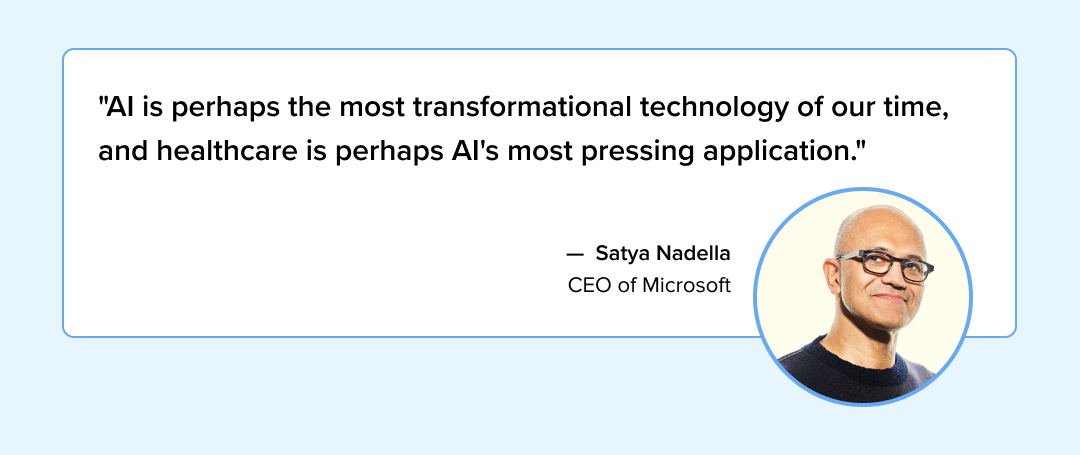
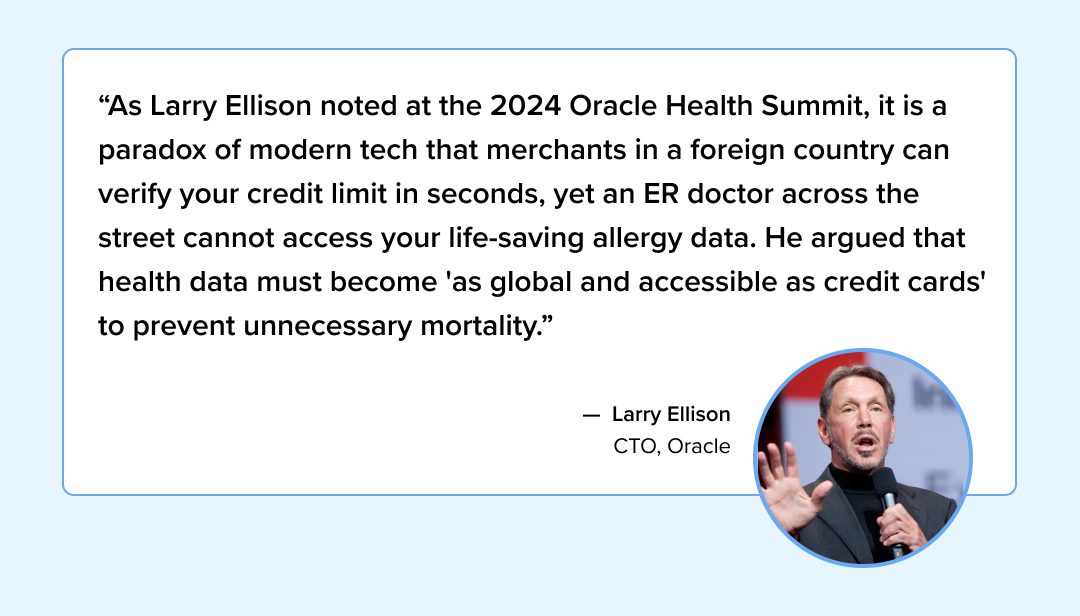
Experts are also pushing for the rising adoption of accessible healthcare data for better efficiency in the modern healthcare environment. Here’s a snippet of the conversation Larry Ellison and Bill Frist had that highlights the same.
Challenges and Considerations
The path is littered with failure. Interoperability remains the arch-nemesis of progress. Data silos are stubborn. Clinical accuracy cannot be "good enough"—it must be perfect.
| The Challenge | The Strategic Solution |
|---|---|
| Sending data isn't integration; understanding it is. If an EHR reads "Tylenol" as a text string rather than a medication object, safety alerts fail. That isn't a bug; it is a patient safety hazard. | Enforce semantic standards (SNOMED-CT, LOINC) immediately. You must translate data into clinical meaning, not just transport it like a digital mailman. |
| You are integrating with 1990s legacy infrastructure (MUMPS, SOAP) that is brittle, undocumented, and hostile to modern APIs. | Build an "anti-corruption layer." This architectural buffer isolates modern microservices from the hospital's decaying code and technical debt. |
| Clinicians click 4,000 times a shift. Adding three extra clicks per patient wastes 15 minutes a day. If the design prioritizes "engagement" over speed, staff will revolt. | Measure "Time to Task Completion." If a tired nurse cannot navigate the interface in three seconds, the design has failed. |
| Generative AI hallucinates. If an LLM invents an allergy or misses a drug interaction, the vendor is liable for the medical error. | Mandate "Human-in-the-Loop" (HITL). AI suggests that a licensed professional signs off. Never let the algorithm drive without a human hand on the wheel. |
| The C-Suite buys software, but the Chief of Surgery kills it. If the actual users find the tool clunky, they will use their political capital to block adoption. | Recruit "Clinical Champions." Find influential doctors to advocate for the tool from the inside. Their endorsement is worth more than the code itself. |
| Systems that work for a 50-patient clinic often collapse under the chaotic data load of a 50,000-patient network. Scale is where pilots die. | Design for enterprise scale immediately. Build multi-tenancy and massive concurrency for the rollout, not the pilot. |
| Regulations change overnight. Treating compliance as a "once-a-year audit" guarantees fines when laws like the EU AI Act shift. | Treat compliance as "Continuous Integration." Use automated tools to flag regulatory violations in real-time, just like syntax errors. |
Selecting a Healthcare Software Development Partner
You cannot do this alone. Finding the right healthcare software development companies is a strategic decision. You need partners in the USA or global hubs who possess deep industry knowledge and technical expertise.
- Look for evidence of IEC 62304 standards in their portfolio.
- Ask for case studies and client testimonials.
- Do they understand safety classification?
- Can they speak fluently about interoperability and data exchange standards?
Whether you choose to hire healthcare software developers outside or sign up for software development staff augmentation, the engagement model must prioritize data security measures.
- Additionally, integrating ITSM in software development ensures that support doesn't end at launch.
- Keep an eye on partners who stay ahead of software development trends—you want a team building for 2030, not 2020.
Conclusion: Healthcare Software Is Critical Infrastructure
Software development for healthcare is mission-critical. We are past the era of experimentation. The systems we build today will define the infrastructure of public health for the next decade. Innovation must balance with regulation; speed must balance with safety.
The stakes are real human lives. The code you write isn't just data; it's a heartbeat, a diagnosis, a lifeline. Treat it with the respect it demands.
Frequently Asked Questions
How long does healthcare software development take?
Founders hate hearing this, but if a dev shop promises you a compliant MVP in three months, they are lying. Realistically? You are looking at 9 to 15 months. Why? Because 30% of that timeline isn't coding; it’s arguing with auditors and documenting every single decision to satisfy the FDA. Speed kills here—literally.
What is HIPAA compliance in software development?
It isn't a feature you "add" at the end; it’s the legal shield keeping you out of federal court. HIPAA dictates that your entire architecture—from database schemas to employee login logs—must be built on the assumption that a breach is inevitable. If you aren't encrypting data at rest and in transit from Day 1, you aren't building a healthcare app; you're building a liability.
How much does healthcare software development cost?
A "prototype" might cost $50k, but that is effectively a toy in this industry. A market-ready, insurable platform starts at $250k and climbs rapidly. You aren't just paying for features; you are paying for the massive overhead of compliance testing, security auditing, and the liability mitigation required to get a hospital CISO to even look at your email.
What are the most important integrations?
If your software doesn't talk to Epic or Cerner, it doesn't exist. EHR integrations are the oxygen of this ecosystem. Beyond that, payment gateways and telemedicine platforms are critical, but without that core connection to the electronic health record, your software is just an isolated island of data that no busy doctor has time to visit.
What is the role of FHIR and HL7?
Think of HL7 as the old, reliable telegraph wire that hospitals still use, and Fast Healthcare Interoperability Resources (FHIR) as the modern internet. You need to be fluent in both. Why? Because while the industry wants to move to modern APIs, your software still has to shake hands with hospital servers from 1998 without crashing them.
How does IEC 62304 apply?
If your code helps a doctor diagnose or treat a patient, it’s not just software; it’s a medical device. The IEC 62304 standard is the global framework that forces you to classify your safety risk and prove your code won’t hurt anyone before you write a single line. Ignore this, and you will never get a CE Mark or FDA clearance.
What testing is required?
Functional testing is just the warm-up. The real work is compliance testing to satisfy the regulators, penetration testing to satisfy the hospital’s security team, and clinical validation to prove to doctors that your UI/UX design won’t drive them insane during a 12-hour shift.
How secure should healthcare apps be?
"Bank-grade" is a marketing term. You need a Zero Trust architecture in your backend development. Assume the hacker already has admin credentials. Can they still read the patient data? If the answer is yes, you failed. Mandatory MFA, AES-256 encryption, and immutable audit trails are the floor, not the ceiling.
What technologies dominate 2026?
The industry has moved past "digitizing paper." The dominant forces now are wearable devices that feed real-time data into AI-driven analytics engines, allowing for predictive care rather than reactive treatment. Everything else is just maintenance.
How to choose a healthcare software partner?
Ignore the logos on their website. Ask them about their worst audit. If they haven't been through one, they are dangerous. You need a partner who understands PACS software, knows why EHR integrations fail, and has the scars to prove they can navigate the regulatory minefield without getting blown up.

Uncover executable insights, extensive research, and expert opinions in one place.
Related Content