- Step 1: Define Your Product Scope and Compliance Requirements
- Step 2: Choose Between In-House, Outsourced, and Dedicated Team Models
- Step 3: Evaluate Technical and Compliance Credentials
- Step 4: Conduct a Healthcare-Specific Technical Assessment
- Step 5: Validate Agile Maturity, Not Just Agile Familiarity
- Step 6: Verify Security Infrastructure and DevOps Practices
- Step 7: Establish Governance, SLAs, and Communication Protocols
- 1. Vague Explanations of HIPAA Technical Controls
- 2. No Proactive Business Associate Agreement (BAA)
- 3. Agile Branding Covering Waterfall Execution
- 4. Zero Exposure to Clinical Workflows
- 5. Compliance Treated as a Final Gate
- 6. Absence of Third-Party Security Certifications
- 7. Suspiciously Low Pricing
- 8. Poor Technical-to-Clinical Communication
- 9. Lack of Documented Software Risk Management
 Share It On:
 The team you hire to build a healthcare platform will either protect your patients, your compliance standing, and your product roadmap, or quietly undermine all three. This guide tells you exactly how to make sure it's done correctly.
Hiring for agile healthcare development is a fundamentally different exercise. The profile you are looking for is not a developer who has heard of HIPAA. It is a team that has a structured delivery process, where security controls, audit logging, and access management are built into the Definition of Done (DoD) and not reviewed at the go-live stage.
So what does the perfect hiring process actually look like? At the team level, it means a cross-functional group having a product owner, a scrum master, a team of architects, developers, QA engineers, and a security specialist. At the individual level, it means engineers who can discuss HL7 FHIR and role-based access control as sprint velocity and backlog grooming.
Choosing to hire agile medical software developers is a strategic move to ensure that your product can pivot as fast as the healthcare regulations do. This guide is designed to help you navigate the strategic roadmap to finding the right talent acquisition.

Step-by-Step Guide to Hiring Agile Healthcare Developers
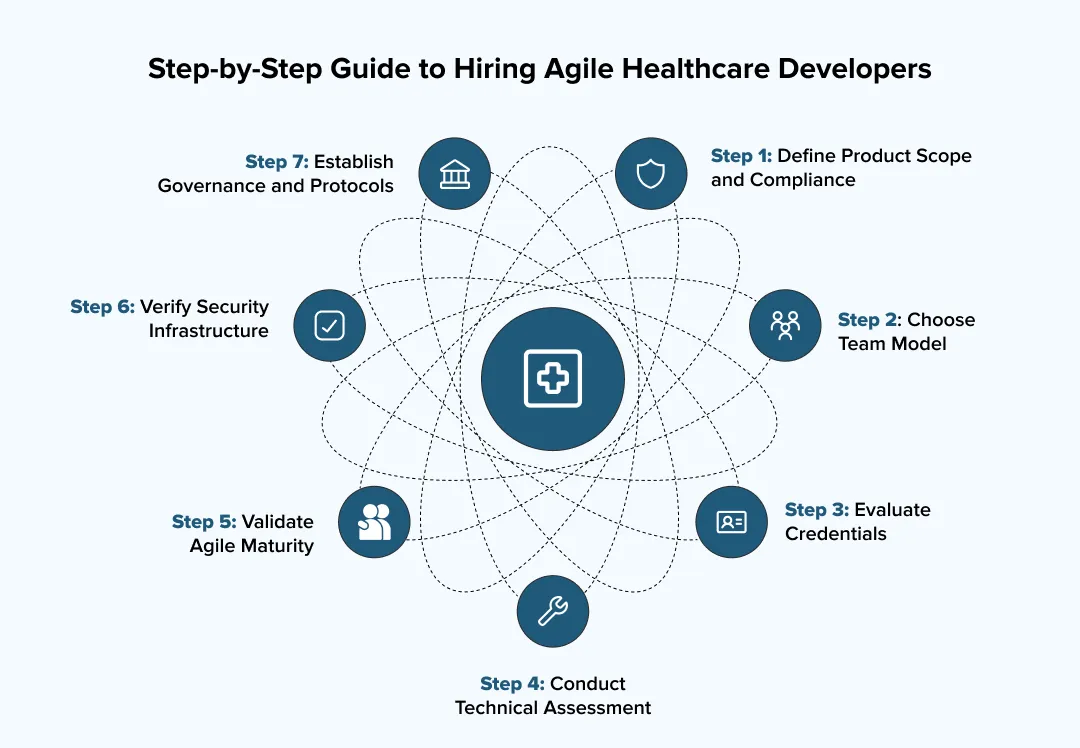
Most hiring processes for healthcare software development teams fail at the requirements stage, not the interview stage. The steps below are designed to correct that. Each step directly informs the next.
Step 1: Define Your Product Scope and Compliance Requirements
Establish your specific software classification before interviewing a single candidate. A Class II medical device requires entirely different engineering rigor than a basic patient portal or RPM tool. HIPAA, HITECH, or the EU AI Act mandates define your technical limits. Defining your data architecture requirements in the beginning ensures that the team you hire doesn't have to re-engineer the entire backend after months into the project.
Step 2: Choose Between In-House, Outsourced, and Dedicated Team Models
Your choice of engagement model will dictate your speed-to-market.
In-house Team: Offers maximum control and cultural alignment, but is the slowest to scale and most expensive.
Outsourced Agency: Ideal for rapid deployment. However, choosing an agile healthcare development company requires deep vetting of their BAA (Business Associate Agreement) history.
Dedicated Team: This hybrid model is increasingly popular for HealthTech startups. It allows you to hire a scrum team for healthcare software development that integrates directly into your existing workflow, which is managed by an in-house team.
Step 3: Evaluate Technical and Compliance Credentials
When you evaluate a healthcare agile development team, ‘we've done this before’ isn't enough. You need case studies as proof. Ask for a portfolio that specifically involves PHI handling. Request their compliance audit history. Do they hold certifications like HITRUST, SOC 2 Type II, or ISO 27001? A team that cannot provide a clear software development checklist for HIPAA compliance will be a liability.
Step 4: Conduct a Healthcare-Specific Technical Assessment
Standard style tests are useless here. You need to see how they handle a secure data handling scenario. Ask them to design a mock FHIR (Fast Healthcare Interoperability Resources) API or explain how they would manage encryption-at-rest using the best encryption software tools. Their ability to handle software development languages is secondary to their ability to code within a regulated framework.
Step 5: Validate Agile Maturity, Not Just Agile Familiarity
To hire agile healthcare development team experts, look for documented evidence of agile sprints in healthcare projects. Ask about their DoD. Does it include security scans and compliance checks? How do they handle the story point in agile estimation when unexpected regulatory changes occur mid-sprint?
Step 6: Verify Security Infrastructure and DevOps Practices
The role of DevOps in software engineering is synonymous with security. Ensure the team that you hire uses CI/CD pipelines with automated security testing. They should know about the cloud compliance environments like AWS GovCloud or Azure Health Data Services. If they are not using AI in software testing to find vulnerabilities, they are behind the curve.
Step 7: Establish Governance, SLAs, and Communication Protocols
A successful hiring process ends with a solid governance framework. Define the sprint cadence, the escalation paths for compliance breaches, and the specific KPIs. Without clear governance, SLAs, and communication protocols, the project can quickly devolve into scope creep and budget overruns.
Also Read: Our Guide on Healthcare Software Development
Red Flags to Avoid While Hiring an Agile Healthcare Software Development Team
According to IBM's 2025 Cost of a Data Breach Report, the average estimation of a healthcare data breach in the USA has reached $10.22 million, the highest of any industry. Most of that cost is not due to cyberattacks. It is the result of preventable compliance failures by teams that were not equipped for healthcare work from the start.
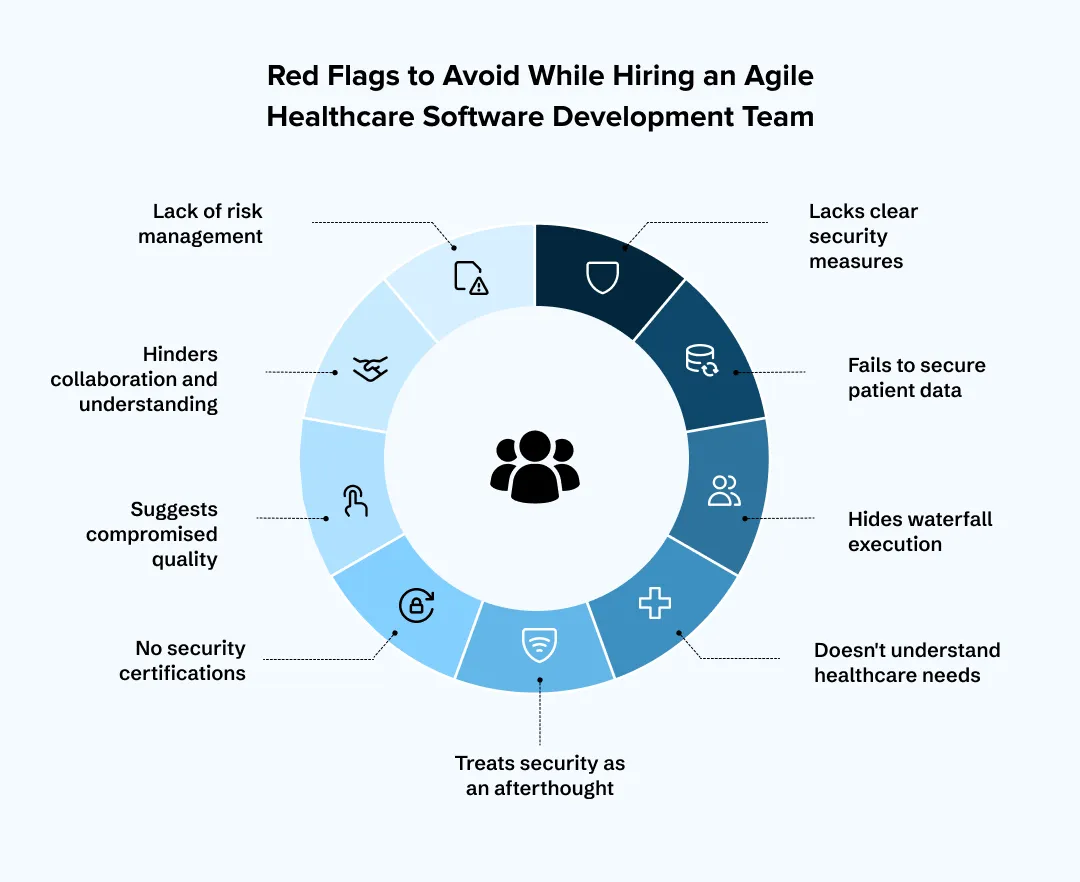
The red flags below are the specific warning signs that separate a credible development partner from one that will create problems.
1. Vague Explanations of HIPAA Technical Controls
Any vendor can claim compliance, but few can explain it. If they can’t detail their encryption standards or how they handle PHI in test environments, their compliance is likely just marketing fluff.
2. No Proactive Business Associate Agreement (BAA)
A team that doesn't raise the BAA requirement unprompted lacks regulatory literacy. Legally, no BAA means no access to PHI. If they overlook this legal cornerstone, they will overlook others.
3. Agile Branding Covering Waterfall Execution
Warning signs include no documented sprint cadence, missing backlogs, or updates delivered in large quarterly batches. If they can’t show a sample backlog, their agile methodology is purely cosmetic and high-risk.
4. Zero Exposure to Clinical Workflows
Coding skills don't automatically translate to healthcare. Teams without clinical experience build products that fail in high-pressure hospital environments because they don't understand how nurses and physicians actually navigate software.
5. Compliance Treated as a Final Gate
Treating compliance as a final audit rather than a daily sprint discipline leads to expensive rework. Real healthcare agile teams bake security and regulatory validation into every DoD.
6. Absence of Third-Party Security Certifications
The complete lack of SOC 2 Type II, HITRUST, or ISO 27001 certifications is a material risk. Reliable engineering partners invest in these external audits to prove their security infrastructure is sound.
7. Suspiciously Low Pricing
Compliance requires security engineering and documentation overhead. Dirt-cheap quotes usually mean the vendor is cutting corners on the regulatory layer. If compliance isn't a line item, it isn't being built in.
8. Poor Technical-to-Clinical Communication
Projects fail when developers can’t translate clinical requirements into technical tasks. If a team struggles to communicate with non-technical stakeholders during vetting, expect major misalignment during the software developers onboarding process.
9. Lack of Documented Software Risk Management
Healthcare development is high-stakes. A team without a clear software risk analysis process is flying blind. They must be able to explain how they identify and escalate risks mid-sprint.
Key Qualities an Agile Healthcare Development Team Must Possess
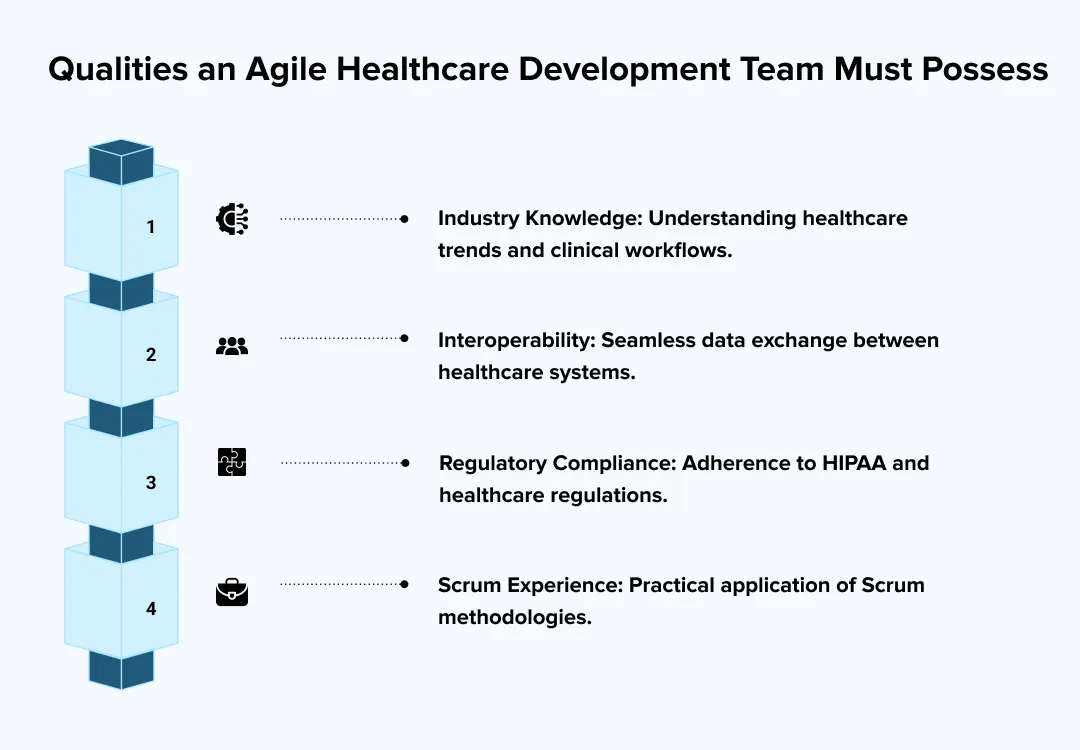
To succeed, you need more product thinkers who understand the clinical environment better and can help design better based on real-life experience. Here are the key skills that every agile healthcare software developer must possess:
1. Industry Knowledge & Clinical Workflow
Developers who have never worked in a clinical environment can build technically sound products that fail in practice. A developer must understand EHR/EMR integrations and standards like HL7 v2/v3 and DICOM to design a better UI for a better workflow.
2. Interoperability and Integration Experience
Your software will likely need to communicate with Epic, Cerner, or various IoT devices. Ensure the team has deep experience with FHIR APIs and the software development glossary of healthcare data exchange.
3. HIPAA and Regulatory Compliance Depth
When you hire agile medical software developers, they must treat compliance as a continuous process. Ask the teams about their experience with Business Associate Agreements (BAAs) and breach notification protocols. The team should use AI in software development to monitor for data leaks in real-time.
4. Scrum Certification vs. Real-World Experience
Agile software development teams that genuinely operate within a Scrum framework rather than just claiming to, demonstrate measurable discipline. Certifications like CSM, PSM, or SAFe are useful signals, but evidence of execution matters more.
Also Read: Agile Software Development In Healthcare
Essential Roles in a High-Performing Healthcare Agile Team
Hiring a single developer is a business arrangement. At the same time, hiring a healthcare agile development team is an organizational decision. The roles below are the core functions a well-structured healthcare engineering team needs to cover and what each one is accountable for.
| Role | Description |
|---|---|
| Product Owner | Primary bridge between your healthcare development environments and the technical requirements |
| Scrum Master | Protector of software development, ensuring no one interrupts the agile movement, sprint ceremonies, and removing blockers |
| Solution Architect | Responsible for ensuring the foundation is HIPAA-compliant, scalable, and manages clinical data standards (HL7 FHIR, DICOM) |
| Frontend & Backend Developers | Expert developers in modern software development trends and security. |
| QA/Compliance Engineer | Someone whose only job is to try to break the compliance of the product. |
| Information Security Specialist | Crucial for managing encryption software tools and threat modeling |
| DevOps Engineer | Automates the bridge between code and cloud. |
| Regulatory Consultant | An optional but vital role if you are seeking FDA clearance |
A Reality Check on Developer Salaries
Budget planning is one of the most common friction points when organizations set out to hire agile healthcare development team resources. The tables below provide a grounded, region-adjusted view of the different software development costs of typical roles.
Roles, Responsibilities, and Pricing Range (USD/Year)
| Role | Core Responsibilities | Salary Range (USD) | HIPAA Premium |
|---|---|---|---|
| Product Owner | Backlog, user stories, clinical requirements | $90,000 – $140,000 | +10–15% |
| Scrum Master | Sprint facilitation, compliance workflow integration | $85,000 – $130,000 | +10% |
| Solution Architect | HIPAA-compliant system design, FHIR architecture | $130,000 – $200,000 | +20–25% |
| Frontend Developer | Clinical UX, accessibility, patient-facing interfaces | $80,000 – $140,000 | +10–15% |
| Backend Developer | PHI data management, FHIR APIs, audit logging | $90,000 – $160,000 | +15–20% |
| QA / Compliance Engineer | Security testing, regulatory validation, sprint QA | $85,000 – $140,000 | +20% |
| InfoSec Specialist | Security reviews, pen testing, CI/CD security gates | $100,000 – $175,000 | +20–25% |
| DevOps Engineer | CI/CD pipelines, cloud compliance, IaC | $95,000 – $165,000 | +15% |
| Regulatory Consultant | FDA/HIPAA alignment, audit preparation | $120,000 – $200,000 (contract) | +25%+ |
Developer Cost by Region and Experience Level (USD/Year)
| Region | Junior Developer | Mid-Level Developer | Senior Developer |
|---|---|---|---|
| USA | $70,000 – $95,000 | $100,000 – $145,000 | $150,000 – $205,000 |
| UK | $40,000 – $58,000 | $60,000 – $85,000 | $85,000 – $120,000 |
| India | $7,000 – $14,000 | $14,000 – $25,000 | $25,000 – $45,000 |
| UAE | $35,000 – $55,000 | $55,000 – $90,000 | $90,000 – $135,000 |
Note: Figures above are approximate annual salary benchmarks as of 2026. Contractor and agency rates will differ. HIPAA specialization commands a 15–25% premium over general software development rates in equivalent markets.
Conclusion: Securing Your Digital Health Future
Hiring a healthcare agile development team is not a staffing exercise. It is one of the most leveraged decisions a healthcare organization or startup can make because the team you hire will determine whether your product reaches patients safely, on schedule, and in full compliance with the regulatory frameworks. In an era where patient trust is the ultimate currency, the quality of your development team is your most valuable asset. If you are looking to simplify this process, MobileAppDaily (MAD) can bridge the gap.
We help you find the most elite HIPAA-compliant software development team, vetted for their ability to deliver agile solutions. Don't leave your product's compliance to chance; let us help you find the partner that fits your vision.
Frequently Asked Questions
What is an agile healthcare development team?
An agile healthcare development team is a specialized, multi-disciplinary group of engineers and QA experts who understand the medical data. They work in short cycles, called sprints. What truly defines them is their deep knowledge of medical standards, such as HL7 FHIR and HIPAA, which general developers often miss.
What certifications should a HIPAA-compliant development team hold?
Prioritize vendors holding ISO 27001, HITRUST CSF or SOC 2 Type II status. At the individual level, Certified Scrum Master (CSM), AWS Certified Security Specialty, and CISM are worth noting.
What is the difference between a HIPAA-aware team and a HIPAA-compliant team?
A HIPAA-aware team has read the rules; a HIPAA-compliant team operationalizes them. Real experts embed encryption and audit logs into every single work cycle. Every cycle includes technical safeguards such as documented incident-response protocols.
Can AI-generated code be used in HIPAA-compliant healthcare software?
Yes, but it cannot be treated as a shortcut for speed. Automated scripts are acceptable only if senior engineers manually audit every single line for security vulnerabilities. Never trust machine logic blindly. Rigorous testing remains mandatory. This means your QA and compliance engineers must be deeply involved in the review process before any such code is merged into the production environment.
What programming languages are most common in healthcare software development?
Python drives data pipelines, while Java or .NET remains the standard for massive clinical records systems. Use React and Angular for building patient portals and clinical dashboards. These stacks offer stability.
What are the most practical tips to hire an agile healthcare software team for a high-stakes project?
Audit their "Definition of Done" before signing any contracts. Reliable partners must automate security scanning during every work cycle. Demand case studies. If they skip safety checks, walk away immediately. Trust results.

Uncover executable insights, extensive research, and expert opinions in one place.
Related Content