
Etsy Review: The Best Online Marketplace for Handmade Products?
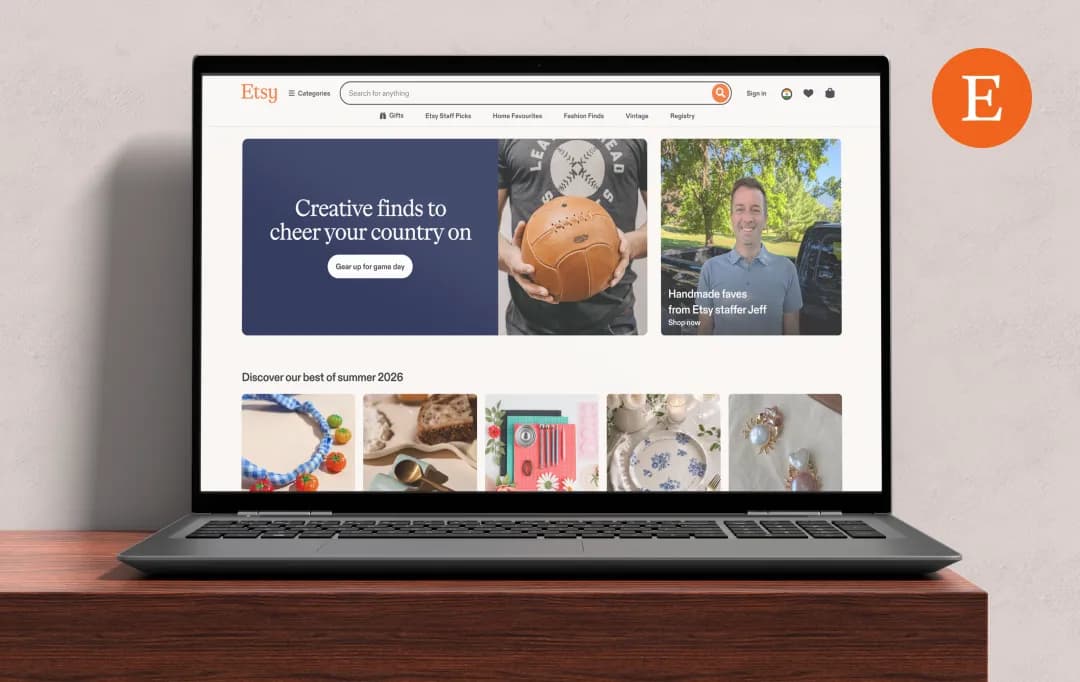
From one-of-a-kind wedding gifts to hand-thrown ceramics and personalised pet portraits, Etsy has built its entire identity around things you genuinely can't find on Amazon. But does the platform hold up for the people actually selling on it?
I spent time going through Etsy's shop management tools, seller fee structure, listing features, and overall experience to see whether it delivers beyond its carefully curated aesthetic. Not just whether it's charming to browse, but whether it stands the best among other e-commerce platforms for independent creators and small business owners.
This Etsy review covers everything: features, pricing, Etsy subscription plans, usability, and the straight answer on whether the platform is worth your time as a seller in 2026.
Pros and Cons of Etsy
Pros
- Access to 86.6 million active buyers without building your own audience from scratch
- No monthly subscription required to start selling; you only pay when you list or sell
- Shop Manager dashboard centralises listings, orders, analytics, and customer messaging in one place
- Over 100 million listed items across niche categories that buyers can't find anywhere else
- Strong mobile commerce performance, 45% of gross merchandise sales (GMS) now flow through the Etsy app
- Etsy Plus subscription adds branding tools, restock alerts, and ad credits for $10/month
- AI-powered product discovery is now integrated with ChatGPT, Gemini, and Microsoft Copilot
- Built-in Etsy Payments handles multiple payment methods and automated tax collection
Cons
- Growing pay-to-play dynamic; organic search visibility has become harder to maintain without paid ads
- Etsy Plus does not improve search ranking; for sellers, visibility still depends entirely on SEO and product quality
- Customer support access is still limited for smaller or newer sellers
- Transaction fees apply to the full order total, including shipping, which catches many new sellers off guard
What Does Etsy Offer | Key Features
Etsy is not just a storefront. This marketplace platform comes with a reasonably robust set of seller tools, and recent updates have meaningfully improved the day-to-day experience of running an Etsy store. Here's a closer look at the Etsy features that make this possible.
1. Shop Manager Dashboard
Etsy's Shop Manager is the central hub for everything a seller needs to run their business on the platform. From a single dashboard, sellers can manage listings, track orders, monitor shop analytics, handle customer messages, set up shipping profiles, and view payment history.
Recent updates have streamlined the layout significantly; the Orders page now loads faster, the Sales & Discounts page loads 40% quicker, and key stats like traffic sources and conversion rate have been moved into a more accessible, dedicated tab.
The dashboard also surfaces a search visibility tool that shows which listings would benefit most from a refresh, giving sellers a prioritised action list rather than making them guess where to focus.
2. Listings Manager
Etsy's updated Listings Manager gives sellers faster tools for adding, editing, and organising products. A Quick Edit mode lets sellers update multiple listings without opening each one individually. A dedicated search function now includes sold-out listings, which is useful for sellers managing seasonal or rotating inventory. Listing form sections have also been reorganised for clarity, with some fields pre-filling based on existing listings to save time.
Real-time listing quality feedback, currently in beta, alerts sellers to issues that could affect their search ranking before they hit publish. It's one of the more practical additions Etsy has made for sellers trying to optimise without hiring an SEO specialist.
3. Etsy Shop Management: Order Tracking and Fulfilment
The Etsy Seller app has seen meaningful improvements to order management. Sellers can now filter and sort orders by status, ship-by date, destination, personalisation, and gift status. A buyer order history view lets sellers see a customer's full purchase and message history directly from the order page, useful for sellers who handle custom or repeat orders frequently.
The app also supports in-app photo editing, background processing for uploads, and custom photo filters to maintain a consistent shop aesthetic. For sellers managing their business on the go, these tools meaningfully reduce the need to switch between platforms.
4. Marketplace Insights Tool
Etsy's built-in Marketplace Insights tool gives sellers access to keyword search data and trend tracking within the platform itself. Recent updates added week-over-week trend indicators (rising or falling buyer interest) and the ability to save up to 50 searches for ongoing monitoring. It's a useful starting point for Etsy SEO, especially for sellers who want to understand demand before adding new products to their catalogue.
5. Etsy Payments and Tax Handling
Etsy Payments is the platform's built-in payment processor, handling multiple payment methods and automatically collecting sales tax in applicable jurisdictions. For US sellers, this includes automated remittance; Etsy collects and pays state sales tax on your behalf, removing one significant administrative burden from solo sellers. Monthly downloadable invoices make bookkeeping straightforward.
6. Etsy Ads and Offsite Ads
Etsy offers two advertising options. On-site Etsy Ads let sellers pay to appear in Etsy search results, with sellers setting their own daily budget and paying per click. Offsite Ads are managed entirely by Etsy; the platform promotes listings across Google, Facebook, Instagram, Pinterest, and Bing, and charges a 15% commission only if a sale results from an ad click within 30 days. For sellers making more than $10,000 annually, the Offsite Ads fee drops to 12%, and participation becomes mandatory.
7. AI-Powered Discovery
Etsy has integrated with AI shopping platforms, meaning eligible Etsy listings can now be discovered and purchased within ChatGPT, the Gemini app, Google AI Mode, and Microsoft Copilot. For sellers in well-optimised categories, this represents meaningful incremental visibility beyond Etsy's own search engine, and it's available without any additional action required from sellers.
Etsy Pricing and Subscription for Sellers
Etsy operates on a pay-per-use model for most sellers, with no required monthly subscription. All sellers pay the same core fees.
| Fee Type | Amount | What It Covers |
|---|---|---|
| Listing Fee | $0.20 per listing | Applies when you publish a product; renews every 4 months or when an item sells from a multi-quantity listing |
| Transaction Fee | 6.5% of total sale | Charged on the full order total, item price, shipping, and gift wrapping |
| Payment Processing Fee | 3% + $0.25 per transaction (US) | Applies to orders processed through Etsy Payments; rates vary by country |
| Offsite Ads Fee | 15% (under $10K/yr) or 12% (over $10K/yr) | Only charged when a sale is directly attributed to an Etsy-promoted ad; capped at $100 per order |
For a typical US seller, mandatory fees on a $30 item with $5 shipping come to approximately $3.78. Add Offsite Ads at 15% and that rises to around $9.03. Most sellers end up in the 12–15% effective fee range on standard sales.
Etsy Subscription Plans
Beyond the standard free model, Etsy offers one optional paid tier: Etsy Plus, priced at $10 USD per month.
| Plan | Price | What's Included |
|---|---|---|
| Etsy Standard | Free | Core selling features, listings, Shop Manager, Etsy Payments, analytics, Etsy Ads access and Offsite Ads |
| Etsy Plus | $10/month | 15 listing credits ($3 value) + $5 Etsy Ads credit monthly, advanced shop customisation (banners, featured listings, layouts), restock request alerts for sold-out items, discounts on custom packaging and domain registration via Hover |
Important caveats on Etsy subscription plans: Credits under Etsy Plus do not roll over, unused listing credits and ad credits expire at the end of each monthly cycle. Etsy Plus also has no impact on search ranking. Listings still compete on SEO quality, photos, reviews, and conversion metrics, not on subscription tier.
For sellers who regularly list 15+ products per month and already run Etsy Ads, the subscription effectively costs around $2/month after credits. For sellers with small, stable catalogues, the credits may go largely unused, and the free Standard plan is the more practical choice.
Who Is Etsy For?
Etsy isn't a one-size-fits-all custom products marketplace, and that's precisely the point. The platform is built around a very specific kind of commerce, handmade, vintage, custom, and craft, which means it naturally attracts a particular type of seller and buyer.
Here's a breakdown of who gets the most out of the platform.
| User Type | Why Etsy Works for Them |
|---|---|
| Independent makers and artisans | Etsy's entire buyer base comes specifically looking for handmade and handcrafted goods; there's no need to build an audience from scratch |
| Vintage sellers | The platform has a dedicated and loyal buyer segment for vintage items aged 20+ years, with strong organic discovery built in |
| Custom and print-on-demand sellers | Made-to-order items accounted for 30% of Etsy's 2024 GMS, making it the strongest mainstream marketplace for personalised products |
| Side hustlers and hobbyists | No monthly subscription required — you only pay when you list or sell, making it low-risk for sellers testing a product idea |
| Craft supply sellers | Craft Supplies is one of Etsy's top-performing categories with $1.3 billion in GMS in 2025, with a built-in buyer base of makers and DIY enthusiasts |
| Small business owners scaling up | Shop Manager, Etsy Ads, Marketplace Insights, and Offsite Ads give growing shops enough tooling to scale without needing a separate tech stack |
| Buyers looking for unique gifts | 29% of Etsy buyers use the platform specifically to find gifts, and 83% say Etsy carries items they can't find anywhere else |
Customer Reviews
How was your experience with the product?