Share It On:
 Sprinting without tracks isn't agility, it's just a highly efficient way to crash. This guide shows how ITSM acts as the strategic backbone for development, ensuring you ship revenue-generating features instead of 3 AM fire drills.
Most software development lifecycles are essentially just organized chaos disguised as a methodology. You have Agile teams sprinting toward deadlines that were decided months ago, while product managers demand new features that didn't exist yesterday. It is a high-speed train that is constantly being built while it is moving, and without the right tracks, it inevitably derails. That is the unvarnished reality we operate in.
In this volatile ecosystem, IT Service Management (ITSM) acts as the only thing preventing total collapse. It is the governance layer that keeps the entropy from consuming your product alive.
The delusion that ITSM is just about fixing printers or resetting passwords is so 2010. The role of ITSM in software development is strategic, aggressive, and absolutely essential for scaling digital products without collapsing under technical debt.
What is IT Service Management (ITSM)?
At its core, IT service management refers to the totality of activities directed by policies, organized and structured in processes and supporting procedures, that are performed by an organization to design, plan, deliver, operate, and control information technology services offered to customers.
It is a service-oriented architecture for your internal processes, treating the delivery pipeline itself as a product. Many IT consulting firms create complex diagrams to explain this simple concept, but it boils down to being the "adult in the room" when things go wrong.
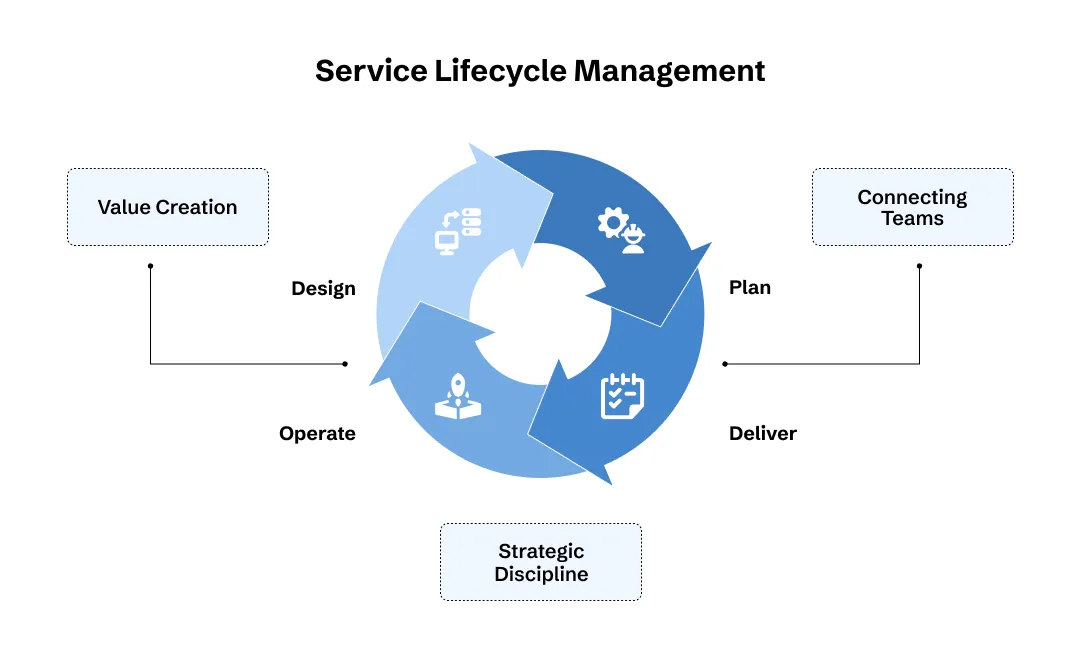
- Service Lifecycle Management: It implies treating the delivery pipeline itself as a distinct product that needs maintenance.
- Value Creation: You need to ensure that when code ships, it doesn't just work technically; it creates value, remains secure, and is supportable long-term.
- Connecting Teams: It acts as a framework that connects development teams, operations, and business stakeholders, ensuring applications are built efficiently.
- Strategic Discipline: It has evolved into a strategic discipline that directly influences how software is planned, built, released, and maintained.
The Role of ITSM in Software Development
You cannot execute a modern strategy with spreadsheets and hope. You need robust IT service management software to centralize your operations and act as the connective tissue between your code repository, your CI/CD pipeline, and your customer feedback loops.
If you are still managing incidents via email threads and changes via Slack messages, you are actively bleeding efficiency every single day. This is where the role of ITSM in software development occurs significantly.
- Centralization of Operations: The platform acts as the single source of truth for everything happening in your IT environment.
- Integration Capabilities: A proper platform connects directly with development tools to ensure seamless data flow.
- Automated Workflows: We are talking about automated change records triggered by pull requests and incident tickets that auto-populate from monitoring alerts.
- Smart Governance: AI in IT services is leveraging machine learning to categorize tickets and predict outages before they happen, feeding that data directly back to the development team to prevent future fires.

Integrating ITSM With DevOps and Agile
There is a persistent myth floating around that ITSM kills agility. That particular assumption is demonstrably false because bad implementation is what actually kills agility. Good ITSM and Agile integration is like adding power steering to a race car; it gives you control at high speeds. Instead of fighting over release windows, ITSM frameworks for software teams provide pre-approved change models that allow developers to move fast without breaking things.
- Standard Changes: Low risk, frequently executed changes get automated approval without human intervention.
- Policy as Code: This is the heart of DevOps in software engineering, using policy as code to speed up delivery while maintaining a paper trail for compliance.
- Bridging Gaps: It effectively bridges the massive gap between the developers who want to push code and the operators who need to maintain system integrity.
- Feedback Loops: Incident data feeds directly into backlog refinement to ensure stability issues are addressed in future sprints.
How ITSM Improves Software Reliability
These are the subjects teams tend to ignore until there is a legal or financial consequence: compliance, security, and reliability. In real environments, the way ITSM improves software reliability is not theoretical.
It works by enforcing discipline without adding manual checkpoints or slowing delivery. Data privacy is the clearest example. If European customer data is involved, GDPR compliance has to exist inside the release process, not after it.
- Legal Compliance: ITSM makes sure every request for data access or deletion is logged, traceable, and completed within the required legal timeframe.
- Accessibility Standards: When WCAG checks are part of the service delivery lifecycle, updates are less likely to shut out users with disabilities by mistake.
- Incident Resolution: Incidents are unavoidable. What matters is having a defined path to resolution that limits Mean Time to Recover (MTTR).
- Preventing Recurrence: Structured problem management exists to stop the same issue from appearing again under a different label.
Core Processes: The Engine Under the Hood
To get this right, you need to respect the disciplines that keep the lights on. A successful implementation starts with culture, but it relies on defined processes.
- Service Level Management (SLAs): Stop guessing what "good" looks like. You need formal Service Level Agreements (SLAs) that act as a contract between IT and the business. This defines exactly what uptime is promised and what happens when you miss it.
- Configuration Management: It is not enough to list your assets; you need to map their relationships. If Server A fails, which three applications go offline? Configuration management gives you that blast radius visibility.
- Knowledge Management: If your senior engineer gets hit by a bus, does your operation collapse? Knowledge Management (KM) ensures that solutions are documented in a searchable, self-service database. It is the organizational memory that prevents you from solving the same problem twice.
- The Service Desk (Not a Help Desk): There is a distinction here. A help desk fixes broken laptops, often through dedicated help desk software, while a service desk handles the entire lifecycle of user requests—software licensing, access permissions, and third-party vendor contracts. It is the single point of entry for the enterprise.
IT Service Management Frameworks
You do not need to invent this methodology from scratch. There are established frameworks that have already solved these problems. The trick is choosing the one that fits your architecture, not the one that has the best marketing brochure.
Here is the breakdown of the heavy hitters in the industry:
You do not need to invent this methodology from scratch. There are established frameworks that have already solved these problems. The trick is choosing the one that fits your architecture, not the one that has the best marketing brochure.
Here is the breakdown of the heavy hitters in the industry:
| Framework | Core Philosophy | The "Superpower" | Best For... |
|---|---|---|---|
| ITIL 4 | Value co-creation with a focus on the service value chain and four dimensions of service management | Universality — the common language of IT service management | Organizations needing a comprehensive, adaptable foundation for service delivery |
| COBIT 2019 | Governance and control; defines what must be done through governance objectives | Alignment — bridges IT risk with board-level business goals | Highly regulated industries where audit and compliance are critical |
| ISO/IEC 20000 | International ITSM standard; rigid, auditable, and certification-based | Proof — the only framework offering formal organizational certification | Managed Service Providers needing to prove operational excellence |
| MOF | Microsoft-centric service lifecycle covering Plan, Deliver, Operate, and Manage | Integration — prescriptive guidance for managing Microsoft technologies | Enterprises deeply invested in the Microsoft ecosystem |
| TOGAF | Enterprise architecture framework focused on IT structure and design | Blueprint — ensures architecture supports services before implementation | Large organizations undergoing digital transformation or infrastructure overhaul |
- The Reality Check: You do not have to pick just one. The most mature organizations mix and match—using TOGAF to design the building, ITIL to run the front desk, and COBIT to keep the security guards in check.
- Service Catalog Definition: Define what you actually do, because if it’s not in the catalog, it effectively is not a service.
- Ruthless Automation: If a human has to type it twice, you should be finding a way to automate it immediately.
- Meaningful Metrics: Ignore vanity metrics like "ticket volume" and focus on things that actually impact the business.
- Security Compliance: If you touch credit card data, PCI DSS ensures you map your assets and track who has access to production environments.
Streamlining Software Delivery with ITSM
When selecting tools, look for specific ITSM software features that support velocity rather than hinder it. You want robust APIs, seamless integration with Jira/Azure DevOps, and solid asset management that doesn't require manual entry. The goal is streamlining software delivery with itsm, not creating administrative hurdles that developers have to jump over just to get their work done.
- Seamless Integration: IT service management best practices dictate that your developers should rarely have to leave their IDE to interact with ITSM processes.
- Invisible Process: If they have to log into a separate portal to file a change request, you have failed the user experience test.
- Asset Management: Knowing exactly what code is running on which server is critical for rapid debugging.
- Strategic Alignment: AI trends suggest that predictive alignment between business goals and IT execution is becoming the new standard.

Future Trends in ITSM and Software Development
The landscape is shifting beneath our feet, and the future is going to be automated, intelligent, and incredibly fast. By 2030, the global IT Service Management market is projected to reach $29.93 billion, growing at a CAGR of 14.4% according to Grand View Research.
This explosion is being driven by the need for ITSM software and tools that can handle the complexity of cloud-native environments without needing a massive army of humans.
- Market Growth & DevSecOps: The DevSecOps market is expected to hit $20.2 billion by 2030. Security is no longer a final checkbox; it is being baked into the code itself.
- Autonomous Knowledge Maintenance: Maintaining documentation is tedious, so nobody does it. Emerging AI trends show algorithms scanning your resolved tickets to automatically update the knowledge base, identifying gaps and writing articles without human intervention.
- Predictive Security: AI agents will soon monitor huge networks in real-time, performing vulnerability assessments and triaging security events before a human analyst even logs in.
- Autonomous Remediation: We are seeing a rise in AI in software testing where intelligent agents conduct autonomous regression testing on every build, writing their own patches for minor bugs.
- Service Expansion: The global software development services market is estimated to surpass $1.04 trillion by 2030. To manage this scale, manual oversight is impossible; intelligent platforms must take the wheel.
- Unified Discipline: Security, operations, and development will fuse into a single, high-velocity discipline. The walls between "who builds it" and "who fixes it" are permanently coming down.
Frequently Asked Questions
Is there actually a meaningful difference between ITSM and DevOps?
DevOps teams are obsessed with pushing code into production as fast as humanly possible. ITSM acts as the necessary counterweight that demands proof of stability before anything goes live. You cannot have one without the other unless you enjoy constant downtime and angry customers. They are opposing forces that keep the system in balance.
Doesn't adding ITSM processes just suffocate Agile teams?
Bureaucracy only destroys velocity when it is implemented by people who love paperwork more than product. Modern service management aims to be completely invisible by automating the safety checks in the background. We replace the heavy clipboards of the past with silent policy enforcers that let developers sprint without crashing.
What features are non-negotiable when buying ITSM software?
Stop looking at the pretty dashboards and start asking tough questions about the API capabilities. If the platform refuses to talk to your existing engineering stack, it is effectively a digital paperweight. You need tools that allow operations to route tickets without writing custom code every single time a workflow changes.
Why isn't a strong CI/CD pipeline enough for quality?
Automated pipelines are fantastic at catching syntax errors, but they have zero concept of user frustration. A green build light means the code works technically, not that the service is actually usable for a human being. ITSM fills that massive void by tracking real-world performance and supportability after the deployment finishes.
Is the AI trend in ITSM real or just marketing fluff?
Most of the marketing talk is absolute nonsense, but noise reduction is the vital exception. Algorithms can sift through thousands of screaming alerts to find the one broken switch that actually matters. That capability changes the game from frantic guessing during an outage to surgical repairs.
Has the cloud made ITIL frameworks completely irrelevant?
The old books are gathering dust, but the fundamental logic of categorizing errors remains valid. You do not need a committee to approve changes, but you definitely need to know the difference between a bug and an outage. Successful teams keep the concepts but throw away the rigid manuals.
Do early-stage startups actually need to bother with this?
Waiting until you are a massive enterprise to implement a process is a guarantee of future failure. You do not need complex databases, but you cannot run a scaling company on sticky notes and memory. Start with basic incident tracking before the internal chaos becomes irreversible and expensive.
What numbers should we look at to measure success?
Counting total tickets is a completely useless exercise for measuring the quality of your work. The only metrics that tell the truth are how often deployments fail and how fast service is restored. If those two numbers are not improving, your strategy is failing regardless of what the other charts say.

Uncover executable insights, extensive research, and expert opinions in one place.
Related Content