Share It On:
 Learn how self-driving AI apps are reshaping automotive innovation and unlocking massive profit potential.
The car industry is in the middle of its biggest shake-up in over a century, and surprisingly, the revolution isn't happening on the assembly line. It’s happening in the code. Much of this transformation is being driven by specialized ai development companies that are building intelligent systems capable of powering autonomous driving, real-time decision-making, and continuous vehicle evolution.
AI-self-driving apps have moved from a far-off concept right into the driver's seat, changing our relationship with the vehicles we drive every day. This is the invisible brain that’s fine-tuning safety features in real-time and, ultimately, powering the push toward full autonomy.
It’s a change backed by huge investments. According to McKinsey, AI can create up to USD 300 to USD 400 billion in value for the auto sector by 2035. This makes it clear that the future of the car is less about what’s under the hood and more about the app that runs it.
That's exactly what we will explore. We’ll learn how these AI apps in self-driving cars are not just adding new tricks, but completely rewriting the definition of a car, reshaping the auto business, and giving us a glimpse of the road ahead.
How AI Apps in Autonomous Vehicles are Redefining Cars?
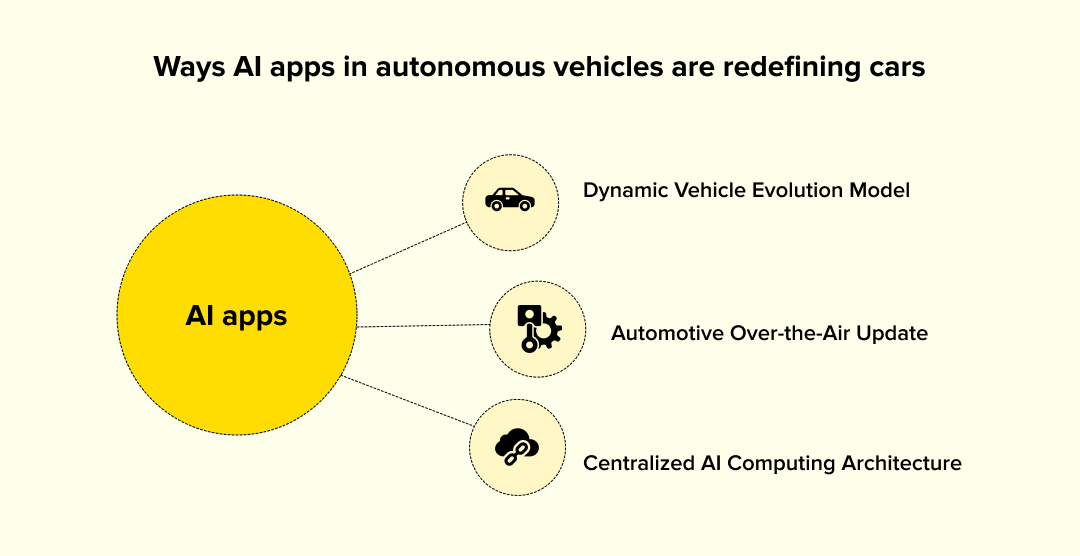
A car was a machine that only got older. But AI in mobile apps and self-driving cars has turned that logic on its head, setting vehicles for evolution. Let’s have a look at how these AI apps in autonomous vehicles are redefining cars.
1. From a Static Machine to an Evolving Device
This is the core change: the vehicle is no longer ‘finished’ at the factory. We now have to think of it more like a smartphone or hardware you buy once, but whose experience is constantly upgraded. An app update six months after purchase can unlock a feature that didn't exist when you first bought it. The car you own a year from now could be vastly more capable, proving that in this new world, the vehicle is never done evolving.
2. The Magic of Over-the-Air (OTA) Updates
The Automotive Over-the-Air (OTA) Updates market size stands at USD 4.78 billion in 2026 and is projected to reach USD 11.23 billion by 2030 at an 18.63% CAGR. OTAs are the engine for this evolution, delivered wirelessly to the car's AI brain.
They are significant upgrades to performance and features. Tesla famously boosted the 0-60 mph acceleration of its cars with an app update. Entirely new functions, from ‘Dog Mode’ to ‘Sentry Mode,’ can appear overnight. This model of continuous improvement effectively makes the older app obsolete.
3. The Car as a Computer on Wheels
This constant evolution isn't just an app trick—it requires a revolution in the car's physical architecture. The old model of using dozens of small, separate controllers was discarded. To make a car that truly learns, you have to build it around a single, powerful central computer complete with dedicated AI processors.
This new hardware backbone is designed with massive excess capacity from day one, making it a future-proofed platform ready for AI updates years down the road. It's what allows the car not just to run an app, but to grow with it.

How Self-Driving App Technology Is Reshaping the Automotive Business?
The redefinition of the car into an evolving platform isn't just an engineering exercise; it's tearing up the financial book of the auto industry. As AI apps for self-driving cars become the star, we're seeing a seismic shift in how companies make money, who their customers are, and what they're even selling.
4. From a Single Sale to a Lifelong Subscription
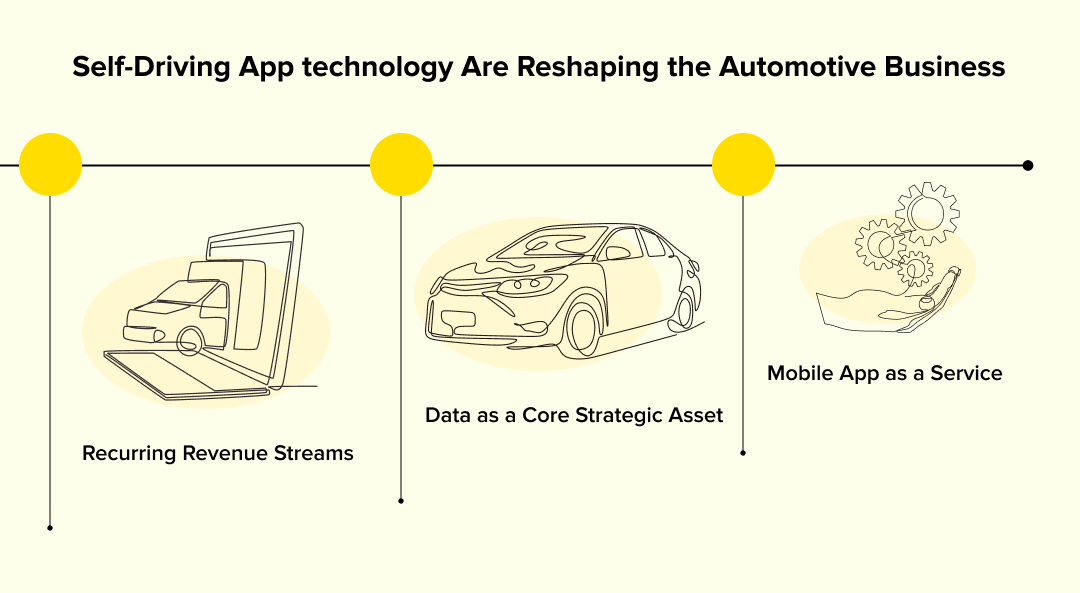
The old transactional model, where a car company's revenue largely ended at the point of sale, is being replaced by the subscription model. AI-powered features are the perfect product to sell this way. With Tesla’s Full Self-Driving (FSD) capability, for example, owners can subscribe monthly instead of paying a large one-time fee.
This creates a stream of predictable, high-margin recurring revenue, shifting the financial focus from the initial sale to the long-term value of a customer. Additionally, Tesla claims FSD to be 54% safer than human drivers. Claims and proven abilities can further add to the driving force behind its subscription and popularity.
5. The Data Goldmine
Every mile an AI in self-driving cars drives is a data-gathering mission. This real-world information trains the AI, creating a powerful feedback loop: more data leads to a smarter AI, which builds a competitive moat that's hard to cross. This information is invaluable; it can be used to learn traffic patterns and can be further sold to city planners or insurance companies, effectively turning the car into a rolling data center.
6. Mobility-as-a-Service (MaaS)
The most radical business shift, however, challenges car ownership itself. Companies like Google's Waymo are building the foundation for a robotaxi future where they aren't selling cars, but selling rides. Their customer is anyone who needs to get from A to B. This positions them as transportation providers, not just manufacturers—a long-term play with the potential to dramatically shrink the personal car market.
What are the Examples of AI Apps in Autonomous Vehicles?
When we look at the real world, we see that the two giants of the space, Tesla and Waymo, aren't just building apps. They're placing two completely different bets on the future. Let’s look at AI use cases that these giants are leveraging:
1. Tesla App Self-Driving Features: The Owner's Command Center
Tesla’s self-driving AI cars app is an all-in-one gadget. It’s built for the owner. It's your digital key, your remote control, your car's diary. It’s designed to deepen your connection to the machine, letting you micromanage it with an almost god-like view—summoning it from a parking spot, checking its security cameras, or pushing an over-the-air update that makes the car physically faster.
The message from the app is clear: this is your powerful, evolving toy, and this is the only controller you'll ever need. It’s a strategy built on individual ownership and passionate engagement.
2. Waymo's App: The Car as a Quiet Utility
The Waymo One app has one core job: get a human who doesn’t own a car to trust a robot that does the driving. It's just a button to hail a ride. The real interface is the screen inside the car that works hard to demystify the AI, showing you, "I see that cyclist" or "I see that traffic cone." It’s all about quiet reassurance. Waymo app ride-hailing AI isn't trying to sell you a powerful toy; it's trying to deliver a utility so reliable it fades into the background of your life.
3. Beyond the Big Two: The Broader Battlefield
While Tesla and Waymo dominate the headlines, they aren't the only ones in the game. GM's Cruise is a direct competitor to Waymo, operating its own app-based robotaxi AI technology service in select cities, showcasing the legacy auto industry's massive investment in autonomy.
Looking beyond passenger cars, companies like Aurora are developing AI and app-based platforms for the trucking industry, aiming to automate long-haul freight. These examples show that the AI app revolution is a broad one, poised to change not just how we get around, but how everything gets delivered.
Future Cars Will Know Your Preferences Better Than You Do
Future autonomous driving mobile apps in self-driving cars will move beyond simple commands to become deeply contextual assistants. Instead of just reacting to your taps, they'll proactively orchestrate your entire journey by understanding your calendar, real-time traffic, and even personal preferences.
Imagine an app that knows you prefer scenic routes on Fridays or pre-orders your coffee on the way to an early meeting. The goal is to evolve from a remote control into a true travel companion that seamlessly manages your trip, making intelligent decisions in the background. It's a shift from controlling a machine to collaborating with an assistant.
As these systems become hyper-personalized, privacy and user control will become the ultimate battleground. The companies that deliver this experience while keeping data private—increasingly through on-vehicle processing instead of cloud harvesting—will win the most loyal users. In the near future, the best AI app won't just be the smartest; it will be the one we trust the most.
To conclude, the winners won't be the companies with the biggest factories. They'll be the ones who understand that drivers want their vehicles as smart as their phones. Tesla proved you could make more money selling app updates than spare parts. Waymo showed some people would rather hail a ride powered by AI and robotics than own a car.
What comes next will probably surprise us. Maybe it's a breakthrough that makes AI in autonomous vehicles so reliable that insurance becomes almost free. Or something we haven't even thought of yet.
One thing feels certain: we're not going back. The apps revolution isn't just changing how we drive—it's changing what driving means entirely.

Uncover executable insights, extensive research, and expert opinions in one place.
Related Content