Share It On:
 AI chatbots in healthcare are rapidly booming, driving digital transformation for better accessibility and efficiency. Let’s explore this game-changing trend.
The human heart, in its ceaseless quest for solace and healing, now finds an unlikely yet potent ally in the realm of artificial intelligence. The pressure upon our medical institutions is immense, a truth as stark as any battlefield. Yet, amidst this chaos, AI chatbots in healthcare emerge not as cold automatons but as diligent assistants, poised to redefine efficiency and accessibility.
This editorial offers a well-researched perspective on the current state and future trajectory of these AI-driven solutions. As we dive deeper, we will examine their market growth, tangible benefits, diverse applications, and the challenges inherent in their implementation.
This analysis is grounded in factual data and is intended to provide clear insights for industry leaders and learners alike.
Market Momentum: The Growth of Healthcare AI Chatbots
The rapid adoption of AI chatbots in healthcare is evident. As digital transformation reshapes industries, medicine is increasingly leveraging AI to meet growing demands for accessible and efficient services. The healthcare chatbots market is expanding at a rapid pace, signaling a fundamental shift in medical interaction and information delivery.
Key market indicators illustrate this trend:
- The global AI in healthcare market is demonstrating substantial growth. Grand View Research reported the market value at USD 26.57 billion in 2024. However, they project an expansion at a compound annual growth rate (CAGR) of 38.6% from 2026 to 2030. The implementation of chatbot technology in healthcare remains one of the larger drivers of these numbers.
- A report by the National Library of Medicine states that ChatGPT, for queries related to Liver transplantation, received “very good” or “excellent” ratings from more than 70% of respondents, marking a significant role of commonly available chatbots in the future of the healthcare industry.
- Market leaders like Buoy Health and Ada Health have managed to secure USD 63.2 million and USD 167 million in total funding, respectively.
- IBM suggests that an AI-powered healthcare solution can reduce the average handling time by up to 20%, which can deliver great benefits.
These figures clearly demonstrate a significant trend. The integration of AI in healthcare, particularly through chatbots, marks a crucial development towards greater operational efficiency and patient empowerment.

Core Advantages: Benefits of AI Chatbots in Healthcare
The application of AI chatbots in healthcare delivers multiple, significant advantages. These are practical improvements that impact clinical operations and patient experiences directly. Understanding the general benefits of AI, especially in the industry like healthcare, helps to contextualize their specific value in the demanding healthcare sector.
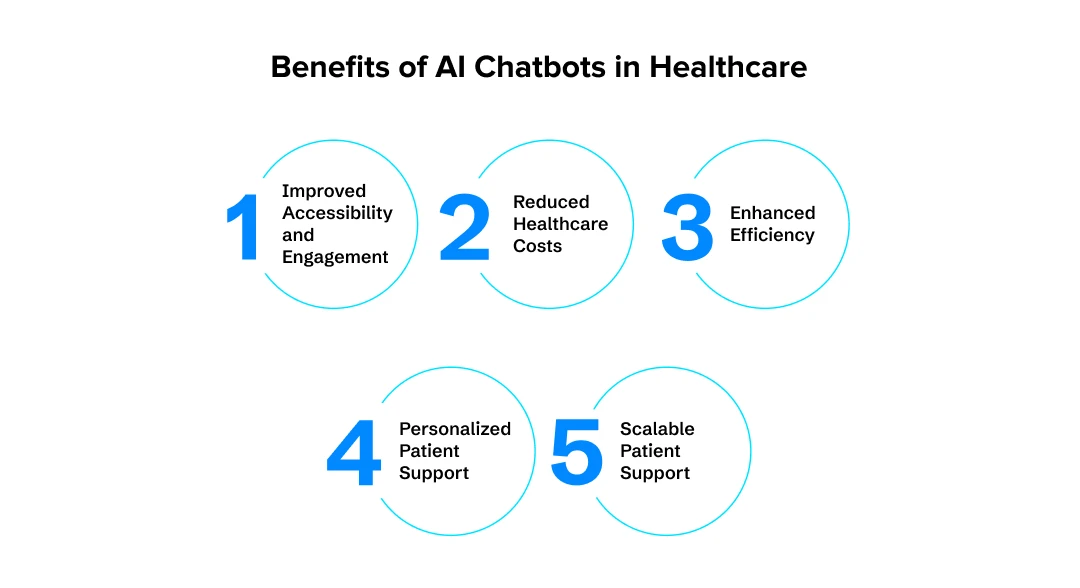
1. Improved Patient Engagement & 24/7 Accessibility: AI chatbots offer continuous availability, functioning like a digital front desk. These bots answer queries, provide information, and guide patients at any time. This enhances patient care with AI and ensures individuals receive timely support.
2. Reduced Healthcare Costs & Administrative Load: By automating routine functions, such as appointment scheduling, where chatbots can handle up to 80% of requests or answer FAQs, healthcare chatbots decrease the administrative workload. This can lead to potential administrative cost savings of 20-30% for some facilities. These chatbots can be smoothly integrated using tons of AI APIs already existing in the market already.
3. Enhanced Efficiency and Streamlined Workflows: A medical AI chatbot can bring greater order to healthcare workflows. It can optimize data collection, manage appointments efficiently, and facilitate timely follow-ups, contributing to smoother operations and reduced patient wait times by effectively triaging inquiries.
4. Personalized Patient Support & Improved Adherence: Modern AI enables chatbots to learn from interactions, thereby offering more personalized responses, health information, and reminders. This tailored engagement is vital for effective AI in disease management. Some programs have also reported up to an 89% accuracy, describing the importance of chatbots for self-care management.
5. Scalable Patient Support & Valuable Data Insights: AI chatbots in healthcare can manage thousands of interactions simultaneously, providing scalable support, especially during high-demand periods. These chatbots also collect extensive anonymized patient interaction data (in compliance with privacy regulations like HIPAA and GDPR). Analyzing this data offers valuable insights into patient needs and disease patterns, aiding in the refinement of healthcare services and supporting aspects of AI in healthcare diagnostics.
Practical Applications: Use Cases and Case Studies of AI Chatbots in Healthcare
The true value of any technology is demonstrated through its practical application. AI chatbots in healthcare are proving their worth across a wide array of scenarios, evolving from simple query handlers to integral elements of the healthcare delivery system. The use cases of AI in this field are growing, with clear, positive outcomes.
The following table highlights key applications and illustrative impacts:
| Use Case | Real-World Impact & Illustrative Case Study Examples |
|---|---|
| Symptom Checking & Initial Triage | Patients use a medical AI chatbot to describe symptoms for preliminary assessment. Example: Babylon Health's AI-driven chatbot provides triage advice, directing users to suitable care levels. It handles a large volume of initial consultations and has demonstrated accuracy comparable to human nurses for specific conditions in some studies. |
| Appointment Scheduling & Management | Healthcare chatbots enable patients to book, receive reminders for, or reschedule appointments. Example: Hospitals integrating eClinicalWorks Cloud EHR and healow® patient engagement solutions reported a 40% decrease in call center volume and improved booking accuracy after integrating healow Open Access. |
| Medication Adherence & Reminders | An AI chatbot for healthcare sends timely medication and refill reminders. Example: Platforms like Medisafe use AI-powered reminders that studies show have improved medication adherence rates among users with chronic conditions. Mental health chatbots like Woebot also incorporate features to support therapy and exercise adherence. |
| Answering FAQs & Providing Health Information | Patients obtain instant, verified responses to common health questions. Example: During the COVID-19 pandemic, the CDC used chatbots to disseminate reliable information, managing millions of inquiries and allowing human agents to focus on more complex issues. |
| Mental Health Support & Initial Assessment | Chatbots offer an accessible first point of contact for mental wellbeing. Case Example: Services like Replika or Wysa provide empathetic conversations and coping tools. While not replacing therapists, they assist users in managing daily stress, with studies indicating positive engagement and mood improvements. |
| Post-Discharge Follow-up & Monitoring | Chatbots engage with patients after hospital discharge to monitor recovery. Example: Some hospitals using AI chatbots for post-operative follow-ups have seen reduced readmission rates due to early detection of potential complications. |
| Chronic Disease Management Assistance | Patients receive ongoing support for managing chronic conditions. Example: Livongo (now part of Teladoc Health) employs AI-driven prompts and chatbot interactions to assist diabetes patients in managing blood sugar levels, showing improved glycemic control among its users. |
These examples provide a snapshot of a dynamic field. For organizations aiming to implement such technologies, selecting experienced healthcare mobile app development companies, chatbot development companies or specialized AI development companies in healthcare is crucial.
As David Rotenberg, Chief Analytics Officer, Centre for Addiction and Mental Health, noted regarding AI's broader impact, "The convenience of 24/7 access to health information and the perceived confidentiality of conversing with a computer instead of a human are features that make AI chatbots appealing for patients to use.”
Implementation Roadmap: Challenges and Recommendations for AI Chatbots in Healthcare
The path to integrating new technologies often presents challenges. Implementing AI chatbots in healthcare, while beneficial, requires careful planning to navigate potential obstacles.
Consider these common challenges and strategic recommendations:
| Challenge | Recommendation for Mitigation |
|---|---|
| Data Privacy & Security (HIPAA, GDPR, etc.) | Prioritize security in the design of your medical AI chatbot. Implement end-to-end encryption, secure data storage, and ensure strict compliance with all relevant data protection regulations. Regularly conduct security audits and maintain transparency with patients about data use. |
| Accuracy & Reliability of Medical Information | Ensure the chatbot's knowledge base is curated and regularly updated by medical professionals using verified sources. Implement rigorous testing, validation protocols, and clear escalation paths to human experts for complex or urgent queries. |
| Integration with Existing Clinical Systems (EHR/EMR) | Plan for deep, API-based integration with Electronic Health Records and other existing clinical software. Select vendors with demonstrated expertise in healthcare IT interoperability to ensure seamless and secure data exchange. |
| User Acceptance, Trust & Digital Equity | Design the chatbot with an empathetic, intuitive, and user-friendly interface that is accessible to all patient demographics, including those with lower digital literacy. Clearly communicate its benefits. Begin with simpler, high-value use cases to build user confidence. |
| Ethical Considerations & Algorithmic Fairness | Train AI models using diverse, representative datasets to minimize potential biases. Establish robust ethical review processes and maintain human oversight. Transparency in how the chatbot arrives at its recommendations or decisions is essential. |
| Regulatory Compliance & Evolving Standards | Stay informed about evolving regulations for medical devices, Software as a Medical Device (SaMD), and AI applications in healthcare. Engage with regulatory experts early in the development lifecycle. |
| Managing Patient Expectations Realistically | Clearly communicate the chatbot’s specific capabilities and its limitations. It serves as an assistant and information tool, not a substitute for professional medical diagnosis or treatment. Ensure users understand when to consult a human healthcare provider directly. |
Addressing these points with strategic foresight will facilitate a smoother and more effective implementation of AI chatbots in healthcare.

Future Outlook: The Continuing Evolution of AI Chatbots in Healthcare
The development of AI chatbots in healthcare is an ongoing process with substantial future potential. The progress observed so far, in market growth, operational benefits, and expanding use cases of AI, sets the stage for an era where these digital tools become even more integral to healthcare delivery. The World Health Organization (WHO) has acknowledged AI's potential to significantly strengthen health systems and enhance public health outcomes globally.
Looking forward, we anticipate several key developments:
1. Increased Sophistication & Enhanced NLU: Future healthcare chatbots will feature more advanced natural language understanding (NLU) and potentially basic emotional AI. This will allow for more nuanced, context-aware, and empathetic interactions. Projections suggest that by 2029, the NLU market could reach USD 62.9 billion.
2. Proactive & Predictive Health Interventions: AI chatbots will increasingly use healthcare data analytics to offer proactive, personalized preventative advice and early warnings for conditions, thereby improving AI in disease management.
3. Hyper-Personalization Through Deeper Data Integration: Chatbots may integrate with more extensive personalized data, potentially including genomic information, to offer highly tailored health advice, assuming ethical and privacy standards are strictly met.
4. Seamless Integration with Remote Patient Monitoring (RPM): Expect deeper integration with RPM devices, enabling chatbots to provide real-time feedback and alerts to both patients and clinicians based on continuous biometric data.
5. Voice and Multimodal Interfaces as Standard: Voice interaction will become increasingly prevalent for healthcare chatbots, complemented by text and visual aids. This will enhance accessibility and could lead to more sophisticated AI-based virtual assistants designed specifically for health and wellness applications.
The global market for AI in healthcare is set for continued significant growth, with chatbots playing a crucial role in improving healthcare access, reducing costs, and personalizing medical care.
This evolution is not just about adopting a new chatbot technology in healthcare; it’s about fostering a collaborative future where technology and human expertise work together more effectively and come up with new healthcare business ideas for patient benefit. This journey requires careful planning, ethical considerations, and a steadfast commitment to improving human health.
Frequently Asked Questions
How are AI chatbots in the healthcare industry used?
AI chatbots in healthcare streamline patient care and administrative processes by leveraging natural language processing (NLP) and machine learning. These chatbots are used for:
- Symptom Checking and Triage: Chatbots like Ada Health assess symptoms and guide patients to appropriate care, reducing unnecessary clinic visits. For example, Ada has conducted over 30 million assessments globally, aiding early detection.
- Appointment Scheduling: Chatbots automate booking, rescheduling, and reminders, reducing call center volumes by 25-40% in some hospital networks (e.g., Medical Risk Solutions LLC reported a 40% reduction).
- Medication Management: Tools like Florence send reminders and manage prescriptions, improving adherence by up to 50% for chronic disease patients ( Healthcare IT News).
- Patient Education: Chatbots provide tailored health advice and explain medical terms, with 79% of healthcare professionals rating chatbot responses as more empathetic than physician responses in some cases.
- Mental Health Support: Chatbots like Woebot offer 24/7 CBT-based support, reducing work impairment by 24%.
- Administrative Automation: They handle FAQs, billing, and EHR integration, freeing staff for critical tasks. A 2022 survey found 77% of call agents use chatbots to automate routine tasks.
Is Siri an example of healthcare chatbot?
No, Siri is not a healthcare chatbot. It answers general health queries but lacks HIPAA compliance and medical-specific training. Dedicated chatbots like Ada or Buoy are built for secure, clinical tasks (The Medical Futurist, 2025).
Which are some of the top healthcare chatbots existing?
Top healthcare chatbots powered by AI existing currently are Ada Health, Buoy Health, Woebot, Florence, Sensely, and Babylon Health.
Is there a medical version of ChatGPT?
No official medical ChatGPT exists. Alternatives include:
- BastionGPT: HIPAA-compliant, clinical notes (BastionGPT, 2025).
- Microsoft Azure Health Bot: EHR-integrated, HIPAA-compliant (Microsoft, 2025).
- Infermedica: Clinical decision support (Keragon, 2025).
Standard ChatGPT lacks healthcare-specific training and compliance.
Which ChatGPT is best for doctors?
BastionGPT is best for doctors:
- HIPAA-compliant: secure data handling.
- Clinical Use: Streamlines notes, error detection (BastionGPT, 2025).
- Integration: Supports medical workflows.
Microsoft Azure Health Bot is also effective for EHR tasks but less documentation-focused.
Is there a HIPAA-compliant version of ChatGPT?
Standard ChatGPT is not HIPAA-compliant. Alternatives can be:
- BastionGPT: Secure, private model, HIPAA-compliant.
- Chat Data: Offers BAA, encrypted.
- SmartBot360: Secure, patient-focused, HIPAA-compliant.

Uncover executable insights, extensive research, and expert opinions in one place.
Related Content